
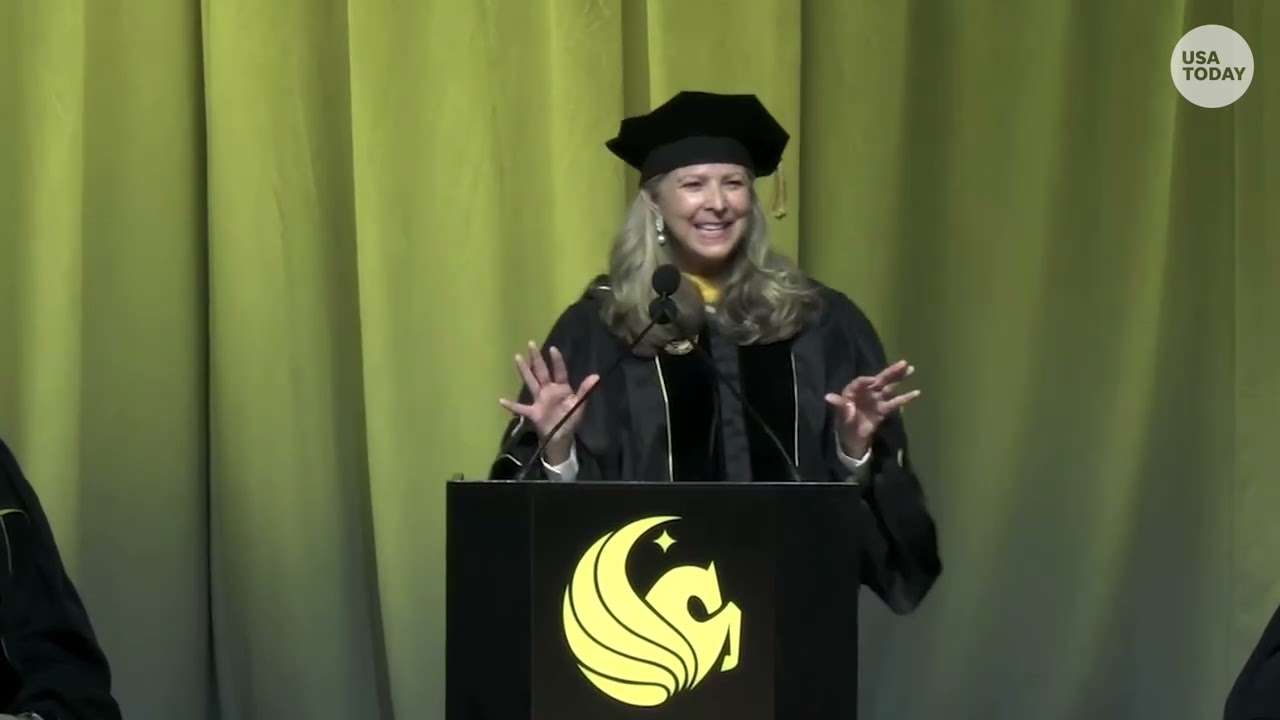
At an American university commencement ceremony, something happened that only seemed trivial at first glance, but can actually be placed directly within the broader context of the "spirit of our time". The speaker stood before graduates of the humanities, communications, design and the arts and tried to sell them a vision of artificial intelligence as "the next Industrial Revolution". The level of tactlessness is fascinating. The audience, predictably, booed her.
At first glance, we could say that the woman (Gloria Caulfield, a vice president at the development company Tavistock Development Company) simply "misread the room" and stumbled into a generational clash between corporate optimism and student anxiety. But in that awkward scene, there may have been more historical truth than in many serious and increasingly tedious conferences "about the future of work". Unpleasant historical truth. Because she probably was not wrong when she called AI "the next Industrial Revolution". That is precisely the problem. She is probably right, but wishing for an industrial revolution, once we remember what it actually looked like, is a fairly dreadful wish. Because they say a revolution "devours its children" - and in this case, that is almost a literal fact.
It is worth watching that moment:
And what does the Industrial Revolution even mean to us? We know it happened, we know roughly when it happened, but the interpretation is often wrong. We are all children of that revolution, but only after a long, very hard and brutal time did we begin to enjoy its "benefits". What came before that final result? What happened at the beginning of the revolution and in its first decades? We do not talk about that, but we will have to, especially now. Because our children will, by all appearances, be the children of the next Industrial Revolution, and that is not exactly a comforting thought.
The Industrial Revolution is generally placed between 1760 and 1840. It did not begin as a clean story of progress at all, but as a brutal reorganization of human life in favor of the machine, capital and especially those who owned both.
Today we remember the Industrial Revolution mostly through its victorious images: the steam engine, the railway, the factory, the growth of cities, the rise of the modern world... That is the museum version of history, cleaned of smoke, blood, exhaustion and children’s fingers lost in machines. But the people who lived through it did not see it as a magnificent transition, but as the collapse of their own world.
Rural communities emptied out. Old trades, skills and ways of survival lost value. People who knew how to create something concrete with their own hands became surplus before machines that could produce faster, cheaper and without negotiation. In fact, one could say that the first revolution "came" for physical labor, and now, after man has partly recovered, though it took him almost two centuries, and moved into tertiary, service and mental sectors, it is coming for those as well. But if we go back to the first revolution, when we recall how cruel it was in its initial phase, why should we believe the next one will be clean and just? The interests have not changed. The interest is still to harness revolutionary inventions in order to maximize profit and minimize cost. And if the interest has remained the same, then this can only mean that a reprise of what we have already seen awaits us.
And what did we see? Cities swelled faster than they could build sewage systems, water supply, adequate housing or any form of decent life. Workers labored 12, 14 or even 16 hours a day. Children were thrown into factories and mines not because society was unaware of their suffering, but because their suffering was simply economically useful. Suffering was not a flaw in the system. It was one of its input costs. Specifically, in the case of children, they were extremely useful in factories because they were given the task of reaching hard-to-access screws and gears inside machines. They literally had to crawl underneath and see "where it had jammed". An adult could not squeeze through; a child could. And often the problem would be fixed, the machine would start running again, and the child would lose a finger, an arm.
And the point is not that the first Industrial Revolution literally ate children and that the new one will not, at least not in that mechanical way. The point is intention, and a human being can be devoured in other ways too - mentally, existentially.
Only later, much later, did history acquire more convenient terminology. Modernization, urbanization, industrial growth, technological progress... But only after generations had already paid the price. Everything required fierce struggle, workers’ struggle. Labor laws, children’s rights, sanitary reforms. The Industrial Revolution did not become humane on its own. It had to be forced into humanity, under the threat of another, political revolution. It is no wonder that revolutionary communism as an idea erupted precisely in that period - the Communist Manifesto of 1848 can still be read today as a description of that very time.
So we must already ask ourselves several important questions. If the next Industrial Revolution is coming, how brutal will its opening phase be? And, assuming that opening phase cannot be skipped, where is the threat of a new revolution by which this one can at least be brought somewhat under control?
Because if we look at the matter through the relationship between "us and them", then it can certainly be said that "they" are far more prepared today to eliminate every form of resistance. The modern worker is under total surveillance, alienated, atomized. There is no longer a factory in which he can gather and rebel. He can complain online, but who even hears him? Where is he supposed to speak when all the "notice boards" have already been fully occupied by a handful of the largest corporations?
That is why the opening story is such a deep historical moment. Today, students, especially those from creative and humanistic fields, are being sold the story of a new era. They are told they must be flexible, that they need to embrace change, that artificial intelligence will not replace people, only, supposedly, those who do not use it.
That is what corporate talk about AI most often hides. "The future" is presented as a neutral fact, as something that comes to everyone equally, like a weather forecast. But the future never comes equally. For someone it comes as an investment opportunity. For someone as a layoff. For someone as rising share value. For someone as a data center consuming water and electricity in a community that had no real power to decide whether it wanted it at all (more on this topic: The Cloud Has Fallen to Earth and Is Swallowing Everything in Its Path: On Data Centers and the Degradation of Societies Left in the Dark).
Transitional periods can last for decades. That is the part today’s prophets of AI most eagerly skip. The benefits of technological revolutions arrive much later. The first generation will lose security, the second its profession, the third will only then get some cheaper products, and the fourth will read that it was "progress". And which generation are we? Certainly not the fourth, and not the third either.
That is why the students were right to boo. They were booing a version of the future in which someone on stage explains to them that their insecurity is actually an "opportunity", while the greatest benefits already belong in advance to those who own the models, servers, infrastructure and capital.
While we wait for the future, we must remain aware of the not-so-distant past. What the Industrial Revolution really was. It was a revolution from above, and such revolutions always grind down the broad base, the ordinary person. This new one is also presented as a vision, but the largest and most important vision will be the one concerning the way to resist that revolution. It took far too many years for machines to stop cutting off children’s hands, for a "regulated economy" to be achieved. But back then, people knew how to create a union, how to define the means of production. Today that will once again be a great abstraction, just as it was for people at the turn of the 18th into the 19th century. People will not surrender. They will find a way, perhaps once again to bring everything somewhat "back into order", but how long will that take? That is perhaps, in the pessimistic scenario, the greatest unease of our time.
Because the real question is no longer whether the new Industrial Revolution will come. The question is how many people we will allow it to grind down before we once again force it to serve humanity.
Comments