
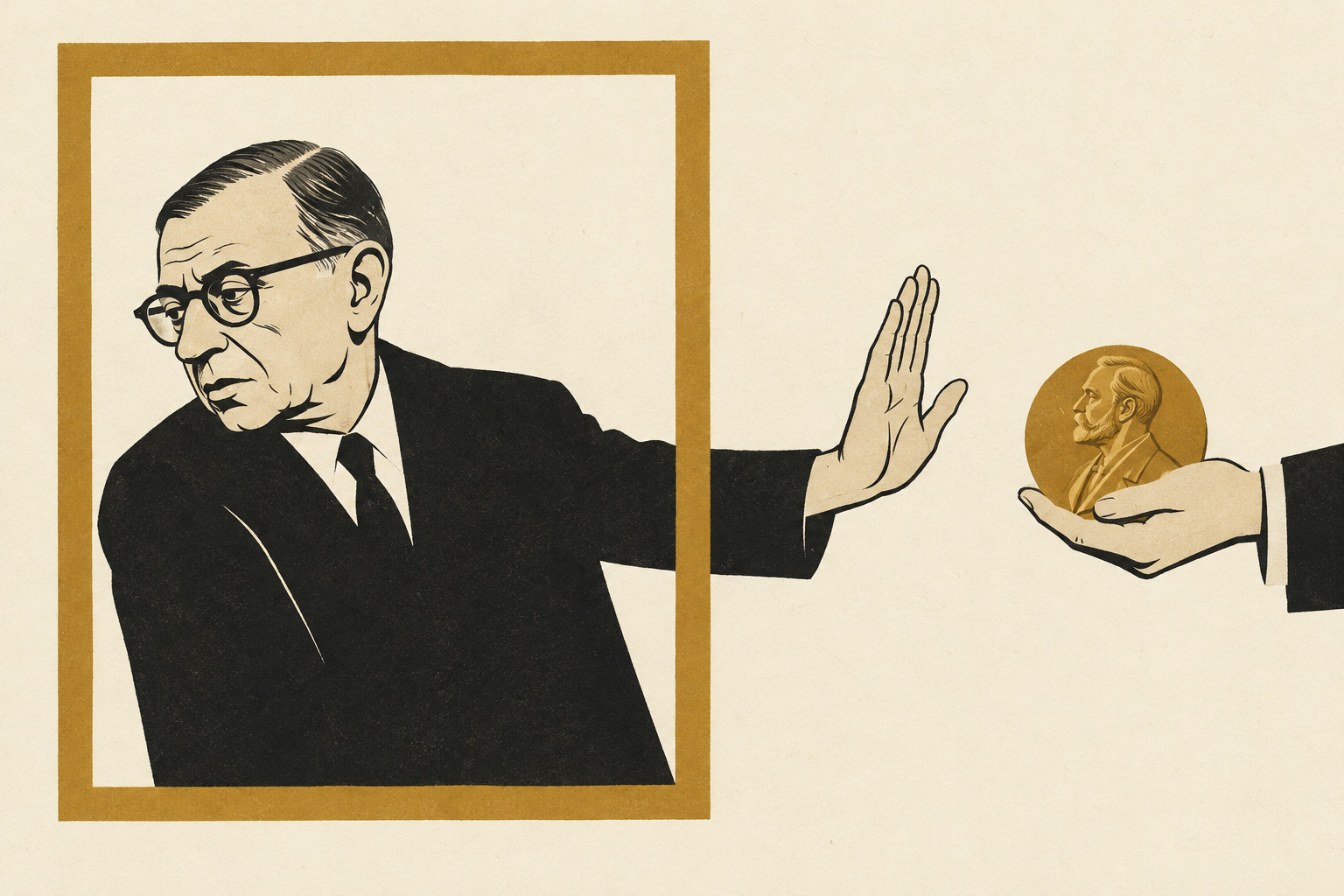
Sartre refused the medal, money, and official stamp, but he could not prevent his refusal from becoming part of the Nobel canon.
Some honors elevate a person, others, at least in his own eyes, imprison him. When the Swedish Academy announced on October 22, 1964, that Jean-Paul Sartre had been awarded the Nobel Prize in Literature, the French philosopher and writer was not faced with a simple decision about whether to accept a medal and a sum of money. He had to decide whether he could remain what he had always claimed to be—a free intellectual belonging to no institution—if he allowed "the greatest cultural institution in the world" to mark him as one of its chosen few.
Sartre had not, in fact, waited for the official announcement. When rumors appeared in the French press that he might receive the prize, he wrote to the Swedish Academy asking to be removed from consideration. His letter arrived too late to stop the decision. The Nobel Committee honored him for a body of work "rich in ideas and filled with the spirit of freedom and the quest for truth," and the man who had described the purpose of his own writing in much the same terms replied that he could not accept the prize.
His refusal was neither a passing whim nor a display of false modesty. Sartre had already turned down the French Legion of Honor in 1945, and throughout his life he avoided official positions and honorary titles. He believed that a writer must speak in his own name and rely solely on what he had written. The moment an institutional seal was placed beside his name, he argued, it changed the way readers approached his words. It was one thing to sign a political statement as Jean-Paul Sartre and quite another to sign it as "Jean-Paul Sartre, Nobel laureate"!
What Sartre Actually Wrote
Sartre’s explanation was more systematic than the famous line about a writer who did not wish to become an institution. He divided his reasons into personal and objective ones. Among the personal reasons, he cited not only his earlier refusal of the Legion of Honor but also his decision not to seek a position at the Collège de France, despite encouragement from friends. A writer who takes political and social positions, he believed, should rely on only one means of influence: the written word. An honorary title might not necessarily change the writer, but it placed pressure on the reader and endowed his signature with an authority that did not come from the text itself.His objective reasons concerned the cultural landscape of the Cold War. Sartre argued that the encounter between Western and Eastern cultures should take place between people and works, without institutions assigning every author to one camp or the other. He therefore stressed that he would not have accepted a Soviet prize either. He did not explicitly call the Nobel a Western honor, but he believed that under the circumstances it functioned as one: a prize awarded either to Western writers or to Eastern dissidents. Among those he believed had been unfairly overlooked, he named Pablo Neruda and Louis Aragon.
His most personal political argument concerned the moment at which the honor arrived. He said that during the Algerian War, after he had signed the Manifesto of the 121 in support of the right to resist military service, he would have regarded the prize as support for a specific struggle for freedom. By 1964, with that battle already over, he feared that accepting it would look like a belated rehabilitation of his controversial political past. He was not merely refusing an honor, he was also rejecting the idea that the cultural establishment had finally made him respectable.
A Prize Worth Too Much
This may sound like excessive sensitivity from a man who had already become an institution without any medal. By 1964, Sartre was one of the best-known intellectuals in the world. His novel Nausea, his philosophical work Being and Nothingness, and his play No Exit had already entered the modern canon. Les Temps modernes, the journal he founded with Simone de Beauvoir and others, had become an important platform for the European left. Parisian waiters knew about existentialism, students quoted him, and journalists followed him from political rallies to cafés.
That was precisely what made his explanation more unsettling than the usual gesture of artistic rebellion. Sartre did not claim that the Nobel Prize was worthless. He claimed that it was worth too much. It was not merely a sum of money and a ceremonial dinner in Stockholm. It rearranged the recipient’s biography, placed all his books under a single heading, and transformed a living, contradictory body of work into an officially recognized legacy. The Academy did not merely bestow prestige—it established the frame through which future generations would view a writer.
There was also a political dimension. The Cold War divided not only military alliances but literature, philosophy, and art. Sartre was Marxist in orientation and often sympathetic to communist movements, but he never became a disciplined intellectual in the service of any party. He supported anticolonial struggles and fiercely opposed France’s war in Algeria. At the same time, he could be sharply critical of the Soviet Union, particularly after it crushed the Hungarian uprising in 1956. He did not want the Nobel Prize to symbolically assign him to the Western camp as a cultural trophy in the rivalry between the two blocs.
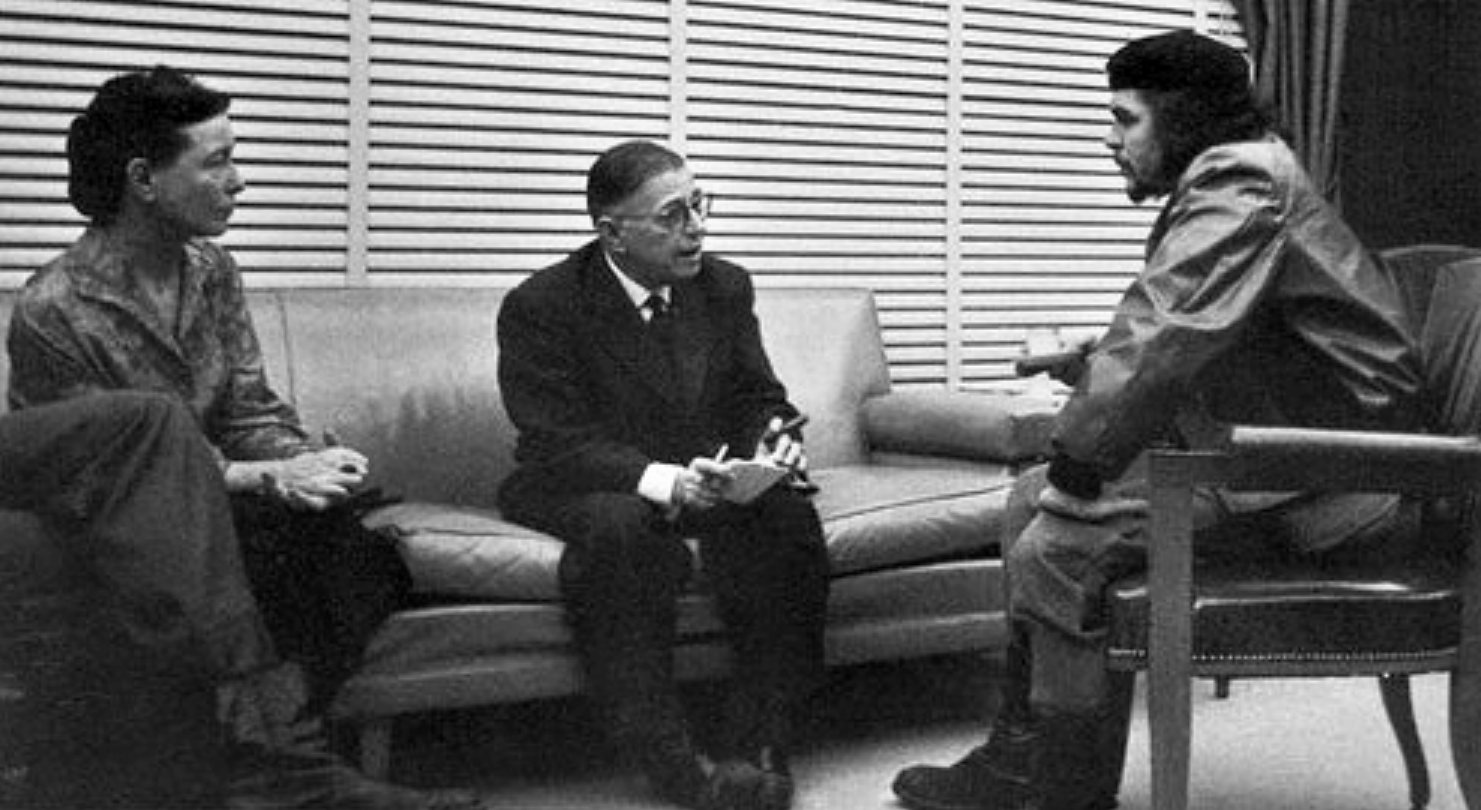
His position was almost deliberately uncomfortable. He wished to be neither an ornament of the liberal West nor an obedient voice of the Soviet East. At its heart was one of Sartre’s fundamental ideas: a person is not what others have decided he is, but what he makes of what he has been given. The Nobel Prize may have been the greatest honor a writer could receive, but that also made it an extraordinarily powerful definition imposed from the outside.
An Institution Against Institutions
Sartre’s distrust of official institutions did not mean that he believed only in the isolated voice of the individual. In November 1966, the British philosopher Bertrand Russell convened the International War Crimes Tribunal to investigate American actions in Vietnam, and Sartre became its executive chairman. Intellectuals and activists from several countries took part, including Simone de Beauvoir, James Baldwin, Isaac Deutscher, and Gisèle Halimi.The "tribunal" had no mandate from any state, no power to impose sentences, and no mechanism for enforcing its decisions. Its hearings were held in Stockholm and Roskilde in 1967 because the French authorities refused to allow them to take place in Paris. The organizers heard witnesses and gathered evidence concerning the bombing of civilian targets, the use of prohibited weapons, and other allegations, while inviting the US government to present evidence of its own. Critics could therefore dismiss it as a political trial whose verdict had been decided in advance, while its participants regarded it as a public inquiry conducted where official institutions had failed to act.
The difference between the tribunal and the Nobel Prize was crucial. The Nobel bestowed prestige on an individual from above, the Russell Tribunal attempted to build authority from below, through evidence, testimony, and public debate. Sartre, then, was not opposed to every institution. He was willing to participate in a temporary body that did not elevate its members but had to prove its own legitimacy before the public—the exact opposite of an honorary title that transferred its authority to an individual in advance.
The Price of Saying No
Rejecting the prize also meant forfeiting the money. At the time, it came to 273,000 Swedish kronor, an enormous sum. Sartre could have accepted it and donated it to a political organization or humanitarian cause, but doing so would still have meant accepting the status of laureate. For him, the symbolic act could not be cleansed by the way he chose to spend the money. That gave his refusal real weight—a principle that costs nothing can easily become a matter of taste, a principle that comes at a cost becomes a decision.
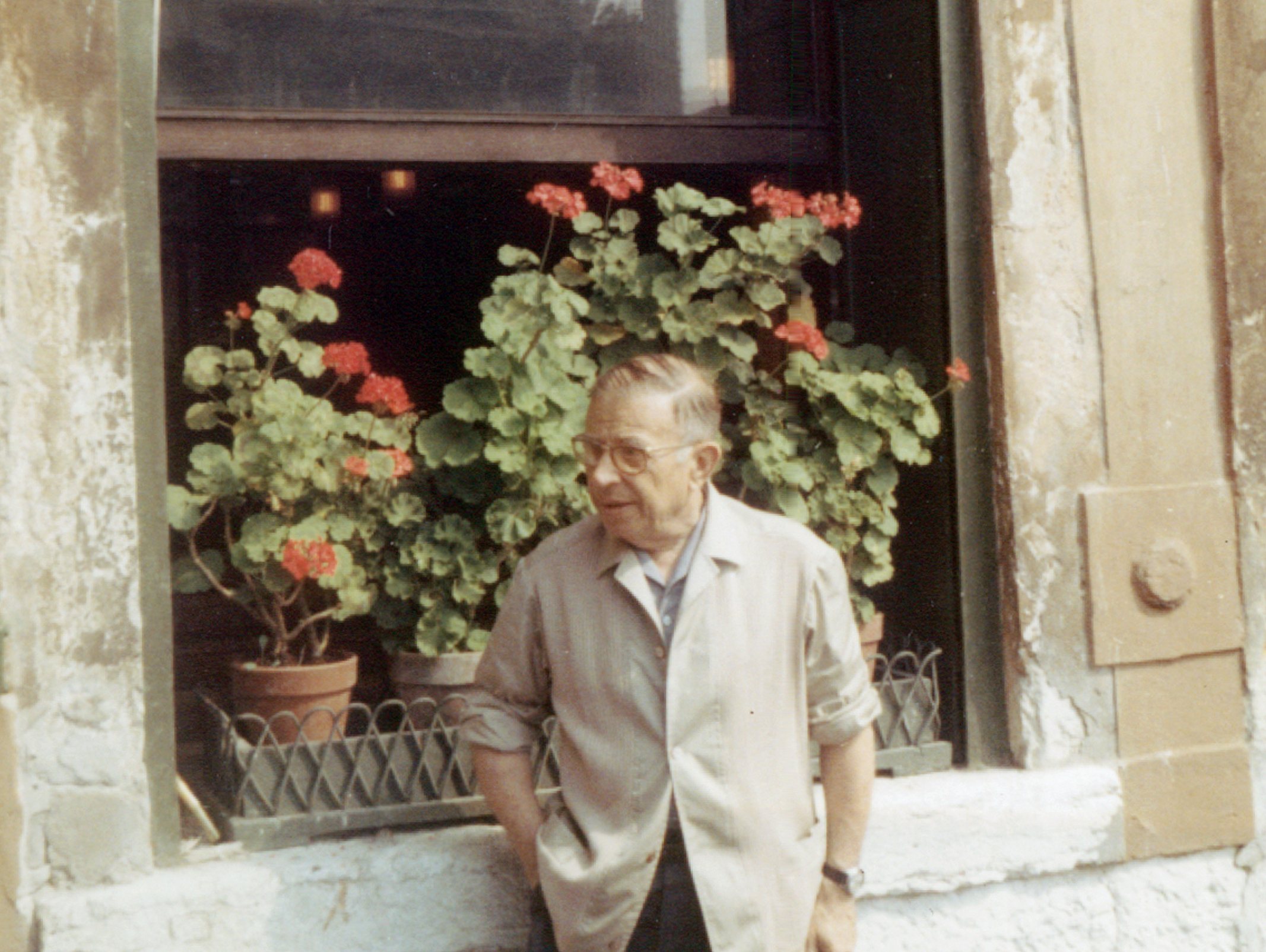
There was, of course, an obvious paradox. By refusing to become an institution, Sartre became an even greater one. Many Nobel laureates are now known mainly to literary historians, while his refusal is still remembered as one of the most famous episodes in the history of the prize. The gesture through which he tried to escape an official aura created an aura of its own. It is hard to imagine a better example of our inability to fully control the meaning of our actions—a subject Sartre had spent his life writing about.
The Swedish Academy, meanwhile, could not reverse its own decision. A prize may be refused, but the recipient’s name remains in the official record. Sartre is therefore still listed as the 1964 Nobel laureate, even though he accepted neither the medal, the diploma, nor the money. In a sense, the institution managed to claim him even through his refusal.
Free to Accept, Free to Refuse
Sartre remains one of only two people to have voluntarily declined a Nobel Prize. The other was the Vietnamese politician Lê Đức Thọ, who refused the Nobel Peace Prize in 1973 because peace in Vietnam, quite reasonably, did not yet exist. The Russian writer Boris Pasternak also renounced the Nobel Prize in Literature in 1958, but only under intense pressure from the Soviet authorities. Sartre was free to accept his. That is precisely why his "no" resonated so powerfully.
Was his refusal an act of integrity, political theater, or a little of both? Probably all of the above. Sartre was never a man who feared the spotlight, but he understood that honors are not innocent. Through them, society does more than express admiration for someone’s work. It also attempts to determine where an author belongs, what he represents, and how he should be remembered.
On October 22, 1964, the Nobel Prize encountered a writer who believed that freedom meant, above all, rejecting a role assigned in advance. Sartre said no, lost the money, and remained a laureate anyway. Perhaps that is the most revealing conclusion to the entire episode—you can refuse an institution’s diploma, but it is much harder to stop the institution from turning your refusal into yet another diploma.
Sources
- Nobel Prize Jean-Paul Sartre – Facts https://www.nobelprize.org/prizes/literature/1964/sartre/facts/
- Nobel Prize Nobel Prize facts https://www.nobelprize.org/prizes/facts/nobel-prize-facts/
- The New York Review of Books Sartre on the Nobel Prize https://www.nybooks.com/articles/1964/12/17/sartre-on-the-nobel-prize/
- Le Monde « L'écrivain doit refuser de se laisser transformer en institution » https://www.lemonde.fr/archives/article/1964/10/24/l-ecrivain-doit-refuser-de-se-laisser-transformer-en-institution_2133977_1819218.html
- NYU Special Collections International War Crimes Tribunal Records https://findingaids.library.nyu.edu/tamwag/tam_098/
- Office of the Historian, U.S. Department of State Foreign Relations of the United States, 1917–1972, Volume VII, Public Diplomacy, 1964–1968: Editorial Note 150 https://history.state.gov/historicaldocuments/frus1917-72PubDipv07/d150
- Internet Encyclopedia of Philosophy Sartre, Jean Paul: Existentialism https://iep.utm.edu/sartre-ex/
- The Guardian From the archive, 23 October 1964: Jean-Paul Sartre refuses Nobel Prize https://www.theguardian.com/books/2010/oct/25/sartre-turns-down-nobel-1964
Comments