
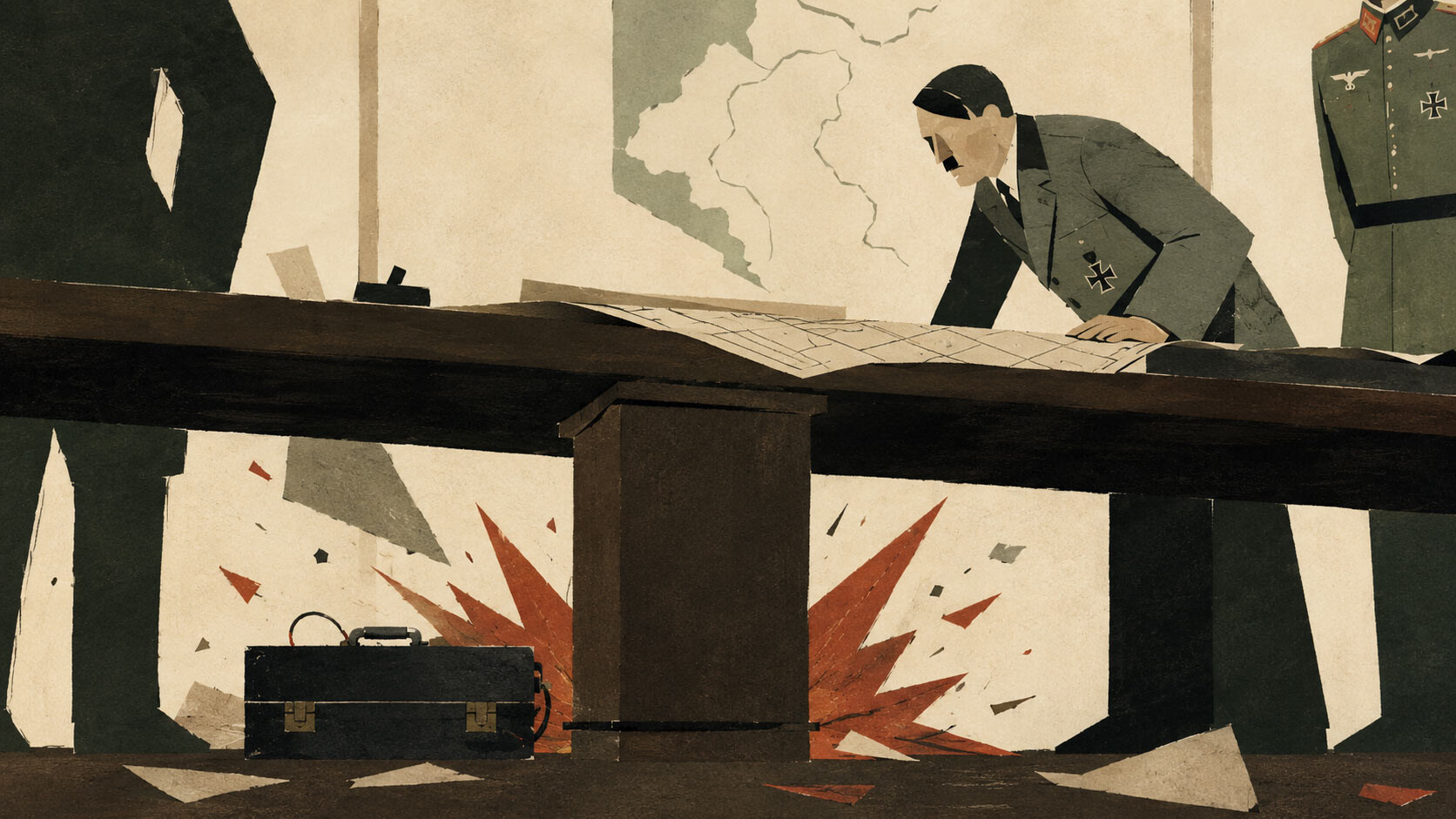
At 12:42 p.m. on July 20, 1944, the wooden conference hut at Hitler’s Wolf’s Lair headquarters erupted in a cloud of dust and splintered timber. German colonel and aristocrat Claus Schenk Graf von Stauffenberg was already hurrying toward the airfield, convinced that no one standing around the conference table could have survived. But he had managed to activate only one of the two explosive charges. The briefcase had then been moved behind one of the table’s massive supports, while the meeting itself was being held above ground rather than inside a bunker because of the heat. Adolf Hitler survived with relatively minor injuries. The bomb went off on time. The conscience that planted it did not.
By the time part of Germany’s military elite decided that Hitler could no longer be allowed to live, he had already revealed every reason why he should have been stopped. The Holocaust had largely been carried out. Europe had endured years of occupation and terror. The Western Allies had landed in Normandy, and Germany’s Eastern Front was beginning to collapse. That is why July 20 is not simply a story of courage. It is also a story of delay—of men who dared to act only once the criminal state had become a military catastrophe for Germany itself.
It would nevertheless be wrong to conclude that German resistance began only in 1944. As early as 1938, Ludwig Beck, the former chief of the Army General Staff, tried to persuade Germany’s generals to resign collectively in an effort to prevent Hitler’s war. A plan for a coup during the Sudeten crisis also formed around intelligence officer Hans Oster. It evaporated when the Munich Agreement handed Hitler yet another victory without a war.
The Briefcase, the Table and the Few Inches That Prolonged the War
The meeting at Hitler’s Wolf’s Lair headquarters had originally been scheduled for 1 p.m., but it was brought forward by half an hour because Italian dictator Benito Mussolini was due to arrive. That cost Stauffenberg precious time. Shortly before the meeting began, he withdrew with his aide Werner von Haeften into a nearby room, supposedly to change his shirt. There they opened the briefcase containing two packages of British plastic explosive, each weighing approximately one kilogram.The device had no clock, wires or switch that Stauffenberg could operate remotely. It relied on a chemical time-delay fuse. A special pair of pliers was used to crush a small glass ampoule inside a copper tube. The liquid it released would then slowly corrode a thin wire holding back a spring-loaded striker. After roughly ten minutes, the wire would give way, allowing the striker to trigger the detonator and set off the explosive. It was a silent device with no ticking sound—and once activated, it could not be stopped.
For a man who had lost one hand and had only three fingers remaining on the other, the procedure was agonisingly difficult. As Stauffenberg and Haeften prepared the explosives, someone knocked on the door and urged them to hurry to the meeting. They managed to activate only one package. The second remained with Haeften, who later threw it from the car during their escape. Had both charges been placed in the briefcase, the outcome would almost certainly have been different. Hitler may have been saved that day not only by circumstance, but by the few minutes the conspirators no longer had.
As already noted, the meeting was not held inside an enclosed concrete bunker, where the blast wave would have rebounded from the walls and intensified the destruction. It took place in an above-ground conference hut with windows through which some of the pressure could escape. At the centre of the room stood a heavy oak table supported by thick wooden legs. Around twenty officers were gathered around it while Hitler, bent over a set of maps, listened to a report on the disastrous situation on the Eastern Front.
Stauffenberg placed the briefcase beneath the table, close to Hitler. A few minutes later, he left on the pretext that he needed to make a telephone call. Then came the minor movement that became one of the most consequential nudges of a briefcase in history. According to the accepted reconstruction, the briefcase was obstructing Colonel Heinz Brandt as he tried to move closer to the maps. Brandt shifted it to the other side of one of the table’s massive supports. In doing so, he placed a thick wooden barrier between the bomb and Hitler—unwittingly saving Hitler’s life while condemning himself to death.
At 12:42 p.m., as General Adolf Heusinger was describing the looming catastrophe in the east, the device exploded. Flames, dust and debris filled the hut. The windows were blown from their frames, the ceiling was badly damaged and the table was torn apart. Stenographer Heinrich Berger died as a result of the blast, while Brandt, General Günther Korten and Hitler’s chief military adjutant Rudolf Schmundt later succumbed to their injuries. Most of those present were wounded.
Hitler emerged alive from the wreckage, dazed and supported by Field Marshal Wilhelm Keitel. His trousers were torn and scorched. He had suffered burns, cuts and an injury to his right arm, while the explosion had damaged his eardrum. Yet only a few hours later, he received Mussolini and showed him the devastated room. He appeared almost euphoric. He did not interpret his survival as the result of a series of coincidences, but as proof that “Providence” had preserved him for a special historical mission.
That night, he addressed the nation by radio to prove to the entire Reich that he was alive. He blamed the assassination attempt on a “small clique” of treacherous officers and promised merciless retaliation. The bomb did not make him more cautious. It made him even more convinced of his own infallibility.
The army, meanwhile, had profited from German rearmament, while conservative elites had long regarded Nazism as an ally against the left. Many within the military leadership objected less to Hitler’s goals than to his recklessness and the danger that, in pursuing them, he would destroy the state. Opposition to the war did not always mean opposition to dictatorship. Sometimes it meant only the belief that the dictator was badly managing a war that had seemed perfectly acceptable the day before.
Stauffenberg himself is even more uncomfortable material for a simple heroic legend. He was a Catholic aristocrat, raised in a culture of duty and deeply influenced by the German poet Stefan George. In 1932, he supported Hitler in the presidential election. As an officer, he took part in the invasion of Poland, and in 1939 he declined an opportunity to join an earlier coup attempt. As late as the end of 1941, he welcomed Hitler’s assumption of supreme military command.
It was only in 1942 and 1943, after confronting both mass murder and the catastrophic conduct of the war, that he joined the resistance. His moral transformation was genuine, but it was not tidy. The conspirators’ plans promised the restoration of the rule of law and fundamental freedoms, but they did not envisage a straightforward return to the parliamentary democracy of the Weimar Republic. Their “other Germany” would have been incomparably better than Hitler’s, but, it should be noted, it was not necessarily the Germany that the Federal Republic would later become.
Nor could the conspirators’ motives be reduced to a single noble idea. Some wanted to stop the mass killings. Others were primarily concerned with rescuing the honour of the army or preventing the Reich’s total destruction. Many also hoped that a new government might negotiate an armistice on more favourable terms, even though the Allies had demanded unconditional surrender since 1943. Morality and national interest were not mutually exclusive—they often coexisted within the same person.
More troubling still, some of those connected to the conspiracy had themselves been involved in atrocities. Arthur Nebe, the head of Germany’s criminal police who participated in plans to overthrow the regime, had previously commanded Einsatzgruppe B. That unit was responsible for murdering more than 45,000 Jews in the occupied Soviet Union. The German resistance was not a sterile chamber untouched by evil. It was an attempt to escape a system in which some of the conspirators had done far more than merely stand by and watch.
Operation Valkyrie also carried an irony worthy of a collapsing dictatorship. It had originally been devised as a military plan for suppressing possible uprisings by forced labourers and other domestic unrest. The conspirators repurposed it as a mechanism through which the Reserve Army would seize key institutions, disarm the SS and arrest the Nazi leadership. A system designed to protect the regime was to be used to destroy it.
But the coup demanded speed and instead encountered hesitation. Orders did not begin leaving Berlin until the afternoon. The conspirators failed to seize the radio stations, while military commands were simultaneously receiving contradictory instructions from Hitler’s headquarters. In Paris, the SS and Gestapo were temporarily neutralised. In Berlin, however, it was enough to confirm that Hitler was alive. The authoritarian order then revealed its banal advantage: most officers did not have to love the dictator. They merely had to wait and see whose orders still carried authority.
On the night of July 20–21, Stauffenberg and his aide Werner von Haeften were shot in the courtyard of Berlin’s Bendler Block. General Friedrich Olbricht and Colonel Albrecht Mertz von Quirnheim were also executed by firing squad. Persecution and show trials followed. Thousands were arrested, and many were executed for only the most tenuous connections to the conspiracy.
The assassination attempt failed militarily, and for the overwhelming majority of Nazism’s victims it came too late. Yet by the time of the attempt, its principal organisers already knew that the chances of success had almost disappeared. German general Henning von Tresckow believed the assassination had to be attempted even if it failed—if only to leave proof before the world and history that Hitler and Germany were not one and the same.
That does not cleanse the conspirators’ biographies, nor does it transform July 20 into a story of flawless men who recognised from the beginning what others could not see. Their courage does not erase their years of blindness. But neither do those years of blindness make their later courage false. The historical significance of the attempted assassination lies precisely within that tension. Conscience rarely awakens under clean and uncomplicated circumstances, and elites often begin listening to it only when the bill for the suffering of others finally arrives on their own desk.
July 20 is therefore not a date for comfortable celebration. It is a date that forces an uncomfortable question: how much evil must be committed before obedience becomes betrayal and disobedience becomes a duty? The conspirators answered it in 1944—courageously, imperfectly and too late. In precisely that order.
Sources
- Gdw-berlin.de GDW-Berlin: 9 Stauffenberg and the Assassination Attempt of July 20, 1944 https://www.gdw-berlin.de/en/recess/topics/9-stauffenberg-and-the-assassination-attempt-of-july-20-1944
- Nationalww2museum.org Friction https://www.nationalww2museum.org/war/articles/friction
- Dhm.de "Too late?" - The attempted assassination of Adolf Hitler on 20 July 1944 https://www.dhm.de/veranstaltung/too-late-the-attempted-assassination-of-adolf-hitler-on-20-july-1944/
- Encyclopedia.ushmm.org The July 20, 1944, Plot to Assassinate Adolf Hitler https://encyclopedia.ushmm.org/content/en/article/the-july-20-1944-plot-to-assassinate-adolf-hitler
- Gdw-berlin.de GDW-Berlin: 8 Paths Leading to July 20, 1944 https://www.gdw-berlin.de/en/recess/topics/8-paths-leading-to-july-20-1944
- History.com Homepage | Hearst Networks EMEA https://www.history.com/articles/july-plot-hitler-assassination-attempt-operation-valkyrie
Comments