
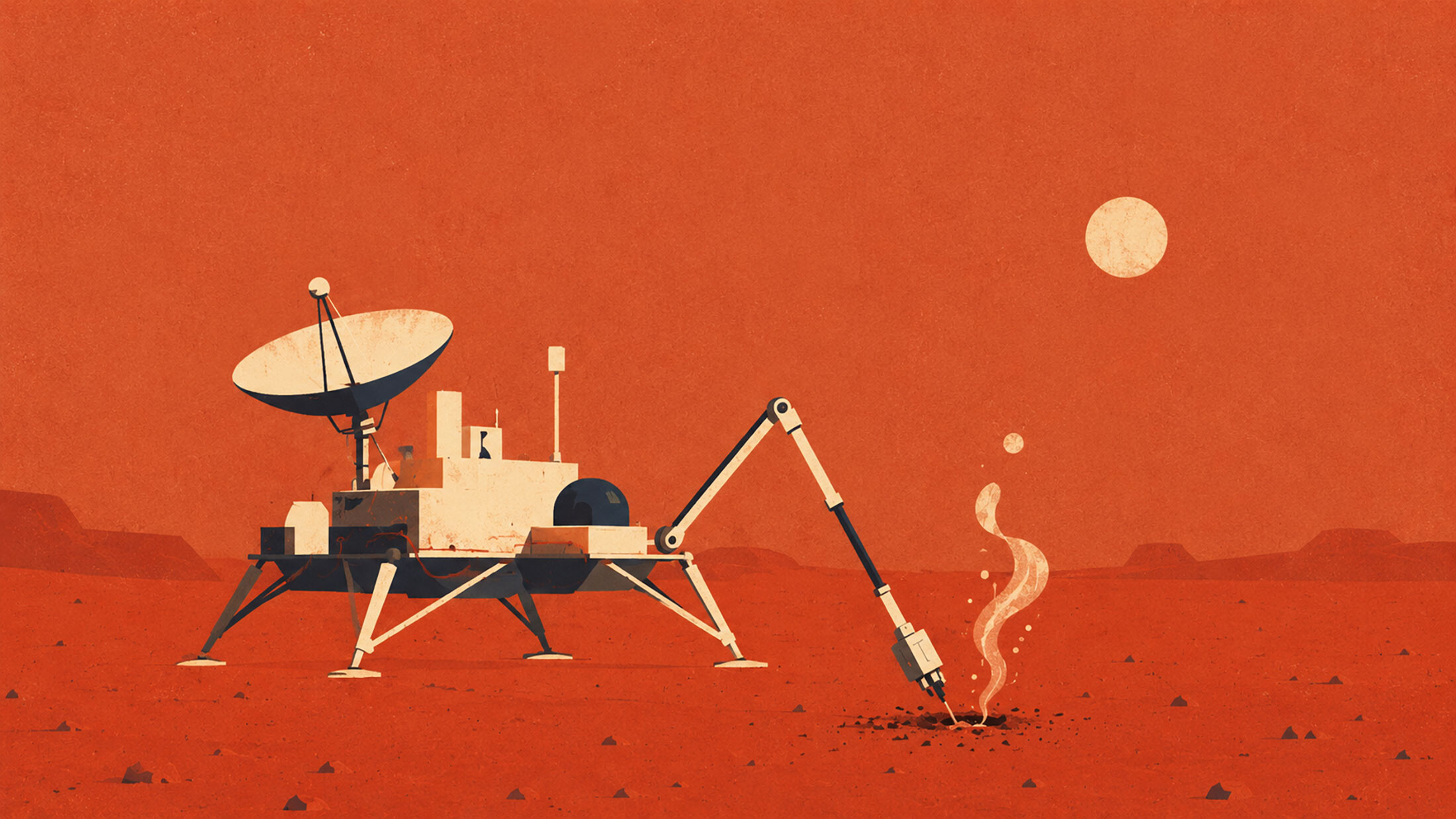
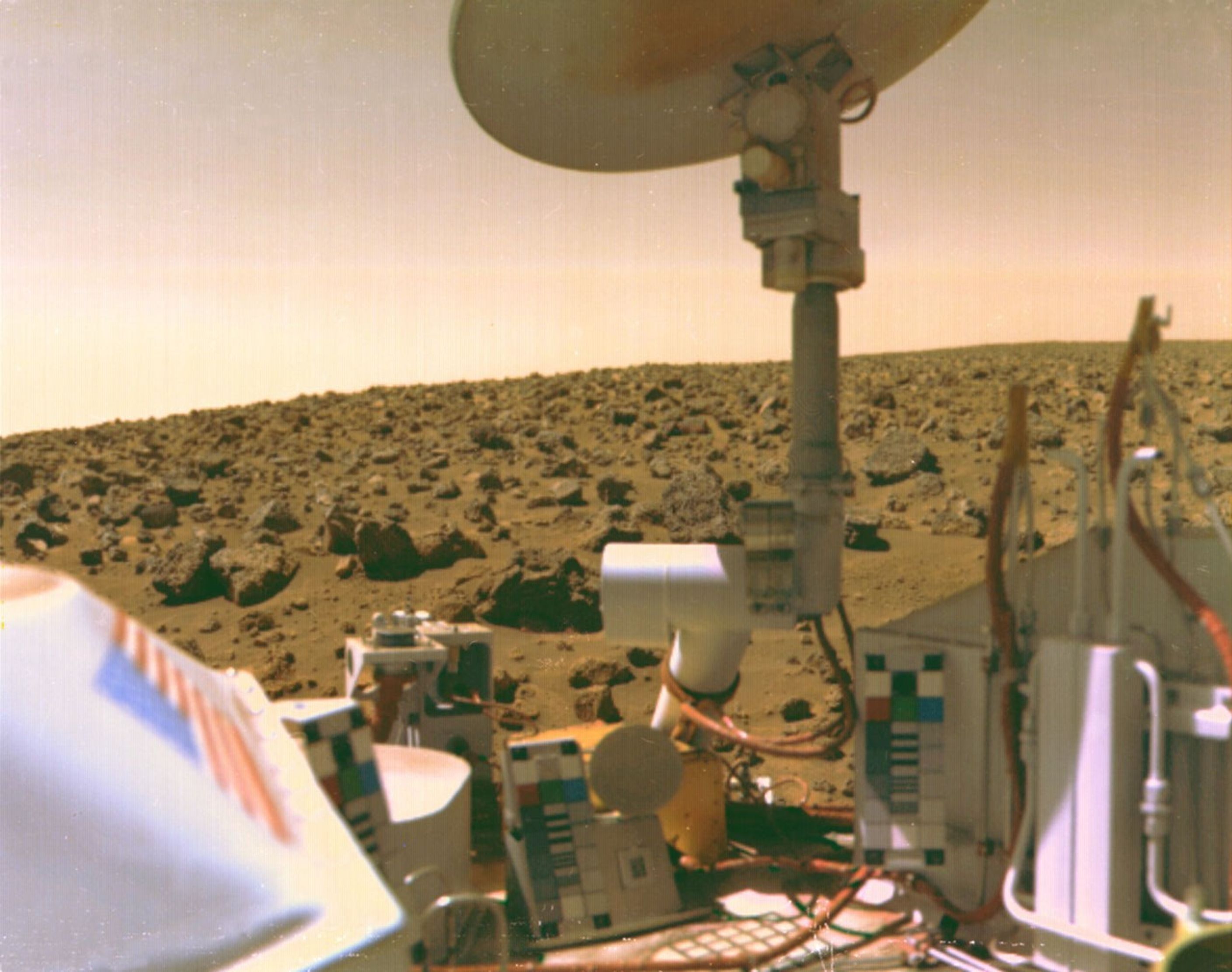
When Viking 2 touched down on the rocky plain of Utopia Planitia on September 3, 1976, Mars received more than a camera perched on three legs. Inside the lander was a tiny automated laboratory with one enormous ambition — to make another planet answer a question: is there life here?
Nine days later, its robotic arm scooped up Martian soil, deposited it inside a sealed chamber and added a drop of nutrient solution containing radioactively labeled carbon. The counter began registering activity almost immediately. Something in the soil had reacted to the meal and released radioactive gas.
Had the same thing happened in a laboratory on Earth, the result would have looked remarkably close to the word "life." Heated control samples did not behave the same way, much as microorganisms cease functioning after sterilization. Yet another instrument aboard the very same lander failed to detect the organic molecules from which such organisms would presumably have to be made. One experiment, in other words, seemed to say that something was "eating." Another said there was nothing there capable of eating. Viking did not encounter silence, silence, at least, would have been easy to explain. It encountered a contradiction.

Today, exactly half a century later, that contradiction matters more than who was an optimist and who was a skeptic at the time. Viking 2 was not the first of NASA’s twins. Viking 1 had landed on Chryse Planitia six weeks earlier. But the second lander was crucial because it tested the same planet some 6,460 kilometers away, farther north and in a colder environment. When similar signals appeared there as well, they could no longer be dismissed quite so easily as a peculiarity of one location or a malfunction in one instrument.
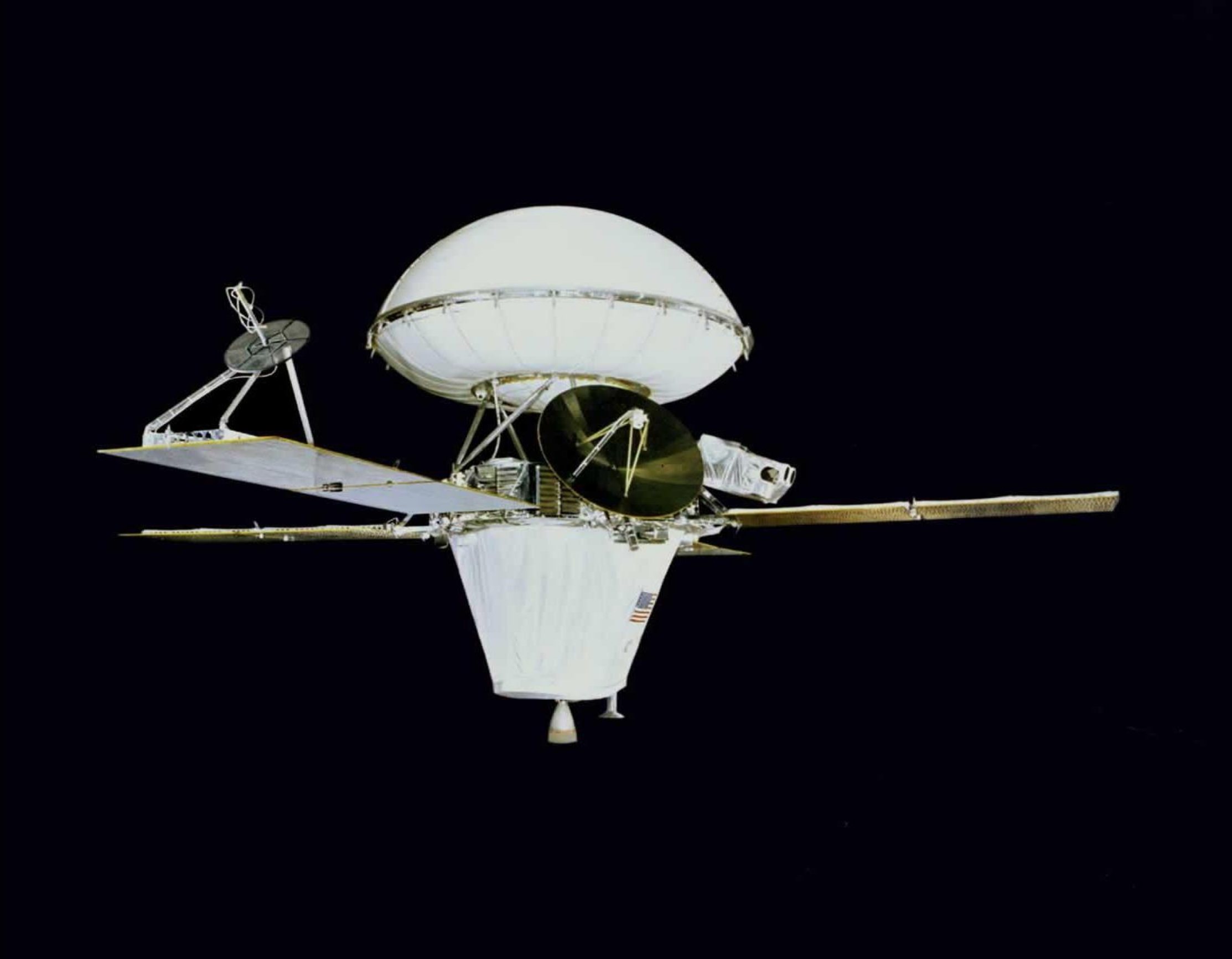
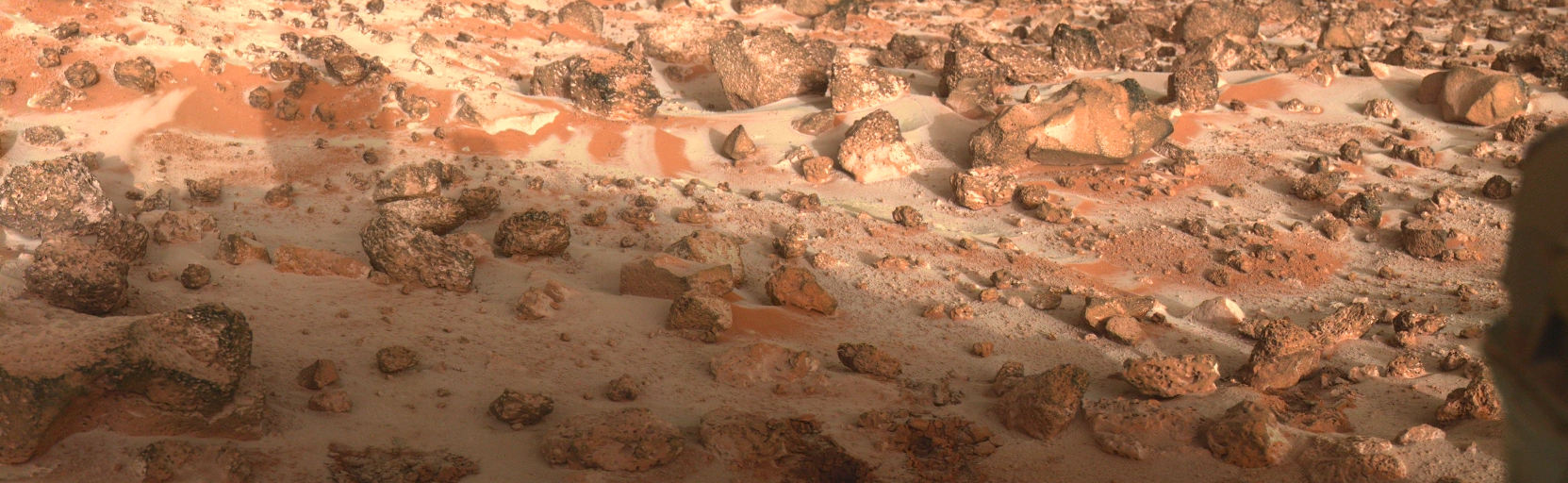
Utopia Planitia was flat and rocky, a landscape almost entirely devoid of Martian theatricality. NASA chose it after the original landing site proved too dangerous, while its position closer to the polar regions offered a better chance of finding traces of water. Viking 2 came to rest at an angle of eight and a half degrees. It would later photograph a thin coating of frost there, but the most important thing it found was invisible to its cameras.
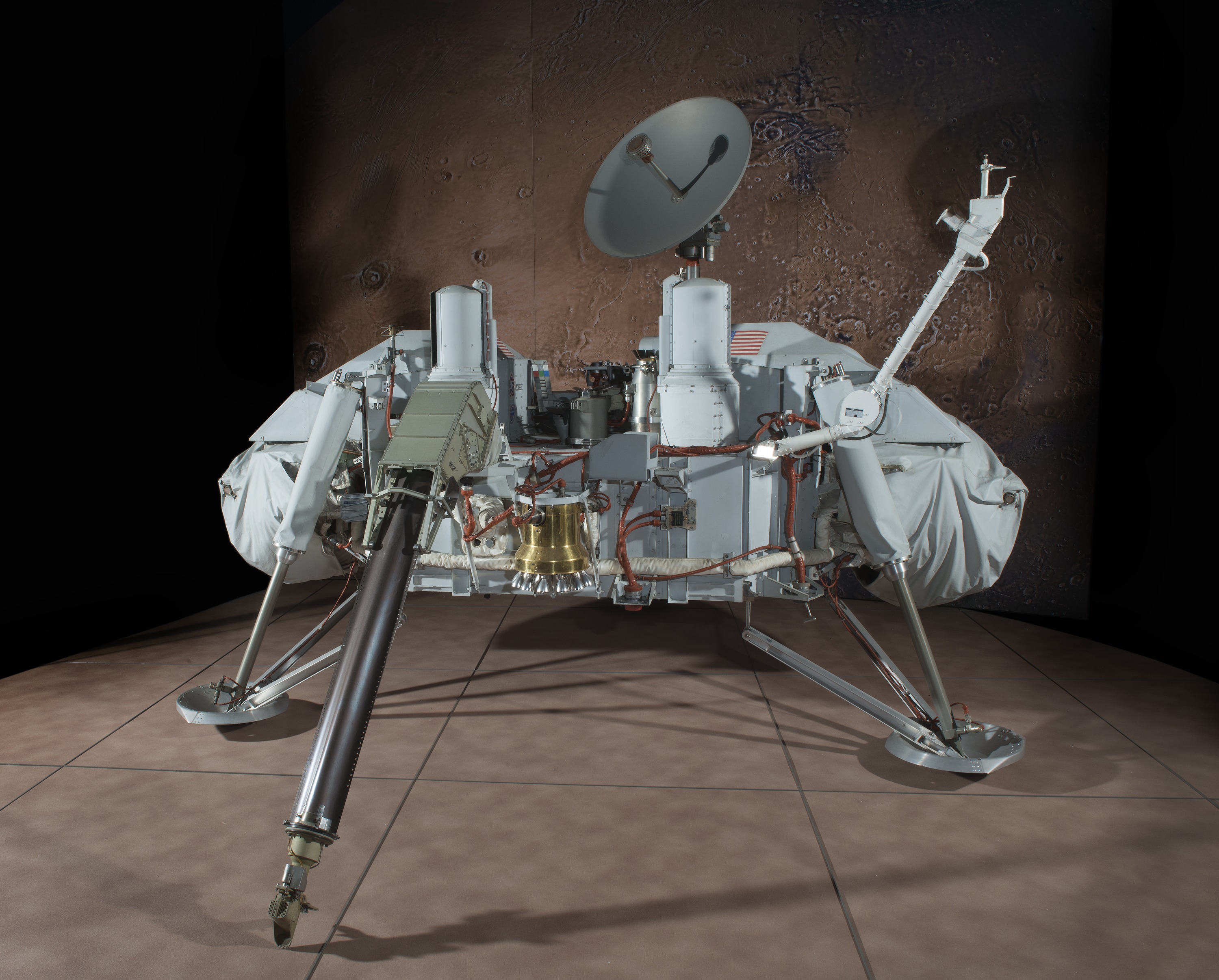
Before launch, NASA went to extraordinary lengths to ensure that any historic discovery would not turn out to be ordinary contamination from Earth. The lander and its protective capsule were sealed inside a biological shield and heated for around 40 hours to roughly 112 degrees Celsius in a nitrogen atmosphere. Engineers had already tested tens of thousands of components to make sure they could survive the process. In other words, before humans could search for life on another planet, they first had to make their own spacecraft as lifeless as possible.
The Viking landers carried no microscope with which to look for a Martian bacterium. Instead, they searched for behavior. The gas-exchange experiment observed what happened when a soil sample was moistened and fed. The pyrolytic-release experiment looked for signs that the soil had incorporated radioactive carbon, somewhat like an extremely simple form of photosynthesis. The most famous experiment was the Labeled Release test devised by American engineer Gilbert Levin. Its premise was elegantly simple: add a nutrient solution labeled with carbon-14 and watch for radioactive gas appearing above the soil as a product of metabolism.
Fresh samples at both landing sites quickly released such gas. A sample heated beforehand to 160 degrees Celsius did not produce the same response, while milder heating substantially weakened the signal. By the criteria established before launch, the result was compatible with biological activity. Then a second helping of "food" arrived and ruined the neat story. Instead of producing another burst of gas, the amount of radioactivity in the chamber initially fell by roughly a third. Terrestrial microbes in comparable experiments would normally respond to fresh nutrients with renewed activity. Martian soil behaved as though it had eaten the first meal, then absorbed the second together with its own breath.
The man who built a trap for Martians — and died searching for life in the most Martian place on Earth
Long before the Viking landers reached Mars, American microbiologist Wolf Vishniac — the son of renowned Russian-American photographer Roman Vishniac — was a biology professor at the University of Rochester trying to solve a strangely practical problem: how do you build a machine capable of recognizing a form of life it has never encountered before? In 1959, Vishniac became the recipient of NASA’s first research grant in exobiology. His instrument was appropriately nicknamed the Wolf Trap. The idea was straightforward. Martian soil would be placed in a nutrient liquid, and the instrument would monitor changes in its acidity and transparency. If the liquid began to turn cloudy, perhaps something was reproducing inside it. The difficulty, of course, was almost philosophical: what kind of food do you prepare for an organism when you do not know whether it exists, much less what it eats?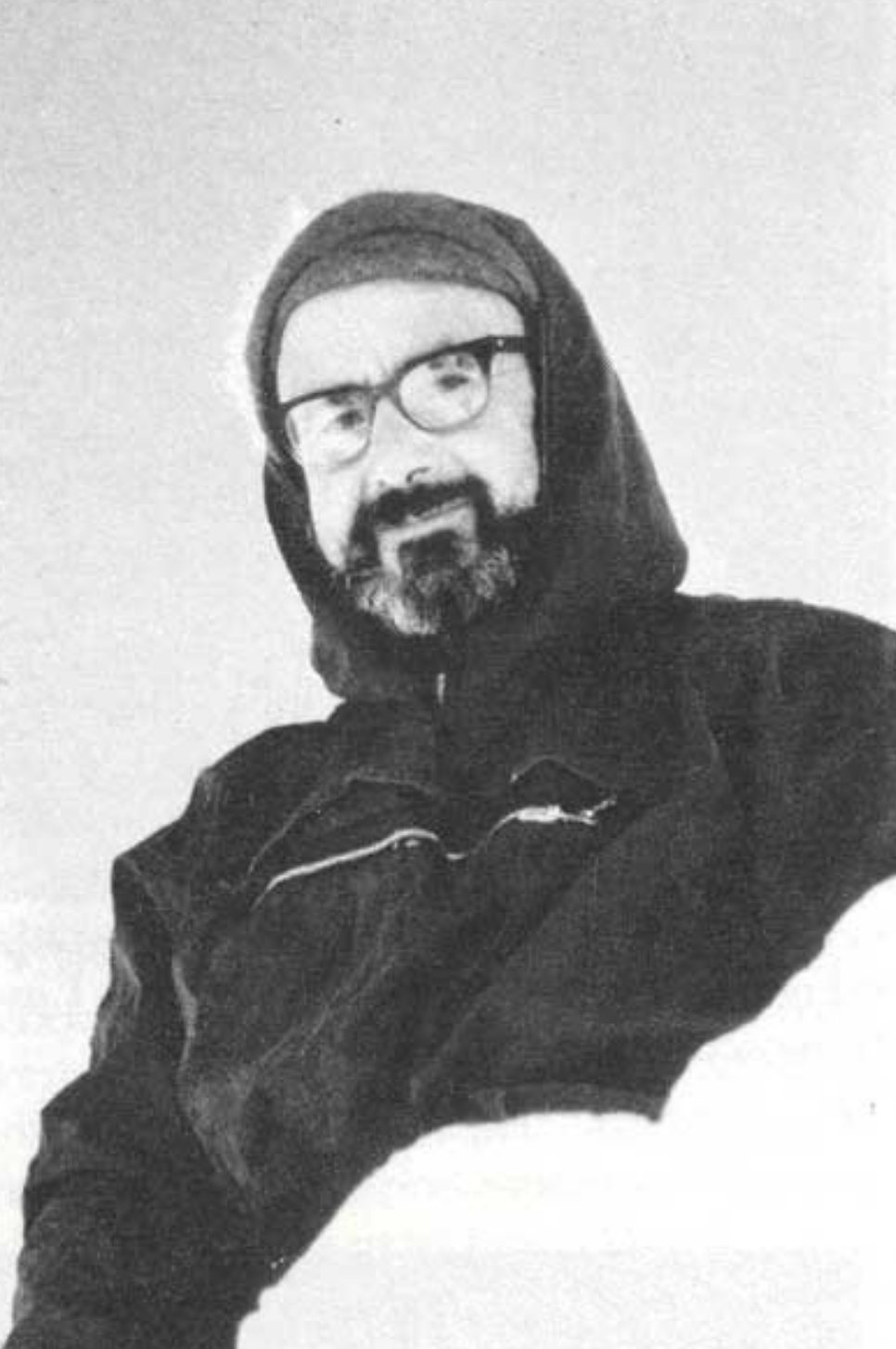
Instead, he turned to a place on Earth that then seemed like an ideal dress rehearsal for Mars — Antarctica’s Dry Valleys, a landscape with almost no precipitation, extreme cold and so little visible life that some soil samples had previously been described as virtually sterile. Vishniac was trying to demonstrate that microorganisms could reproduce even in such an environment. In December 1973, while conducting fieldwork in the Antarctic valleys, collecting samples and setting up small microbiological experiments, he fell from a cliff roughly 150 meters high on December 10 and, unsurprisingly, was killed. He was 51.
Carl Sagan, the American astronomer and one of the best-known advocates of the search for extraterrestrial life, later wrote in Vishniac’s obituary that his colleague had died while exploring "the most Martian" parts of Earth. Sagan even drew a somewhat grandiose but unforgettable parallel with Giordano Bruno: Vishniac, he suggested, was the first person since Bruno to die in a pursuit connected with extraterrestrial life. When the Viking landers finally began digging into Martian soil three years later, Vishniac was no longer there. His name nevertheless made it to Mars — a crater in the planet’s southern polar region is now named Vishniac.
The other two biology experiments offered little reassurance. The gas-exchange experiment detected a surprising release of oxygen, far too rapid and abundant for most researchers to feel comfortable attributing it to microbes. The pyrolytic-release experiment detected a small amount of fixed carbon, but the signal was not clean enough. The decisive blow came from the gas chromatograph–mass spectrometer. Designed to heat the soil and search for organic compounds, the instrument failed to find the organic material scientists expected. Within the biology we knew, life without organic chemistry was not a revolutionary hypothesis, it was a contradiction in terms.
Harold Klein, the American biologist who headed Viking’s biology team, therefore regarded unusual soil chemistry as the more persuasive explanation. Ultraviolet radiation, extreme dryness and powerful oxidants might have turned the surface into a chemical trap capable of mimicking metabolism as soon as water was added. NASA’s conclusion was not that Mars had been proven dead. It was that there was no clear evidence of living microorganisms. Popular memory, notoriously impatient with footnotes, gradually translated "inconclusive" into the much simpler "there is nothing there."
Gilbert Levin, the American engineer, founder of Biospherics and principal investigator behind Viking’s Labeled Release experiment, never accepted that translation. For decades he maintained that his experiment had satisfied the criteria established beforehand: it produced a repeatable response at two widely separated sites, and that response disappeared after the sample was heated. An interesting interview with Levin, who died in 2021, can be heard here.

Most of his colleagues disagreed. Levin’s problem was never a lack of an intriguing result, but a lack of corroboration from the other instruments. In science, one spectacular witness may be enough to open an investigation, but rarely enough to secure a verdict.
1,281 Martian days completely alone
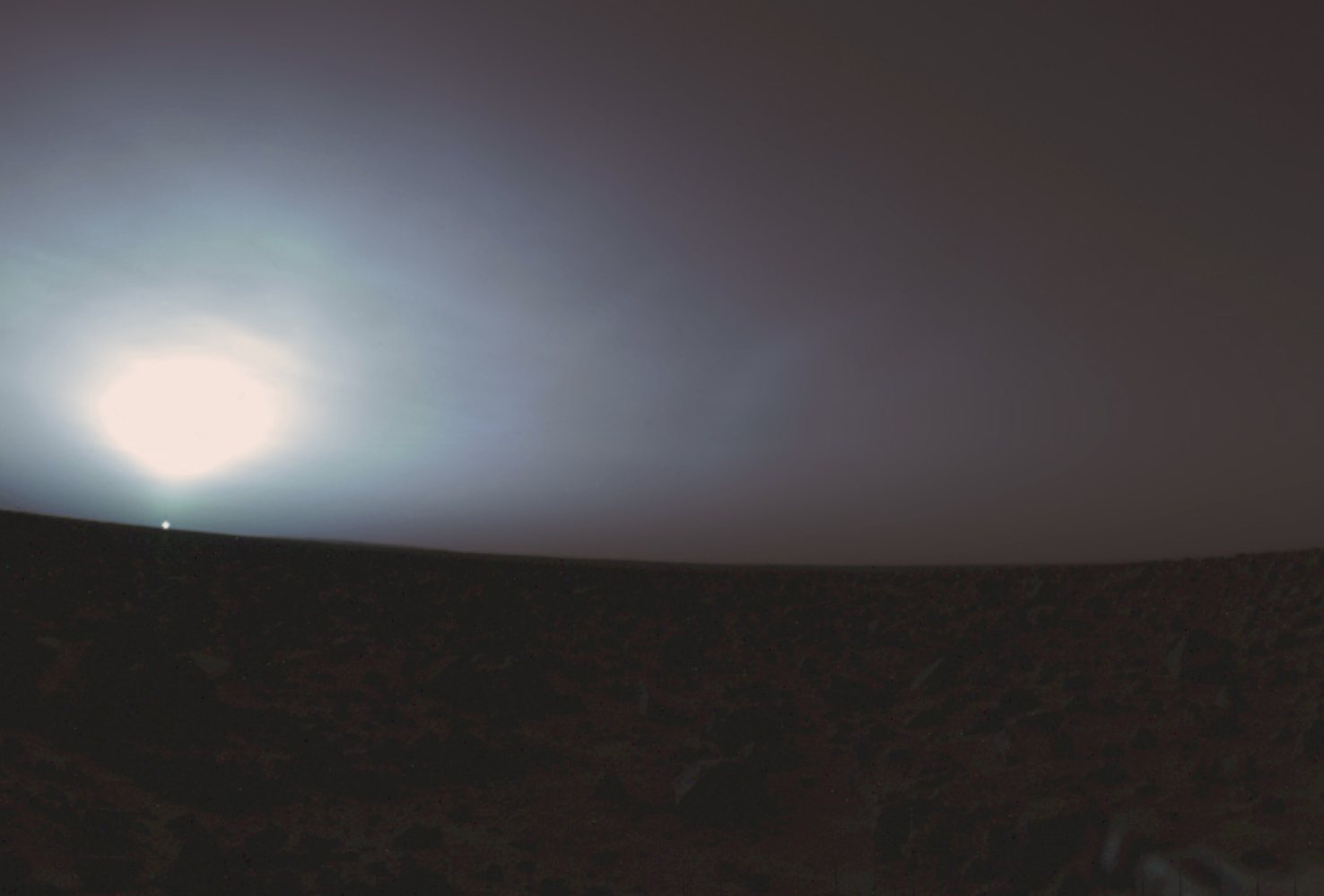
Viking 2 had been designed for a mission lasting roughly 90 days. Instead, it remained operational for 1,281 Martian days — almost three and a half Earth years. Once the experiments intended to detect life were over, it had nowhere else to go. It had no wheels, could not move to another location and could not investigate a more interesting rock a few meters away. It simply remained where it had fallen from the sky on September 3, 1976, standing on three legs among the stones of Utopia Planitia and watching Mars pass through its seasons.And Mars proved less static than the first photographs suggested. Viking 2 survived two Martian winters, during which temperatures fell to around minus 123 degrees Celsius. It watched dust alter the landscape and endured the great storms of 1977. It took more than 1,800 photographs, continuously monitored the atmosphere and weather, and one winter saw something no camera had ever before recorded on the surface of another planet: frost. A thin white layer appeared around nearby rocks and even inside a trench its robotic arm had previously dug into the soil. The following Martian year, the frost returned almost on schedule.
Many years later, in 2008, the Phoenix lander discovered perchlorates in the Arctic soil of Mars. These salts are fairly stable in the cold, but when heated they become extremely hostile to organic molecules. Two years later, researchers added magnesium perchlorate to soil from Chile’s Atacama Desert and processed it in a way similar to Viking’s analysis. The experiment produced chloromethane and dichloromethane — exactly the compounds detected by the Viking instruments and dismissed by scientists in 1976 as residues from terrestrial cleaning agents. It is therefore possible that Viking did not fail to detect organic material at all. Perhaps it burned the organics while trying to measure them, then dutifully recorded the chemical remains.
That weakened one of the strongest arguments against a biological interpretation, but it did not prove the existence of life. In a new analysis published in 2025, planetary scientists Christopher McKay, Richard Quinn and Carol Stoker concluded that perchlorates, together with other non-biological oxidants, could explain Viking’s results without invoking microorganisms. Yet their conclusion comes with an important limitation. Explaining the signal without life is not the same as proving that life was absent. It merely means chemistry has a convincing alibi.
NASA has not sent another direct biology experiment to Mars since Viking. The strategy shifted toward water, organic molecules and the question of whether ancient Mars was once habitable. That caution is understandable, but it has produced a curious consequence: today we possess cameras, spectrometers and rovers that engineers in 1976 could only have dreamed of, yet we have never repeated the fundamental question in an equally direct form. We know incomparably more about the geology of Mars. About whether anything is alive there right now, we still know remarkably little.
Viking 2 did not discover life, but it discovered the boundary between a result and its interpretation. Mars answered neither "yes" nor "no." It produced a signal that might have belonged to biology, but one that chemistry knew how to imitate.
Life, after all, is not a substance an instrument simply finds like a piece of iron. Life is an explanation for a collection of traces, and that explanation must be better than every lifeless alternative. Half a century after Viking 2 landed on Utopia Planitia, the most honest answer remains that Mars said something — we are simply still not entirely sure whether we asked it the right question.
Sources
- Science.nasa.gov Viking 2 - NASA Science https://science.nasa.gov/mission/viking-2/
- Planetary.org Viking 1 and 2, NASA’s first Mars landers | The Planetary Society https://www.planetary.org/space-missions/viking
- Agupubs.onlinelibrary.wiley.com Reanalysis of the Viking results suggests perchlorate and organics at midlatitudes on Mars https://agupubs.onlinelibrary.wiley.com/doi/10.1029/2010JE003599
- Doi.org Recent results from the Viking Labeled Release Experiment on Mars https://doi.org/10.1029/JS082i028p04663
- Scientificamerican.com Mars '76 https://www.scientificamerican.com/blog/life-unbounded/mars-76/
- Space.com Is it time to revisit what NASA's Viking lander found on Mars in 1976? https://www.space.com/mars-viking-lander-1976-results
- Nature.com Chemical model for Viking biology experiments: implications for the composition of the martian regolith - Nature https://www.nature.com/articles/338633a0
- Pubs.acs.org The Viking GC/MS and the Search for Organics on Mars https://pubs.acs.org/doi/10.1021/ac071972t
- Sciencedirect.com The Viking biology experiments on Mars revisited https://www.sciencedirect.com/science/article/pii/S0019103525000132
- Astrobiology.nasa.gov NASA Astrobiology https://astrobiology.nasa.gov/about/faq/astrobiology-program-evolved/
- Jpl.nasa.gov Frost on Utopia Planitia | NASA Jet Propulsion Laboratory (JPL) https://www.jpl.nasa.gov/images/pia00530-frost-on-utopia-planitia/
Comments