
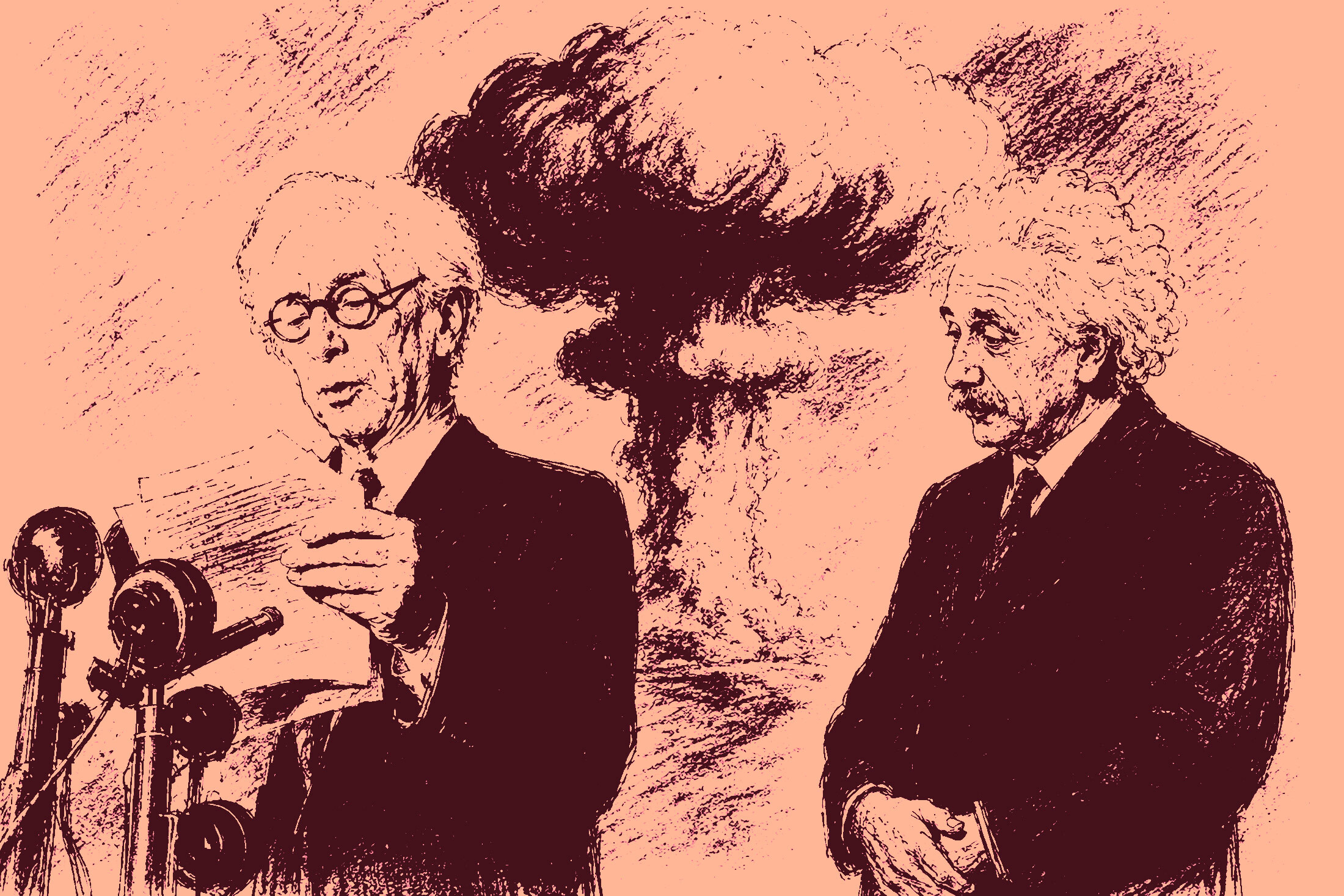
On 9 July 1955, one of the Cold War’s most unusual documents was made public in London. It was not written by a general, a president, or an intelligence officer. It was written by people who understood better than most what happens when an abstract equation becomes a ball of fire. Bertrand Russell, the British philosopher and mathematician, stood before reporters at Caxton Hall and read a warning that also carried the name of Albert Einstein, the German-American physicist who by then had been dead for several months. It was a message from the world of science, but also something close to a posthumous message from the conscience of the 20th century.
Einstein signed the manifesto on 11 April 1955, just one week before his death. Russell later wrote that he heard the news of Einstein’s death on a plane from Rome to Paris, convinced that his plan was falling apart. Yet when he arrived at his hotel in Paris, a letter was waiting for him in which Einstein had briefly confirmed that he was willing to sign Russell’s statement.
The Russell–Einstein Manifesto emerged at a moment when the Cold War was beginning to look less like a political tension and more like a technical problem of species survival. The bombings of Hiroshima and Nagasaki had taken place ten years earlier, but they still seemed like a prelude, not a climax.
In the meantime, the hydrogen bomb had changed the scale of catastrophe. The American Castle Bravo test on Bikini Atoll in 1954 had a yield of 15 megatons, more than twice what had been expected, and scattered radioactive material across thousands of square kilometres of the Pacific. Residents of nearby atolls were exposed to radiation, while the Japanese fishing boat Daigo Fukuryū Maru, known as the Lucky Dragon, became floating proof that a radioactive cloud does not care to be contained.
That was the heart of the manifesto. The problem was no longer who would win the next war. The problem was that victory itself had become a grotesque and apocalyptic concept.
Russell and Einstein asked people, at least for a moment, to stop seeing themselves as Americans, Soviets, communists, anti-communists, or followers of this or that flag, and to see themselves instead as members of a biological species whose survival was not guaranteed. The line that became most famous sounds almost childishly simple: "Remember your humanity, and forget the rest."
The manifesto was signed by 11 distinguished scientists and intellectuals. Among them were Max Born, the German-British physicist and one of the founders of quantum mechanics, Linus Pauling, the American chemist and later Nobel Peace Prize laureate, and Joseph Rotblat, the Polish-British physicist who had worked on the Manhattan Project but left it for moral reasons. Most of the signatories were Nobel laureates, or would later become so. But the document did not rest on that authority alone. Its force came from the uncomfortable fact that it was signed by people who were not speaking out of sentimental pacifism, but from a professional understanding of the mechanics of destruction.
Out of the manifesto grew Pugwash, an international movement of scientists that first met in 1957 in the town of the same name in Nova Scotia. It was not a club of sages capable of disarming states through clever observations, but Pugwash did open a channel of communication between scientists on both sides of the ideological curtain.
In the Cold War, such channels were no small thing. When official diplomatic language sounded like ritualized threat, people who understood the physics of explosion could at least talk about its consequences. Pugwash and Rotblat received the Nobel Peace Prize in 1995 for their efforts to reduce the role of nuclear weapons in international politics.
Of course, the manifesto did not save the world in the neat way school textbooks might like. Nuclear weapons did not disappear. According to SIPRI estimates, at the beginning of 2026 the nine nuclear-armed states possessed around 12,187 nuclear warheads in total, most of them held by Russia and the United States, with thousands deployed on missiles and aircraft. History, as usual, did not listen to the smartest people in the room. But Russell and Einstein were not asking for applause. They were asking for a change in the way humanity thought. In that sense, the manifesto remains uncomfortably relevant.
Today, the question no longer belongs only to nuclear physics. Artificial intelligence and synthetic biology are reopening an old unease: what does a scientist owe the world when they can see danger before politicians, investors, and the public do?
That is why the Russell–Einstein Manifesto is not only a document against nuclear war. It is a text about the moment when knowledge ceases to be neutral.
Not all science carries the same moral weight, but some kinds of knowledge bring with them an obligation to speak. A scientist who understands how a system can fail cannot hide forever behind the claim that they merely performed the calculation.
On this day in 1955, a group of scientists tried to explain to humanity that apocalypse was no longer a theological metaphor, but a technical possibility.
Comments