
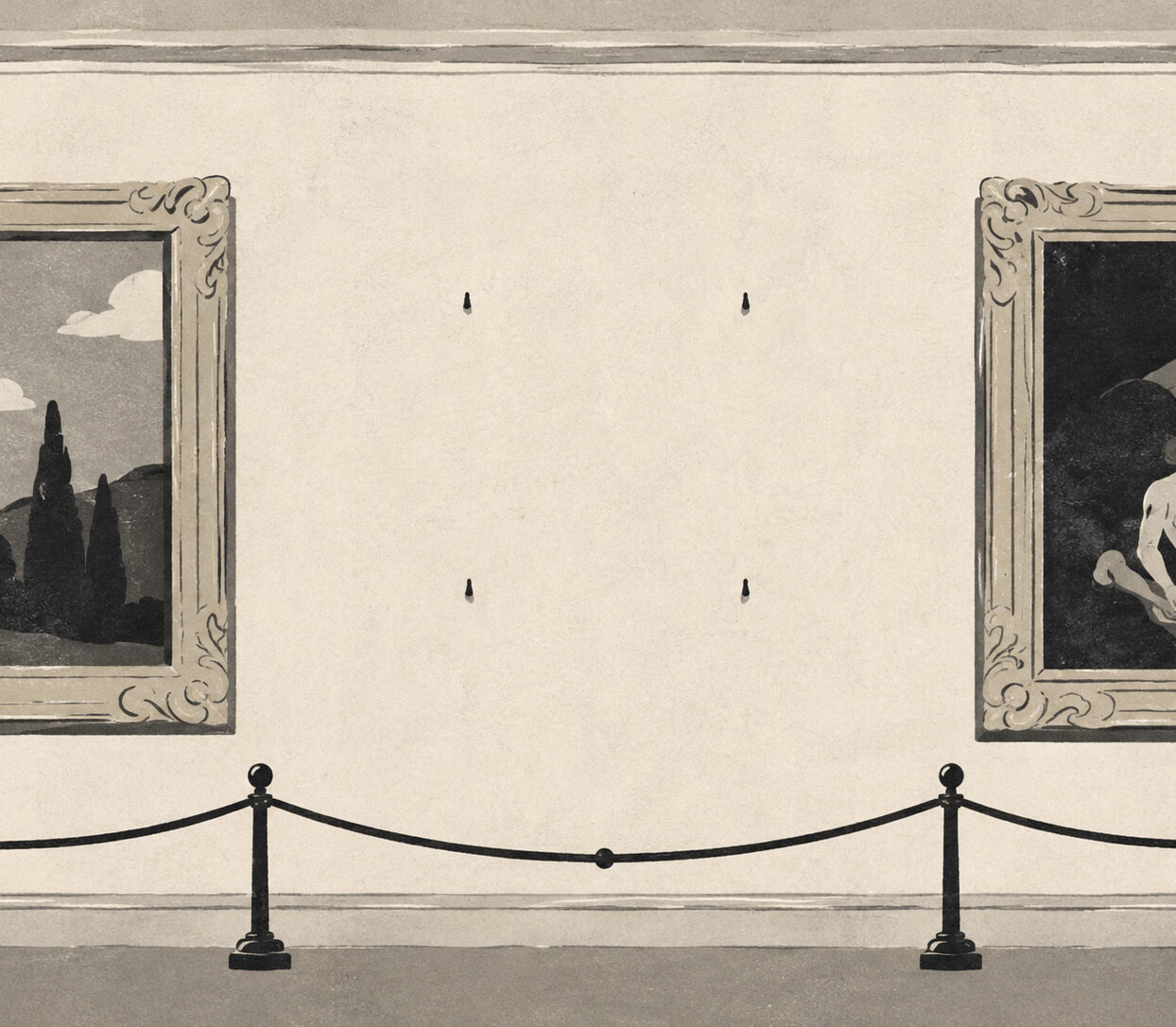
The image that would become the most famous painting in the world first truly became visible on the morning when no one could see it. On Tuesday, August 22, 1911, the French painter Louis Béroud arrived at the Louvre to work on a copy of the Mona Lisa. On the wall of the Salon Carré, he found four iron pegs and an empty rectangle. At first, the guards were not alarmed. They assumed the painting had been taken to the museum photographer, as artworks were routinely moved around for such purposes. Only when it turned out not to be there either did they realize that someone had removed it from the wall the previous morning and carried it out of the Louvre.
In the days that followed, people came to look at the place where the painting was no longer hanging. The empty wall became an attraction in its own right, almost a monument to French humiliation. To report that the Mona Lisa was missing, newspapers had to keep showing readers what it looked like. Then came everything from postcards and caricatures to cabaret songs and short films. The theft, one might say, gave the painting something artworks usually lack - a plot. Its disappearance gave it a biography, and mass media gave that biography an audience.
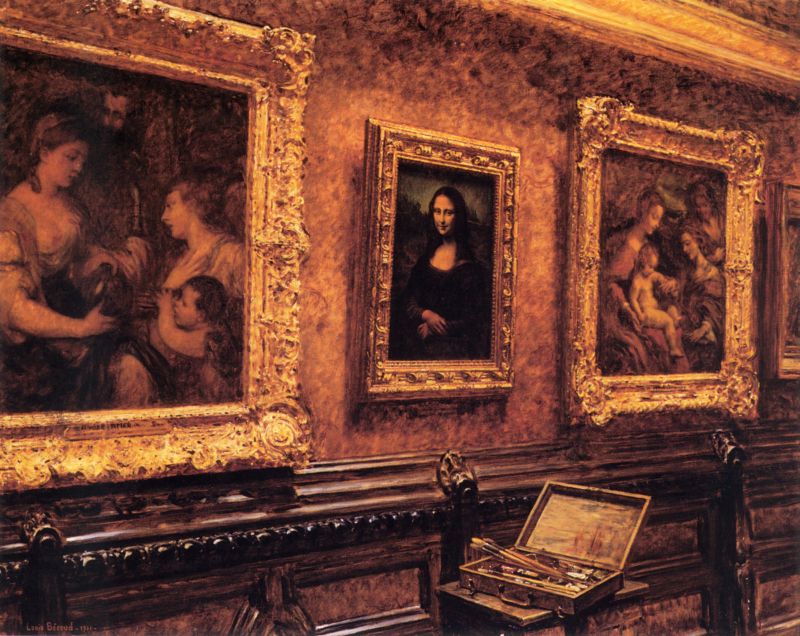
It would be wrong, however, to say that the Mona Lisa had been "unknown" before the theft. Leonardo da Vinci, the celebrated Italian Renaissance artist and one of the central figures of European cultural history, painted the portrait in the early 16th century. The sitter is traditionally identified as Lisa Gherardini, wife of the Florentine silk merchant Francesco del Giocondo. His surname gave the painting its Italian name, La Gioconda, and its French one, La Joconde. King Francis I of France acquired the work after Leonardo moved to France. By the 19th century, writers such as the French critic Théophile Gautier and the British essayist Walter Pater had already built an almost mystical cult around her gaze.
But there is a difference between a masterpiece and a celebrity. In 1911, the Mona Lisa belonged to the artistic canon, but she did not yet belong to everyone. The popular Baedeker guide to Paris devoted less space to her than to the Winged Victory of Samothrace and the Venus de Milo. Art historians, educated travelers and regular museumgoers knew her. The theft moved her out of that circle and onto the front pages. It did not create her artistic value, but it did create her modern fame.
The man who carried out the theft was no international criminal mastermind. Vincenzo Peruggia was a Lombard immigrant, a house painter and glazier who had worked for a company contracted by the Louvre. He had helped install protective glass over valuable paintings and knew how the museum operated. According to his later account, he arrived early on Monday, August 21, wearing the white work smock used by museum employees. The Louvre was closed to the public that day. Peruggia lifted the portrait off its four pegs, carried it to a service staircase and removed its frame and protective glass.
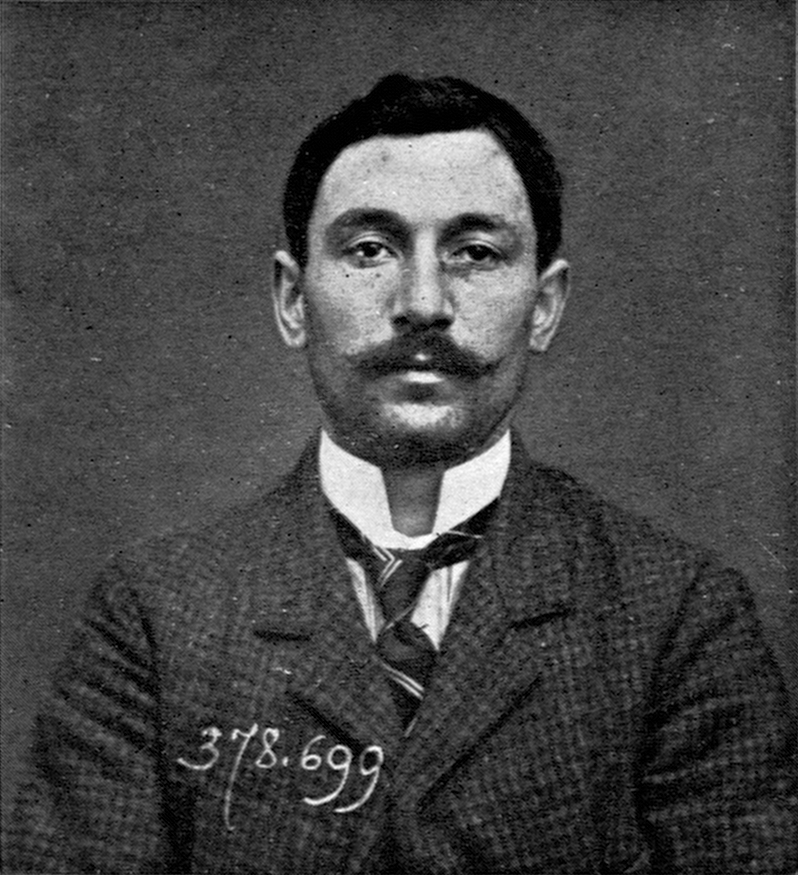
One of the most famous art thefts in history required no tunnels, explosives or team of acrobats. All it took was work clothes and an institution in which a white smock was more persuasive than an identity check. It is worth noting that the Mona Lisa is not painted on canvas but on a poplar panel, about 77 centimeters high and 53 centimeters wide. It is often said that Peruggia hid it beneath his clothes. According to his own account, he took off his smock, wrapped the panel in it and simply carried it away under his arm. There is something almost comical about the fact that the Louvre protected the painting with glass but failed to protect the door from the man who knew how to remove that glass.
The police had Peruggia's fingerprint - they just didn't know how to find it
One of the greatest ironies of the investigation was that the French police already had almost everything they needed. A sufficiently clear fingerprint had been found on the Mona Lisa's protective glass, and Vincenzo Peruggia was already in police records following earlier arrests in 1908 and 1909. His file contained identifying information and fingerprints. In other words, the thief had left something resembling a signature at the crime scene, and the police already possessed another copy of that signature.The problem was the way the enormous archive was organized. Parisian criminal identification was dominated by the system developed by Alphonse Bertillon, the French pioneer of forensic identification. His so-called bertillonage classified people primarily by precise body measurements - head length, arm span and other physical characteristics. Fingerprints were already in use, but the Paris police still lacked an efficient enough classification system to take an unknown print and easily compare it with thousands of existing records.
That distinction was crucial. An officer could take Peruggia's file and check whether his fingerprint matched the one found at the Louvre. What he could not easily do was start with the anonymous print and search through an enormous archive until he discovered that it belonged to Peruggia. Today, a computer would search such a database automatically. In 1911, investigators had little choice but to work through records manually within a system designed around a different method of identification.
The theft of the Mona Lisa thus became an almost perfect illustration of a transitional moment in the history of forensic science. The police had the clue, they had the culprit in their archive, and they knew fingerprints could identify a person - what they lacked was a way to connect those three facts. The world's most famous art thief did not get away because he had left no trace. He got away because he left one a few years too early.
France responded to the humiliation with an enormous investigation. Around sixty police investigators worked on the case, the Louvre remained closed for days, and the magazine L’Illustration offered 50,000 francs for the painting's return. The museum director resigned. With little else to go on, police attention eventually turned to the French poet Guillaume Apollinaire, who spent several days in jail, and even to the Spanish painter Pablo Picasso. The connection was not entirely imaginary - a man from Apollinaire's circle really had stolen small antiquities from the Louvre, and some of them had ended up in Picasso's possession. But neither man had anything to do with the Mona Lisa.
While police watched the borders and interrogated avant-garde artists, the painting was sitting in Peruggia's modest Paris room. Remarkably, police even questioned him as a former Louvre worker, but accepted his answers and never conducted a serious search of the premises. The Mona Lisa remained there with him for 28 months. Meanwhile, thousands of people visited the empty spot in the Louvre. Among them were the Prague writer Franz Kafka and his friend Max Brod, who later went to see a stage show that was already making fun of the theft. High art had entered the rhythm of mass culture - crime, headline, parody, another headline.
France's greatest policeman versus a man in a work smock
If anyone in 1911 was supposed to find the Mona Lisa quickly, it was Louis Lépine, the legendary prefect of the Paris police. Newspapers sometimes went so far as to call him "the greatest policeman in the world." He was the man who modernized the Paris police, encouraged the development of forensic methods and reorganized the way public order was maintained throughout the city. His name survives today in the Concours Lépine, the inventors' competition he founded in 1901. Once it became clear that the Mona Lisa had been stolen, Lépine sent around 60 inspectors to the Louvre. The museum was closed, exits were blocked, rooms were searched and employees questioned.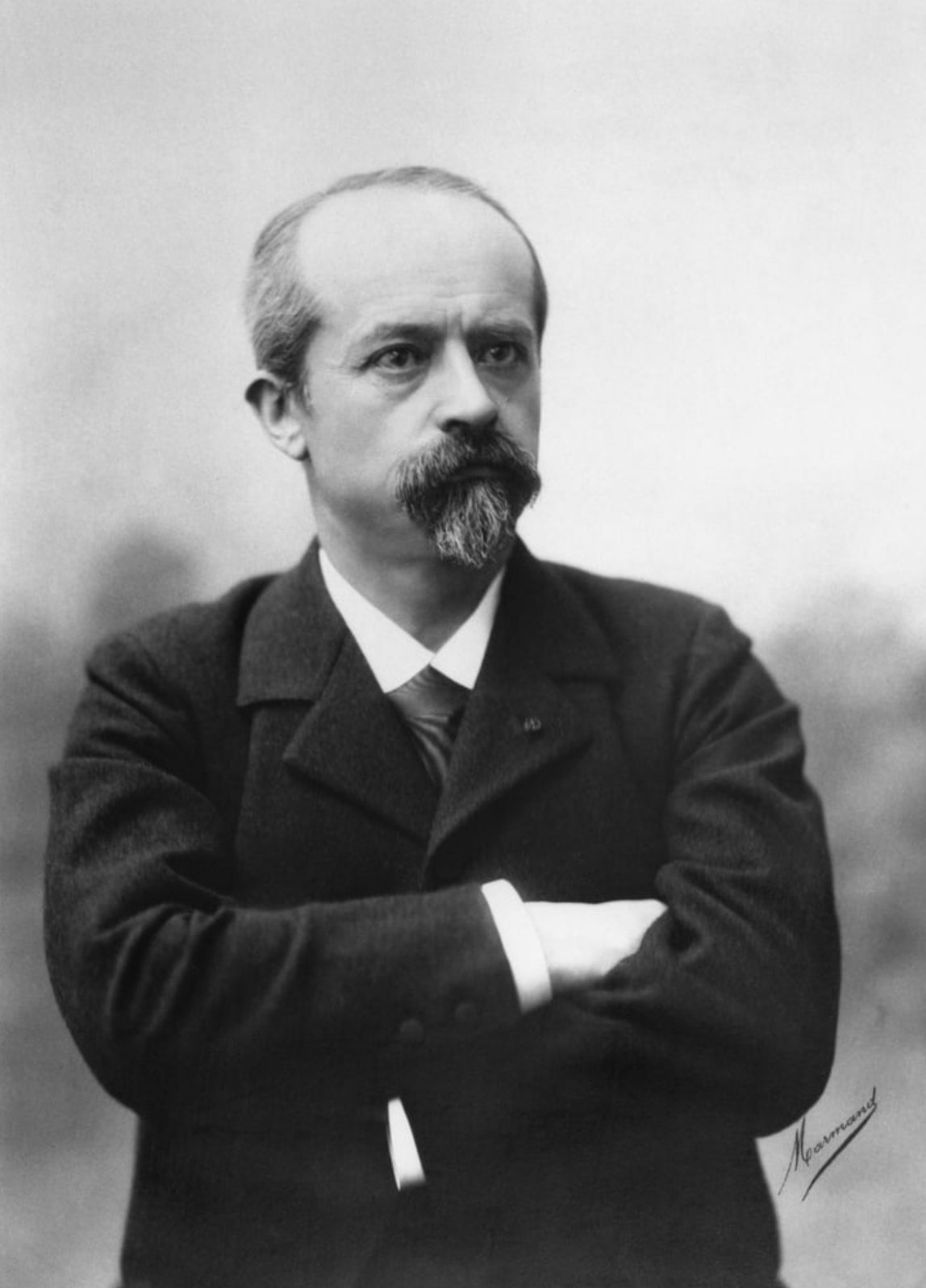
The best part of the story came when the investigation finally reached Peruggia himself. Because he had worked on installing protective glass at the Louvre, police did in fact question him in 1911. An inspector visited his small Paris room and accepted his claim that he had been working elsewhere at the time of the theft. The Mona Lisa was in that very room. According to later accounts, it was hidden so close to the investigator that the entire episode eventually acquired the quality of a crime farce.
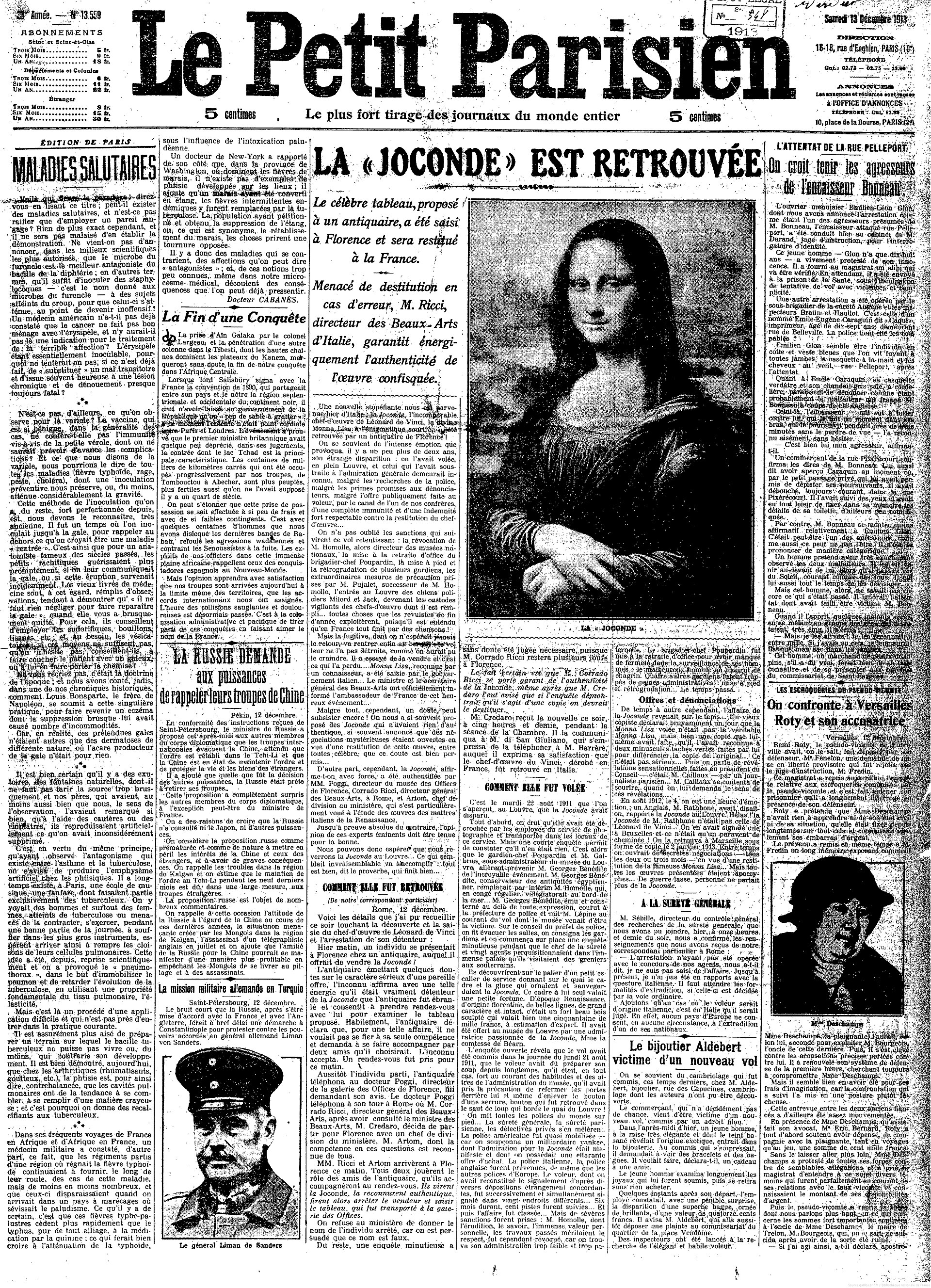
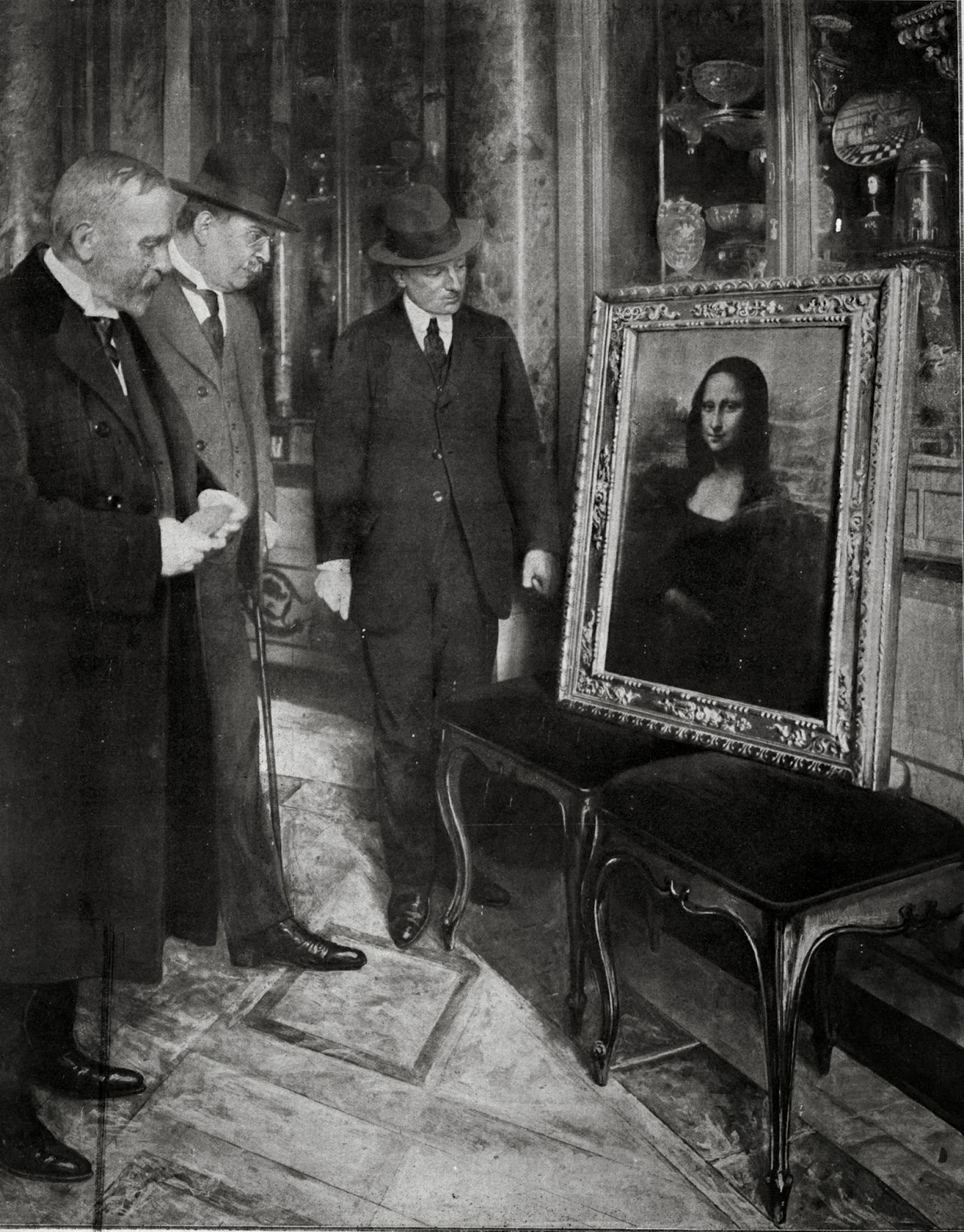
In December 1913, Peruggia, signing himself "Leonardo V.", contacted the Florentine art dealer Alfredo Geri. He claimed that he wanted to return the painting to Italy, but at the same time asked for a very tangible reward - 500,000 lire. Geri summoned Giovanni Poggi, director of the Uffizi Gallery, who confirmed that the painting was genuine. But the two experts had no intention of allowing Peruggia's plan to unfold quite as he imagined it. They took possession of the painting for safekeeping and informed the police. Peruggia was arrested at his hotel.
His defense was romantic enough to outlive the facts. He said he wanted to undo Napoleon's plunder of Italy and return Leonardo's painting to its homeland. The problem was that the Mona Lisa had never been Napoleonic war booty. As already noted, Leonardo himself brought it to France, and Francis I acquired it almost three centuries before Napoleon's campaigns. Peruggia later spoke about the insults he had endured as an Italian worker in Paris, so his nationalism may not have been entirely invented. Still, the letters, negotiations and demand for 500,000 lire suggest that patriotism was not his only motivation.
Six Mona Lisas sold while the real one was missing?
There is another story about the theft of the Mona Lisa that is almost too good to be true. Most likely because it isn't. According to a version that did not appear until 1932, Vincenzo Peruggia was not acting out of Italian patriotism alone. Behind him supposedly stood Eduardo de Valfierno, a mysterious Argentine con man whose plan was far more elegant than a simple theft. He allegedly had no need for the original at all. He merely needed the original to disappear.The story was published in the Saturday Evening Post by the American journalist Karl Decker, who claimed that Valfierno had told it to him personally back in 1913. According to Decker, before the theft Valfierno hired a forger named Yves Chaudron to produce six convincing Mona Lisas. He then found six wealthy American collectors and made each of them the same promise - he would steal Leonardo's original specifically for him. The forgeries were supposedly shipped to the United States in advance, while the real Mona Lisa was still hanging in the Louvre and customs officials had no reason to scrutinize them.
Then, on August 21, 1911, the painting really did disappear from the Louvre. The news went around the world and, at least according to the story, provided Valfierno with the perfect proof of authenticity. Each of the six buyers received a forgery and could reasonably conclude that the painting hidden in his home was the very masterpiece Europe was searching for. The scam had another ingenious safeguard: a victim could hardly go to the police and complain that he had been sold a fake Mona Lisa without admitting that he had knowingly tried to buy a stolen masterpiece.
Yet there is almost no independent evidence for any of it. None of the supposed six forgeries has ever been found. There is no reliable confirmation that Yves Chaudron participated in such an operation, and serious doubts remain about whether Valfierno even existed in the form described by Decker. The story surfaced more than twenty years after the theft and rests almost entirely on a single magazine article. Historians of art crime therefore tend to treat it today as legend rather than as the solved second act of the Mona Lisa theft.
But perhaps that makes it all the more appropriate for the Mona Lisa. The theft of 1911 did not merely increase the fame of a single painting. It began generating new stories around it, stories that seemed to improve as they became harder to verify.
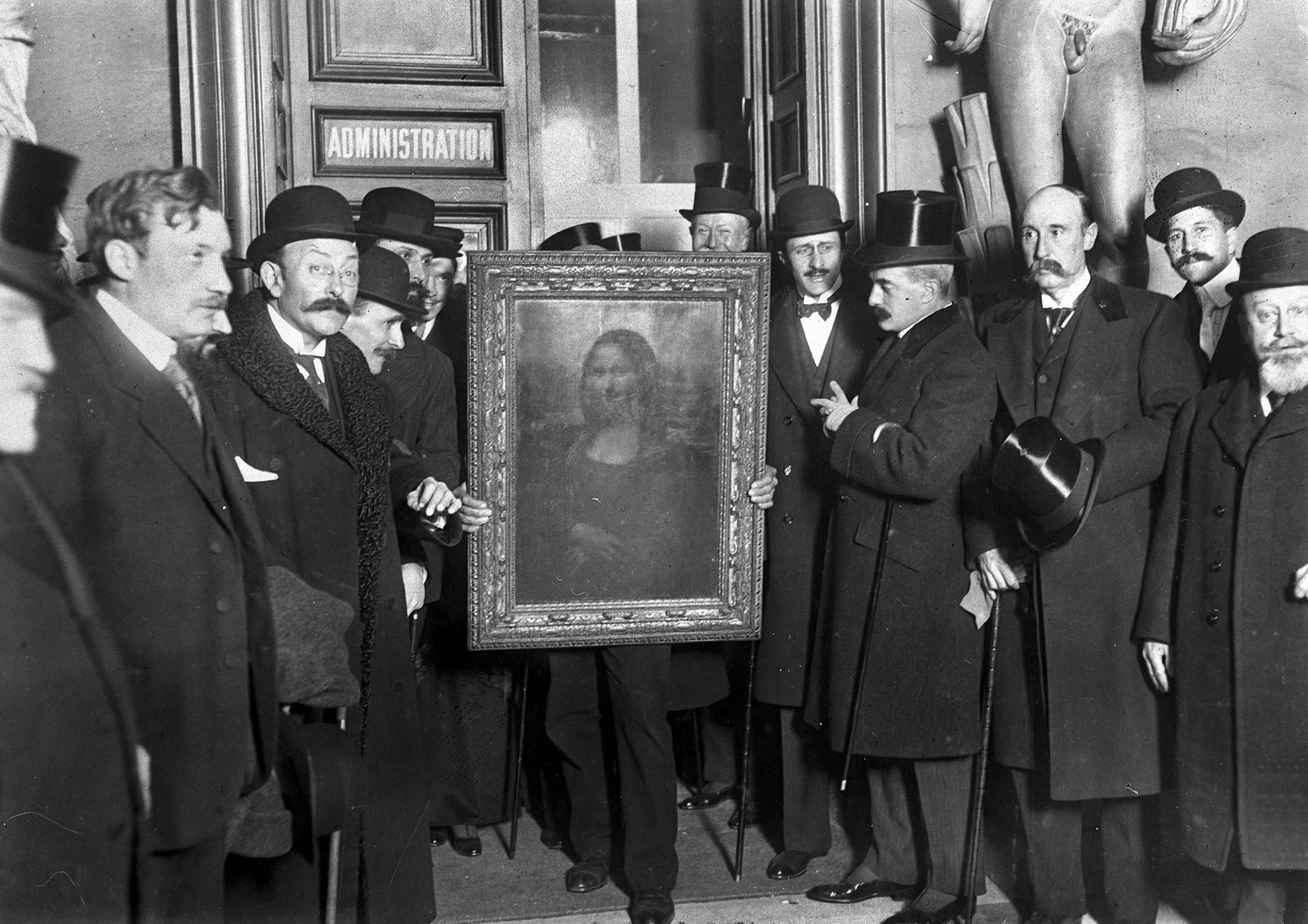
Even so, parts of the Italian public embraced Peruggia as a clumsy national hero. The Mona Lisa was exhibited in Florence, Rome and Milan, under police guard and before enormous crowds.
Peruggia received a lenient sentence and spent only a few months in prison. The painting returned to the Louvre in early January 1914. More than 100,000 people came to see it during the first two days after it was rehung. The theft was over, but its promotional effect was only beginning.
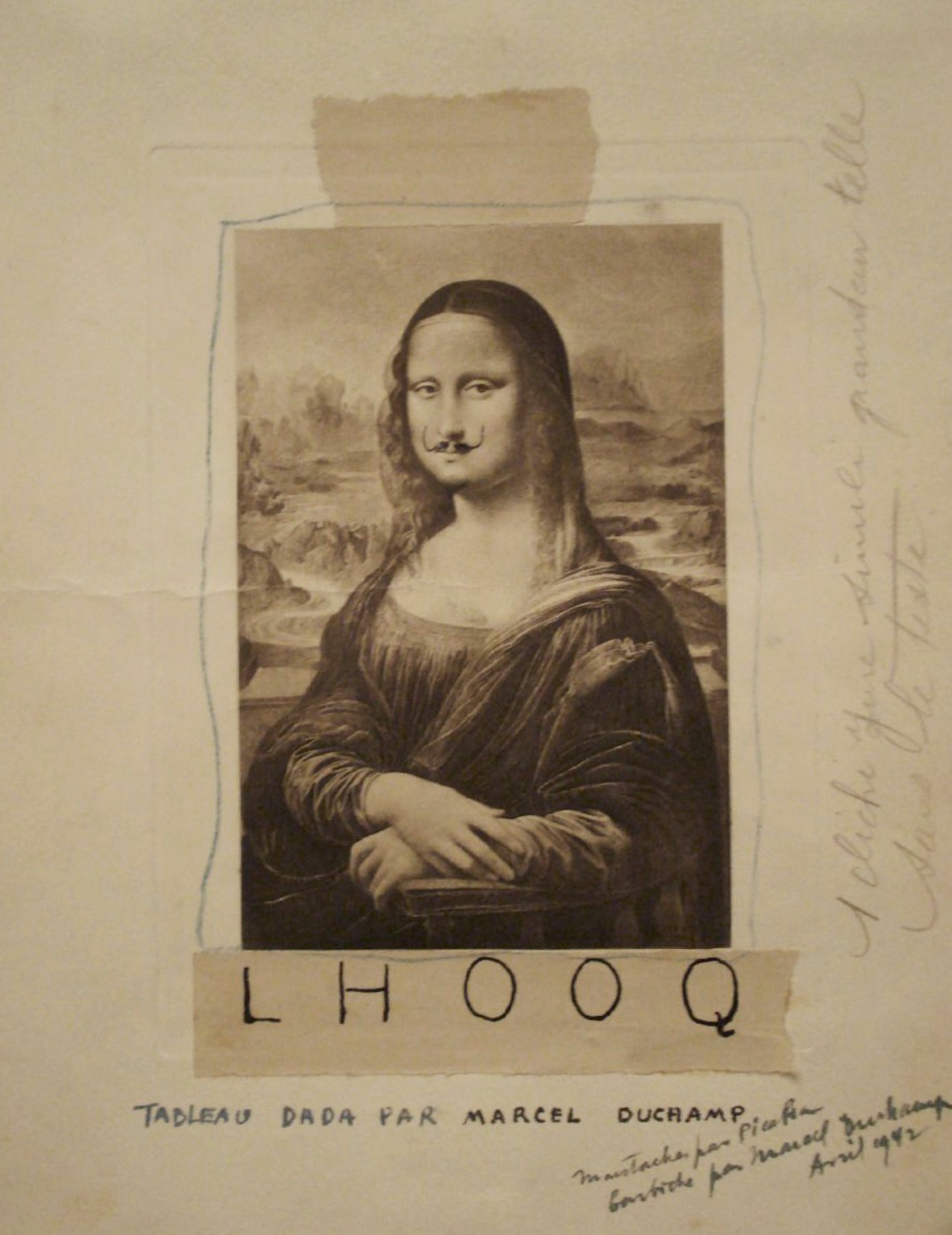
From then on, the Mona Lisa became both more and less than a painting. More, because she became a universal symbol of art itself. Less, because her image could now be endlessly reproduced, sold and mocked. In 1919, the French artist Marcel Duchamp drew a moustache and goatee on a cheap reproduction and called the work L.H.O.O.Q. The joke worked only because the audience instantly knew what had been desecrated. True cultural fame begins when the name no longer even needs to be mentioned.
Today's visitor therefore does not approach the Mona Lisa without expectations. They come to see whether the real painting - surprisingly small to many - matches the enormous image they already carry in their minds. They look at the soft, almost smoky transitions of Leonardo's sfumato, but they are also looking at the theft, the headlines, Duchamp's moustache and the millions of photographs taken by people before them to prove that they, too, had stood there. Fame itself has become part of the material.
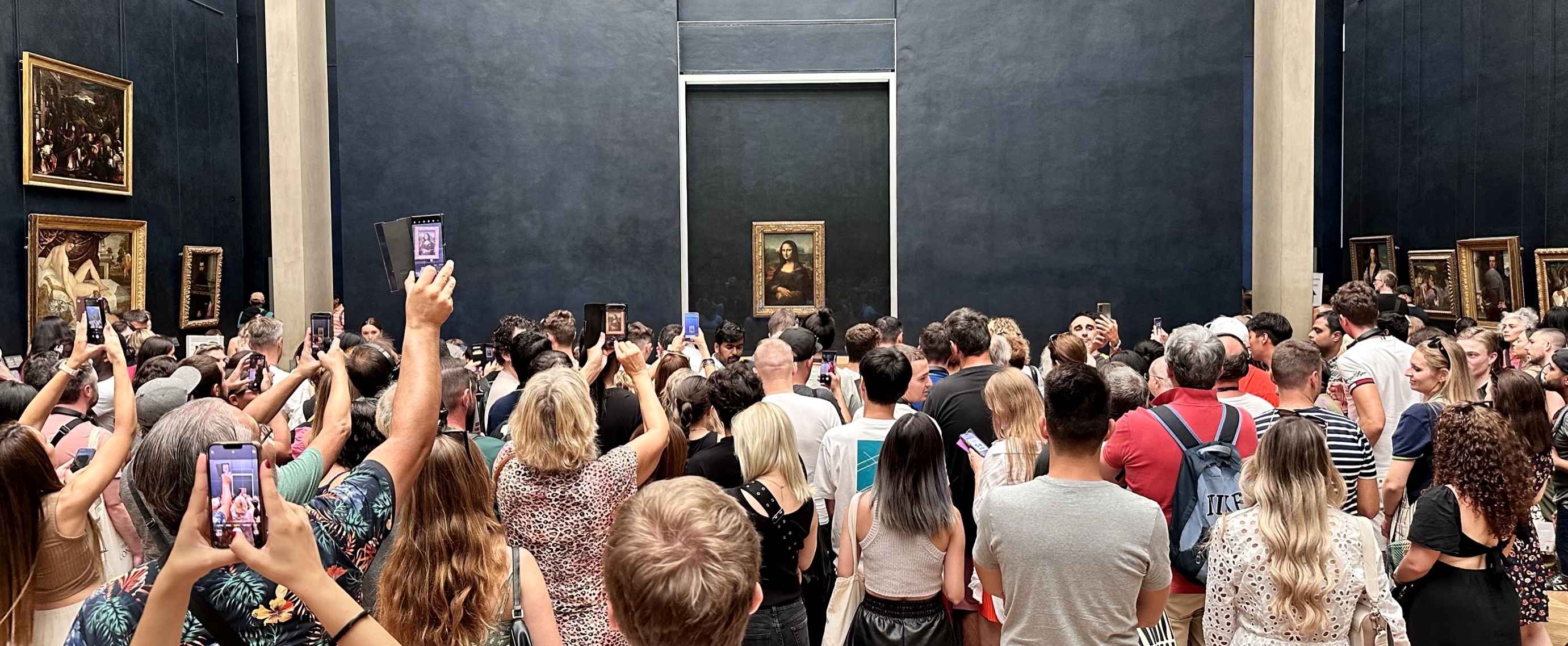
Peruggia may have wanted to return the Mona Lisa to Italy. Instead, he returned her to mass culture. His theft failed as an act of repatriation but succeeded as one of the most effective publicity campaigns in history. It did not change the smile in the painting. It changed the number of people who were convinced they already knew it.
Sources
- Smithsonianmag.com Stolen: How the Mona Lisa Became the World’s Most Famous Painting https://www.smithsonianmag.com/arts-culture/stolen-how-the-mona-lisa-became-the-worlds-most-famous-painting-16406234/
- Moma.org Marcel Duchamp. L.H.O.O.Q. 1930 https://www.moma.org/audio/playlist/352/4929
- Louvre.fr A superstar… and a wedding crowd! https://www.louvre.fr/en/explore/visitor-trails/the-louvre-s-masterpieces/a-superstar-and-a-wedding-crowd
- Theartnewspaper.com Missing Mona Lisa: the story behind the 1911 theft of Leonardo’s masterpiece https://www.theartnewspaper.com/2024/02/06/missing-mona-lisa-the-story-behind-the-1911-theft
- Retronews.fr 1913 : « On a retrouvé la Joconde ! » https://www.retronews.fr/faits-divers/echo-de-presse/2016/04/19/1913-retrouve-la-joconde
- Europeana.eu Did Picasso steal the Mona Lisa? A famous artist on trial for a shocking crime https://www.europeana.eu/ga/stories/did-picasso-steal-the-mona-lisa
- Guides.loc.gov Research Guides: Theft of Mona Lisa: Topics in Chronicling America: Introduction https://guides.loc.gov/chronicling-america-theft-mona-lisa
Comments