
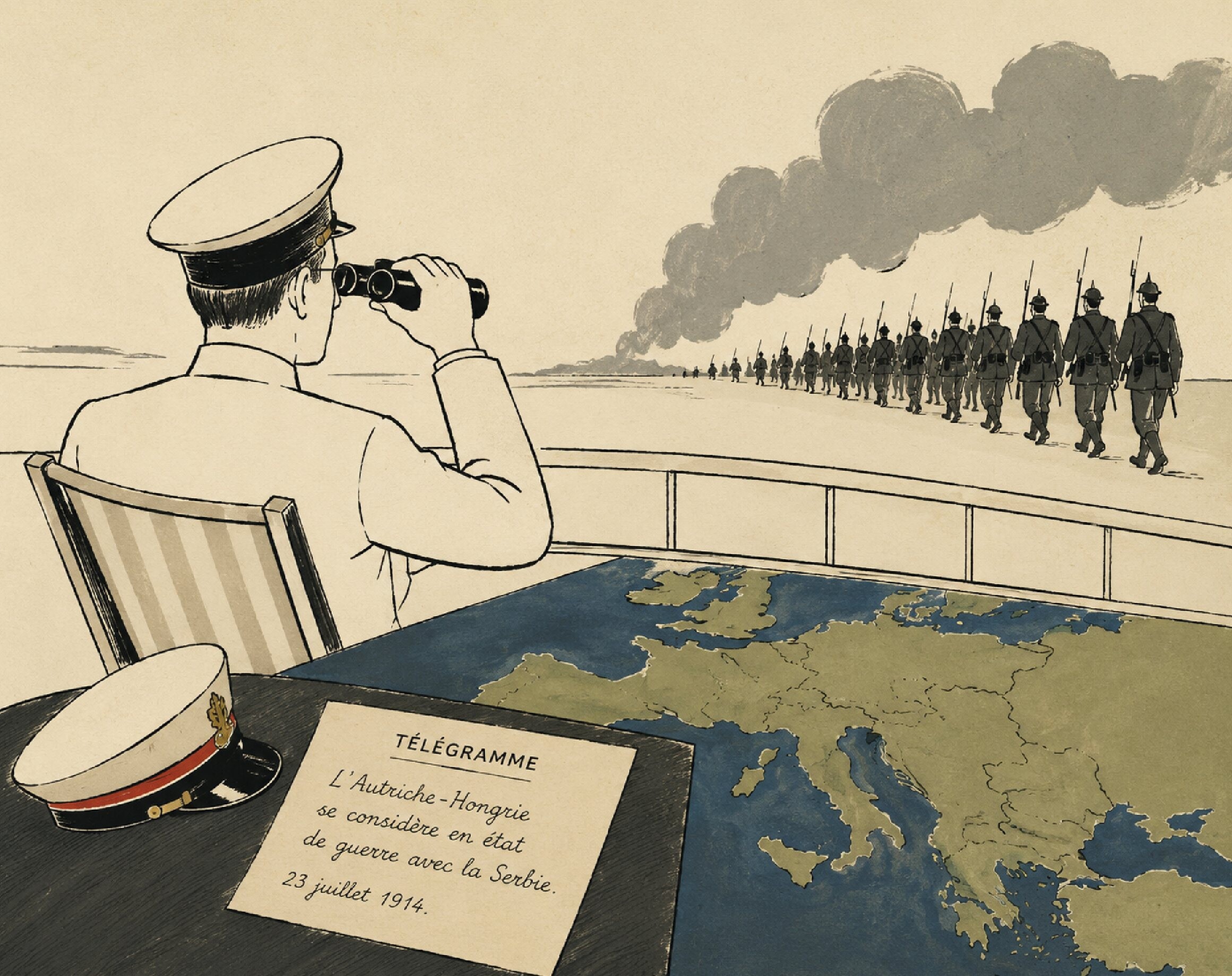
While emperors cruised and summered, and soldiers waited for the harvest to end, diplomats were sealing off Europe’s last exits from crisis.
The largest war humanity had ever seen began with an uncoded telegram, written in French and delivered to Serbian Prime Minister Nikola Pašić in Niš. In a few cold sentences, Count Leopold Berchtold, the Austro-Hungarian foreign minister, announced that Serbia’s response to the ultimatum was unsatisfactory and that the Monarchy therefore considered itself to be at war with Serbia. The document appeared almost banal—an administrative confirmation that an unpleasant procedure had reached its conclusion.
The most disturbing thing about July 1914 is not that nobody understood the danger. Many understood it perfectly well. The problem was that almost everyone believed the other side would back down first. Europe did not stumble into war like a man falling into an unmarked pit. It was more like a group of people shoving one another towards the edge, each convinced that the others would not dare take the final step. By the time they realised that everyone was prepared to do so, turning back already seemed more dangerous than pressing ahead.
The assassination in Sarajevo on 28 June gave Vienna the moral capital it needed for a reckoning, but it did not in itself produce a world war. Gavrilo Princip and his fellow Young Bosnia revolutionaries received weapons and assistance through men connected to the Black Hand and Serbian military intelligence. Pašić’s government, however, had not ordered the assassination. The Serbian state was not innocent, but neither was it a single, unified machine: the legal government and the conspiratorial networks operating around it often answered to different authorities. There was a particular irony in the fact that the murdered heir to the Austro-Hungarian throne, Franz Ferdinand, had spent his final years opposing war with Serbia and clashing over the issue with the bellicose chief of the General Staff, Franz Conrad von Hötzendorf.
For Vienna, Serbia represented a problem far greater than the investigation of a single—albeit very serious—crime. After the Balkan Wars, it had emerged territorially enlarged, militarily more confident and increasingly attractive to parts of the Monarchy’s South Slavic population. To a multinational empire haunted by its own national questions, a small neighbouring state could appear more dangerous as an example than as an army. The assassination was therefore seen in Vienna as an opportunity to crush the "Serbian challenge" once and for all.
On 5 July, Germany issued its so-called blank cheque. Kaiser Wilhelm II and Chancellor Theobald von Bethmann Hollweg promised to support whatever action Austria-Hungary chose to take, even if the conflict drew in Russia. Berlin calculated that Russia would retreat. If it did not, some within the German leadership believed it would be better to fight in 1914 than several years later, when Russia’s army and railway network would be stronger.
At the same time, diplomats spoke of "localising" the war in the Balkans. It was an elegant term for a plan that required all of Germany’s opponents to react exactly as Germany expected them to. In other words, the continent was treated like a table for controlled gambling, except that none of the players knew the true size of the stakes.
Europe Went on Holiday as War Drew Near
In July 1914, Europe did not look like a continent preparing to commit collective suicide. It resembled a postcard from the final summer of the old world. Kaiser Wilhelm II was cruising along the Norwegian coast aboard his yacht. Emperor Franz Joseph was staying at his summer residence in Bad Ischl. French President Raymond Poincaré and Prime Minister René Viviani were on a state visit to Russia, while Britain’s political elite was preoccupied with the crisis over Irish Home Rule. Europe was still travelling in trains with dining cars, visiting spa resorts and arguing over protocol. Within weeks, those same trains would be carrying millions of mobilised soldiers.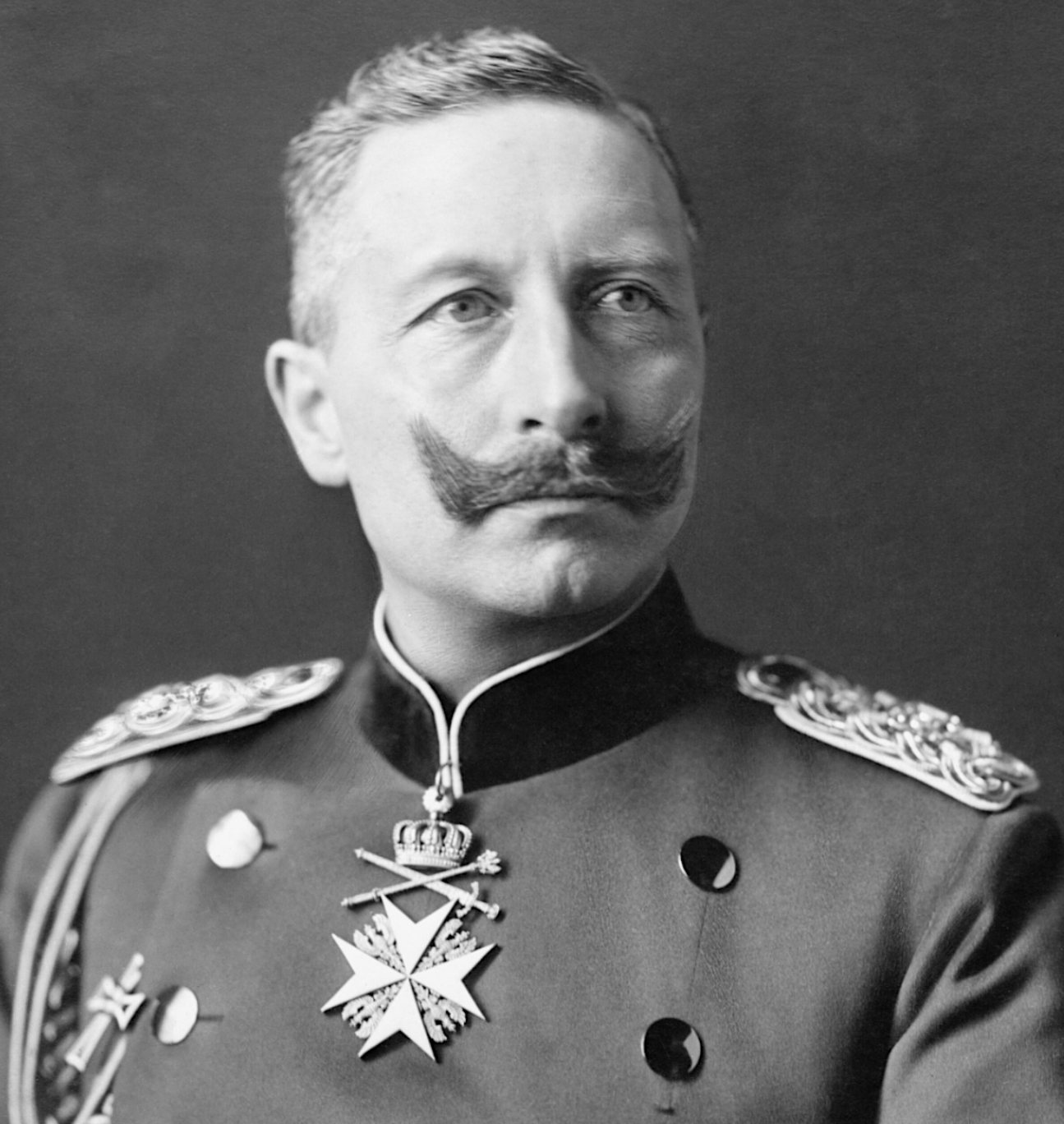
The French itinerary was exploited with particular precision. Austria-Hungary did not want to deliver its ultimatum to Serbia while Poincaré and Viviani were meeting Tsar Nicholas II in St Petersburg, where the French and Russians could immediately coordinate their response. Vienna therefore waited until the two French statesmen had left Russia and boarded the battleship France. The ultimatum was delivered on 23 July, just as the French leadership was at sea, far from Paris and dependent on unreliable radio communications. Poincaré did not return to French soil until 29 July, one day after Austria-Hungary declared war on Serbia. To say that French policy was "at sea" during those decisive days was almost literally true.
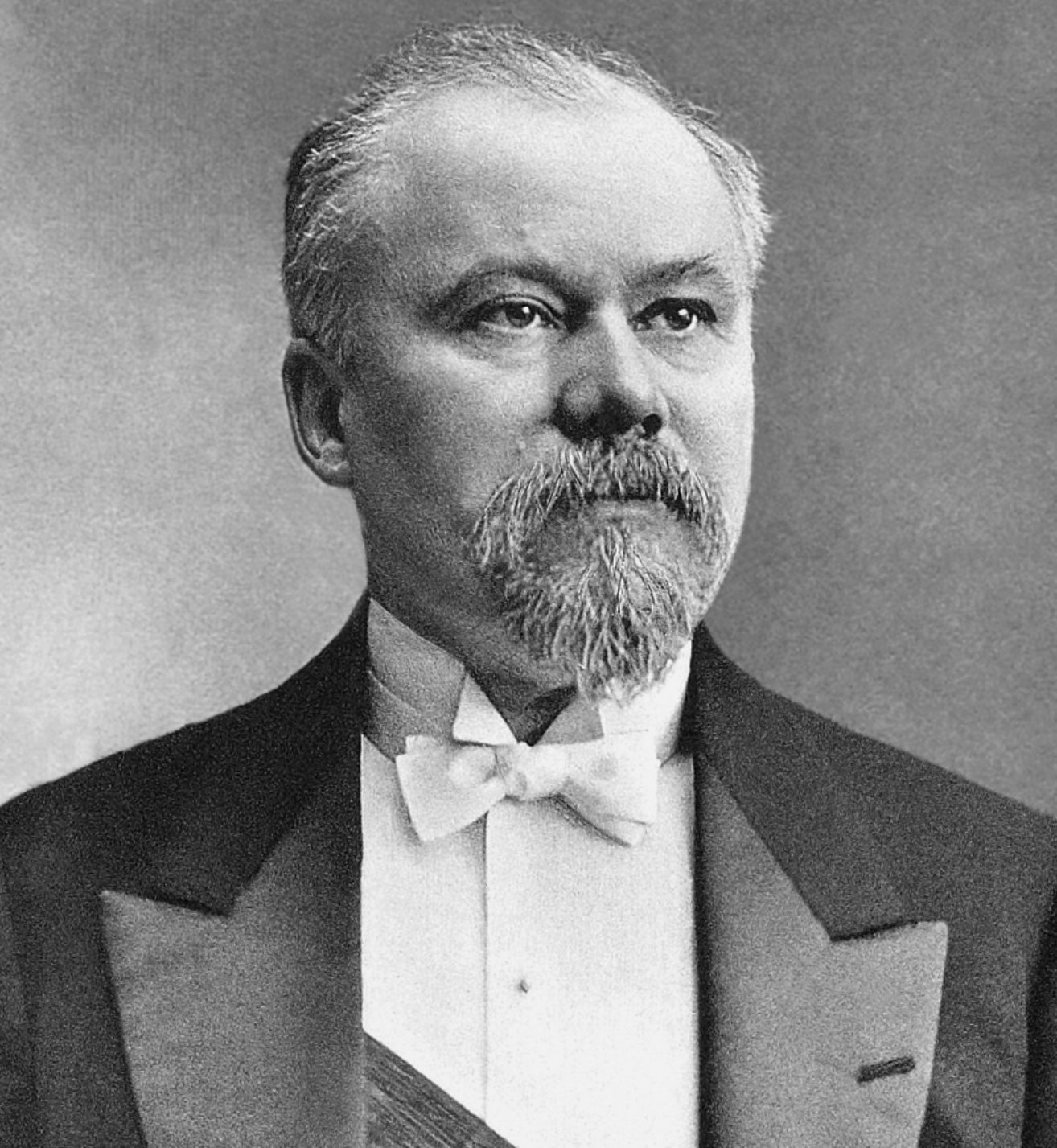
Franz Joseph ultimately approved the war against Serbia from his imperial villa in Bad Ischl. The documents were brought to the elderly ruler at his summer retreat, another item of state business fitted between the familiar rituals of his daily life. Soon afterwards, he left the place where he had spent his summers for decades and never returned.
The Austro-Hungarian ultimatum was delivered to Serbia at 6 p.m. on 23 July, with a deadline of just 48 hours. The timing was carefully chosen to coincide with French President Raymond Poincaré’s return journey from Russia, making it more difficult for Paris and St Petersburg to coordinate their response. Its ten demands included a crackdown on propaganda against the Monarchy and the dissolution of the Narodna Odbrana organisation. The most controversial provisions called for Austro-Hungarian representatives to operate on Serbian territory and participate in the investigation.
The ultimatum was not written as an invitation to negotiate. Baron Wladimir Giesl, the Austro-Hungarian envoy in Belgrade, had been instructed to sever diplomatic relations regardless of how Serbia responded. The objective, therefore, was not to secure acceptance, but to produce a rejection that could then be presented as justification for war. In short, Vienna regarded a diplomatic victory as almost useless. What it wanted was a military solution.
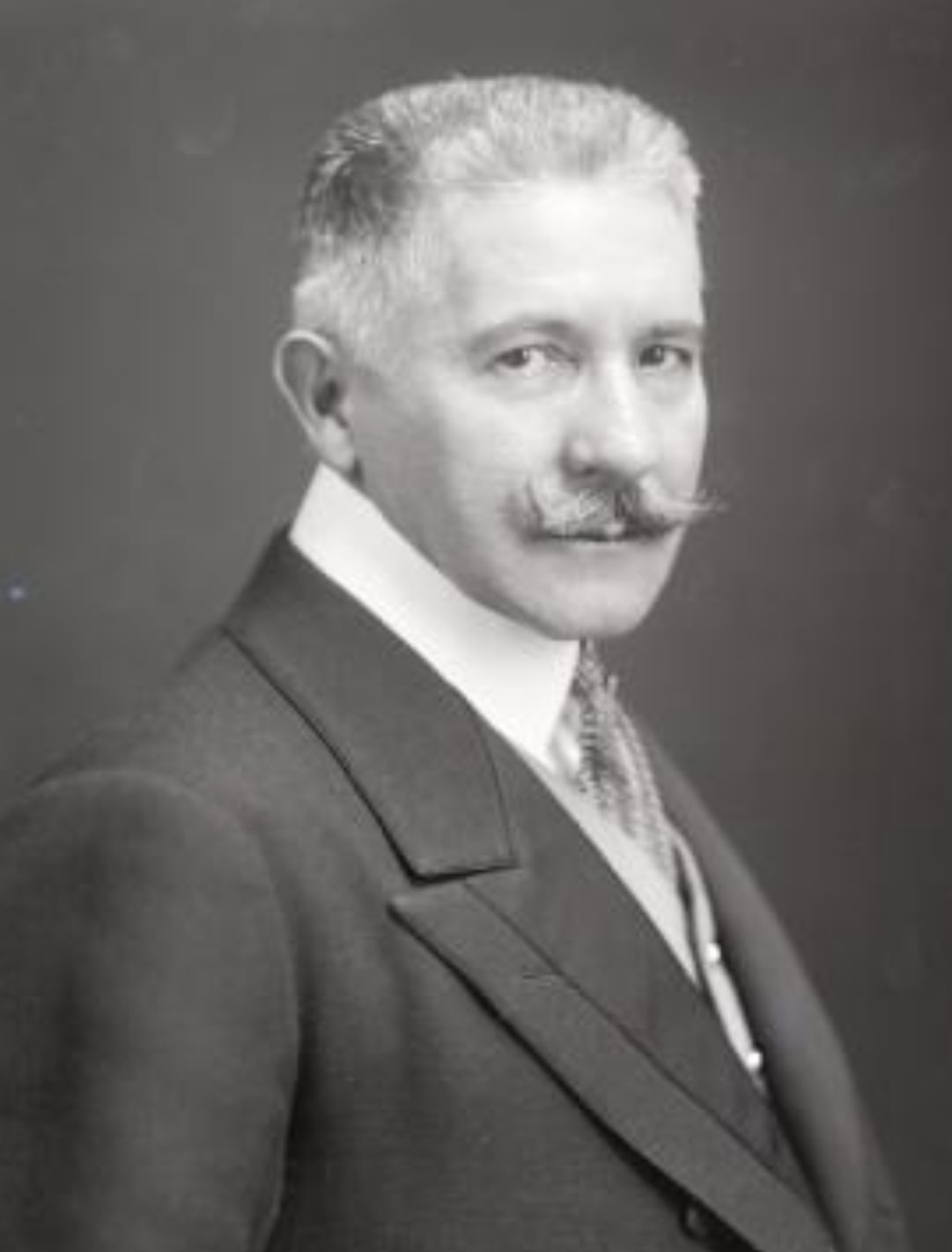
Serbia’s answer nevertheless astonished Europe. It accepted almost every demand. Belgrade agreed to make arrests and take action against organisations connected to the assassination, but placed limits on provisions that infringed upon Serbian sovereignty. It proposed international arbitration for the remaining dispute. Giesl, as already noted, had no authority to seek a compromise. He soon left Belgrade.
When Wilhelm II read the Serbian response, he concluded that the grounds for war had effectively disappeared. British Foreign Secretary Edward Grey likewise believed that the reply had opened the way for an international conference. It was one of the final exits from the road to catastrophe—and it was not missed by accident, but deliberately passed.
On 28 July, the declaration of war was sent to Pašić in Niš through the regular telegraph system via Bucharest. It was an open, unencrypted message. The procedure was so unusual that the Serbian prime minister had to ask the Romanian government to confirm its authenticity. The telegram itself referred only to Austria-Hungary and Serbia. It did not mention Russia, Germany, France or Britain. In the grammar of the document, the war was still a local affair. Geography and military planning already said otherwise.
During the night of 28–29 July, the Austro-Hungarian river monitor Bodrog—a small, heavily armed, shallow-draught warship designed for operations on rivers and lakes—opened fire on Belgrade. Russia was already expanding its mobilisation measures. Tsar Nicholas II and Wilhelm II then exchanged urgent telegrams in English, signing them with their childhood nicknames, "Nicky" and "Willy". The scene was almost surreal: two royal cousins attempting to slow the crisis through personal messages while their general staffs moved millions of men towards the frontiers.
Mobilisation did not formally mean war, but in 1914 it was a threat no adversary could calmly ignore. Military plans depended on precise railway timetables, the calling up of reservists and the movement of enormous quantities of equipment. Mobilisation could be stopped, but every government feared that doing so would cost it days that the enemy would not give back.
Russia ordered general mobilisation on 30 July, prompting Germany’s next moves. Germany declared war on Russia on 1 August and on France two days later. By invading neutral Belgium on 4 August, Germany brought Britain into the conflict. In less than a week, Vienna’s "local war" had become a European war—and would soon become a world war.
Austria-Hungary consciously chose to provoke a military confrontation with Serbia, and Germany made it possible for Vienna to accept that risk. Russia then chose mobilisation. France reaffirmed its support for its Russian ally, while British ambiguity left Berlin hoping that London would remain on the sidelines.
Responsibility was not evenly distributed, but neither did the alliances operate automatically. At every exit stood people who decided that compromise was more dangerous than war. In Vienna and Berlin, some politicians did not merely accept war as a possibility; they considered it preferable to yet another diplomatic settlement.
Europe’s leaders were later described as sleepwalkers. It would be more accurate to call them gamblers. They did not know what an industrial war of machine guns, heavy artillery and mass graves would look like, but they knew they were risking a major conflict. They believed it would be short, that the enemy would back down or that the existing order would return to equilibrium after a limited burst of violence. History has rarely punished mistaken assumptions so swiftly or so completely.
By the end of the war, more than 16 million people were dead. Serbia, which Vienna had intended to discipline through a short punitive expedition, lost roughly one-sixth of its population. Austria-Hungary, which had launched the war to demonstrate its strength and preserve the authority of the empire, ceased to exist.
That may be the most fitting epitaph for the telegram of 28 July 1914: a great power resorted to war to prove that it could not be ignored, and ended by disappearing from the map.
Sources
- Iwm.org.uk The outbreak of the First World War in 1914 https://www.iwm.org.uk/history/first-world-war/outbreak
- Unesco.org Telegram of Austria-Hungary`s declaration of war on Serbia on 28th https://www.unesco.org/en/memory-world/telegram-austria-hungarys-declaration-war-serbia-28th-july-1914
- Open.edu The July Crisis: A chronology https://www.open.edu/openlearn/history-the-arts/history/world-history/the-july-crisis-chronology
- Blog.oup.com The month that changed the world: Tuesday, 28 July 1914 https://blog.oup.com/2014/07/28-july-1914-austria-declares-war-on-serbia/
- Encyclopedia.1914-1918-online.net July Crisis 1914 / 1.1 / handbook - 1914-1918-Online (WW1) Encyclopedia https://encyclopedia.1914-1918-online.net/article/july-crisis-1914-1-1/
- Ww1.habsburger.net The declaration of war https://ww1.habsburger.net/en/chapters/declaration-war
Comments