
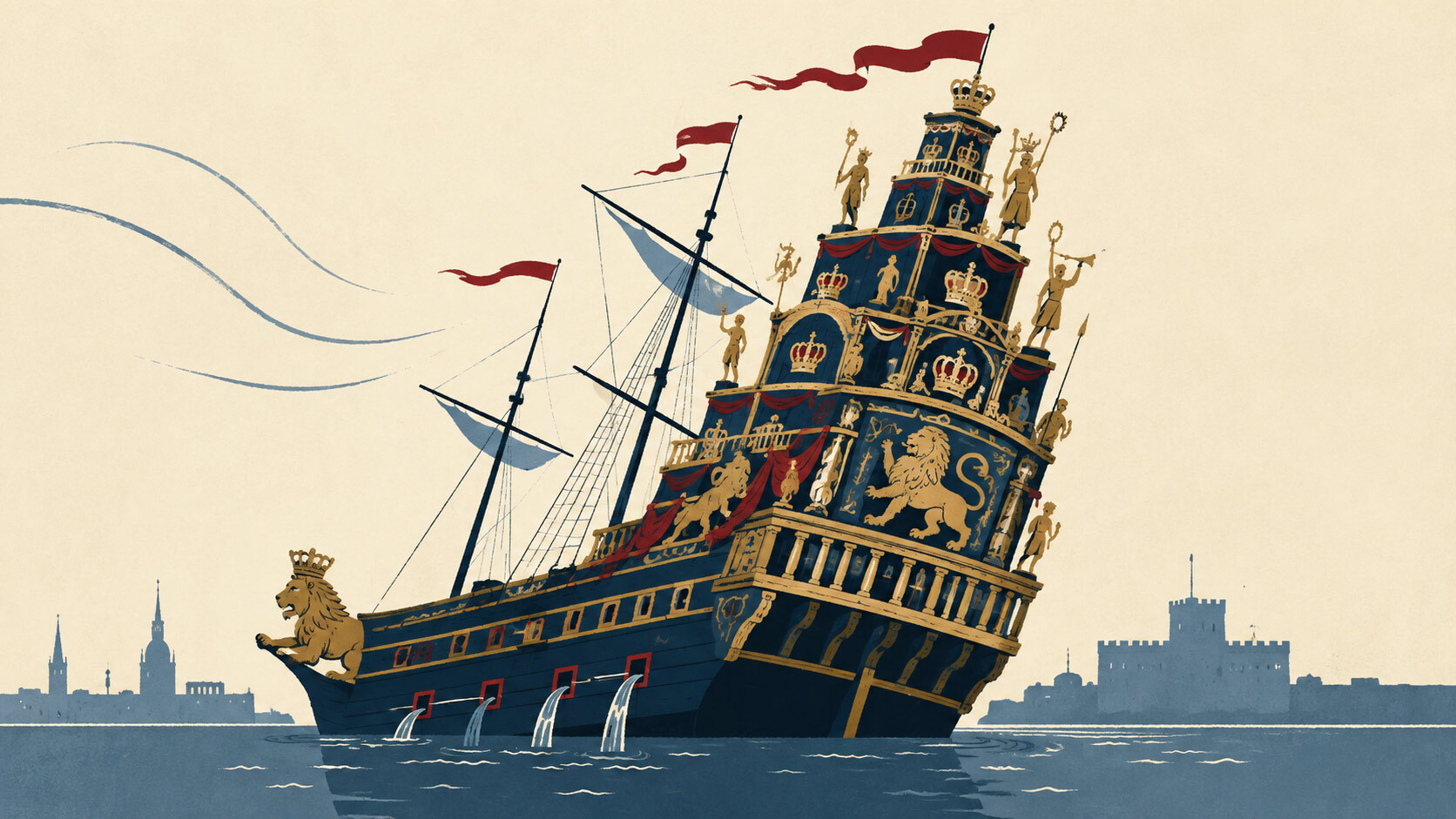
A state can order cannon, gilding and a ceremonial salute, but—as all of history will attest—it cannot lower a ship’s center of gravity by royal decree. On August 10, 1628, a gust of wind in Stockholm harbor did what no admiral had dared to do: it conducted an independent audit of the most ambitious symbol of Swedish power. The warship Vasa heeled over, took on water through its open gunports and sank before the eyes of citizens, sailors’ families and foreign diplomats who had come to witness Sweden’s future.
The disaster lasted only a few minutes, but it was not really a surprise. Several weeks before the ship sailed, thirty men had been ordered to run from one side of the deck to the other to test its stability. Vasa began rocking so violently that the test had to be stopped. In other words, the ship had failed its most important test in front of witnesses. Yet it sailed anyway. And that is where the more interesting story begins—not the story of a bad ship, but of a state.
Sweden in the 1620s was not the later Nordic country of cautious institutions and discreet foreign policy—though after its headlong rush into NATO, perhaps it is no longer quite that country either. It was a small, intensely militarized power trying to force its way into the ranks of Europe’s great empires. Gustavus Adolphus, king of Sweden and one of the most important military reformers of the seventeenth century, inherited wars against Denmark, Russia and the Polish-Lithuanian Commonwealth. He spent no fewer than 18 of his 21 years on the throne at war. At the same time, he built a bureaucracy designed to extract more soldiers, money and weapons from a country with a relatively small population. The sea was not the edge of his kingdom. It was the road to the battlefields of Poland, the Baltic and Germany.
In January 1625, the king signed a contract with Henrik Hybertsson, a Dutch master shipwright, and his business partner Arendt de Groote. They were to build four ships, including Vasa. When completed, the vessel was around 69 meters long and stood more than 50 meters from keel to the top of the mainmast. It weighed more than 1,200 tons. It carried 64 guns, including 48 bronze 24-pounders—cannon that fired iron balls weighing a little over ten kilograms each. A single broadside could throw roughly 250 kilograms of shot at the enemy, about four times the firepower of a typical Swedish warship of the period.
This was not simply a “bigger ship.” It was an attempt to skip an entire technological generation.
Gustavus Adolphus believed that naval warfare of the future would be decided by artillery, while many of his officers still thought in terms of closing with the enemy and boarding his ship with soldiers. Vasa was expected to satisfy both doctrines. It had to carry enormous firepower, high fighting decks and hundreds of troops. A single wooden hull was being asked to serve simultaneously as a floating fortress, a fast artillery platform and a stage for royal authority.
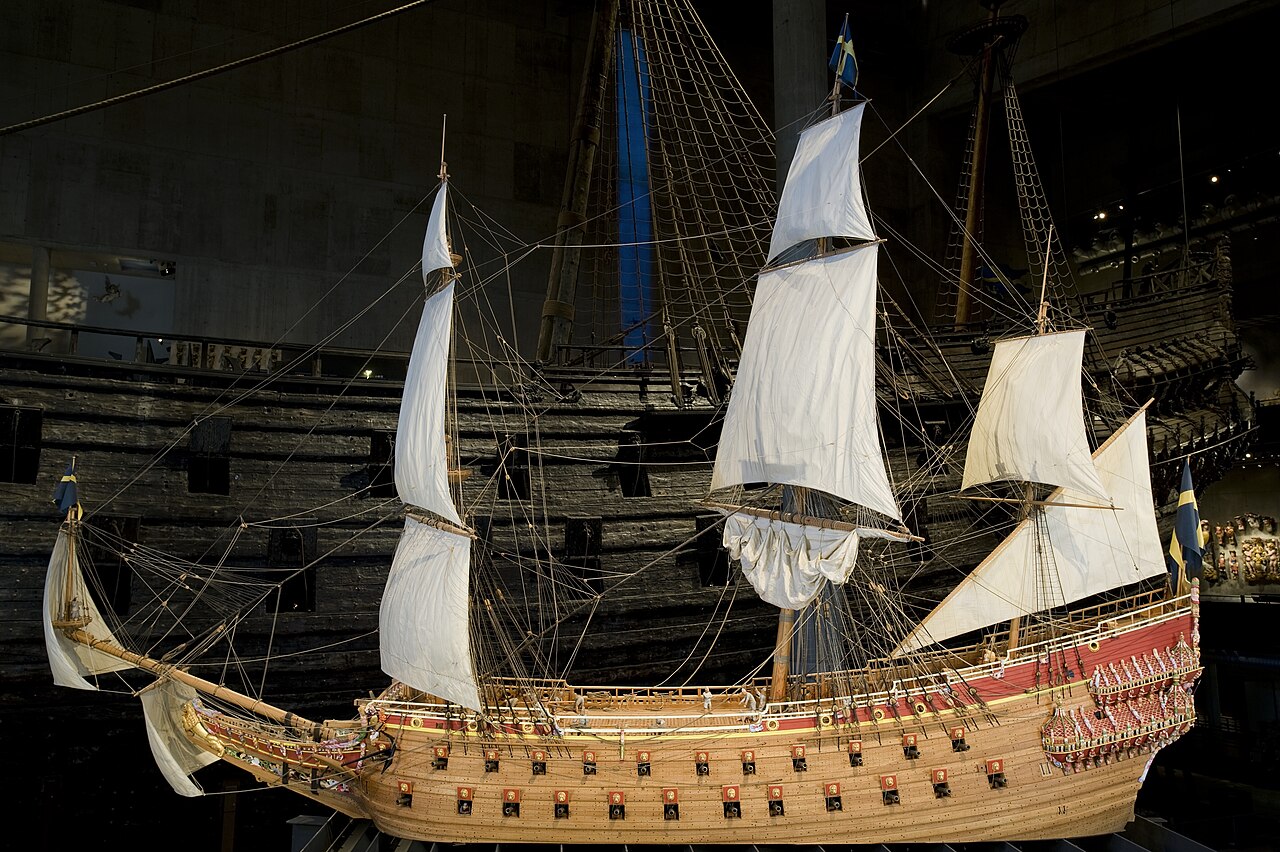
The problem was that shipbuilders still lacked the mathematical methods needed to calculate in advance the stability of a vessel this large. They built by experience, proportion and the rules of their craft. Hybertsson, meanwhile, became seriously ill during construction and died in 1627. Work was continued by his assistant Hein Jakobsson and Hybertsson’s widow, Margareta Nilsdotter, who took over management of the contract. Swedes, Finns, Dutchmen and Germans all worked together in the shipyard. They even used different systems of measurement, which helps explain why the surviving hull is visibly asymmetrical (!).
It would be tempting to explain the disaster with a single mad order from the king or a few unnecessary statues. But that is not the whole story. Yes, the fundamental problem was one of proportion. The upper structure was too tall and too heavy for the portion of the hull below the waterline. The center of gravity therefore remained dangerously high, and not even 120 tons of stone ballast could cure the ship’s geometry. Propaganda, then, did not literally sink Vasa. Wooden lions did not by themselves capsize a war machine weighing more than a thousand tons. But propaganda explains why a defective machine could not be stopped, even after it had become obvious that it was defective.
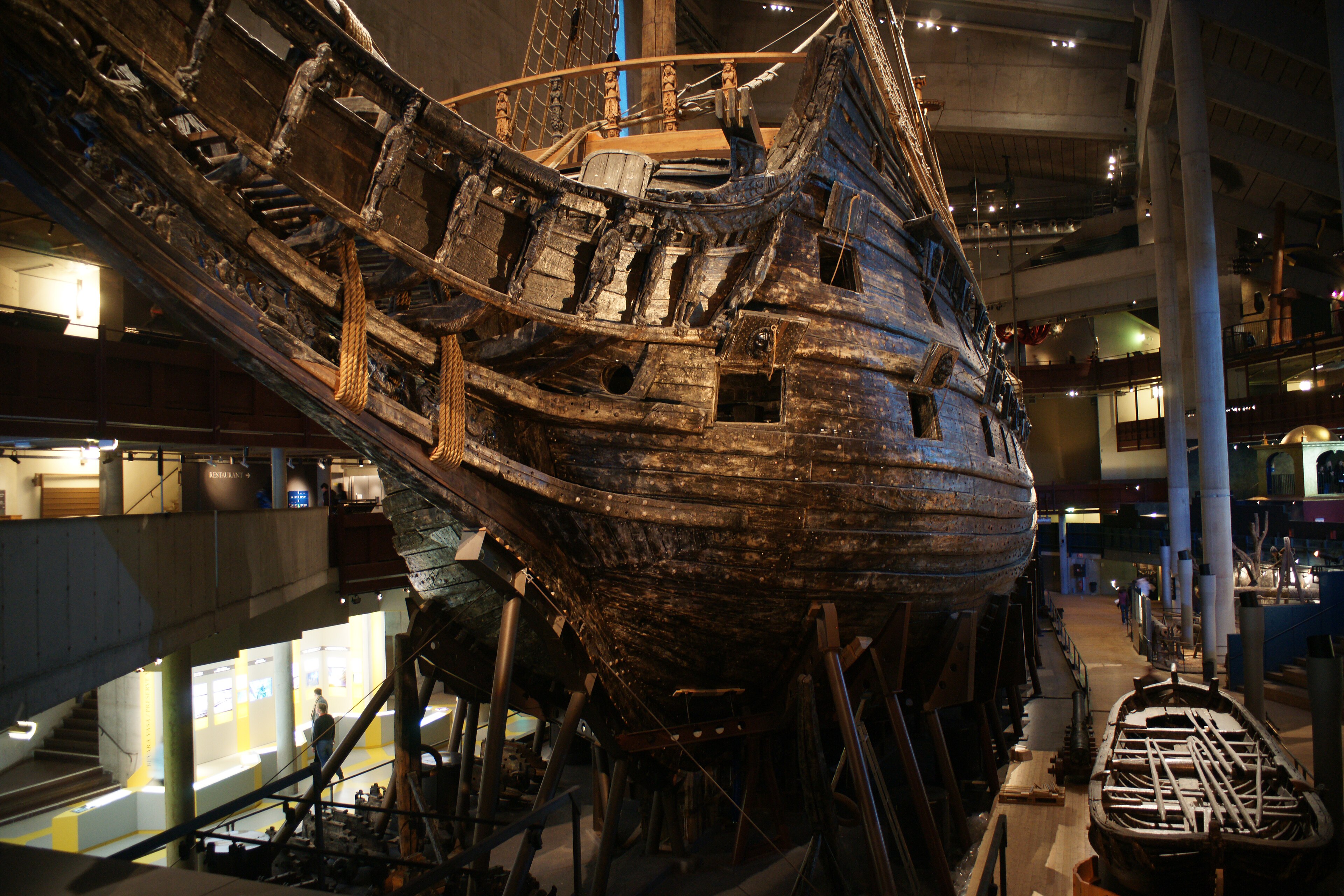
And propaganda was everywhere. Vasa carried more than 700 sculptures and ornaments (!), originally painted in vivid reds, yellows and blues and embellished with gold leaf. At the bow stood a three-meter-long lion, symbol of the Vasa dynasty and of royal courage. Behind it were Roman emperors. The stern featured the biblical Gideon and David, the mythical Hercules and, of course, a young Gustavus Adolphus spreading his arms protectively over his people. The message was not especially subtle: the king was the rightful ruler, heir to the heroes of antiquity and a man who had God on his side.
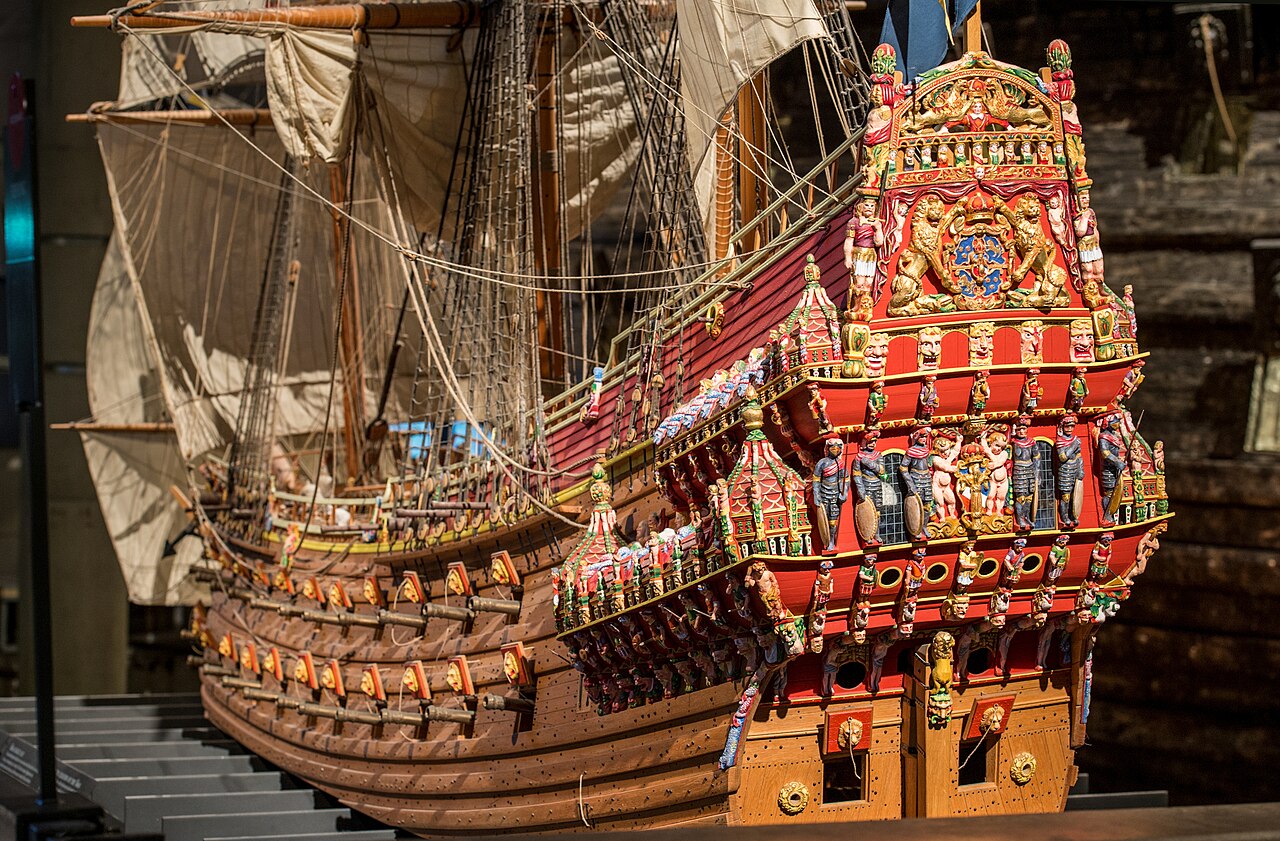
Some of the messages were, believe it or not, even more explicit. Sweden was then at war with the Polish-Lithuanian Commonwealth, so sculptures of two Polish noblemen were placed beneath the toilets at the bow. Sailors were expected to relieve themselves over the figures while the carved enemies symbolically begged for mercy. Even the ship’s sanitation system had a foreign-policy function. Vasa, needless to say, was not camouflaged. It was supposed to be impossible to miss—a gigantic floating state advertisement cruising the Baltic and informing Europe that a new power had arrived.
That is precisely why the test with the thirty men matters so much. Captain Söfring Hansson invited Klas Fleming, Sweden’s vice admiral and the king’s representative at the shipyard, to watch as the men ran back and forth across the deck. After only a few crossings, the ship rolled so violently that those present feared it might capsize while still tied to the quay. Fleming reportedly exclaimed, “If only His Majesty were at home!” The king was with the army in Prussia at the time. Yet the vice admiral did not send him a warning. He was under pressure to get the ship to war as quickly as possible.
The captain knew the ship was unstable. The admiral had seen the test. The shipbuilders had already tried to widen the hull slightly. But once Vasa had become a royal project, delay no longer looked like a sensible technical decision. It looked like disobedience, cowardice or a public admission that the state had spent enormous resources on something that might not float.
On Sunday, August 10, the crew received Communion, and some of the sailors brought their wives and children aboard. They were supposed to disembark at Vaxholm fortress before the ship continued on to join the war fleet. At around four in the afternoon, Vasa left its berth beneath the royal palace. Four of its ten sails were raised, and its cannon fired a salute. But the first gust of wind already made the ship heel before it slowly righted itself. A second gust pushed it over farther. Seawater poured through the open gunports on the lower gun deck. After sailing roughly 1,300 meters, Vasa lay at a depth of 32 meters. Its masts remained above the surface, allowing some survivors to cling to them. Around 30 people died, most of them trapped inside the ship.
What Life Aboard Vasa Would Have Been Like Had It Not Sunk
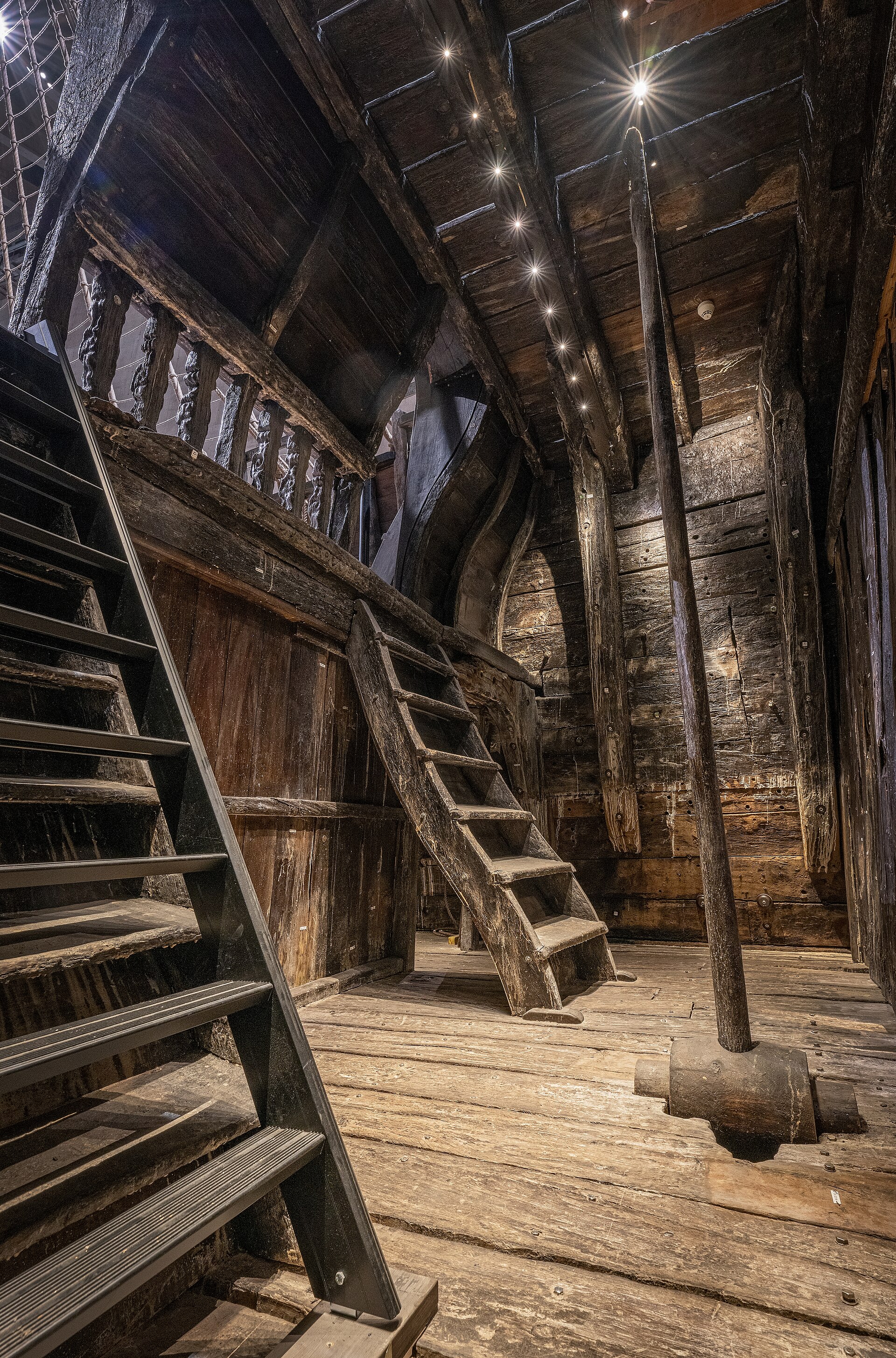
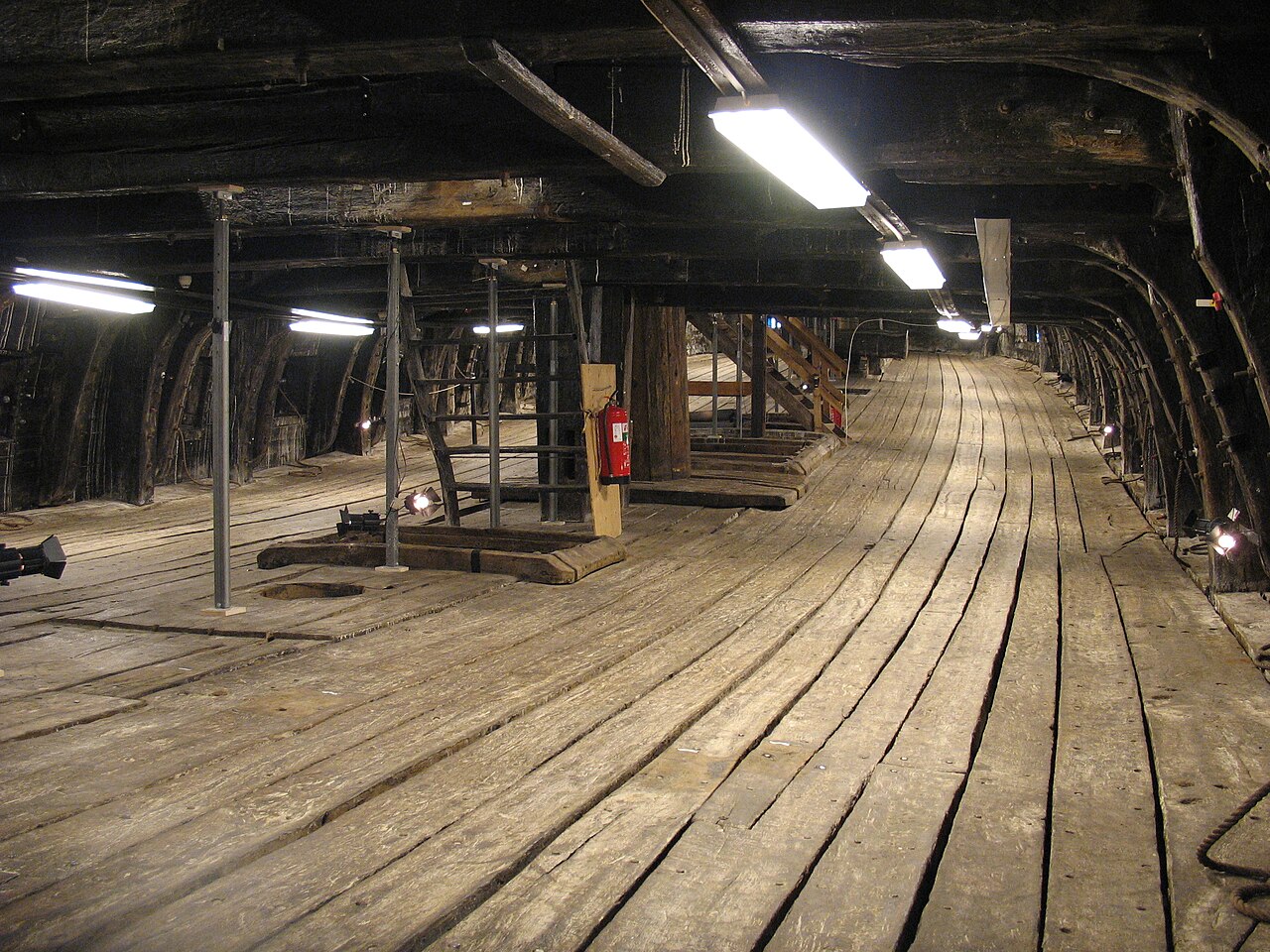
Had Vasa survived its first voyage out of Stockholm, its interior would soon have looked far less like a royal monument and far more like an overcrowded wooden barracks. According to Swedish naval plans, the ship was to carry 133 sailors and around 300 soldiers in wartime. More than 400 men would have had to sleep, eat and work together in less than 600 square meters of space. Much of their time would have been spent below deck, surrounded by cannon, ropes, chests, barrels and other human beings.The sailors were divided into two watches. They would work for four hours, rest for four, then start all over again, day and night. Free time rarely meant leisure. Clothes needed mending, shoes needed repairing, or a man simply tried to get some sleep before his next watch began. They could play games, make music or smoke tobacco, still a relatively new European fashion at the time. Because of the danger of fire, smoking was permitted only in the ship’s galley. Archaeologists even found a backgammon set, probably belonging to an officer.
From Prussia, the furious king demanded an investigation and the punishment of those responsible. The captain was arrested almost as soon as his clothes had dried. He insisted that the crew had been sober and the cannon properly secured. The testimony increasingly pointed toward the ship’s design. The builders replied that they had followed plans approved by the king. The commission of inquiry therefore found itself charged with establishing guilt—but not so high up that it might reach the Crown.
The most convenient culprit became the dead Henrik Hybertsson. He could not defend himself, he did not need to be imprisoned, and the navy could continue employing the men it still needed. In the end, nobody was punished. Indeed, almost all of the principal figures involved went on to advance in their careers. The inquiry performed its ceremonial function while leaving the system largely untouched. It was a political performance staged in the aftermath of the shipwreck of another political performance.
Vasa spent 333 years on the bottom of Stockholm harbor. It was located in 1956 and raised on April 24, 1961, before television cameras and thousands of spectators. More than 98 percent of the ship’s original structure has survived. A war machine that failed to survive even its first afternoon at sea became one of the most important sources we have for understanding seventeenth-century shipbuilding, warfare and everyday life.
Management literature later produced the term “Vasa syndrome”—a name for the combination of unclear objectives, poor communication, political interference and an organization that no longer knows how to adapt a project to its own capabilities. The irony is complete. A ship designed to prove that Sweden knew how to wage war is remembered instead as proof that no institution should ever deprive its technical experts of the right to say one simple sentence: this will not float.
Ambition itself was not the mistake. Without ambition there are no new ships, no new technologies and no great states. The mistake begins when the symbol becomes more important than the object carrying it, and obedience becomes more valuable than verification. That is why Vasa is more than a maritime disaster. It is a monument to a world in which everyone can see the problem, yet everyone waits for someone more important to admit it first.
On August 10, 1628, no one did. The wind did it for them. After all, the wind did not know who the king was.
Sources
- Tandfonline.com Vasa II: Rigging and sailing a Swedish warship of 1628, part I: The material remains and archaeological context https://www.tandfonline.com/doi/full/10.1080/00253359.2025.2485764
- Smithsonianmag.com The Bizarre Story of ‘Vasa,’ the Ship That Keeps On Giving https://www.smithsonianmag.com/smart-news/bizarre-story-vasa-ship-keeps-giving-180964328/
- Popularmechanics.com The Greatest Warship of the 1600s Lasted Just 20 Minutes. Then It Was Lost for 333 Years. https://www.popularmechanics.com/science/archaeology/a71922104/warship-lasted-20-minutes/
- Sciencedirect.com Full scale finite element modelling and analysis of the 17th-century warship Vasa: A methodological approach and preliminary results https://www.sciencedirect.com/science/article/pii/S0141029620343662
- Financial Times Lessons from a shipwreck https://www.ft.com/content/200a6c44-9b66-4af3-82eb-98acb53898e4
- Researchwith.njit.edu Vasa syndrome: Insights from a 17th-century new-product disaster https://researchwith.njit.edu/en/publications/vasa-syndrome-insights-from-a-17th-century-new-product-disaster/
- Nature.com Deterioration of the seventeenth-century warship Vasa by internal formation of sulphuric acid - Nature https://www.nature.com/articles/415893a
- Vasamuseet.se The Disaster https://www.vasamuseet.se/en/explore/vasa-history/disaster
Comments