
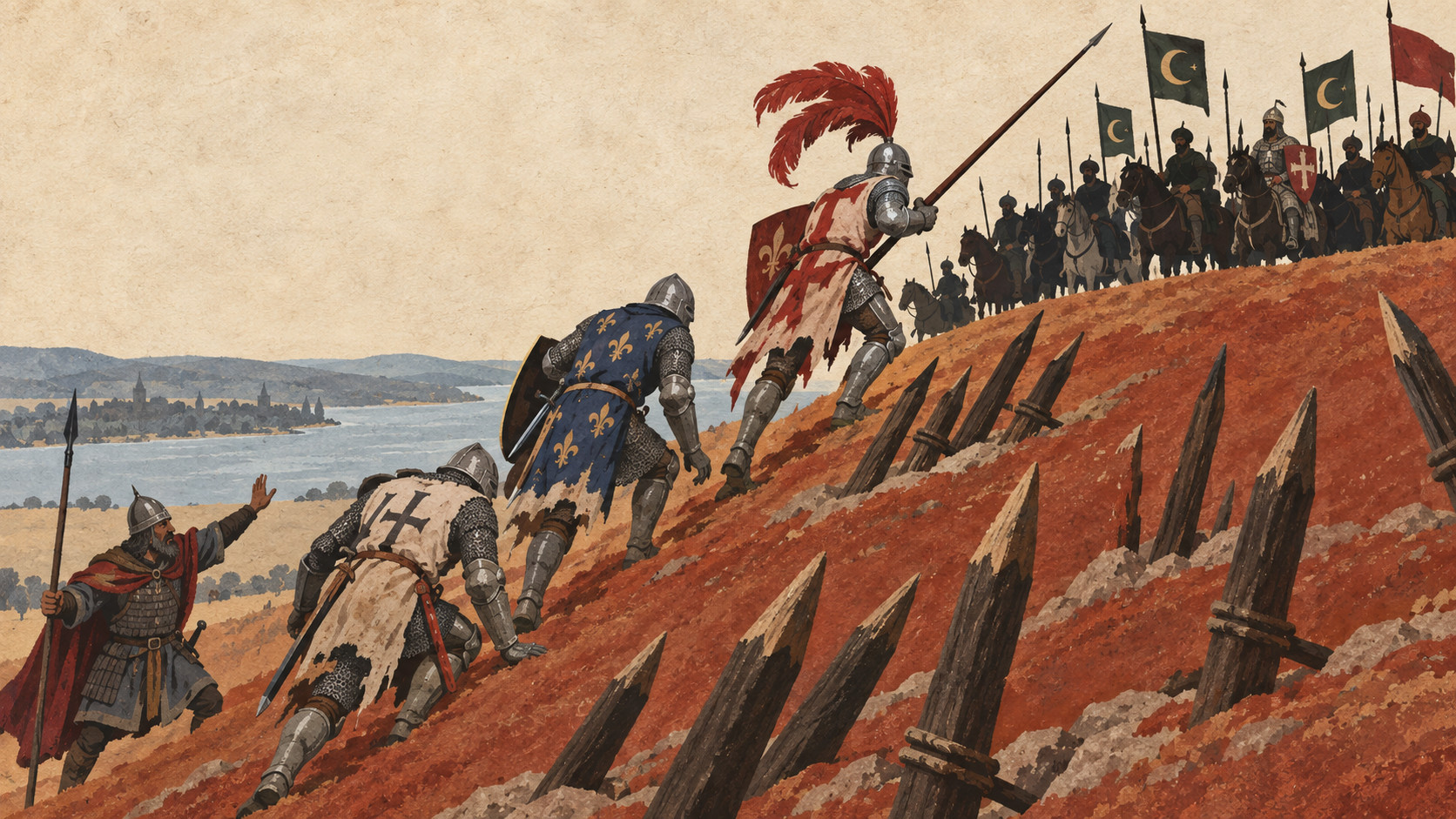
For a moment on 25 September 1396, the French and Burgundian knights may have believed they were winning. They had smashed the Ottoman vanguard, broken through an infantry position protected by stakes and climbed the slope south of Nicopolis in their heavy armour. But at the summit, they found not an open road to glory but Bayezid I’s fresh cavalry. At the decisive moment, the armoured Serbs of Prince Stefan Lazarević also entered the battle – Orthodox Christians helping a Muslim sultan destroy a crusading army.
That single scene contains the entire paradox of Nicopolis. The battle was not merely a clash between Christian Europe and Islam, nor a simple tale of chivalric arrogance punished on the battlefield. It was the catastrophe of an army that possessed courage, money and illustrious family names, but no unified plan. The men who had been fighting the Ottomans for years urged caution. The knights who had arrived from France and Burgundy demanded the right to strike first because, in their world, one’s place in the battle line was also one’s place in the social hierarchy.
The Thunderbolt reaches the Danube
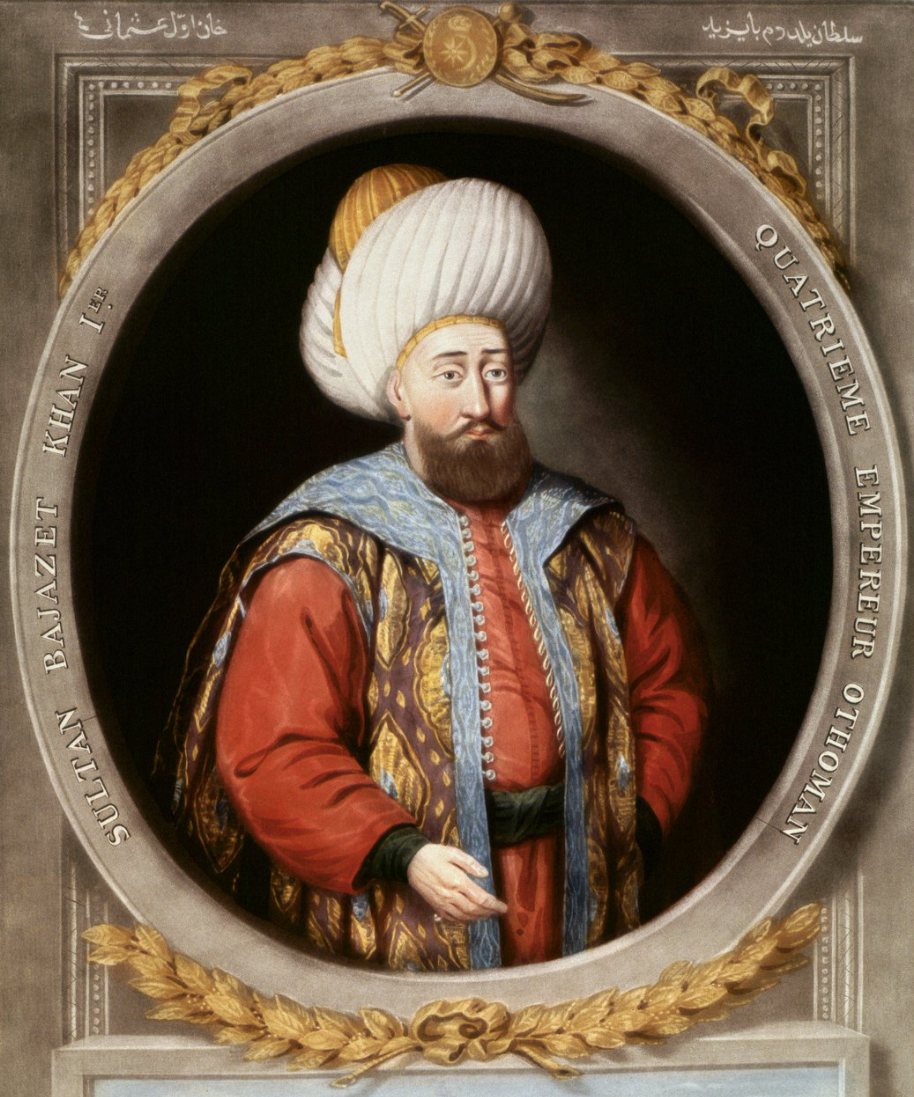
Seven years after the Battle of Kosovo, the Ottoman state was no longer a distant Asian power making occasional incursions into the Balkans. Bayezid, known as Yıldırım – the Thunderbolt, had inherited the throne from his slain father Murad I and accelerated the expansion towards the Danube. Tarnovo fell in 1393, while Constantinople came under mounting pressure. Sigismund of Luxembourg, king of Hungary and Croatia, realised that his kingdom’s frontier could no longer be defended somewhere far to the south. Pope Boniface IX proclaimed the campaign a crusade, while a temporary lull in the Hundred Years’ War allowed the great lords of the West to redirect their martial energies eastward.
A crusade launched by a divided Church
When the crusaders gathered against Bayezid in 1396, Western Christianity had already been without a single undisputed pope for almost two decades. The Western Schism had begun in 1378, and rival popes in Rome and Avignon simultaneously claimed to be the rightful head of the Catholic Church. Each regarded the other as illegitimate, while European states chose sides according to their own dynastic and political interests.Sigismund and the Kingdom of Hungary-Croatia belonged to the Roman obedience of Pope Boniface IX, who supported the crusade. France and Burgundy, from which its most celebrated Western contingent had come, recognised the Avignon pope Benedict XIII. Burgundian knights therefore went to war beneath the sign of the cross alongside men who, in the Church’s own conflict, did not recognise the same pope.
A common enemy briefly bridged the schism, but did not heal it. A papal appeal could give the campaign sacred legitimacy, but it could not create a common political authority, a unified chain of command or an agreement over whose word should prevail on the battlefield. What marched towards Nicopolis under the banner of a Christian army was therefore a coalition united in purpose, but belonging neither to one Church nor to one political system.
An alliance that looked more like a procession of armies
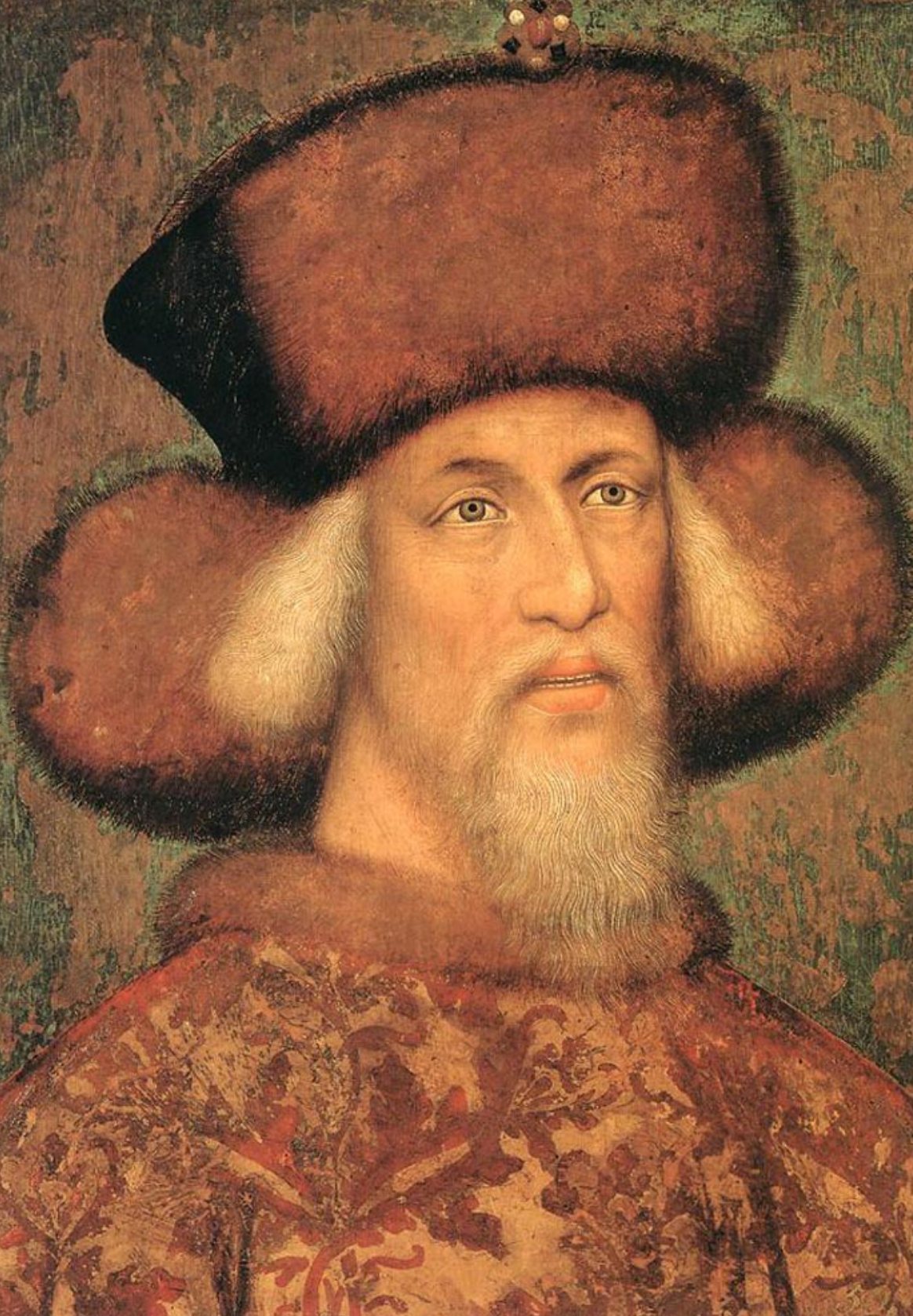
The Franco-Burgundian contingent was nominally led by the young John of Nevers, the future Burgundian duke John the Fearless. He was accompanied by some of the most celebrated knights in Europe. Sigismund was joined by Hungarian and Croatian nobles, the Wallachians of Mircea the Elder, German warriors and the Knights Hospitaller. The Venetians and Genoese provided naval support. It was an impressive alliance, but it resembled several armies travelling in the same direction more than a single force under one command.
At first, the advance down the Danube appeared successful. Vidin opened its gates to the crusaders, while the Ottoman garrison at Rahova was overcome. Surrender was followed by looting and the murder of prisoners, despite promises that their lives would be spared. After the battle, this atrocity would be invoked to justify a far greater massacre. When the crusaders reached Nicopolis, they lacked the heavy siege equipment needed to take the fortress quickly. Yet they behaved as though time were on their side. Bayezid responded with a ferocious march towards the Danube. This time, the name Thunderbolt was more than a courtly compliment.
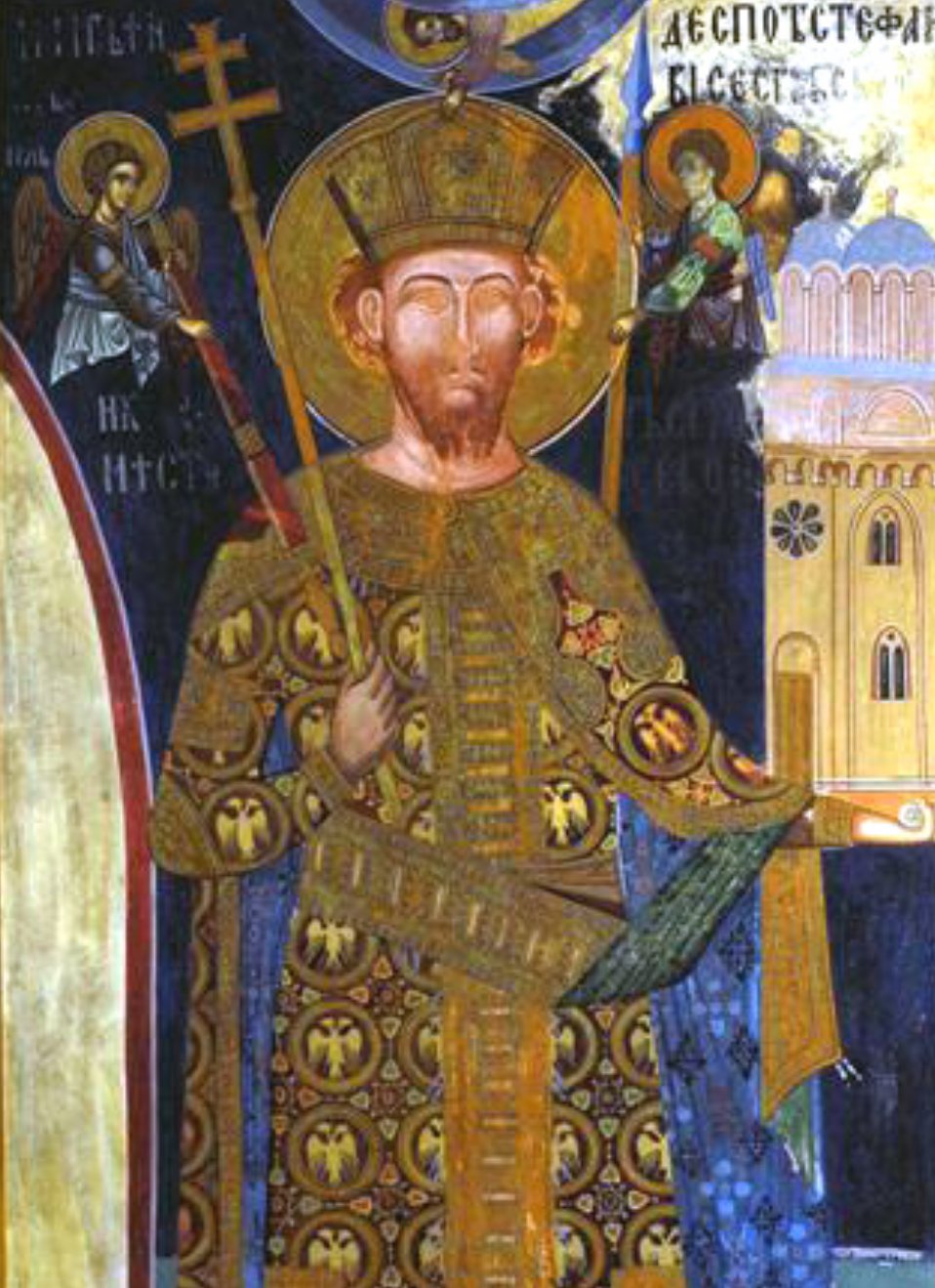
Nor was his army a single, monolithic Muslim force. It included Anatolian and Balkan contingents, archers, infantry and several kinds of cavalry. Among Bayezid’s vassals was Prince Stefan Lazarević, son of Prince Lazar, who had died at Kosovo. Stefan’s sister Olivera was married to Bayezid, while Moravian Serbia paid tribute and supplied troops in exchange for retaining limited autonomy. To modern eyes shaped by nationalism, this may look like treason. In the political world of the 14th century, it was survival. Faith determined the language of war, but it did not always determine which side a Christian ruler would fight for.
Nicopolis – the wider historical context
Modern-day Nicopolis, or Nikopol in Bulgarian, is a small town in northern Bulgaria on the high southern bank of the Danube. It stands opposite the Romanian town of Turnu Măgurele, several kilometres downstream from the mouth of the Osam River. It should not be confused with the ancient city of Nicopolis ad Istrum near Veliko Tarnovo. Medieval Nicopolis was a fortified town with a citadel overlooking the river, not merely an isolated fortress. From its heights, it was possible to control traffic along the Danube, the crossings into Wallachia and the routes leading from the river basin into the Bulgarian interior. The remains of the Nicopolis fortifications are now listed as a Bulgarian cultural monument of national importance.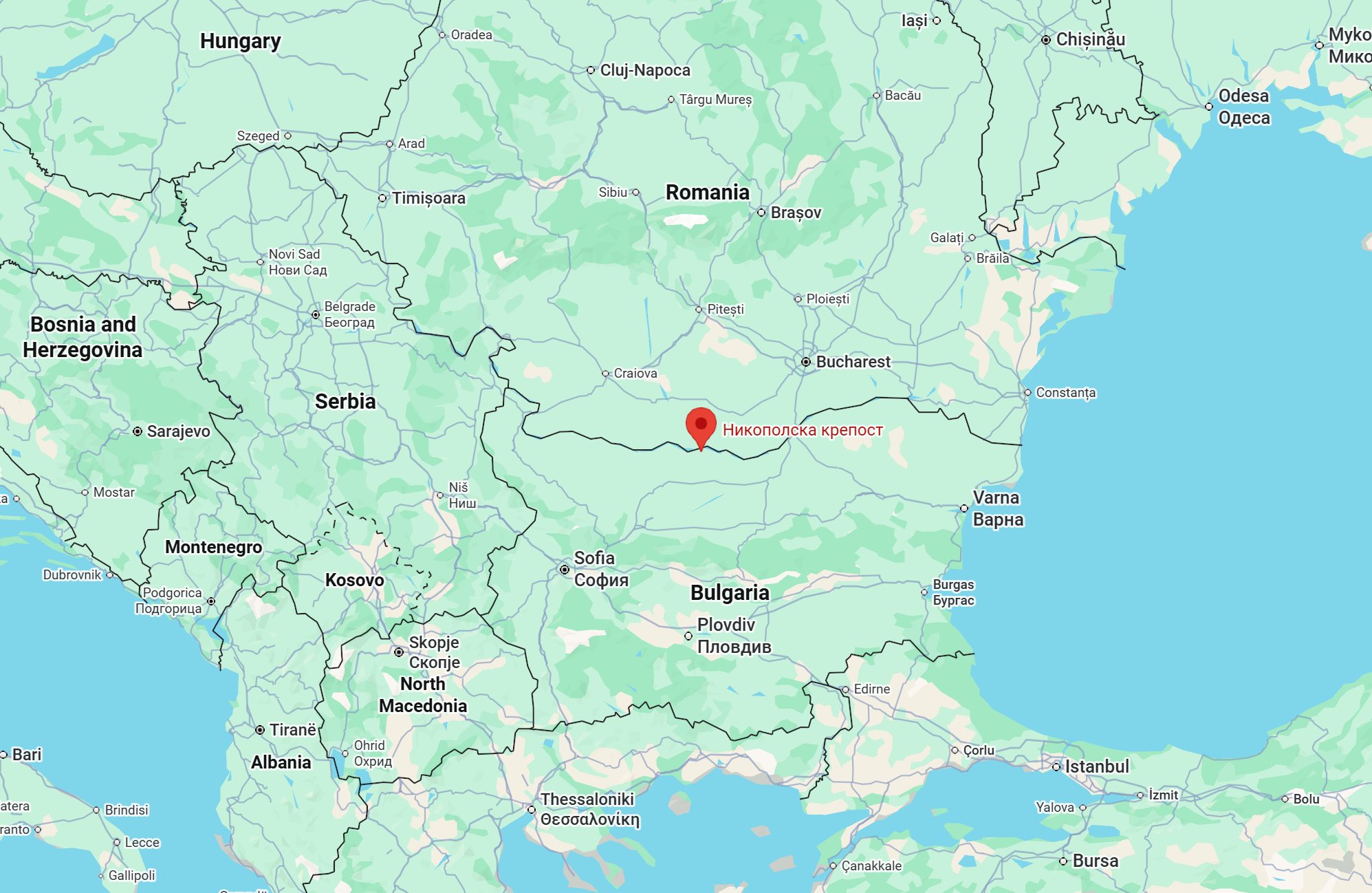
The region’s political map was far more complex than it is today. Bulgaria was no longer a unified kingdom. The Tarnovo Tsardom had been crushed, while Ivan Sratsimir still ruled in Vidin, though as an Ottoman vassal. North of the Danube, Wallachia under Mircea the Elder was struggling to remain independent and therefore fought alongside Sigismund. The Byzantine Empire still existed, but barely extended beyond the walls of Constantinople. Between these territories lay smaller principalities, noble estates and vassal domains whose rulers frequently changed allegiances simply to survive.
Nor had Serbia been completely conquered and turned into an Ottoman province by 1396. The Serbian state did not vanish after the Battle of Kosovo in 1389, but its position became extremely precarious. Prince Lazar was dead, his son Stefan Lazarević was still young, and various Serbian nobles controlled territories of their own. Stefan’s mother Milica accepted Bayezid’s supremacy to preserve the family’s realm. This meant paying tribute, obeying the sultan politically and supplying troops when summoned. Stefan’s sister Olivera was married to Bayezid, sealing the vassal relationship with a dynastic marriage.
Stefan therefore fought for the Ottomans at Nicopolis, but he was neither an Ottoman governor nor the ruler of a land that had already become an ordinary imperial province. He retained his own administration, nobility, Church and army, but paid for that autonomy through service to the sultan. He had already joined Bayezid’s campaign against the Wallachian voivode Mircea in 1395, and a year later he was required to march to Nicopolis. Such an arrangement may appear contradictory today, but a medieval vassal did not choose between complete freedom and outright occupation. Often, the real choice was between limited submission and the extinction of his state. Only after Bayezid’s defeat at Ankara in 1402 would Serbia have an opportunity to change sides and draw closer to Sigismund.
Croatia, meanwhile, was linked to Hungary through a common king. The Croatian and Hungarian crowns had been joined in a personal union since 1102. This did not mean that Croatia was simply a Hungarian province. It retained its royal title, its ban, its nobility and its political institutions, but shared a ruler and foreign policy with Hungary. Sigismund of Luxembourg was therefore both king of Hungary and king of Croatia and Dalmatia. When sources refer to his "Hungarian army," it may also have included Croatian and Slavonian nobles with their own retainers, although medieval chronicles did not classify them neatly according to modern national categories.
Nicopolis thus stood at the point where two complex networks collided. On one side were Western knights, the Kingdom of Hungary-Croatia, Wallachia and the maritime republics. On the other was an Ottoman army composed of the sultan’s own forces and his Balkan vassals, including the Serbs. The town and its fortress were not merely the backdrop to a catastrophe. They formed one of the crucial locks on the Danube – the very point at which the crusaders’ road south collided with an already established Ottoman system of power.
Vanity written into the battle plan
According to the account of Johann Schiltberger, a Bavarian page who joined the campaign and ended up in captivity, Mircea the Elder and Sigismund wanted the Balkan contingents familiar with Ottoman tactics to advance first. The Franco-Burgundian commanders refused to surrender the honour of leading the vanguard. The exact conversation cannot be reconstructed, and medieval chroniclers were fond of turning defeat into moral drama. Yet the dispute over command was real. Indeed, even before the campaign, Philip the Bold, Duke of Burgundy, had instructed his son to demand a place in the vanguard. Vanity did not emerge only on the eve of battle – it had been written into the plan.
The Western knights’ charge was neither cowardly nor militarily worthless. It was terrifyingly effective, but only during its first phase. The crusaders drove back the light cavalry and broke through part of the Ottoman infantry line. They then lost their horses at the field defences, stretched their formation and exhausted themselves climbing uphill. When they crossed the ridge, they encountered Bayezid’s reserves. Their initial success had carried them precisely where the sultan wanted them.
Sigismund’s forces still attempted to save the battle, but by then there was no longer a common formation to preserve. Ottoman cavalry struck the exhausted knights, while Stefan Lazarević and his Serbs attacked the king’s section of the army. Schiltberger claims that Sigismund’s standard was brought down, after which the retreat became a rout. The king fought his way to the Danube and boarded a ship. He was forced to return home by the long route through Constantinople and the Adriatic. Many of his soldiers never even reached the river.
Ransom for the nobles, death for the common soldiers
The following day, Bayezid ordered the mass execution of prisoners. The number killed is unknown – chroniclers’ claims of tens of thousands are not credible – but at least several hundred men probably died. The sultan’s fury was fuelled both by his own losses and by the crusaders’ earlier massacre at Rahova. The most distinguished nobles were spared because they were worth more alive. The medieval social hierarchy thus reasserted itself in the most cynical possible way: ordinary prisoners became corpses or slaves, while the great lords became ransom bills. The sixteen-year-old Schiltberger escaped execution, then spent more than three decades in captivity and travelling through the Ottoman and Timurid worlds.
After his victory, Bayezid captured Vidin and took its ruler Ivan Sratsimir prisoner, extinguishing the last remnant of independent medieval Bulgarian rule. The Ottoman position on the lower Danube was secured, while Constantinople remained under pressure. Yet Nicopolis was not the final crusading attempt. Varna would follow in 1444, while Bayezid himself would be defeated and captured by Timur at Ankara in 1402. History had not yet been decided. What vanished was merely the illusion that a single great chivalric charge could reverse decades of political change in the Balkans.
From Nicopolis to the Bloody Sabor
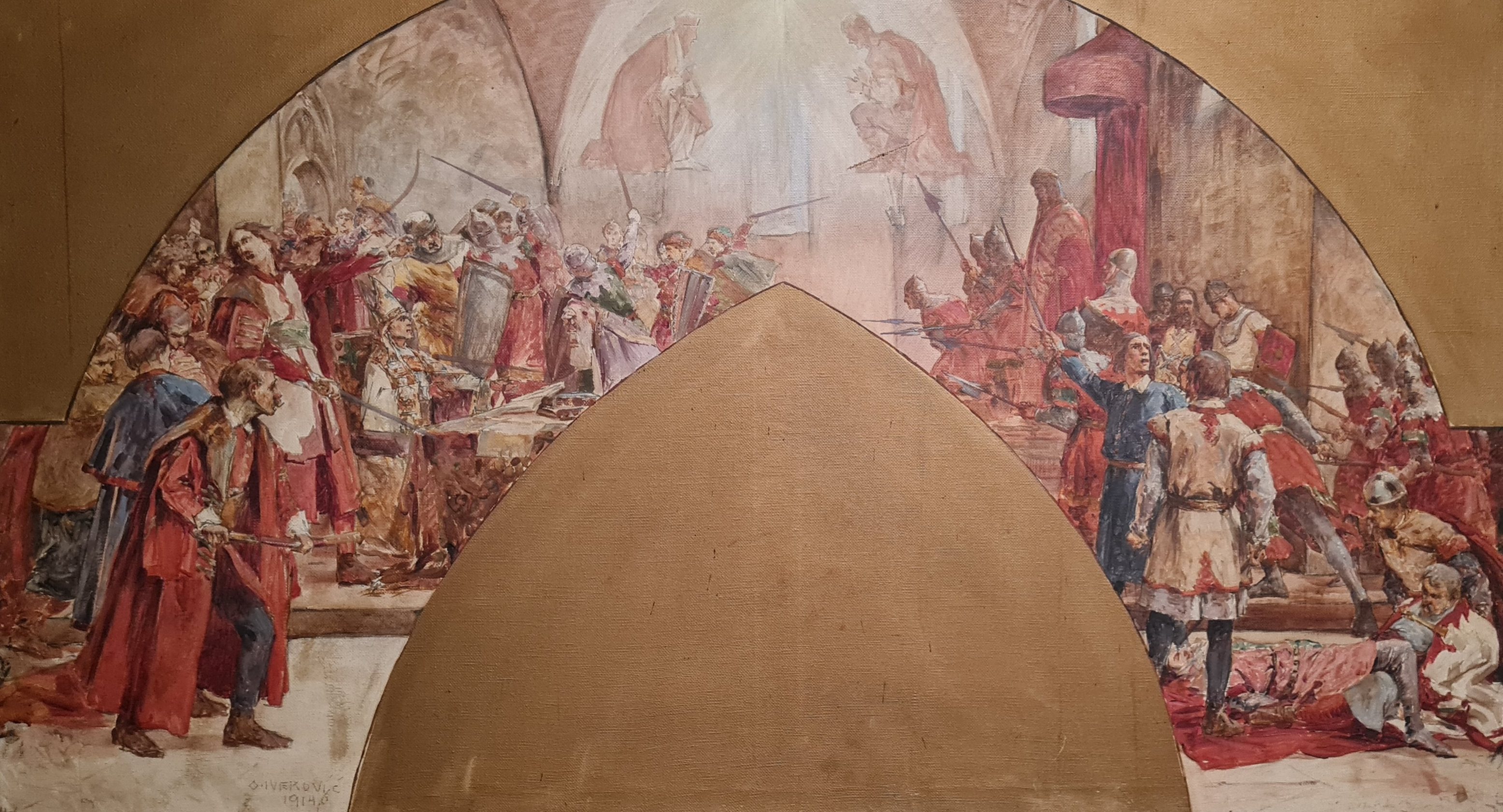
Among the nobles who survived Nicopolis was Stephen II Lackfi, a former ban of Croatia and Dalmatia, voivode of Transylvania and palatine of Hungary. While it remained uncertain whether Sigismund had even survived the defeat, Lackfi attempted to place the king’s rival, Ladislaus of Naples, on the throne. Ladislaus appointed him as his deputy in Hungary and Croatia. The military catastrophe thus almost immediately became a crisis of royal authority.When Sigismund returned, Lackfi attended an assembly at Križevci on 27 February 1397 to seek reconciliation, relying on the king’s guarantee of safe conduct. The discussion turned into a violent reckoning. Among the accusations levelled against Lackfi was the claim that he had abandoned the king at Nicopolis and contributed to the defeat. Sigismund’s supporters killed Lackfi, his nephew and several members of their retinue in the king’s presence.
A catastrophe in the West, merely another Ottoman victory
Historians Hilmi Kaçar and Jan Dumolyn have noted another curious disparity. In Burgundian chronicles, Nicopolis became a profound trauma and an inexhaustible moral lesson, while Ottoman writers devoted comparatively little attention to it. For the West, it was a catastrophe that had to be explained. For the Ottomans, it was merely a victory soon to be overshadowed by the far more devastating defeat at Ankara.
The most enduring lesson of Nicopolis is therefore not that the Western knights were incompetent. On the contrary, they were exceptionally brave. The problem was that they treated courage as a substitute for knowledge, discipline and a willingness to listen. They came to save a region they did not adequately understand, only to be defeated by an army whose very composition contradicted their simplistic view of the world. Europe did not lack heroes that day. It lacked a common plan.
Sources
- World History Encyclopedia Battle of Nicopolis https://www.worldhistory.org/Battle_of_Nicopolis/
- De Re Militari - The Society for Medieval Military History The Battle of Nicopolis (1396), according to Johann Schiltberger https://deremilitari.org/2025/01/the-battle-of-nicopolis-1396-according-to-johann-schiltberger/
- Ghent University Academic Bibliography The Battle of Nicopolis (1396), Burgundian Catastrophe and Ottoman fait divers https://biblio.ugent.be/publication/4148223
- Project Gutenberg The Bondage and Travels of Johann Schiltberger https://www.gutenberg.org/files/52569/52569-h/52569-h.htm
- New Advent - Catholic Encyclopedia Western Schism https://www.newadvent.org/cathen/13539a.htm
- Medievalists.net The Lack of a Western European Military Response to the Ottoman Invasions of Eastern Europe from Nicopolis (1396) to Mohacs (1526) https://www.medievalists.net/2017/05/lack-western-european-military-response-ottoman-invasions-eastern-europe-nicopolis-1396-mohacs-1526/
- Medievalists.net The Battle of Nicopolis (1396), Burgundian Catastrophe and Ottoman Fait Divers https://www.medievalists.net/2017/10/battle-nicopolis-1396-burgundian-catastrophe-ottoman-fait-divers/
Comments