
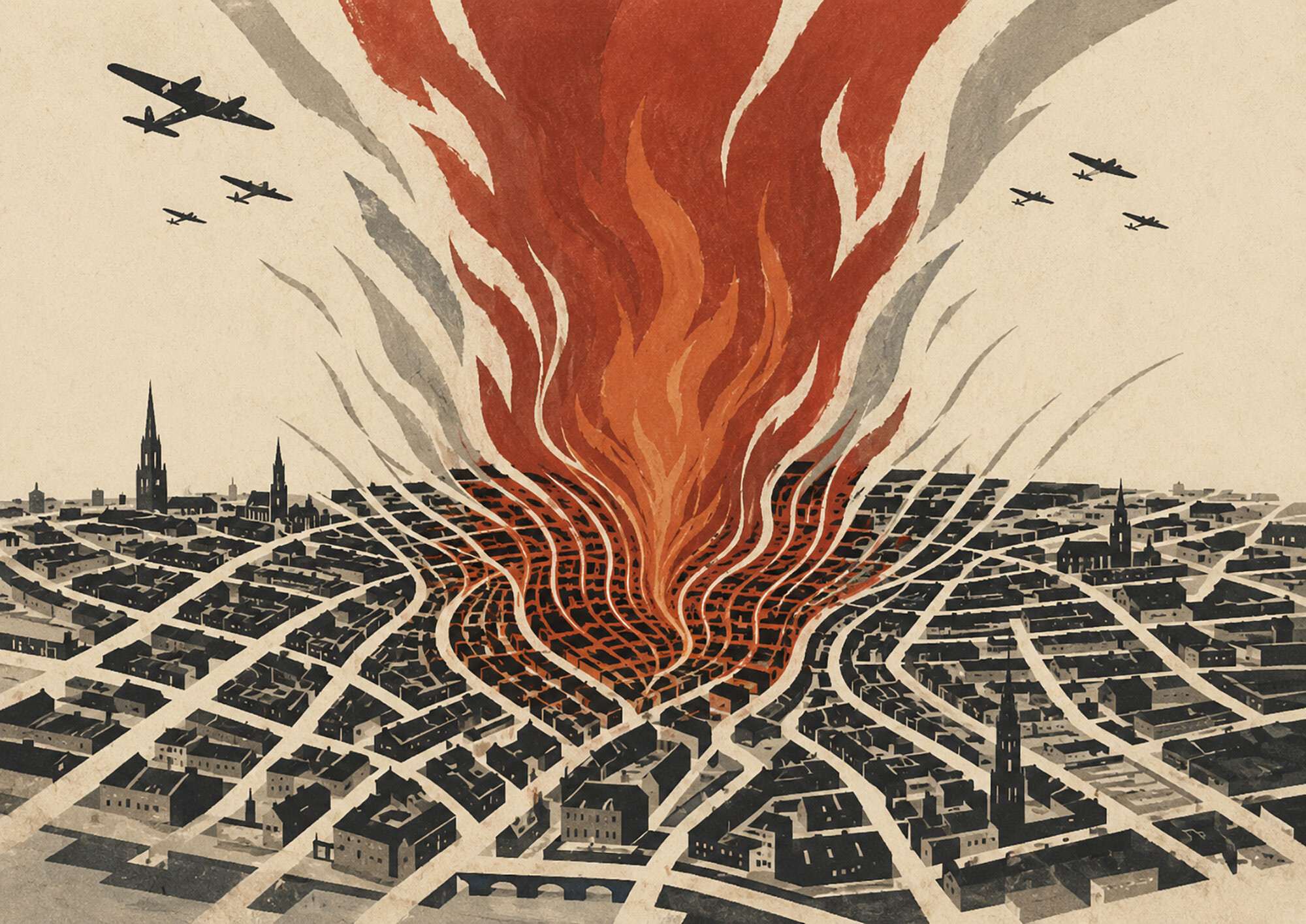
Thousands of separate fires merged into a single inferno. Superheated air rose above Hamburg’s eastern districts, drawing fresh air violently into the vacuum below. The streets became tunnels of hurricane-force wind. People fleeing the flames were knocked off their feet and, in some cases, dragged back toward them. The city had become a furnace feeding itself with oxygen.
This physics of hell reached its climax during Operation Gomorrah, the Allied bombing campaign that began on the night of July 24–25, 1943, and continued into early August. Even the codename evoked the biblical city destroyed by fire and brimstone—the moral judgment was embedded in the military designation itself.
Hamburg was no arbitrary target. It was a major port and one of the Third Reich’s most important industrial centers. U-boats were built there, factories contributed directly to the war effort, and the city’s transport links were vital to the German military. By day, the Americans attempted to strike the harbor, shipyards, and industrial facilities. By night, Britain’s Royal Air Force bombed entire urban areas, including densely populated working-class neighborhoods.
The broader context, of course, cannot be ignored. Nazi Germany had started the war in Europe, occupied much of the continent, and carried out a systematic campaign of extermination. The Allies were not fighting an ordinary rival state, but a regime that had turned war and genocide into interconnected projects of government. Yet historical responsibility is not the same as a collective death sentence. A child in a Hamburg air-raid shelter did not become a military target because Hitler had invaded Poland.
British strategy arose partly from impotence. In 1941 and 1942, night bombers flying at high altitude simply could not hit individual factory buildings with any reliability. The solution was to bomb the entire surrounding area. The targets were no longer merely factories, but workers’ homes, municipal services, and—as official doctrine put it—the "morale of the enemy civilian population." Sir Arthur Harris, commander of RAF Bomber Command, became the method’s most outspoken advocate, although he had inherited the policy from higher military and political authorities.
The first night of Operation Gomorrah also introduced an important technological innovation. British aircraft released bundles of metallized strips known as "Window." German radar screens were suddenly flooded with false echoes, leaving fighter pilots and anti-aircraft crews unable to distinguish real bombers from the electronic haze. Of the more than 700 bombers dispatched, only 12 were lost. One of the most sophisticated air-defense networks of its time had briefly been defeated by something resembling the contents of a wastepaper basket.
The worst came three days later, on the night of July 27–28. More than 700 bombers reached the target and dropped incendiaries across the districts east of the city center. The summer had been hot and dry, while neighborhoods such as Hammerbrook, Hamm, and Rothenburgsort were densely built. The fires began to merge. Temperatures at the heart of the firestorm exceeded 1,000 degrees Celsius, and the rising column of superheated air generated winds stronger than those found in many hurricanes. Hamburg behaved like an enormous chimney.
Many people did not die in the open flames, but inside shelters. Smoke and carbon monoxide seeped into basements. Rooms heated beyond the limits of human survival, while shattered water mains and streets blocked by rubble made firefighting and escape almost impossible. In some shelters, rescuers later found bodies with no visible burns. The victims appeared to be asleep, although they had been killed by poisoned air.
The exact death toll will never be known. Most modern estimates place the number killed during the operation at between 35,000 and 40,000, around 30,000 of them during the night of the firestorm alone. More than 277,000 homes were destroyed or rendered uninhabitable. Roughly 900,000 people fled the city or were left homeless. Entire neighborhoods effectively ceased to exist.
Among those wandering through the burning streets was seven-year-old Marione Ingram, a Hamburg girl of Jewish descent then known as Marione Oestreicher. Her mother, Margarete, had just received an order for deportation to Theresienstadt. Because of antisemitism, neighbors refused to allow Margarete and her daughters into certain shelters, leaving them exposed to the bombing. Yet the destruction of official records and the chaos of the evacuation allowed them to disappear from the Nazi bureaucracy. They went into hiding and survived until the end of the war. The Allied bombs had not been dropped to save them, but in their case they destroyed the administrative machinery that was meant to send them to a camp. History rarely produces an irony more brutal than one catastrophe interrupting the path toward another.
Nor were the people in the ruins limited to those whom Nazi propaganda could portray as innocent German victims. Forced laborers and concentration camp prisoners were later made to recover bodies and remove unexploded bombs. Beneath the simple image of "the Allies against the Germans" lay a far darker reality: victims of Nazism were forced to deal with the consequences of an Allied attack on the Nazi state.
Did Operation Gomorrah achieve its objective? In one sense, it did. It shocked the German leadership, triggered the mass displacement of civilians, and demonstrated that the Luftwaffe could no longer protect the cities of the Reich. Albert Speer, the Nazi minister of armaments, concluded that several months of attacks on this scale might bring German war production to a halt. Yet Hamburg recovered faster than Allied strategists had expected. By the end of 1943, industrial output had returned to around 82 percent of its former capacity, while the total production lost amounted to less than two months’ output.
During the Battle of Hamburg, the RAF lost 87 bombers, and more than 550 British and Allied airmen were killed. Many believed they were shortening the war against a regime whose submarines and aircraft had threatened Britain for years.
Hamburg does not require us to equate the two sides. Acknowledging the suffering of German civilians does not rehabilitate the Third Reich, just as remembering Nazi crimes cannot make every Allied method morally unquestionable. The war against a genocidal regime was necessary. Turning residential neighborhoods into a firestorm remains an atrocity that victory cannot cleanse.
War from the air creates a particular kind of moral distance. From several thousand meters above the ground, a city becomes geometry, a target coordinate, and a weather report. Altitude may remove the human face from view, but it cannot remove the consequences from history. Hamburg reminds us of that more urgently than ever as we watch two major wars being fought largely from the air. We have not yet seen a catastrophe on Hamburg’s scale in today’s wars. That does not mean we never will.
Sources
- Nationalww2museum.org Operation Gomorrah: The First of the Firestorms https://www.nationalww2museum.org/war/articles/operation-gomorrah-first-firestorms
- Collections.rafmuseum.org.uk Target map for Hamburg, 1943 https://collections.rafmuseum.org.uk/collection/object/object-115065/
- Geschichtsbuch.hamburg.de Marione Ingram – Ein jüdisches Mädchen überlebt versteckt in Hamburg https://geschichtsbuch.hamburg.de/epochen/nationalsozialismus/marione-ingram-ein-juedisches-maedchen-ueberlebt-versteckt-in-hamburg/
- Nationalgeographic.com The bombing of Hamburg foreshadowed the horrors of Hiroshima https://www.nationalgeographic.com/history/article/the-bombing-of-hamburg-foreshadowed-the-horrors-of-hiroshima
- Uni-hamburg.de The Bombs, Their Meaning, and the Consequences Today : Newsroom : University of Hamburg https://www.uni-hamburg.de/en/newsroom/im-fokus/2023/0724-80-jahre-feuersturm-althoff.html
- Iwm.org.uk ROYAL AIR FORCE BOMBER COMMAND, 1942-1945. https://www.iwm.org.uk/collections/item/object/205023601
Comments