
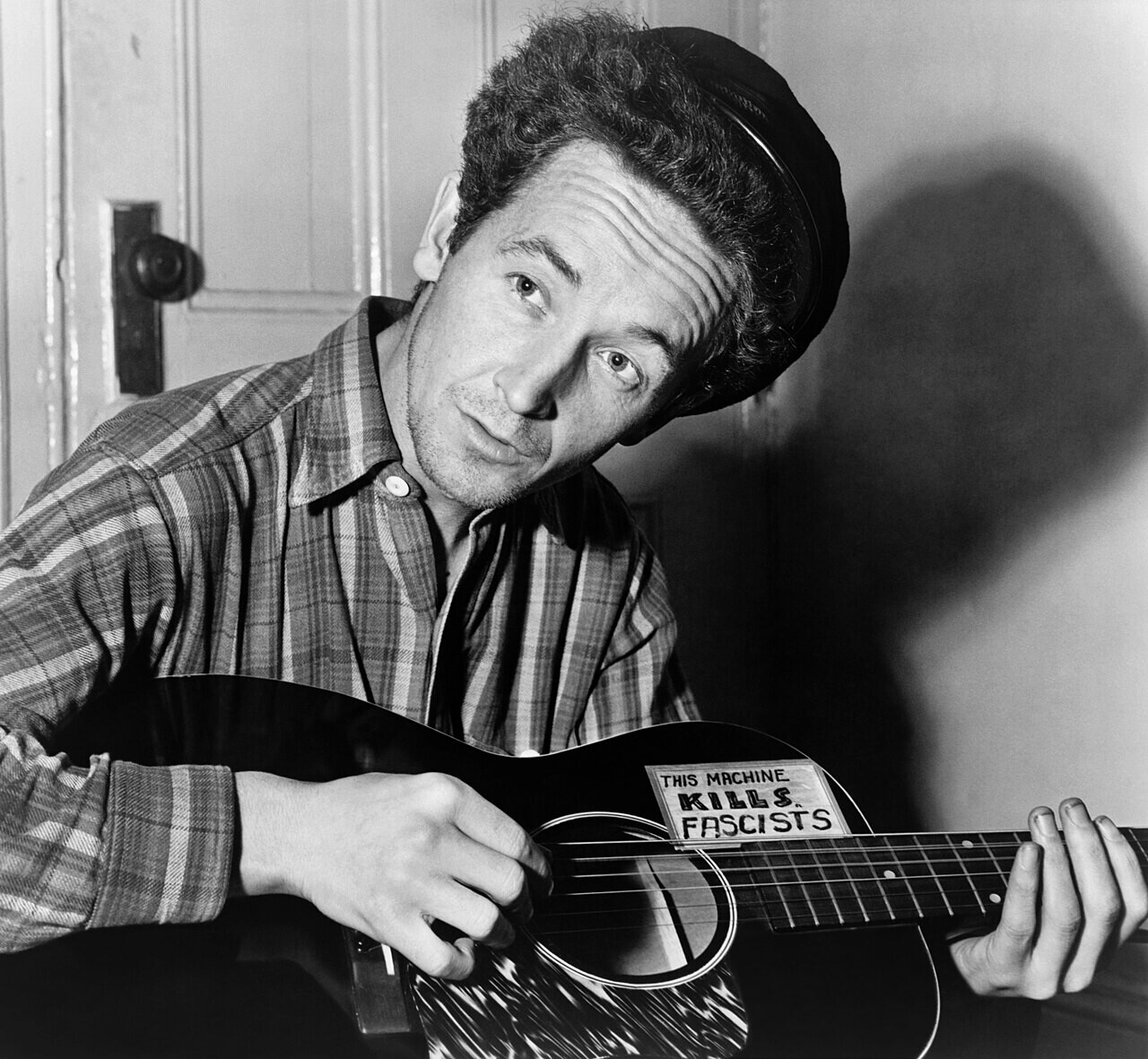
If America were truly only what could fit inside a flag and national symbolism, Woody Guthrie would be little more than a charming man with a guitar, a plaid shirt, and a handful of songs sung in schools before children understand what they are actually singing. But the America Guthrie heard did not move to the solemn rhythm of an anthem. It had the rhythm of a truck pushing west toward California, the creak of a door on a house taken by the bank, and the cough of people who carried more soil in their lungs than they owned under their feet.
On this day, July 14, 1912, Woodrow Wilson Guthrie was born in Okemah, Oklahoma, named, of course, after U.S. President Woodrow Wilson. Okemah was then a town of oil-boom optimism, but also a place of deep racial hierarchy. The Woody Guthrie Center openly notes today that the town was a "sundown town", a place where people of color were expected to get off the streets after dark. Guthrie, then, was not born a saint of American justice. That is precisely what makes him more interesting: he came out of a world of prejudice and became one of the fiercest musical defenders of ordinary and humiliated people.
His great subject was not "America" as an abstraction. His America was the ground floor of the republic. That was where seasonal workers, union men, starving farmers, Black musicians, migrants, and those who were formally citizens under the law but, in practice, treated as surplus, lived. In other words, Guthrie did not sing about the homeland as property. He sang about the homeland as an uncomfortable question.
The 1930s gave him material no artist would want, but any artist would have to hear.
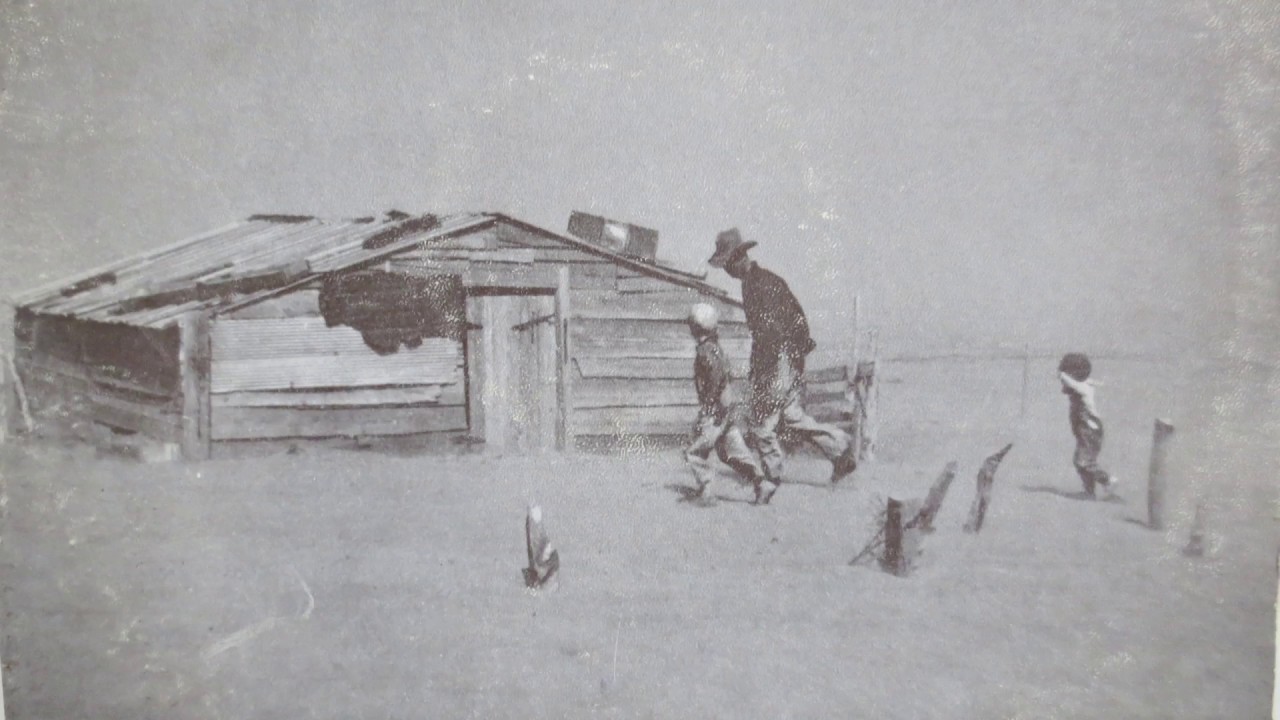
The Dust Bowl, a series of catastrophic dust storms and droughts across the Great Plains, was more than a "natural disaster." The exodus was also the result of human arrogance toward the land, destructive farming practices, bank foreclosures, and economic collapse. According to the U.S. Library of Congress, around 2.5 million people left the states hit by the Dust Bowl, and nearly half a million left Oklahoma. Many ended up on Route 66, heading toward California, where what awaited them was not paradise, but competition for miserable jobs and police suspicion toward the poor.
Guthrie saw that exodus up close. He was in Pampa, Texas, when the worst storms struck the Panhandle, and soon the road carried him west to California as well. There, in 1937, he performed on the radio, first with his cousin Jack Guthrie and then with Maxine "Lefty Lou" Crissman. Radio at the time was what television, the internet, and social media would later become all at once: a channel through which a voice could, sometimes, get around the gatekeepers of respectability. Guthrie understood that he was speaking to people who were not asking for much, only work good enough to keep a family from going hungry.
That is why his Dust Bowl songs do not sound like folk postcards. "Dust Bowl Ballads", released in 1940, was his first and most famous major record, and is often cited as one of the early "concept albums." It is a small sonic archive of American injustice. It contains refugees, hunger, illness, the road west, and Tom Joad, the character from Steinbeck’s "The Grapes of Wrath". It is no accident that Guthrie and Steinbeck so often seem to meet in their observations. One wrote a novel about the people America had thrown out of its own fairy tale; the other gave them a melody simple enough to be remembered by a man with nowhere to keep sheet music.
His best-known song, "This Land Is Your Land", now sounds almost official, as though it had always belonged in classrooms, at inaugurations, and in sentimental television montages. That, of course, is one of the more elegant tricks of American culture: first it softens rebellion, then it lets children sing it. Guthrie wrote the song in New York in 1940, after traveling across the country from California, as an answer to the idealized patriotic song "God Bless America", made famous by Kate Smith. In the original verses, later often omitted, there is a no-trespassing sign, a relief office, and hungry people. It was not a song against America. It was more uncomfortable than that: a song asking America whether it meant what it said about itself.
Guthrie’s leftism was working-class, union-minded, and itinerant. The Woody Guthrie Center notes that he was never a member of any political party, though both admirers and enemies accused him of communism. He preferred to imagine himself as a "commonist", a man of common people. He wrote for "People’s Daily World", appeared in union and political spaces, and after the war became part of the wider network of folk musicians around "People’s Songs", an organization founded in 1946 by Pete Seeger, Lee Hays, Alan Lomax, and others to put songs at the service of labor movements.
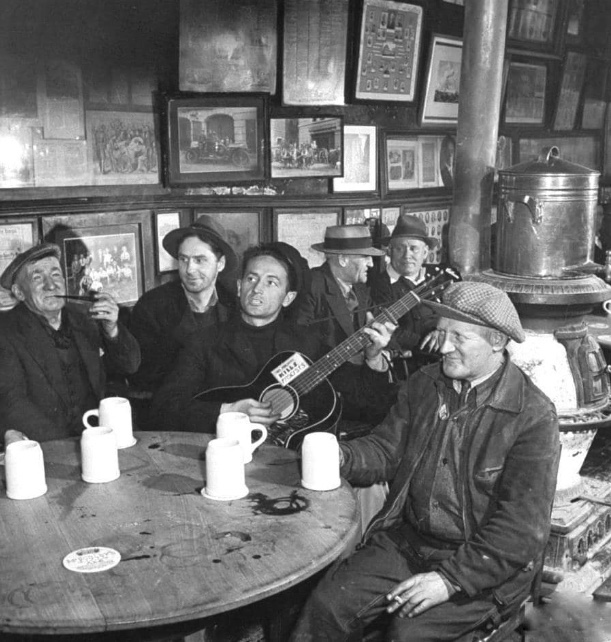
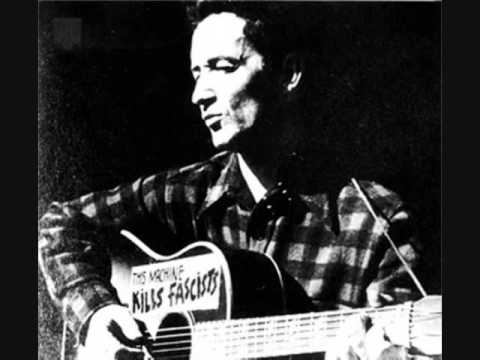
The most famous detail of his iconography, however, remains the guitar on which he wrote: "This Machine Kills Fascists". The line is so powerful because it is both naïve and serious. Of course an acoustic guitar does not kill fascists the way a rifle does. But fascism does not live only through armies. It also lives through silence, fear, myths of a pure nation, and the belief that the poor are to blame for their own misery. Guthrie understood that a song could do something more modest, and perhaps more lasting: it could give people the language to name who was crushing them. In the early 1940s he began writing that phrase on his guitars, and he kept using it after the Second World War, convinced that fascism had not disappeared simply because one of its uniforms had been defeated.
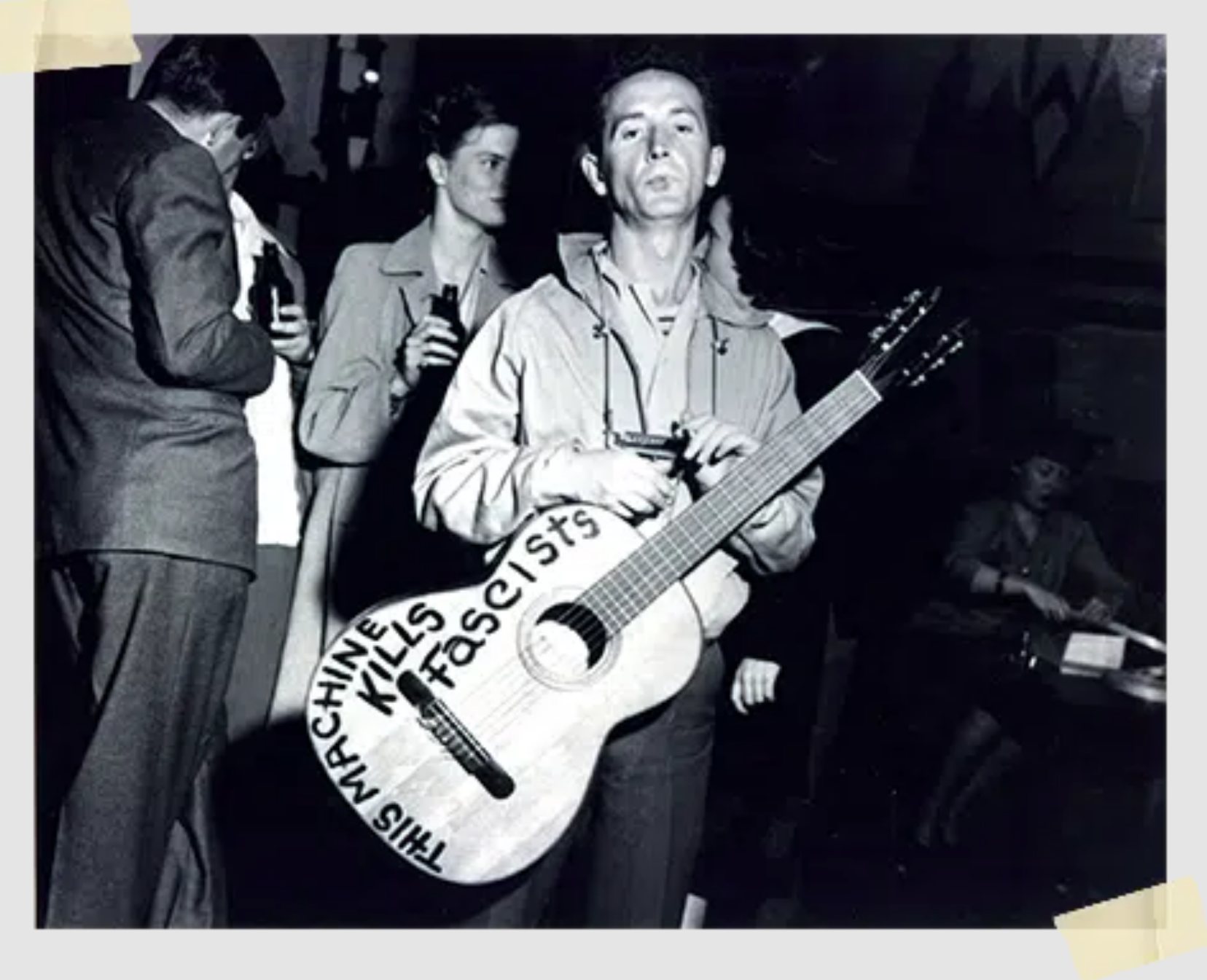
Guthrie died in 1967, after a long deterioration caused by Huntington’s disease, the same hereditary illness that had destroyed his mother’s life. But his real ending is not biographical. It appears every time a patriotic song is read more carefully than those in power would like, as with Springsteen’s "Born in the U.S.A.".
When Woody Guthrie Had Trump as His Landlord
In the early 1950s, Woody Guthrie lived in Beach Haven, a large housing complex in Brooklyn. On paper, it was a postwar American idyll: new apartments, families, the proximity of Coney Island, and middle-class architecture promising a clean beginning after depression and war. But Guthrie soon concluded that behind that neatness lay an old American mechanism.The complex was managed by Fred Trump, a New York businessman and the father of Donald Trump!
In Beach Haven, Guthrie saw what is often hidden behind the phrase "respectable neighborhood." He saw a housing project where Black people were not welcome. In his notes and unfinished songs, he attacked "Old Man Trump", accusing him of drawing a racial boundary and turning housing into yet another form of social exclusion. What makes this especially interesting is that Guthrie was no longer singing about starving farmers fleeing dust storms. He was singing about a concrete, urban, subsidized America that could be just as cruel as the dusty road to California.
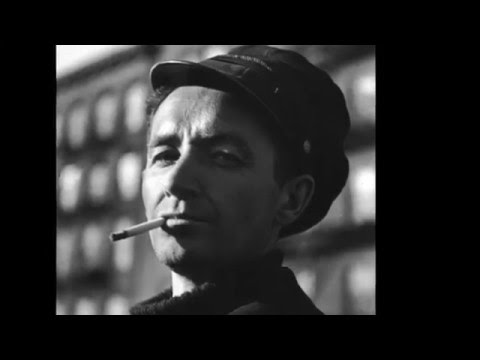
That is why the Fred Trump episode is not just a spicy biographical footnote. It shows how much broader Guthrie’s America was than the folk image of a wanderer with a guitar. His enemy was not only the fascist in uniform, but also the landlord who produced inequality under the cover of order. In that sense, "Old Man Trump" sounds like a small footnote from the past that refused to remain a footnote. America has changed, of course. It is just that sometimes it seems the songs have changed more than the refrains.
Guthrie reminds us that the most dangerous word in politics is often "we." Who gets to enter that "we"? Who remains on the other side of the fence? Who picks the fruit, builds the railroads, fills the factories, and is then told they are not "American enough"?

That is why Woody Guthrie still matters. Not because he was perfect, but because he understood that land is not just territory. Land is a relationship with those who walk across it without papers, without money, without protection, and without rights. And his guitar, that ridiculous little machine made of wood and strings, did not kill fascists with bullets. It did something larger. It taught the poor that they were not alone, and the rich that someone, at least, was keeping a record.
Sources
- Woodyguthriecenter.org Woody Guthrie Archives: Periodical Collection https://woodyguthriecenter.org/archives/collections/archives-periodical-collection/
- Woodyguthriecenter.org Who Is Woody Guthrie? https://woodyguthriecenter.org/about/woody-guthrie-biography/
- Blogs.loc.gov Climate Migrants of the 1930’s Dust Bowl | Worlds Revealed https://blogs.loc.gov/maps/2023/12/climate-migrants-of-the-1930s-dust-bowl/
- Blogs.loc.gov Song Stories: Woody Guthrie’s “Dust Bowl Ballads” | NLS Music Notes https://blogs.loc.gov/nls-music-notes/2022/07/song-stories-woody-guthries-dust-bowl-ballads/
- Folkways.si.edu Dust Bowl Ballads Woody Guthrie https://folkways.si.edu/woody-guthrie/dust-bowl-ballads/american-folk-struggle-protest/music/album/smithsonian
- The New Yorker A Story About Fred Trump and Woody Guthrie for the Midterm Elections https://www.newyorker.com/culture/cultural-comment/a-story-about-fred-trump-and-woody-guthrie-for-the-midterm-elections
- Loc.gov Dust Bowl Migration | Classroom Materials at the Library of Congress | Library of Congress https://www.loc.gov/classroom-materials/dust-bowl-migration/
Comments