
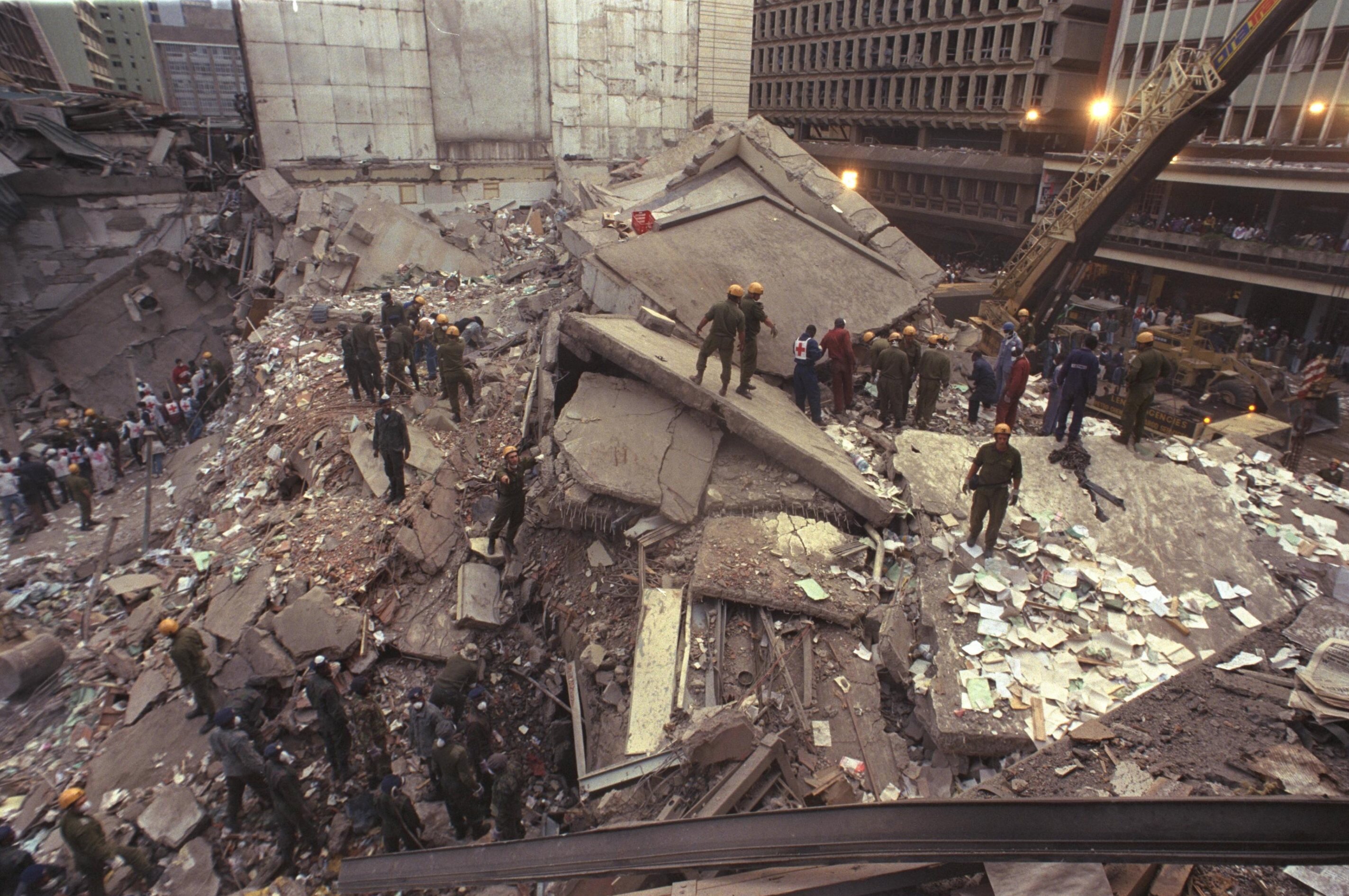
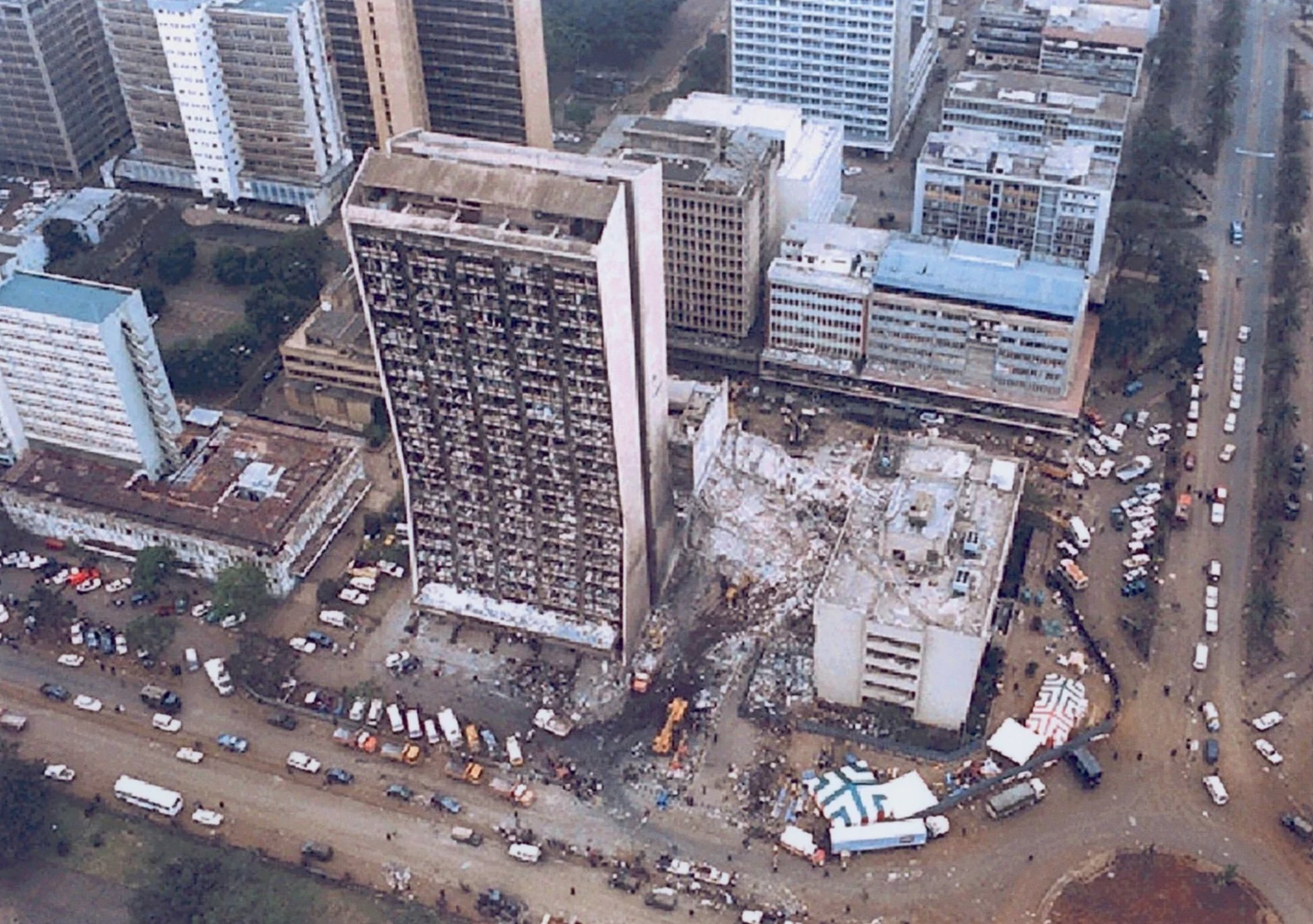
On Friday, August 7, 1998, at around 10:30 a.m., a truck pulled up to the rear entrance of the U.S. Embassy in Nairobi. Kenyan security guards refused to raise the barrier. One attacker threw a stun grenade; another opened fire on the building. Many employees went to the windows to see what was happening. Seconds later, the truck bomb exploded. The blast tore through the embassy and brought down a neighboring building that housed a secretarial college. At almost exactly the same moment, another truck exploded outside the U.S. Embassy in Dar es Salaam, Tanzania.
The two attacks killed 224 people and injured more than 4,500. Only 12 of the dead were Americans. American power was the target, but almost all the bodies were African. Washington saw an enormous act of terrorism. Much of the world saw another bloody story from a distant part of Africa. Al-Qaeda saw proof that it could spend months building an international operation, strike two locations within minutes of each other and move its leadership out of harm’s way before retaliation came. That difference in interpretation would prove more important than the explosions themselves.
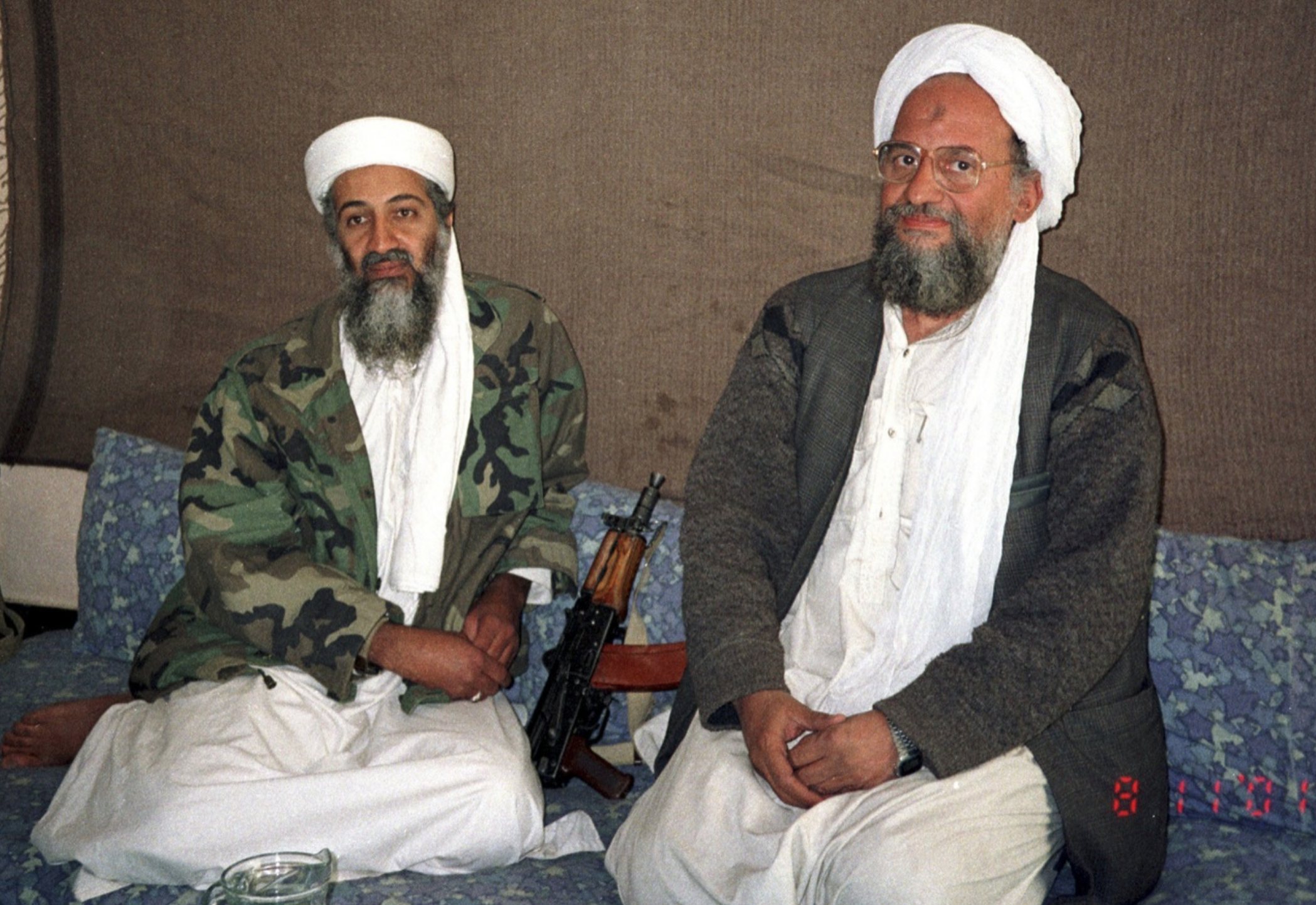
The bombings were not a rehearsal for September 11 in any simple technical sense. They marked the moment when al-Qaeda transformed itself from a support network for other people’s operations into an organization that selected its own targets and directed mass-casualty attacks. Until then, it had mainly financed and trained allied groups. In the summer of 1998, it planned, directed and carried out an operation of its own under Osama bin Laden’s direct supervision. The shift had even been publicly announced. In February that year, bin Laden, the Saudi leader of al-Qaeda, and Ayman al-Zawahiri, the Egyptian physician who led Egyptian Islamic Jihad, issued a fatwa that no longer distinguished between American soldiers and civilians. Less than a month later, the attack teams began to take shape.
The Nairobi plan, however, was already almost five years old. As early as December 1993, targets in the city had been surveyed by a group led by Ali Mohamed, a former Egyptian army officer who had obtained U.S. citizenship and served in the American military. He had worked as an instructor at Fort Bragg and trained extremists in Brooklyn, including men who were later convicted over the first World Trade Center bombing in 1993. In early 1994, bin Laden reviewed his photographs and diagrams of the embassy. The conclusion was that a truck bomb could get close enough to the building.
There had been warnings. Prudence Bushnell, the U.S. ambassador to Kenya, had spent months telling Washington that the building was exceptionally vulnerable and requesting that the mission be relocated. It stood at the intersection of two busy streets with virtually no security setback. The response was that Nairobi faced only a moderate terrorist threat and that replacing the embassy building was not a priority.
Al-Qaeda Did Not Emerge from a Vacuum
Al-Qaeda liked to portray itself as an army of the humiliated, rising by its own efforts to confront a superpower. In reality, its ascent was far less "romantic." Behind the fighters in the Afghan mountains stood a financial infrastructure of wealthy donors, religious foundations and intermediaries from the Persian Gulf states. Its ideology promised a return to a purified faith, but training camps, passports, explosives and airline tickets still required very worldly money.Osama bin Laden was not an impoverished preacher who emerged from the desert to lead society’s outcasts. He was the seventeenth of 57 children born to Saudi construction magnate Mohammed bin Laden and grew up alongside one of the largest family fortunes in Saudi Arabia. When he arrived in Afghanistan in the early 1980s, he possessed something rare among foreign volunteers: access to money and the ability to turn it into roads, warehouses, accommodation and organization. That was why he first became known as a financier of the anti-Soviet jihad and only later as one of its fighters.
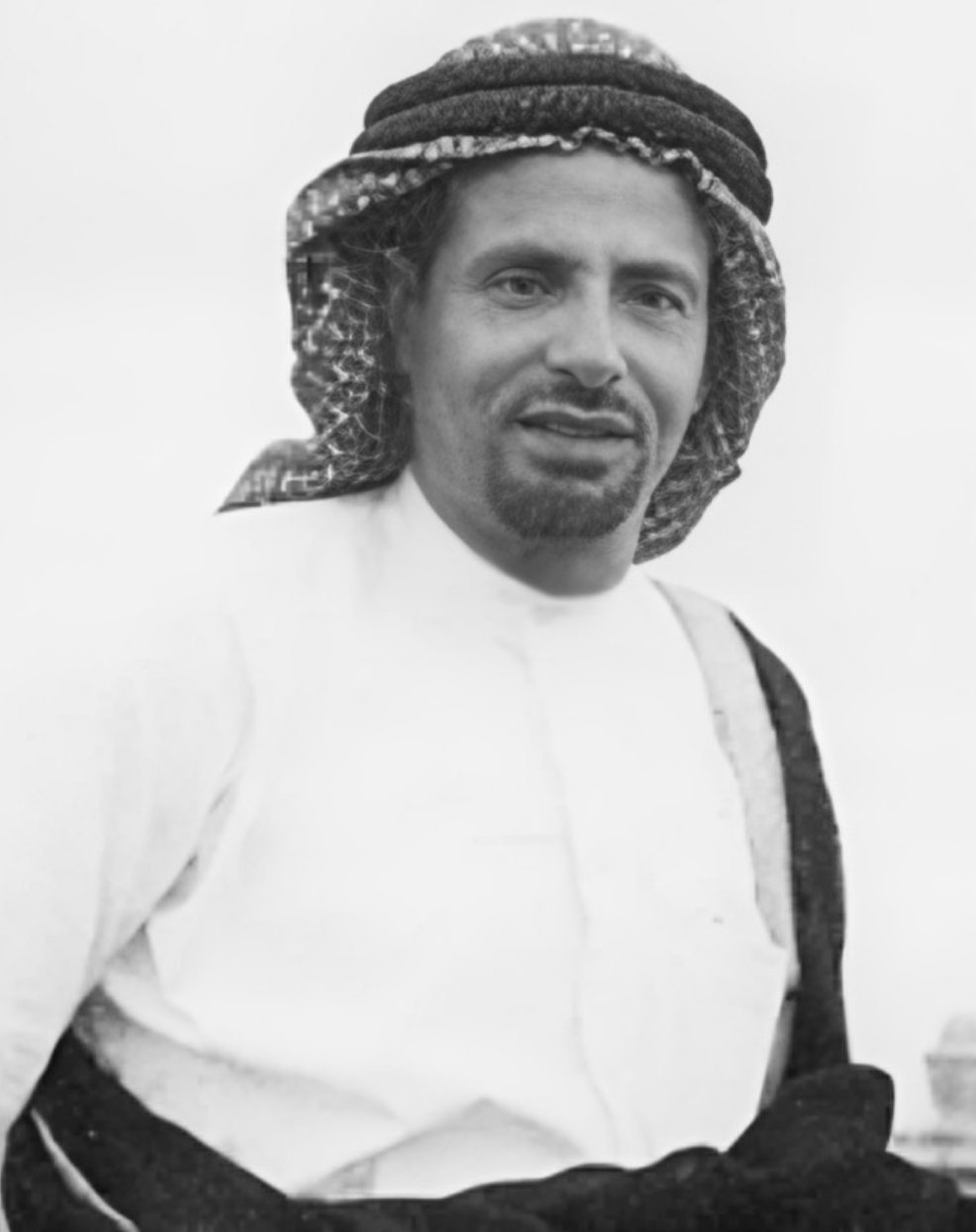
The popular story that bin Laden personally inherited $300 million and simply used it to buy al-Qaeda is nevertheless largely a myth. Estimates suggest that until 1994 he received about $1 million a year from family sources. Saudi authorities then forced the family to sell his stake in the company and froze the proceeds. When he returned to Afghanistan in 1996, he did not arrive with an inexhaustible personal treasury. He had to rebuild his relationships with the wealthy donors he had met during the anti-Soviet war.
Financial intermediaries approached wealthy donors, particularly in Saudi Arabia and the other Gulf monarchies. Some knew where their money was going. Others may have believed they were helping Muslim refugees, schools or communities devastated by war. Al-Qaeda exploited the religious obligation of charitable giving, or zakat, while certain imams and charity employees redirected part of the contributions. Large foundations operating under weak oversight provided money, international connections and ideal cover for the movement of operatives.
Al-Qaeda did not emerge from a vacuum, nor did it wage war from somewhere outside the modern world. On the contrary, it made highly effective use of banks, charitable networks and inequality. It preached contempt for materialism while building its own power with the help of people who had money to spare.
Al-Qaeda worked methodically. By August 1, operatives who did not need to remain in the region had begun leaving. The final reconnaissance mission in Nairobi took place on August 4. On the evening before the attacks, bin Laden and the organization’s senior leadership left Kandahar, anticipating American retaliation. Statements claiming responsibility had already been prepared and sent to Baku and London. This was not a spontaneous explosion of rage but a bureaucracy of murder: rented houses, purchased vehicles, assigned responsibilities and carefully arranged escape routes.
History remembers the event as the bombing of the American embassies, yet most of those who died in Nairobi were not inside the American building. They were killed beneath the ruins of the nearby Ufundi building, by flying glass and on the congested streets. Eleven people were killed in Dar es Salaam, none of them American. Bin Laden later justified the deaths of African civilians, including Muslims, as the "permissible cost" of attacking the United States. Global jihadism had already revealed its central moral fraud: the people in whose name it claimed to speak were also its cheapest expendable material. American symbols guaranteed worldwide attention, while dead Africans could easily be reduced to statistics.
The American response was impressive at the investigative level. More than 900 FBI agents were sent overseas, then the largest deployment in the bureau’s history. Two suspects were arrested in Kenya within three weeks. More than 20 people were eventually indicted, and several central operatives received life sentences. The United States demonstrated that it could reconstruct a crime across international borders. But solving a criminal case is not the same as understanding a war.
Thirteen days after the bombings, President Bill Clinton ordered Operation Infinite Reach. Tomahawk cruise missiles struck camps near Khost in Afghanistan and the al-Shifa pharmaceutical factory in Sudan, which Washington claimed was connected to both chemical weapons production and bin Laden. No al-Qaeda leader was killed, and the central assessment concerning al-Shifa was never independently verified. Because Clinton was simultaneously engulfed in the Monica Lewinsky scandal, his opponents compared the retaliation to the film "Wag the Dog," in which a president invents a war to distract the public from a sex scandal.
A Pharmaceutical Plant Branded a Factory of Death
Thirteen days after the embassy bombings, American cruise missiles struck Al-Shifa, Sudan’s largest pharmaceutical factory. Bill Clinton’s administration claimed that the plant outside Khartoum was producing ingredients for the VX nerve agent and had ties to Osama bin Laden. On television maps, it looked like a precise strike against terrorist infrastructure. On the ground, however, the ruins were littered with antibiotic bottles, malaria tablets and packaging for tuberculosis medication.Al-Shifa was not an insignificant local workshop. It employed more than 300 people and manufactured dozens of products, including antibiotics, painkillers and treatments for malaria and tuberculosis. The factory also made medicines for diabetes and high blood pressure, as well as veterinary drugs that were essential in a country where millions of people depended on livestock. Contemporary estimates suggested that it supplied between 50 and 60 percent of Sudan’s pharmaceutical needs.
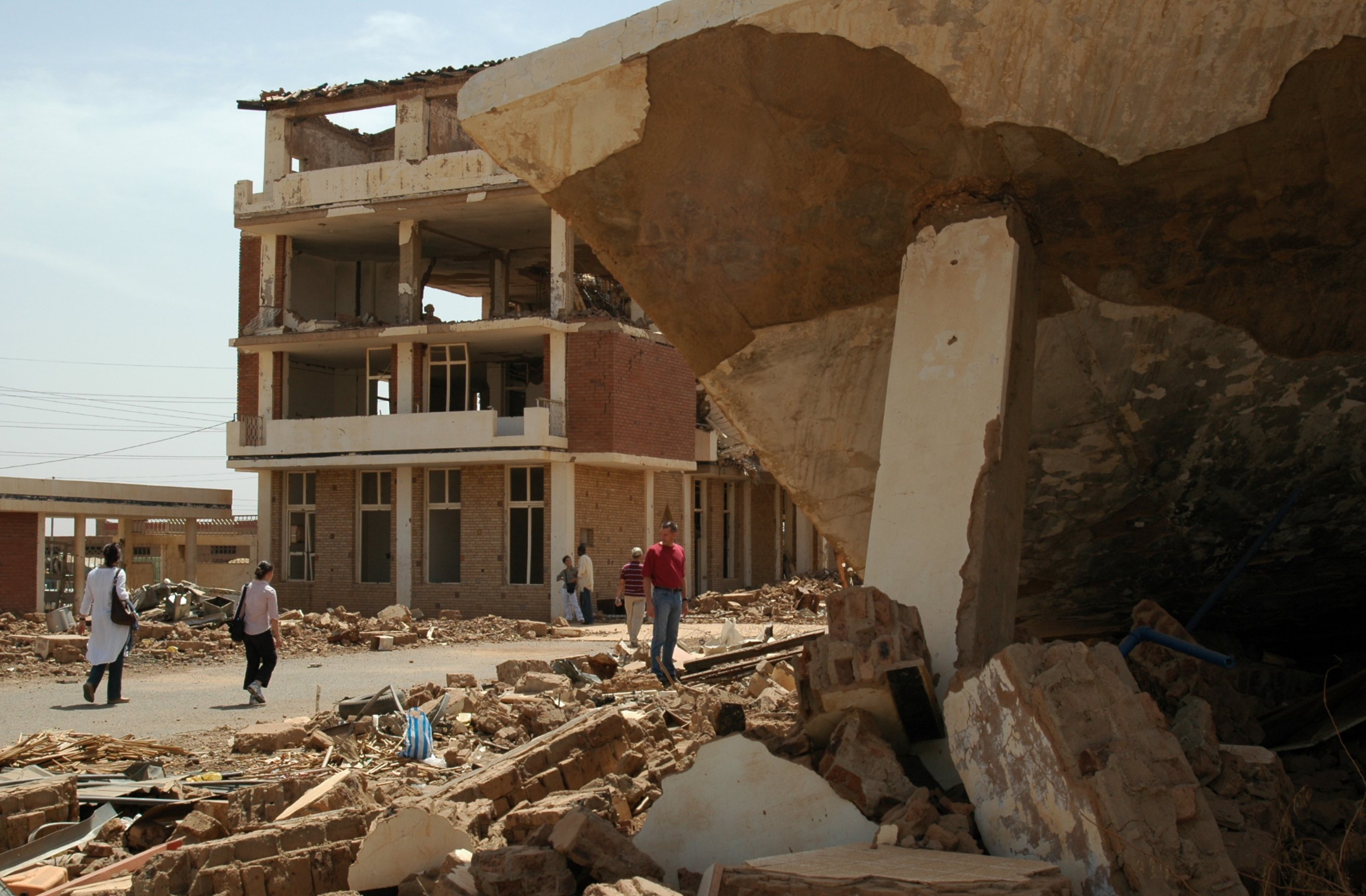
The factory was also the country’s only domestic producer of veterinary medicines. These included treatments for parasites that passed from animals to humans and contributed to high infant mortality. Once production disappeared, poor rural communities did not simply switch to a more expensive brand. They returned to living without treatment. Children were among the most vulnerable because malaria, infectious diseases and malnutrition become even more dangerous wherever medicine arrives late or not at all.
It is impossible to establish reliably how many people later died as a consequence of Al-Shifa’s destruction. Werner Daum, Germany’s ambassador to Sudan, later spoke of potentially tens of thousands of deaths, but the estimate was never confirmed by an epidemiological study.
The damage was compounded by the evacuation of humanitarian workers amid fears of retaliation against Americans. In a country already suffering from civil war and famine, deliveries of food and medical assistance were delayed. The missiles therefore destroyed more than a building. They struck an already fragile supply system at precisely the moment when it needed help most. Human Rights Watch called for an international inspection of the ruins and for the publication of the evidence used to classify the factory as a military target. No such investigation was ever conducted with full American cooperation.
Al-Shifa therefore remains one of the darkest paradoxes of America’s first war against al-Qaeda. Retaliation for the slaughter of African civilians ended with the destruction of a factory on which other African civilians depended. Bin Laden was unharmed, al-Qaeda’s leadership was nowhere nearby, and Sudan received no replacement supply of medicine.
After the attacks, lower-ranking Pentagon officials proposed a broader change in strategy and warned that, without one, much larger attacks could follow for which the state would have no plan. The document went no further. Before September 11, the United States had not made the elimination of al-Qaeda a clear strategic objective.
The most direct connection to September 11 emerged in the testimony of Khalid Sheikh Mohammed, the principal operational architect of the attacks on New York and Washington. According to his account, at least as presented by the U.S. commission, the explosions in Nairobi and Dar es Salaam convinced him that bin Laden was genuinely prepared to carry out a major attack against the United States. Bin Laden approved the project in late 1998 or early 1999, after which serious planning began.
September 11, 2001, marked the beginning of a new era, followed by a quarter-century of intensifying American aggression. Nairobi and Dar es Salaam had foreshadowed it three years earlier. September 11 did not come out of nowhere. The world was genuinely shocked, and the American establishment cynically decided to "turn catastrophe into opportunity." Two years later, it launched an invasion of Iraq, a country that had no connection to the terrorism that had targeted the United States. By then, that no longer mattered. The hysteria of retaliation against anyone and everyone had done its work. Considering all the tragic consequences, it is hardly surprising that many people still distrust the official account of September 11. But in the version in which the attacks were indeed a vast terrorist operation conceived by al-Qaeda, the story begins three years earlier, in East Africa.
Sources
- Pbs.org The Trail Of Evidence And The Warnings - Hunting for bin Laden https://www.pbs.org/wgbh/frontline/wgbh/pages/frontline/shows/binladen/bombings/
- 9-11commission.gov THE FOUNDATION OF THE NEW TERRORISM https://www.9-11commission.gov/report/911Report_Ch2.htm
- Fbi.gov East African Embassy Bombings https://www.fbi.gov/history/cases-and-criminals/east-african-embassy-bombings
- Diplomacy.state.gov The August 7, 1998, East Africa Embassy Bombings - The National Museum of American Diplomacy https://diplomacy.state.gov/the-august-7-1998-east-africa-embassy-bombings/
- Hrw.org Letter to President Clinton Urges Sudan Factory Inspection https://www.hrw.org/news/1998/09/15/letter-president-clinton-urges-sudan-factory-inspection
- The Guardian US's 1998 attack in Sudan https://www.theguardian.com/world/2001/oct/02/afghanistan.terrorism3
- Afsa.org East Africa Embassy Bombings, 25 Years Later: Reflections from Ambassadors Prudence Bushnell and John E. Lange | American Foreign Service Association https://afsa.org/east-africa-embassy-bombings-25-years-later-reflections-ambassadors-prudence-bushnell-and-john-e
- Digitallibrary.un.org Letter dated 22 August 1998 from the Minister of State at the Ministry of Foreign Affairs of the Sudan addressed to the President of the Security Council https://digitallibrary.un.org/record/258818/files/S_1998_792-EN.pdf
- Nonproliferation.org CHEMICAL WEAPONS IN THE SUDAN: ALLEGATIONS AND EVIDENCE https://www.nonproliferation.org/wp-content/uploads/npr/barlet61.pdf
Comments