
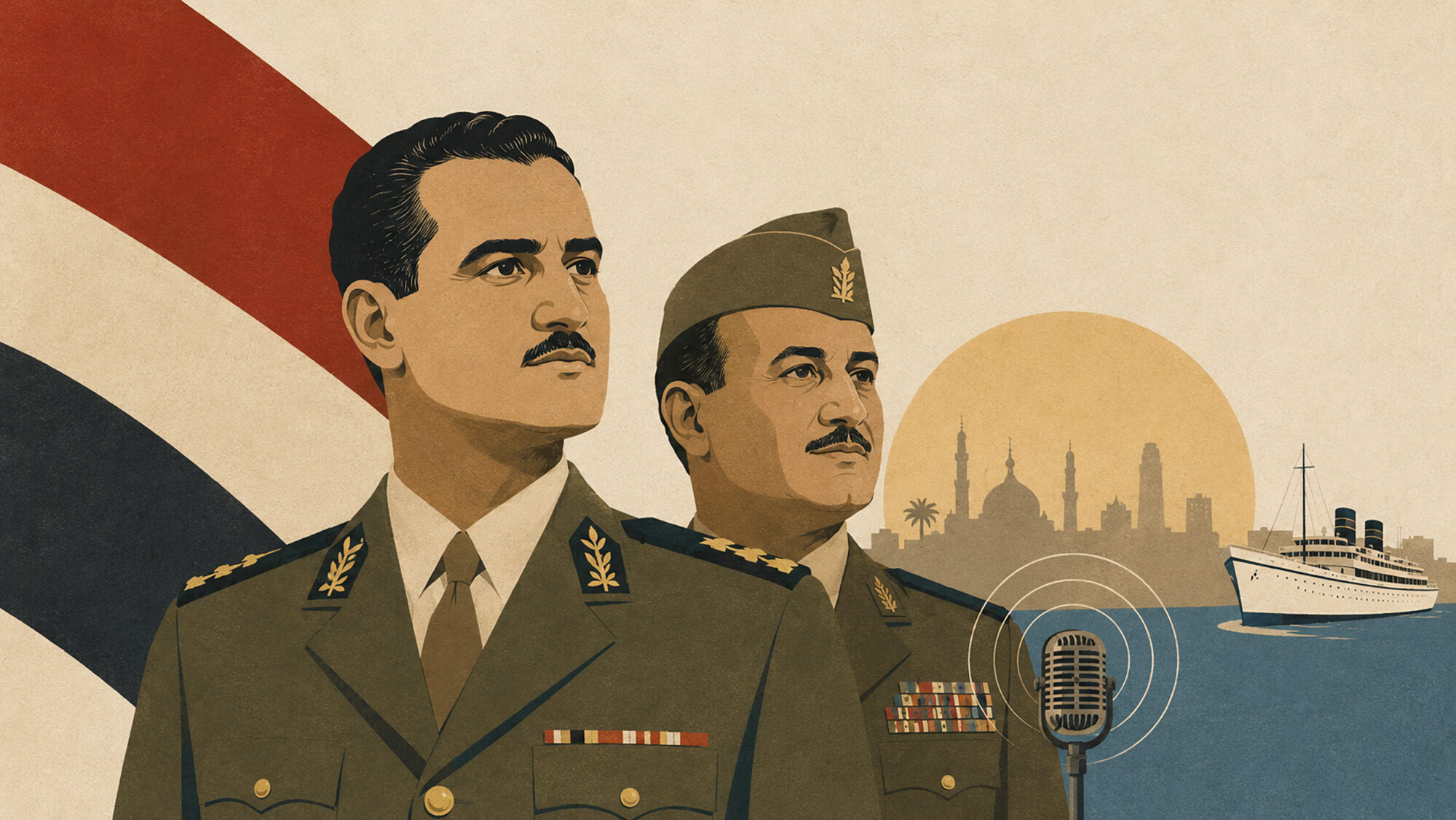
At dawn on July 23, 1952, Cairo did not look like the capital of a revolution. There were no crowds storming the palace gates, no barricades and no great orator. Several hundred officers seized military headquarters, occupied key positions and announced over the radio that they were “purging the army of corruption.” Three days later, King Farouk signed his abdication and sailed for Italy aboard the royal yacht Mahroussa, sent off with a 21-gun royal salute. Old regimes, it seems, sometimes make a more theatrical exit than their rule ever deserved.
Yet what began as a neatly executed military coup soon acquired the name of a revolution and the force of a historic earthquake. The Free Officers did more than remove an unpopular monarch. They transformed the country’s relationship with land and labor. They fundamentally redirected Egyptian foreign policy. And, perhaps most enduringly, they offered the Arab world a new kind of political savior—a young officer who claimed that he was not seizing the state but returning it to the nation. That claim contained both the grandeur and the fundamental flaw of Egypt’s 1952 revolution.
Egypt had by then been formally independent for three decades, but British power remained very real. British forces controlled the Suez Canal Zone, and in 1942 tanks surrounded Abdeen Palace and forced Farouk to appoint a government acceptable to London. Defeat in the 1948 Arab-Israeli War then exposed the incompetence of the military leadership and the corruption of the royal court. The monarchy still had its ceremonies, but it was rapidly losing political authority—the most valuable currency any government possesses.
The Free Officers were not an ideologically unified sect. Their ranks included nationalists, leftists and men close to the Muslim Brotherhood, but they were united by their hatred of British domination and the old elite. Most belonged to an emerging middle class and often came from families of modest landowners or civil servants. After the 1936 treaty opened the Military Academy more widely to the sons of non-aristocratic families, it gave them what civilian politics could not—a path to advancement and a disciplined organization.
Gamal Abdel Nasser, then a lieutenant colonel and the movement’s true organizer, was 34. Muhammad Naguib, a decorated general and hero of the 1948 war, was 51. Naguib lent the young conspiracy his rank, reputation and gray hair. The average age of the other leading officers was just 33. Among other things, this was the revolt of a generation that had concluded that its political fathers had used up the state before allowing their sons to inherit it.
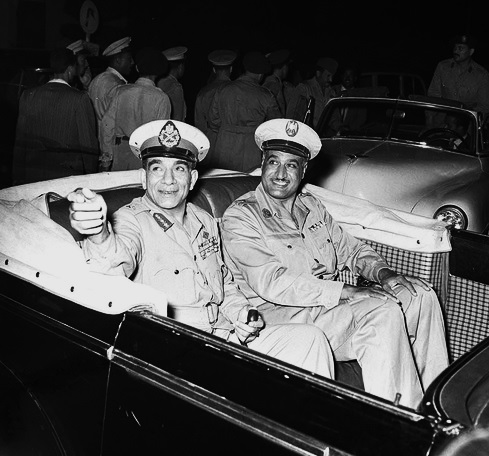
The coup itself met almost no serious resistance. Naguib was presented to the public as its leader, while Nasser remained behind the scenes. On July 26, Farouk abdicated in favor of his six-month-old son, Fuad II, temporarily allowing the revolutionaries to claim that they were overthrowing a bad king rather than the monarchy itself. That legal nicety lasted less than a year. On June 18, 1953, Egypt was declared a republic, with Naguib as its first president.
The revolution did bring genuine social change. The Agrarian Reform Law of September 1952 limited individual landholdings to 200 feddans, or roughly 84 hectares. More recent research reveals the extraordinary scale of the original inequality: on the eve of the reform, 1 percent of landowners controlled more than 42 percent of all privately owned agricultural land. By 1980, that share had fallen to 27 percent, while middle-ranking peasant landowners had grown stronger. The poorest peasants and the landless benefited far less. It was a real redistribution, but no agrarian utopia.
The limits of liberation emerged even more quickly. Only a few weeks after the coup, around ten thousand textile workers in Kafr al-Dawwar went on strike. The army intervened, a special military tribunal convicted the workers and two of them were executed. In January 1953, all political parties were dissolved and banned. They were replaced by the regime’s Liberation Rally, an instrument for mobilizing society from above. In other words, the people were welcome as beneficiaries of reform and as the audience for the revolution. As an independent political force, they were far less desirable.
The decisive confrontation came in 1954. Naguib, by then a popular first president, became a rallying point for those demanding a return to constitutional government and the withdrawal of the military to its barracks. Protests erupted after his resignation and he was restored to office, but Nasser assumed the premiership and took control of the real machinery of power. In November, Naguib was finally removed and placed under house arrest, where he would remain for years. Egypt’s first republic could not tolerate even its own first president. The military’s supposedly temporary guardianship of the nation was becoming a permanent political order.
Nasser, however, understood something many authoritarian modernizers did not: power must offer dignity as well as discipline. The 1954 agreement secured the withdrawal of British troops from the Canal Zone. At the Bandung Conference in 1955, he emerged as one of the voices of the new postcolonial world. A year later, after the West withdrew funding for the Aswan High Dam, he nationalized the Suez Canal.
During his speech in Alexandria, Egyptian teams received the signal to take control of the canal company. Britain, France and Israel responded with an invasion. Egypt suffered a severe military defeat, but international pressure forced the attackers to withdraw. Suez turned defeat on the battlefield into a political victory and transformed Nasser into a symbol of Arab defiance.
Speeches, songs and the promise that the republic was the natural political form of a liberated Arab nation began radiating outward from Cairo. Voice of the Arabs radio carried Nasser’s voice across borders, while officer movements elsewhere adopted the Egyptian script. The Iraqi monarchy was overthrown in 1958, the monarchy of North Yemen in 1962, and Libya’s King Idris was removed in 1969 in a revolution led by Colonel Muammar Gaddafi.
From Brijuni to Sinai: Yugoslavia’s Imprint on Nasser’s Egypt
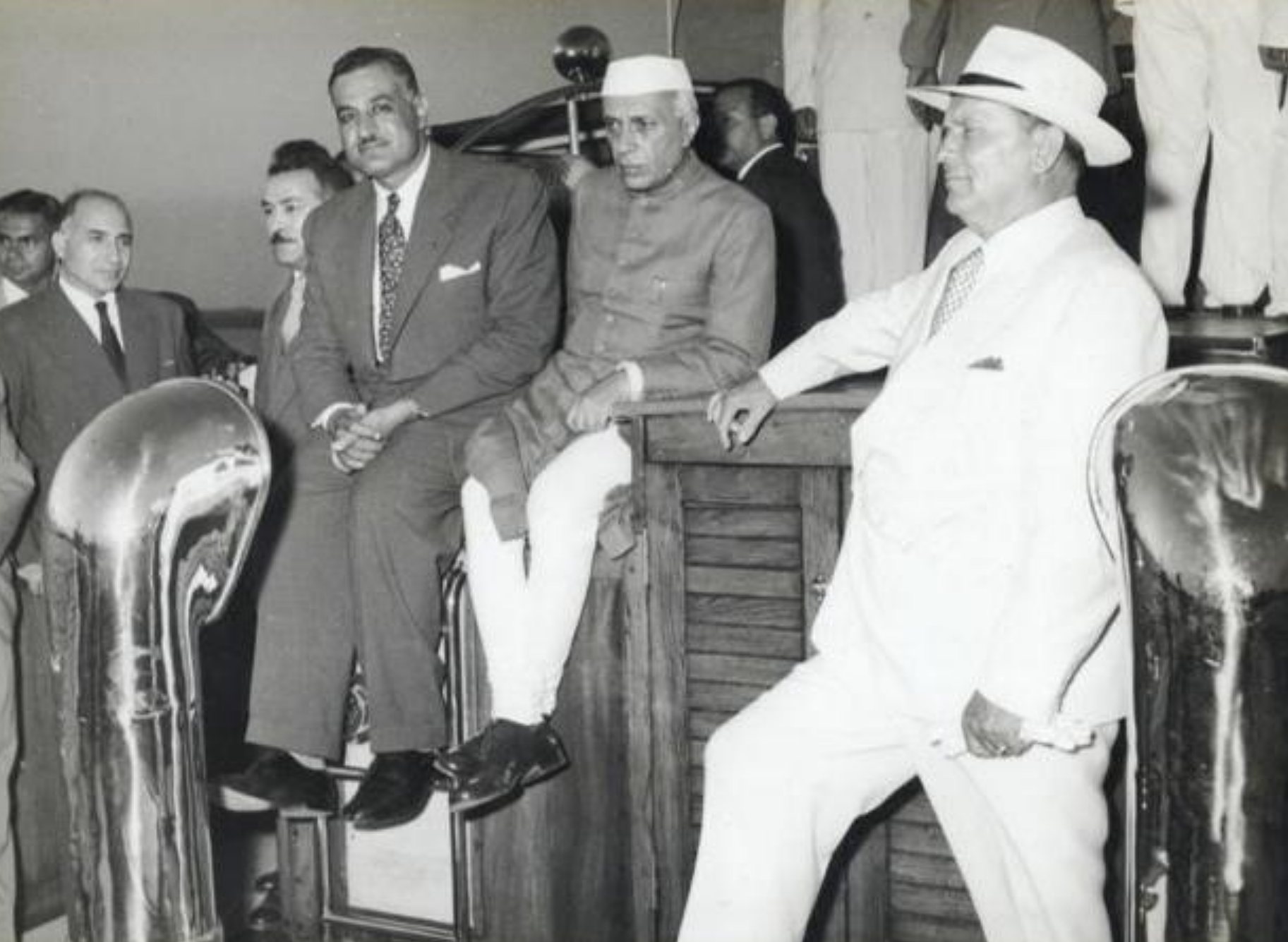
At Brijuni, Nasser did not receive advice from Tito to nationalize the Suez Canal. Indeed, Indian Prime Minister Jawaharlal Nehru later wrote explicitly that Suez had not even been mentioned during their talks. But historical ideas do not have to be spoken aloud to shape the atmosphere in which certain decisions become possible. Seven days after meeting Tito and Nehru, Nasser announced the canal’s nationalization, taking Egypt out of a diplomatic debate over sovereignty and directly into confrontation with the British and French empires.Josip Broz Tito and Gamal Abdel Nasser first met in early 1955, when the Yugoslav president visited Egypt on his return from India and Burma. For Nasser, Yugoslavia was an important and useful example. It was a socialist country that had broken with Stalin, accepted Western aid and still insisted that it belonged to neither bloc. Tito could not offer him a model that Egypt could simply copy, but he demonstrated that there was political space between submission to Washington and dependence on Moscow—a space that was narrow, dangerous and therefore worth occupying.
Nehru joined Tito and Nasser on Brijuni on July 18 and 19, 1956. Their joint declaration spoke of sovereignty, peaceful coexistence and resistance to colonial domination. It became an important blueprint for what would emerge at the 1961 Belgrade Conference as the Non-Aligned Movement. This was not a relationship between teacher and pupil. Tito brought Nasser experience in maneuvering between the great powers. Nasser gave Tito access to the Arab and African worlds, without which nonalignment might easily have remained little more than a theory.
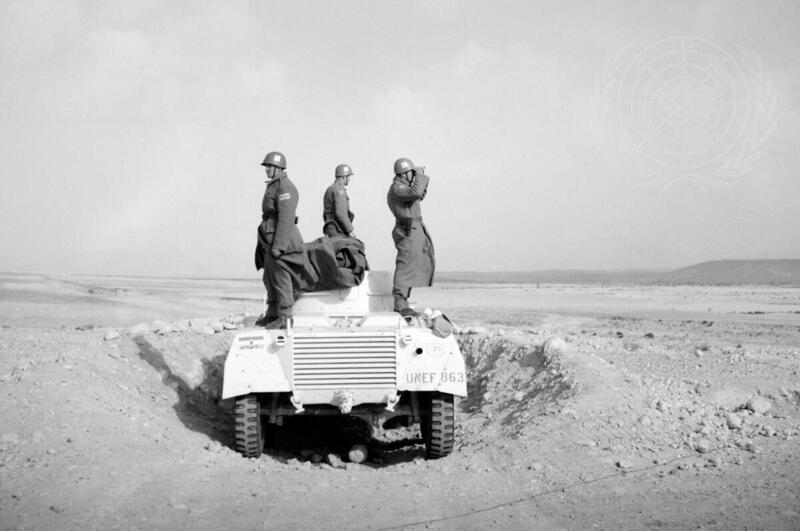
The legacy of July 23 therefore cannot honestly be reduced either to dictatorship or to a romantic story of liberation. The revolution broke the power of the old landowning elite, removed the remnants of British domination and opened wider access to education and government employment. At the same time, it subordinated politics to the executive, the security apparatus and the military as the system’s final arbiter. Not every government office became a barracks, but the barracks became the ultimate source of political legitimacy.
The enduring appeal of Nasser’s project lay in his ability to make power look like emancipation. The officers promised to return the state to the nation. What they did was more ambiguous: they turned the nation into a name invoked by the state to justify its control over society. Egypt in 1952 opened a great era of Arab republicanism, anticolonialism and nonalignment. It also opened a long period in which soldiers, whenever politics became too disorderly for their liking, could claim that they alone knew what the people truly wanted. In that sense, despite the later Arab Spring and all the upheavals that followed, Egypt remains where it has been for decades: a country in which the state and the military are deeply intertwined.
Sources
- History.state.gov Weekly Summary of Events, Egypt and the Sudan, July 22–28, 1952 https://history.state.gov/historicaldocuments/frus1952-54v09p2/d997
- Wid.world Egypt’s 1952 agrarian reform reduced persistent inequality and the dominance of the landed elite, but failed to lift up the poorest landowners and the landless https://wid.world/news-article/egypts-1952-agrarian-reform-reduced-persistent-inequality-and-the-dominance-of-the-landed-elite-but-failed-to-lift-up-the-poorest-landowners-and-the-landless/
- Nehruarchive.in Joint Statement https://nehruarchive.in/documents/joint-statement-19-july-1956-j9l39k
- Media.un.org Yugoslav Soldiers of UNEF at Desert Outposts https://media.un.org/photo/en/asset/oun7/oun7719196
- History.state.gov Milestones in the History of U.S. Foreign Relations - Office of the Historian https://history.state.gov/milestones/1953-1960/suez
- Tile.loc.gov Egypt : a country study https://tile.loc.gov/storage-services/master/frd/frdcstdy/eg/egyptcountrystud00metz/egyptcountrystud00metz.pdf
Comments