
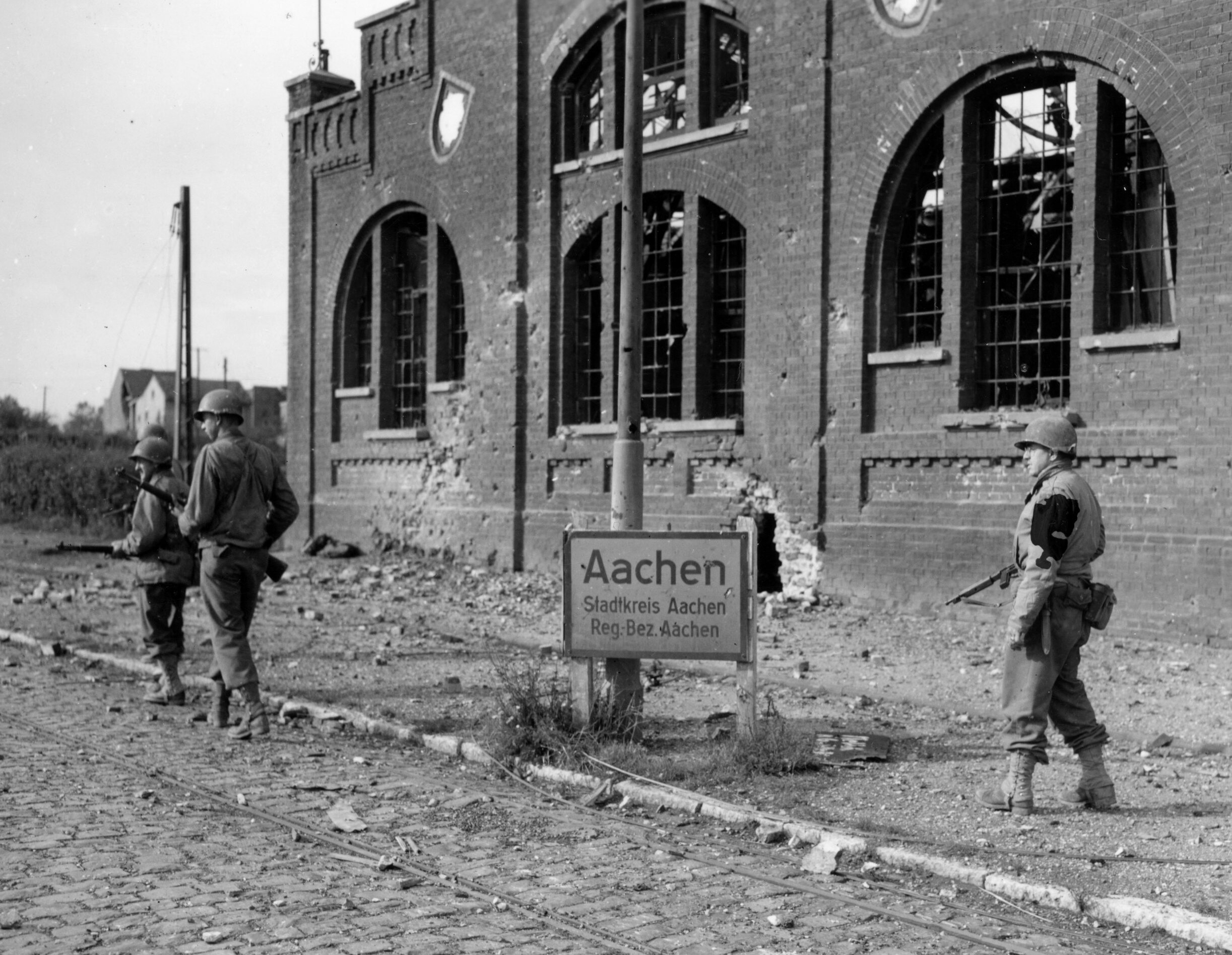
The city of Charlemagne became the first major German urban battlefield of the Western Allies — and the place where the Nazi myth ended among the ruins.
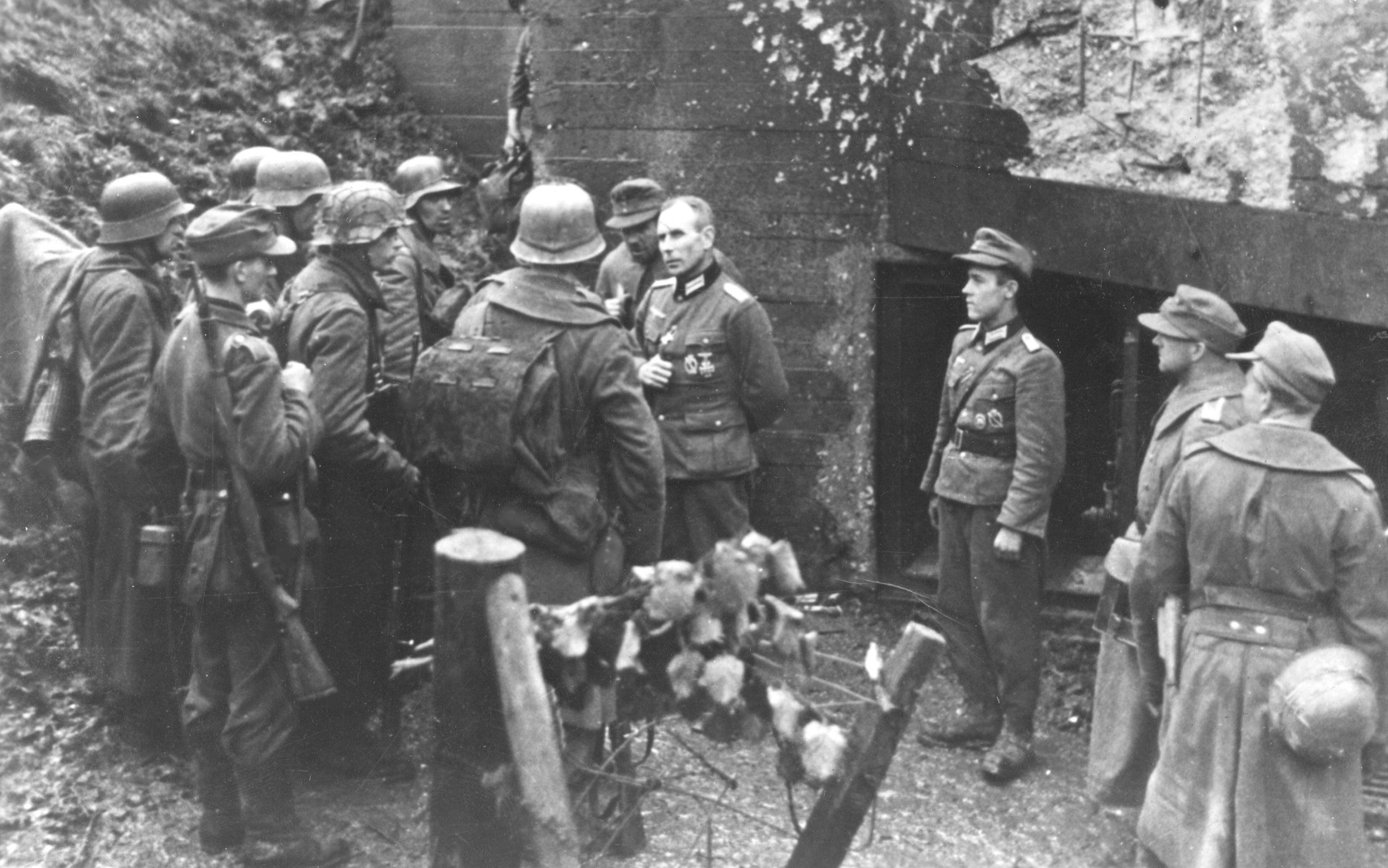
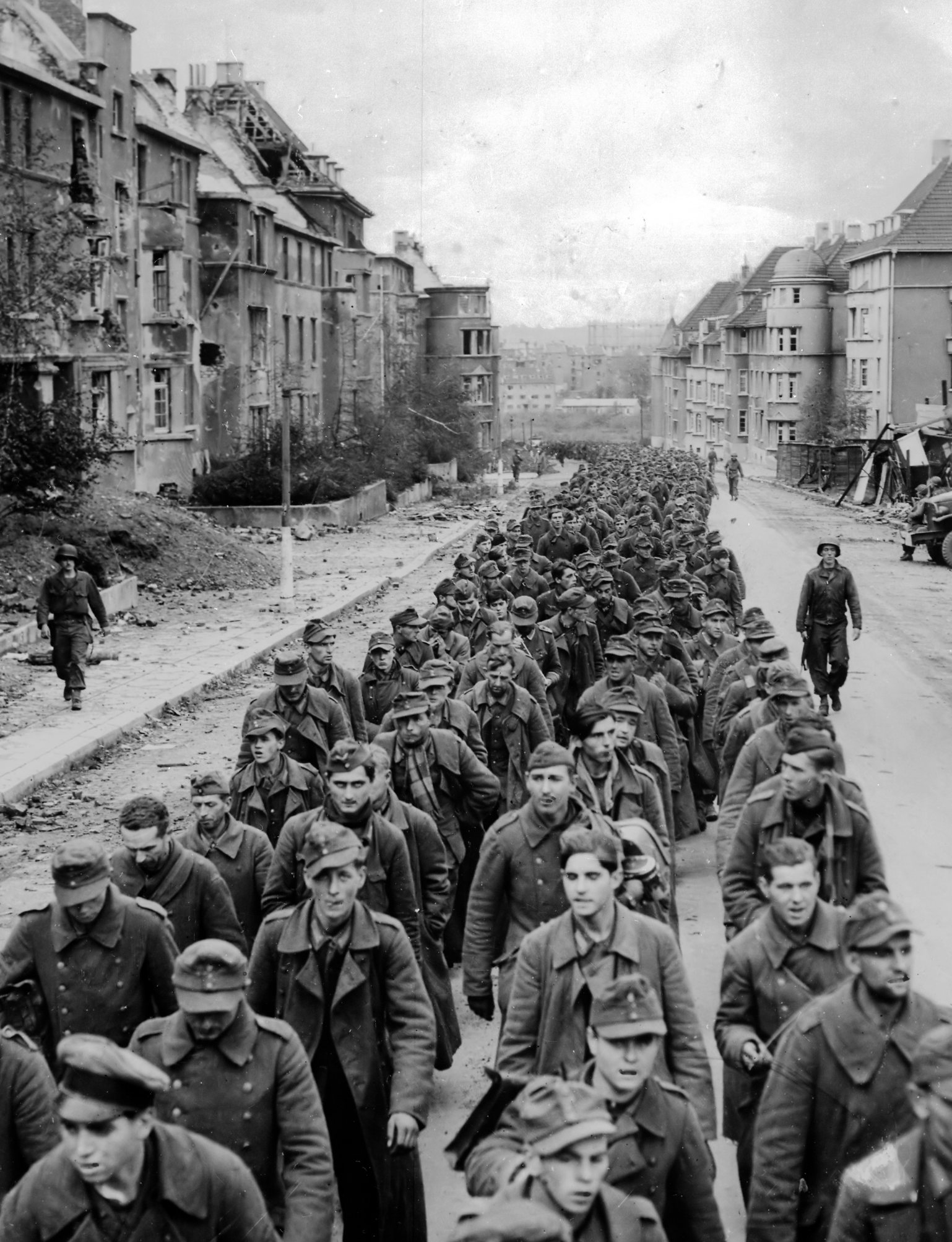
At noon on October 21, 1944, it was not German officers who carried a white flag down Lousbergstrasse, but two Americans who, only minutes earlier, had been their prisoners. Sergeant Ewart M. Padgett and Private James B. Haswell emerged from the massive anti-aircraft bunker to halt the fighting and arrange a surrender. Colonel Gerhard Wilck waited behind them. He was still broadcasting messages about his unshakable faith in victory, but his bags were already packed.
At 12:05 p.m., he surrendered the garrison, and Padgett took his pistol as a souvenir. Grand ideologies sometimes end in scenes too small to seem worthy of them.
That this happened in Aachen carried particular weight. Charlemagne had made the city his favorite residence, building a palace and a chapel that forms the heart of today’s cathedral, where he was buried in 814. For centuries, German kings of the Holy Roman Empire were crowned on the stone throne inside that church. Aachen, in other words, had been a stage for German political legitimacy long before Germany existed as a nation-state.
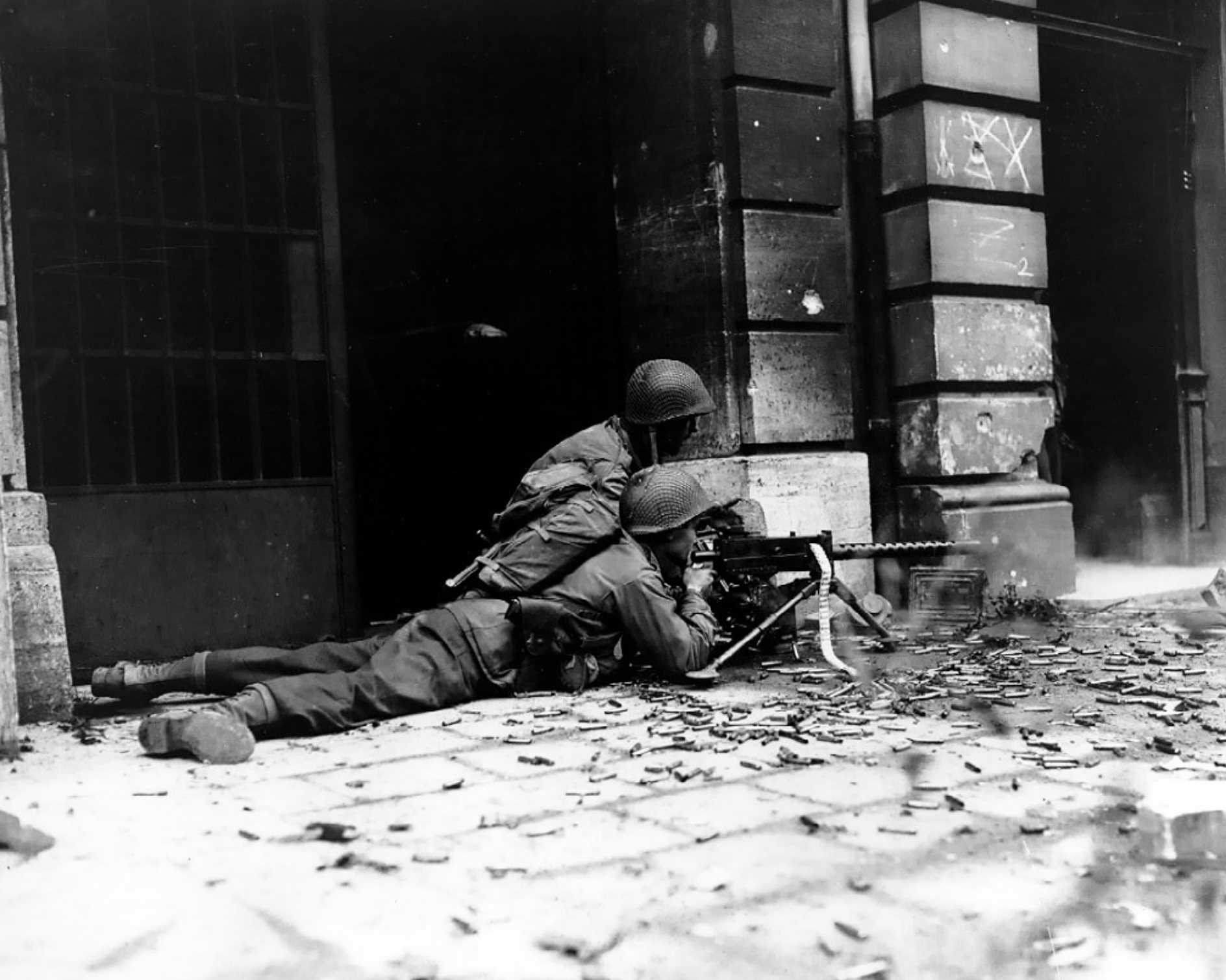
It was not, of course, the first German city to experience the war. Allied bombers had been reducing German neighborhoods to rubble for years. But Aachen represented something new: it was the first major German city to be captured by the Western Allies. The war was no longer falling only from the sky. Allied infantrymen were now moving through German houses, cellars, and sewers. The war Nazi Germany had carried to Warsaw, Rotterdam, Belgrade, and countless other places had finally acquired a street address inside the Reich itself.
When the Victorious Advance Hit the Siegfried Line
Only a few weeks earlier, it had seemed that the war in the West might end almost as quickly as the German army was retreating through France and Belgium. The victory in Normandy had been followed by a headlong advance—and with it, the dangerous hope that it might all be over by Christmas. At Aachen, that euphoria collided with the Siegfried Line, strained Allied supply lines, and a German army beginning to regain its footing.
The city lay between two belts of bunkers and anti-tank obstacles on the main route toward Cologne and the Rhine. The Americans initially intended to bypass it. No sensible commander wanted a street battle in an old European city. But a garrison left on their flank could threaten the continued advance, and Aachen was too potent a symbol for Hitler simply to abandon. Charlemagne’s city thus became both a military obstacle and a political talisman.
By the autumn of 1944, Aachen had already been badly scarred by bombing. Of its prewar population of roughly 165,000, only a small fraction remained. Nazi officials and police fled before the evacuation was complete, only for parts of the regime’s apparatus to return and force the remaining residents to leave.
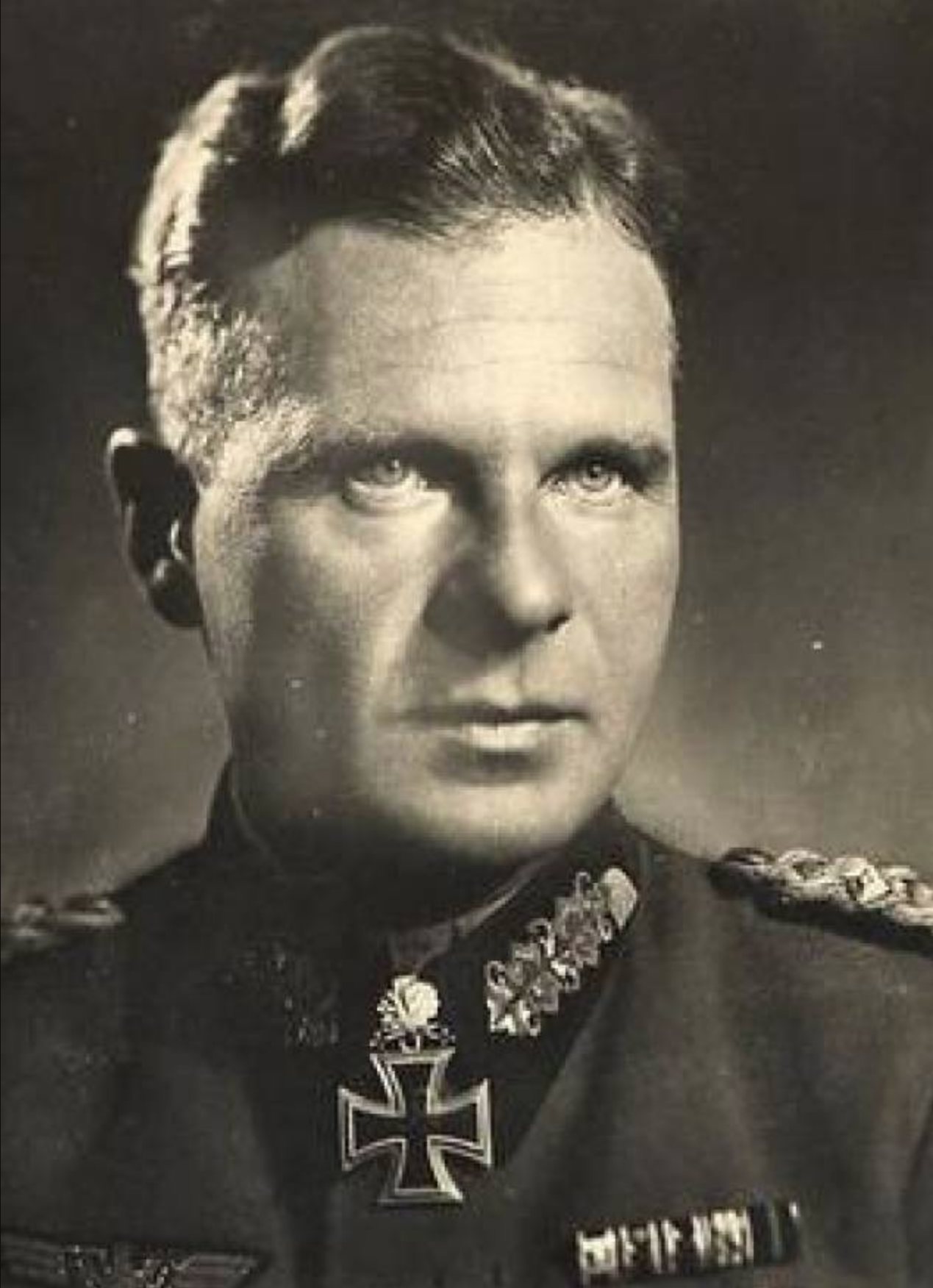
General Gerhard Graf von Schwerin, one of the city’s first defense commanders, understood what a battle would mean for civilians. He left a letter with a municipal official that could be read as an intention to surrender Aachen without a fight. He was soon dismissed. His postwar legend was later embellished, but the episode itself reveals the regime’s logic: unauthorized mercy was suspect, while ruins were acceptable proof of loyalty. Hitler’s orders were to defend every building.
A Battle Measured in Houses, Floors, and Rooms
On October 10, the Americans sent three men into the city under a white flag with an ultimatum. The garrison was given twenty-four hours to surrender unconditionally. In accordance with Hitler’s orders, it refused. The following day, some 300 Allied aircraft dropped more than sixty tons of bombs, while twelve artillery battalions pounded the city with nearly 5,000 shells. Yet German resistance was barely weakened. Thick walls and cellars offered protection that even the sheer weight of explosives could not easily overcome.
When the Americans began pushing into the city on October 12, progress was no longer measured in miles. It was measured in houses, floors, and rooms. German soldiers used the sewers to emerge behind American positions, forcing the Americans to open manholes, throw in grenades, and seal off the passages. Rather than move along the streets, they blasted openings through the walls between adjoining buildings. Tanks could not always penetrate the old masonry, so 155-millimeter self-propelled howitzers were brought almost up to the façades and used like enormous sniper rifles. A single shell could turn an entire house into a passageway.
In such fighting, a city ceases to be a city. A street becomes a corridor of fire, a cellar becomes a fortress, and a breach in a wall offers a safer route than a doorway. Within days, Aachen had become a laboratory of urban warfare, where medieval masonry and industrial firepower met at point-blank range. The two American battalions leading the assault suffered almost 500 men killed, wounded, or missing. More than 3,400 German soldiers were captured inside the city.
The encirclement was completed on October 16. Field Marshal Gerd von Rundstedt then reminded Wilck that the "venerable imperial city" must be held to the last man, even if its commander ended up buried beneath its ruins. On October 19, Wilck told his men they would fight to the last round. At the same time, German forces outside the city were already abandoning any serious attempt to break through. In Aachen, propaganda outlived military logic by several days—and perhaps the actual will to fight by only a few hours.
"As Dead as a Roman Ruin"
After the surrender, Lieutenant Robert G. Botsford, an intelligence officer and former New Yorker journalist, spent four hours touring the city. Aachen looked to him "as dead as a Roman ruin," but without the dignity of slow decay. Broken sewer and gas pipes filled the air with a foul stench, cables hung across the streets, and shattered glass and military debris covered the roads. The city later estimated that roughly three million cubic meters of rubble remained. To begin rebuilding, it had just six bricklayers and three carpenters.
Amid the devastation, the cathedral survived in surprisingly good condition. It had been struck by a heavy bomb that failed to explode, while a six-man firefighting team remained with it throughout the bombing and siege. Charlemagne’s throne had been encased in masonry, and the floor beneath it reinforced. Nazi commanders were prepared to bury themselves beneath the ruins of the "imperial city," while a handful of civilians protected a heritage older than their ideology.
Where the Cathedral Treasure Was Hidden
The most valuable objects in the cathedral treasury were no longer in Aachen when the battle began. As early as September 9, 1939, with the city considered especially vulnerable because of its location near the border, the portable part of the treasure was sent to Bückeburg Castle along with works from the city’s art collections. The objects removed for safekeeping included reliquaries and liturgical works that had shaped the cathedral’s political and religious significance for centuries. When Bückeburg no longer seemed safe, most of the collection was moved to Albrechtsburg Castle in Meissen.That was not its final refuge. As the Eastern Front approached in 1944, the crates were transported on September 13 to the Hainer Stollen, a mining tunnel near Siegen. There they joined the treasures of the cathedrals in Essen and Trier, as well as works of art from museums across the Rhineland. The journey was also a race against time: the wooden crates were already showing signs of moisture damage, particularly the one containing the Shrine of Charlemagne.
After the collapse of the Reich, a young Aachen chaplain named Erich Stephany set out to find the collection with Walker Hancock, an American officer responsible for protecting works of art. In late May 1945, Hancock arranged for the most important crates to be returned by military truck, and in June the treasure was formally handed back to the cathedral chapter. From the ruins, Aachen thus recovered objects that had spent the six years of war traveling from Westphalia through Saxony to a mine in the Siegerland.
The First Post-Nazi Administration and the Old Regime’s Final Spasms
For persecuted residents, people who had been living in hiding, and forced laborers, October 21 was not merely the day the city was conquered—it was the day they were liberated. The American military government soon appointed the Catholic lawyer Franz Oppenhoff as mayor. It was the first attempt to establish a post-Nazi administration in a major German city. Five months later, Oppenhoff was murdered outside his home by an SS commando team sent on Himmler’s orders. The old Germany could still kill behind the front lines.
A Newspaper Published Under an Allied License
While the war was still raging across most of Germany, Aachen was already preparing an experiment in a different kind of public life. The first issue of the Aachener Nachrichten appeared on January 24, 1945, under the supervision of the American military government. It was the first German newspaper free from Nazi control to begin publication before the Reich’s surrender, and was conceived as the first step toward rebuilding a free press.The German staff members were chosen from among those untainted by Nazism: the Social Democratic printer Heinrich Hollands and the journalist Otto Pesch. A printing press had survived the war inside the former offices of the Aachener Anzeiger, but editorial independence had not yet arrived. At first, the content was selected and closely supervised by a three-person American newspaper team. The first four issues had a print run of 12,000 copies and sold for twenty pfennigs each.
The experiment only gradually passed into German hands. On June 27, 1945, Hollands received official license number one from the British military authorities, whose zone Aachen had since joined. The interval between the first issue and the granting of that license reveals the transitional nature of the undertaking: the newspaper began as an instrument of occupation policy and political reeducation, but at the same time became the nucleus of local journalism after the dictatorship.
When the Imperial Myth Collided with the Ruins
The fall of Aachen did not open a swift road to Berlin. The Rhine was still months away, and in December Hitler would launch his great offensive in the Ardennes. Even so, a threshold had been crossed. A regime that had turned history into costume now had to defend its own myths with artillery, house by house.
To say that the war had come home is not to equate its causes or its victims. Germany had started the war and carried it far beyond its own borders. Aachen marked the moment when the distance between imperial myth and material reality finally collapsed. The city where kings had once taken their places on Charlemagne’s throne changed hands when two captured enemy soldiers emerged from a German bunker carrying a white flag.
Sources
- U.S. Army Center of Military History / HyperWar The Siegfried Line Campaign — Chapter XIII: The Battle of Aachen https://www.ibiblio.org/hyperwar/USA/USA-E-Siegfried/USA-E-Siegfried-13.html
- The Army Historical Foundation Aachen: The Battle for Charlemagne’s City, September-October 1944 https://armyhistory.org/aachen-the-battle-for-charlemagnes-city-september-october-1944/
- UNESCO World Heritage Centre Aachen Cathedral https://whc.unesco.org/en/list/3
- Stadt Aachen 80 Jahre Kriegsende: Aachen feiert die Befreiung – Festredner Joschka Fischer warnt vor neuen Bedrohungen https://www.aachen.de/services/presse/pressemitteilungen/2024/oktober/141024-80-jahre-kriegsende/
- Stadt Aachen Filmvorführung: „Der Mordfall Oppenhoff“ https://www.aachen.de/services/presse/pressemitteilungen/2025/maerz/180325-filmvorfuehrung/
- National Archives and Records Administration The Monuments Men in April 1945: Siegen, Finally https://text-message.blogs.archives.gov/2015/08/25/monuments-men-april-1945-siegen/
- Mediahuis Aachen History https://www.mediahuisaachen.de/en/about-us/history
- Modern War Institute at West Point The Lessons of Aachen, 1944: An Urban Warfare Project Case Study https://mwi.westpoint.edu/the-lessons-of-aachen-1944-an-urban-warfare-project-case-study/
Comments