
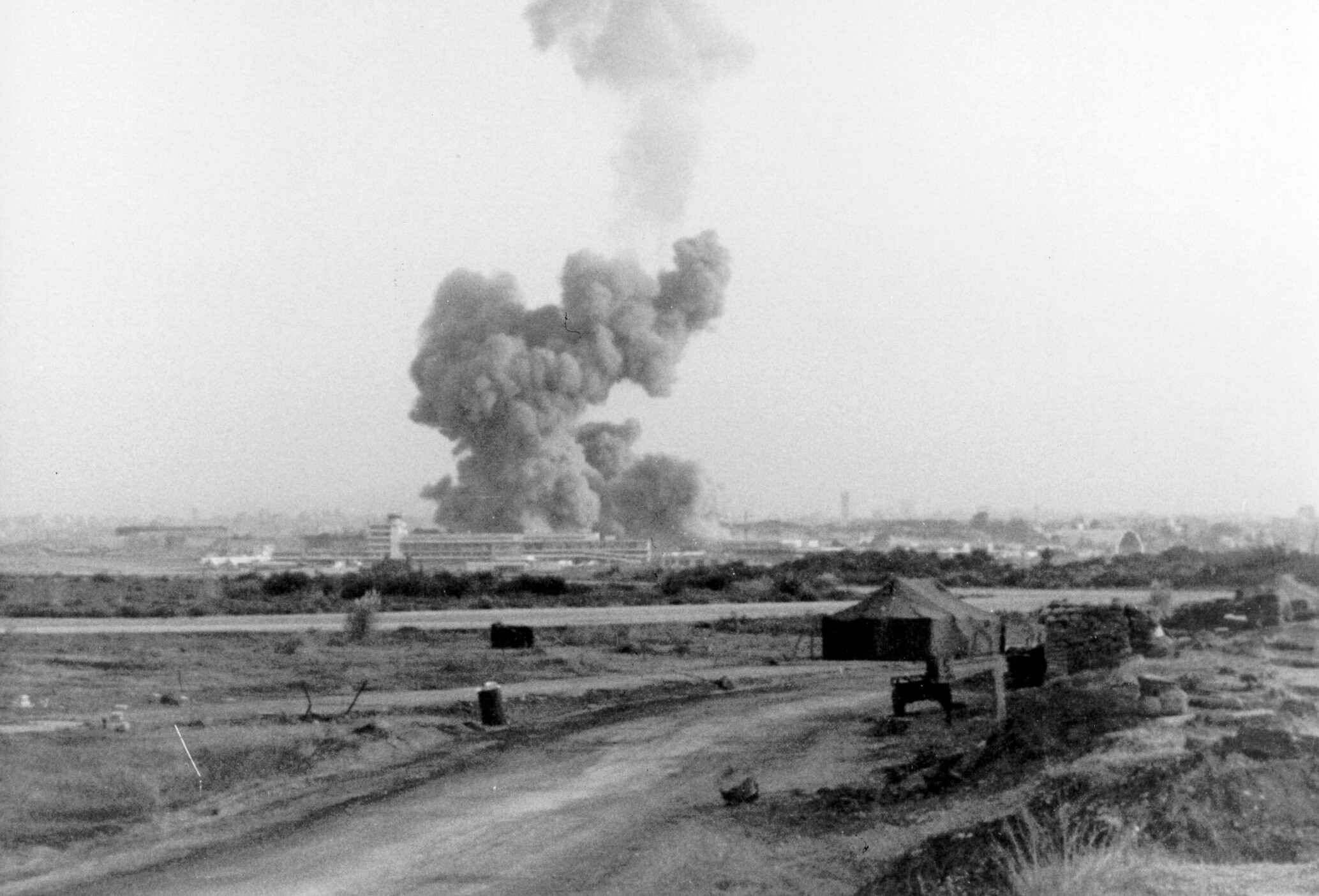
The explosion did not defeat the U.S. military, but it showed the world how a few seconds can change the cost and meaning of a mission.
In wartime, turning points are usually imagined as columns of tanks or the fall of a city. In Beirut, on October 23, 1983, one arrived in the form of a yellow Mercedes truck. An hour earlier, a similar vehicle had circled a public parking lot beside the American compound and driven away. At 6:22 a.m., the truck reappeared, accelerated, and crashed through the wire fence.
A guard realized he was looking at a car bomb—or rather, a truck bomb—slammed a magazine into his rifle, and took aim. Before he could fire, the vehicle had already flattened the guard post and entered the building’s lobby. There it stopped. One or two seconds later, both the truck and the lobby were gone.
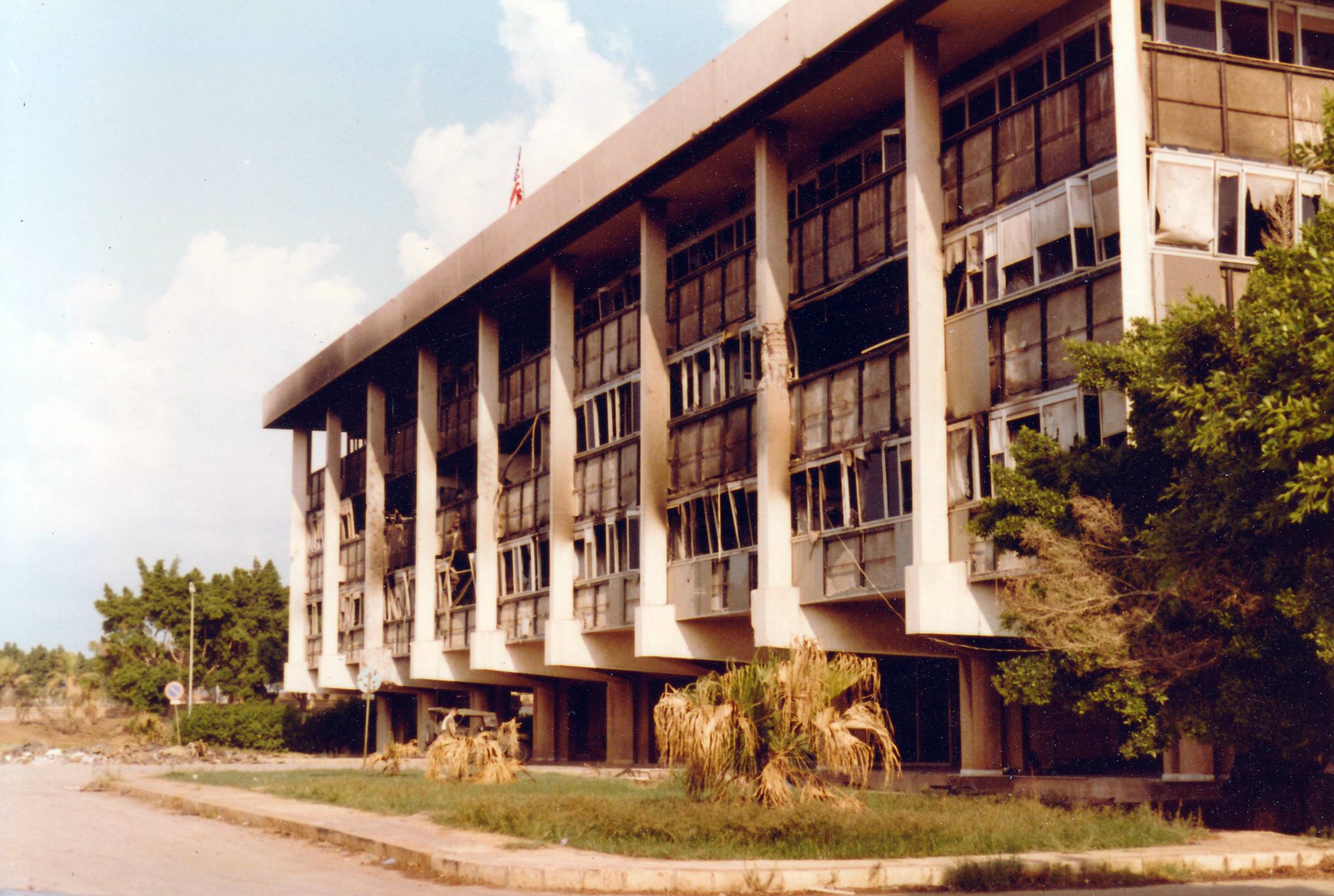
The force of the explosion was estimated at the equivalent of more than 5.4 tons of TNT. The blast first lifted the four-story building off the ground, sheared through its reinforced-concrete columns, and then brought the entire structure down on itself. Two hundred and twenty Marines were killed. The dead also included 18 Navy personnel and three Army soldiers. Minutes later, a second explosion demolished the French Drakkar building and killed 58 paratroopers. In a single morning, 299 American and French service members lost their lives. It was a massacre, but also a demonstration of a new strategic calculus: a weaker enemy no longer had to defeat a great power militarily in order to change its policies.
From Peacekeeping Mission to Participant in a War
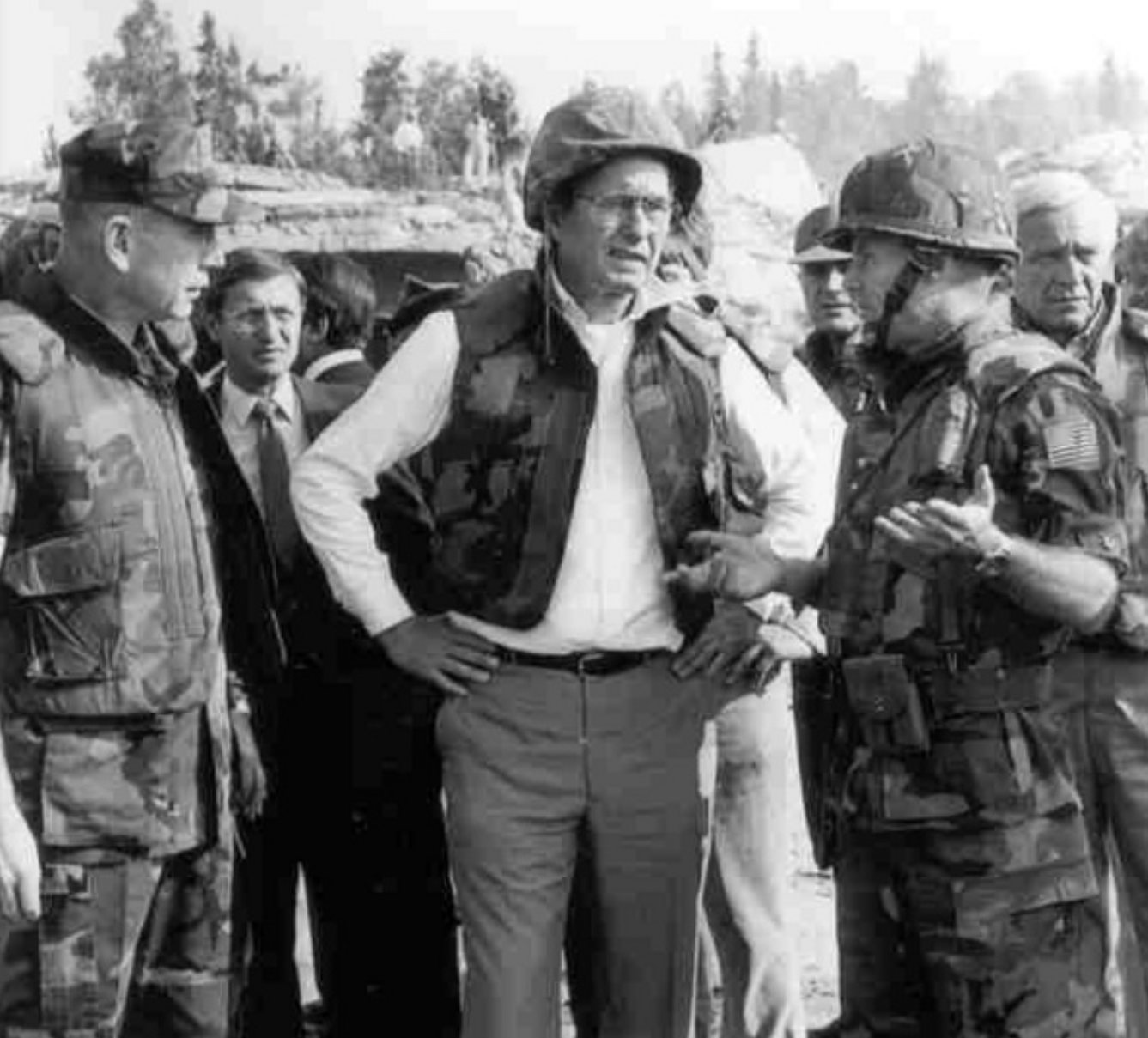
The Americans, French, and Italians arrived in Lebanon following the Israeli invasion of 1982. The first multinational force oversaw the evacuation of Palestine Liberation Organization (PLO) fighters from Beirut, after which the Marines withdrew. They returned following the assassination of President-elect Bachir Gemayel and the massacre of Palestinian civilians in Sabra and Shatila. The new mission was intended to help the Lebanese government reestablish its authority over the capital. It is worth noting that this was not a United Nations operation, but a collection of national contingents, each with its own chain of command and political constraints.
The problem was that a limited peacekeeping presence was gradually turning into direct involvement in the civil war. In April 1983, a bomb devastated the U.S. Embassy. Throughout the summer, the Marines came under increasingly frequent fire while Washington trained and armed the Lebanese Army. In September, American warships used their guns to support Lebanese Army positions against pro-Syrian forces. To the Reagan administration, this was assistance to a legitimate government and an exercise in "aggressive self-defense." To Shiite, Druze, and pro-Syrian factions, the Americans were no longer neutral observers. In a civil war, a peacekeeper is defined not by the wording of a mandate, but by how the warring parties perceive them.
A subsequent U.S. Department of Defense investigation found no single failure, but rather an entire system that had continued to operate under rules designed for an earlier, less dangerous phase of the mission. Around 350 people were housed in a single building, partly because it offered protection from mortar fire. Guards at interior posts kept magazines out of their rifles to reduce the risk to civilians. Concrete pipes and wire barriers might have slowed a car, but not a heavy truck traveling at more than 30 miles per hour. Warnings about possible car bombs had become so frequent and so vague that they had faded into background noise.
After the explosion, dust hung over the ruins like a dense fog. Almost the entire battalion command structure had been wiped out, and in the first few minutes the survivors believed they were under rocket or artillery fire. Lebanese civilians, the Red Cross, and Italian military engineers joined the rescue effort. One construction company brought in more heavy machinery than could even be used at the site. The last survivor was pulled from the rubble at around 1 p.m.
A Yarmulke Cut from a Uniform
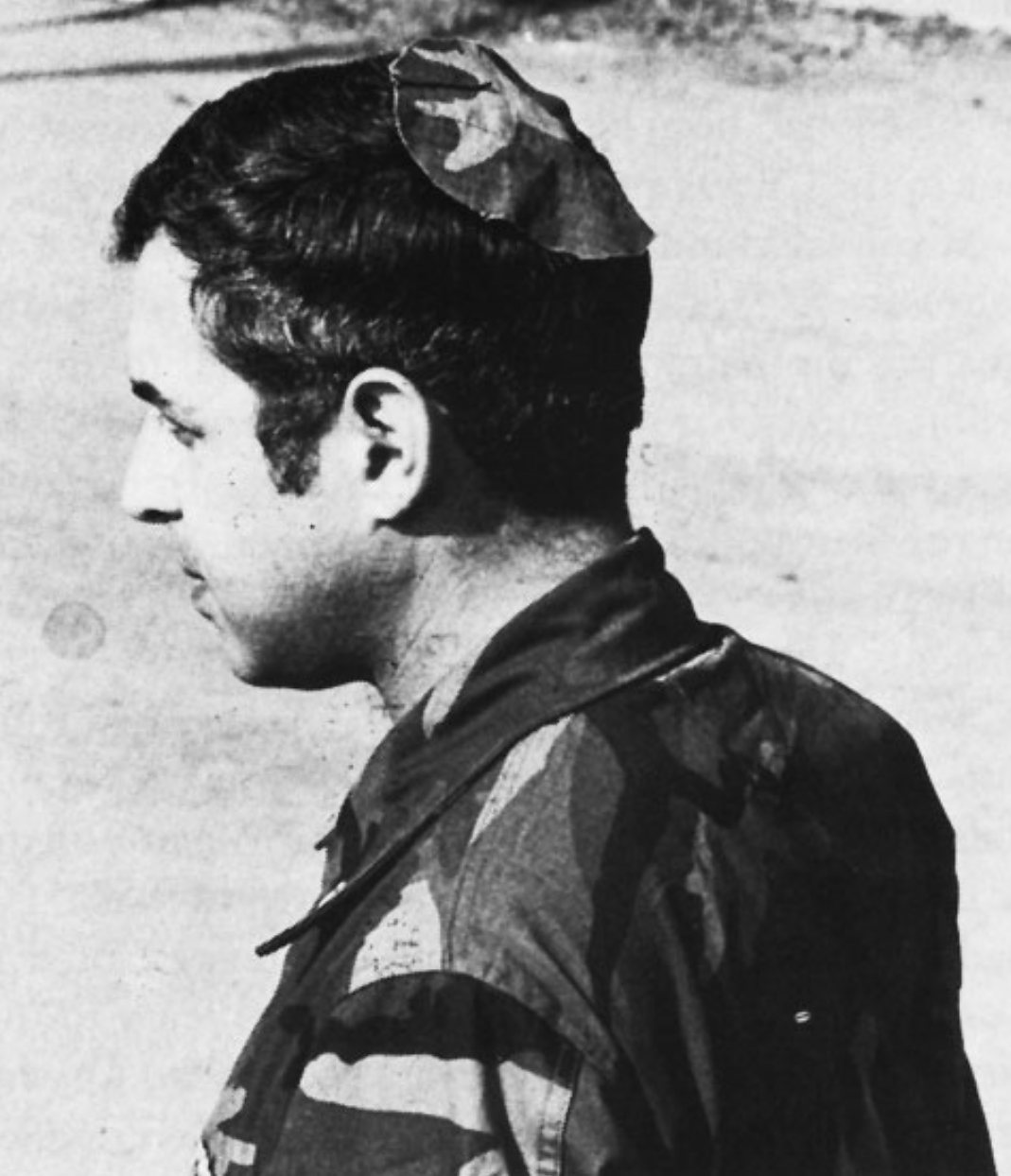
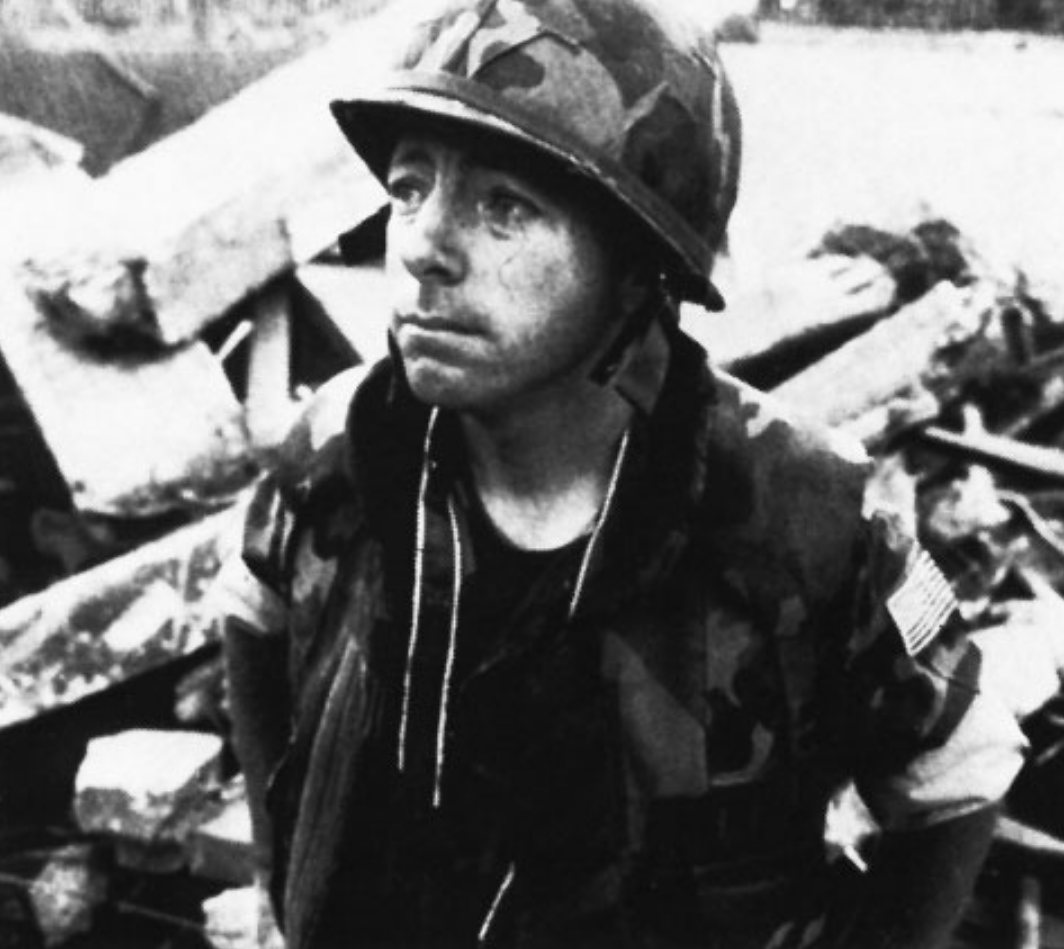
Among those who ran toward the ruins was Navy rabbi Arnold Resnicoff. As he tended to the wounded, he used his yarmulke to wipe blood and dirt from a Marine’s face. Amid the chaos, he either lost it or discarded it once it became soaked through. Catholic chaplain George Pucciarelli had arrived at the blast site wearing his purple stole so that he could administer the last rites. He noticed that his colleague no longer had anything covering his head.Pucciarelli cut a piece of camouflage cloth from his own uniform—or, more precisely, its cover—and fashioned it into an improvised yarmulke. It was not a ceremonial gesture staged for the cameras, but a practical response in the middle of a rescue operation: a Catholic priest recognized what a Jewish rabbi needed in order to continue ministering to the dead and wounded. Photographs of Resnicoff wearing the camouflage yarmulke transformed that small scrap of fabric into one of the most enduring symbols of a day marked by mass death.
The Attack That Created a Model, Not a Method
Responsibility was claimed by the shadowy Islamic Jihad Organization. U.S. authorities later linked it to the pro-Iranian circles from which Hezbollah would emerge, although the precise operational chain has never been fully established. Nor was the method invented that morning. Suicide car bombs had already been used against the Iraqi Embassy in Beirut in 1981 and the Israeli headquarters in Tyre the following year. In April 1983, the same tactic had struck the U.S. Embassy. The attack on the Marines did not invent suicide bombing. It turned it into a model visible around the world.
The Legal Battle Decades Later
The families of those killed did not seek legal redress from the anonymous organization that had claimed responsibility, but from the state they alleged had enabled it to operate. In Peterson v. Islamic Republic of Iran, a federal court in Washington ruled in 2003—in a default judgment issued without Iran’s participation—that Iran had provided material and technical support to Hezbollah, or its alleged precursor, for the attack. Four years later, surviving victims and relatives of the dead were awarded approximately $2.65 billion in damages.Winning a judgment did not mean collecting the money. The plaintiffs therefore pursued Iranian assets beyond Tehran’s reach, including roughly $1.75 billion in bonds owned by Iran’s central bank, Bank Markazi, and held through intermediaries in New York. In 2012, the U.S. Congress enacted a provision that made those specific assets available to satisfy terrorism-related judgments. Iran argued that the law had been drawn so narrowly that Congress had effectively decided the outcome of a particular court case.
In 2016, the U.S. Supreme Court rejected that argument by a vote of six to two, allowing the frozen funds to be distributed to victims of the Beirut bombing and other attacks attributed to Iranian support. The 1983 explosion thus became more than a historical reference point in debates about asymmetric warfare. More than three decades later, it also set a precedent for whether the assets of a foreign central bank could be used to satisfy judgments against a "state accused of sponsoring terrorism." The problem, of course, was that this was a process in which the United States had effectively decided in advance who was guilty.
A Window of Just a Few Seconds
The advantage of a suicide attack was terrifyingly simple. A driver who had no intention of escaping served simultaneously as the guidance system, the detonator, and the final means of correcting the weapon’s course. The defender had to secure every approach at all times, the attacker needed only a single opening lasting a few seconds. Yet the most important imbalance lay not in weaponry, but in the stakes involved. The local organization was fighting a battle it regarded as existential. For the United States, Lebanon was a distant and increasingly ill-defined mission. The attackers did not have to destroy the U.S. military. They only had to raise the cost of staying until the question in Washington shifted from "Can we remain?" to "Why are we still there?"
Ronald Reagan did not order an immediate withdrawal. On the contrary, his administration expanded the rules of engagement after the attack and, for a time, adopted an even more assertive posture. The final decision came only in February 1984, after the Lebanese Army on which the American strategy depended began to disintegrate. On February 26, the Marines left the airport and redeployed to ships offshore. The bomb was therefore not the sole reason for their departure, but it dramatically increased its political cost and offered the world a simpler lesson: inflict enough pain on a superpower, and it will retreat.
A wide range of organizations studied that lesson. The secular Tamil Tigers developed one of the largest suicide-bombing campaigns in history. Osama bin Laden later cited Beirut explicitly as proof that Americans could not endure sustained casualties. Suicide bombing spread like a military technology, crossing religious and ideological boundaries. Its effect, however, was never guaranteed. If a great power believes it is defending a vital interest, the same kind of attack may provoke a massive counteroffensive rather than a withdrawal.
The Most Vulnerable Point
The United States drew lessons from Beirut about protective barriers, vehicle standoff distances, and dispersing personnel. Far harder to solve was the political problem that no concrete barrier could stop. The truck did not capture the airport or defeat the United States militarily. It revealed something more troubling: a superpower can control the sea and the sky and still lose the strategic contest if its objective is unclear and matters more to its enemy than it does to itself. In asymmetric warfare, a great power’s most vulnerable point is sometimes not its base, but its answer to the question of why its people should be there at all.
Sources
- U.S. Department of Defense Commission Report of the DoD Commission on Beirut International Airport Terrorist Act, October 23, 1983 https://www.ibiblio.org/hyperwar/AMH/XX/MidEast/Lebanon-1982-1984/DOD-Report/index.html
- Office of the Historian, U.S. Department of State The Reagan Administration and Lebanon, 1981–1984 https://history.state.gov/milestones/1981-1988/lebanon
- Arlington National Cemetery Beirut Barracks Memorial https://www.arlingtoncemetery.mil/Explore/Monuments-and-Memorials/Beirut-Barracks
- Ronald Reagan Presidential Library Remarks at the Baptist Fundamentalism Annual Convention https://www.reaganlibrary.gov/archives/speech/remarks-baptist-fundamentalism-annual-convention
- Rabbi Arnold E. Resnicoff Beirut Barracks Bombing https://resnicoff.net/beirut/
- Congressional Research Service Terrorists and Suicide Attacks https://www.everycrsreport.com/reports/RL32058.html
- American Political Science Review The Strategic Logic of Suicide Terrorism https://www.cambridge.org/core/journals/american-political-science-review/article/abs/strategic-logic-of-suicide-terrorism/A6F51C77E3DE644EBD20ADE176973547
- Legal Information Institute, Cornell Law School Bank Markazi v. Peterson https://www.law.cornell.edu/supremecourt/text/14-770
Comments