
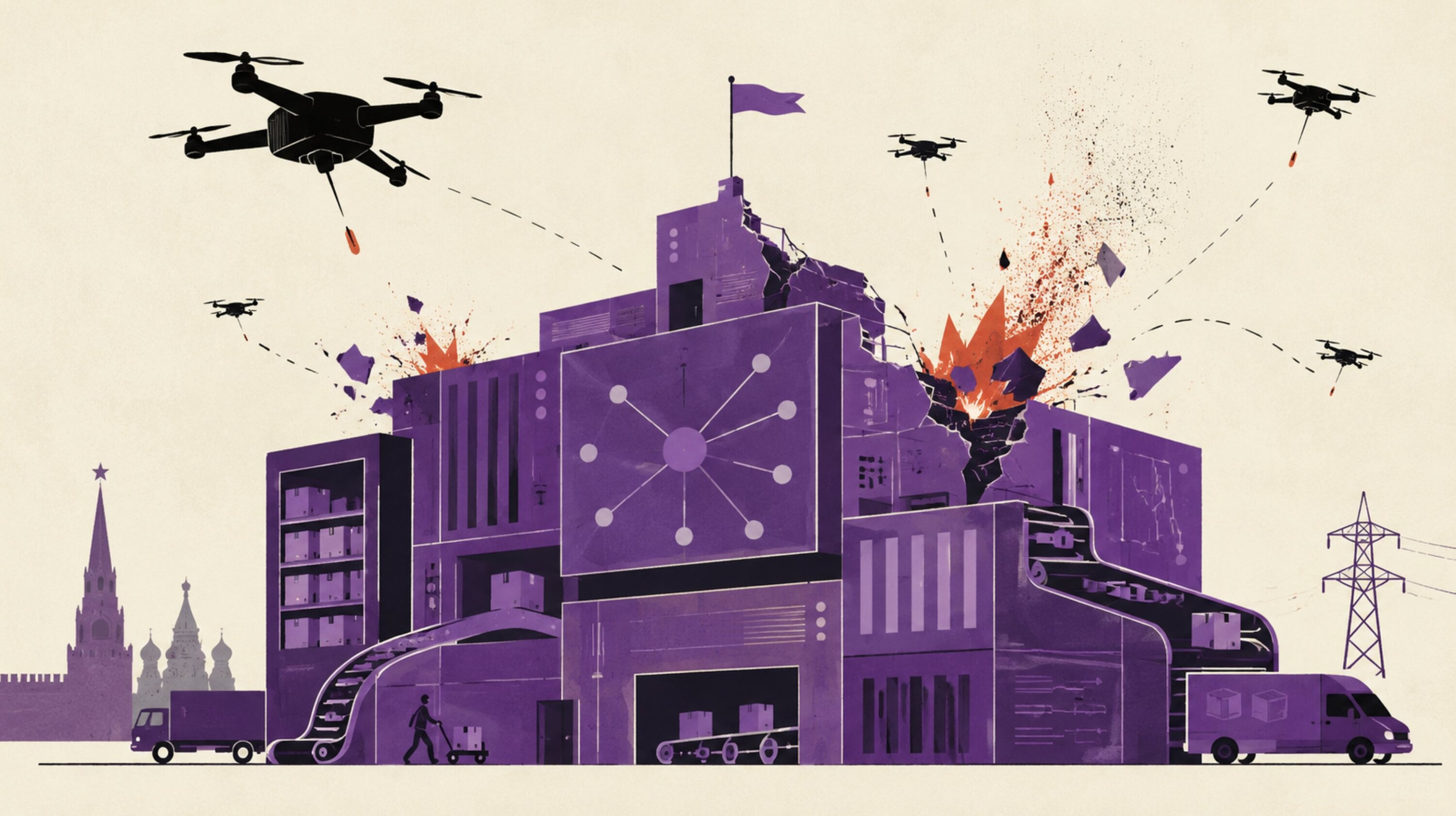
When warehouses become battlefields, war no longer only affects the army: it enters into loans, small shops, and the everyday lives of millions of people.
Wildberries’ vast warehouses were at once shops, distribution centres, banks, workplaces and the final link connecting millions of Russian customers with an enormous number of small sellers. When Ukrainian drones struck logistics hubs in Kotovsk and Elektrostal on 18 July, the flames consumed more than goods stacked on shelves. Eight workers were killed and dozens injured, while the attacks spread over the following days to Krasnodar, Nevinnomyssk, St Petersburg and the Leningrad region. By 30 July, at least seven warehouses had been badly damaged, roughly 10% of the company’s storage capacity had been destroyed or put out of service, and the death toll had risen to at least nine.
The choice of target marks a new phase in Ukrainian strikes deep inside Russia. Refineries, airfields, weapons factories and railway junctions have long been on the target list, but Wildberries belongs to a new category. It is part of the infrastructure of everyday life, the system through which people buy clothes, household appliances, medicines, cosmetics, pet food and thousands of other products. Kyiv claims that the logistics centres were used to supply the Russian military with drone components and other equipment, something both the Kremlin and the company deny. Yet Ukraine’s justification has not been limited to military logistics. A representative of one of Ukraine’s leading arms manufacturers has openly discussed Wildberries’ credit exposure and the possibility that an attack on the company could trigger problems throughout the Russian banking system.
In other words, the objective is no longer simply to prevent a particular box from reaching a military unit. It is to provoke a chain reaction in which a burned warehouse becomes a defaulted loan, a tax shortfall, a broken supply line and a source of political discontent. The war is moving out of industrial zones and military bases and into the realm of everyday consumption. Ukrainian drones are seeking to do to Russians what Russian attacks have already done to millions of Ukrainians: destroy the sense that there is still a safe rear area somewhere, insulated from the battlefield.
To understand the significance of these attacks, it is necessary to look beyond the Western nickname "Russia’s Amazon", which is both useful and misleading. Wildberries processes around 20 million orders a day, while its warehouses cover approximately three million square metres. Collecting a parcel from one of its purple pick-up points has become as routine for many Russians as going to a shop. Wildberries and its largest competitor, Ozon, together with smaller platforms, facilitate the sale of goods and services worth the equivalent of roughly 8.5% of Russia’s GDP. Directly or indirectly, the platforms provide work for around four million people, more than 5% of the Russian labour force.
It began far more modestly. Former English teacher Tatyana Kim and her then-husband Vladislav Bakalchuk launched Wildberries from their apartment in the Moscow region in 2004. The company rode the expansion of internet access, rising consumption and the realities of Russia’s immense geography, where traditional retail networks had never been able to serve major cities, provincial towns and remote regions equally well. Kim eventually became Russia’s richest woman, with Forbes estimating her fortune at around $7 billion. Her biography acquired the status of a home-grown entrepreneurial legend: proof that a vast business empire could be built outside oil, gas, metals and the well-connected privatisations of the 1990s.

Wildberries became even more important after the outbreak of the war and the imposition of Western sanctions. The departure of some foreign companies, the disruption of established supply routes and reduced access to international services created even more room for domestic digital platforms. Russian online retail grew by 28% in 2025, reaching 11.5 trillion roubles, while Wildberries became the principal link between more than one million registered sellers and customers spread across eleven time zones. As high interest rates, a strong rouble, sanctions and military expenditure weigh on the wider economy, e-commerce remains one of the few major areas of civilian growth.
The Kremlin saw more in this development than a successful retail business. Maxim Oreshkin, one of Vladimir Putin’s most influential economic advisers, described digital platforms as a new form of planned economy. Unlike the Soviet Gosplan, where officials compiled production tables for steel, tractors and shoes, the modern plan is produced by algorithms. In real time, they can see what people are buying, where goods are in short supply, how much warehouse space is required and which route a parcel should take. The larger the platform becomes, Oreshkin argued, the lower its relative coordination costs and the greater its economic efficiency.
There is intellectual appeal in that comparison, but also a considerable amount of ideological fog. Wildberries’ algorithm can calculate how many pairs of winter boots will be sold in Perm, where a warehouse should be opened and which seller should be favoured in search results. But it cannot decide for itself that Russia must develop a new generation of machine tools, medicines, passenger aircraft or microprocessors. It plans the circulation of goods, not the long-term structure of the economy. Its criteria are not politically defined social needs, but turnover, delivery speed, margins and customer retention.
Even so, it would be a mistake to underestimate the strategic value of such a system. Across a country the size of Russia, logistics is almost as important as production. Through Wildberries, a small company in a remote region can reach customers it could never have found on its own. The platform collects data, processes payments, builds warehouses and connects cities that would otherwise remain at the margins of the national market. In a country under Western financial and technological pressure, such a network begins to resemble sovereign infrastructure, even if it formally remains in private hands.
That ambition became clear in 2024, when Wildberries merged with Russ, Russia’s largest outdoor advertising operator. The stated objective was not merely to sell more products inside Russia. The new RWB Group was intended to build a high-tech commercial platform combining e-commerce, advertising, finance, media, logistics and industrial services. The project was conceived for Russia, the post-Soviet space and the Global South, from Asia and the Middle East to Africa, India and China—a potential market of almost six billion people. The merger received the Kremlin’s blessing, showing that the authorities no longer regarded the new company as an ordinary retailer.
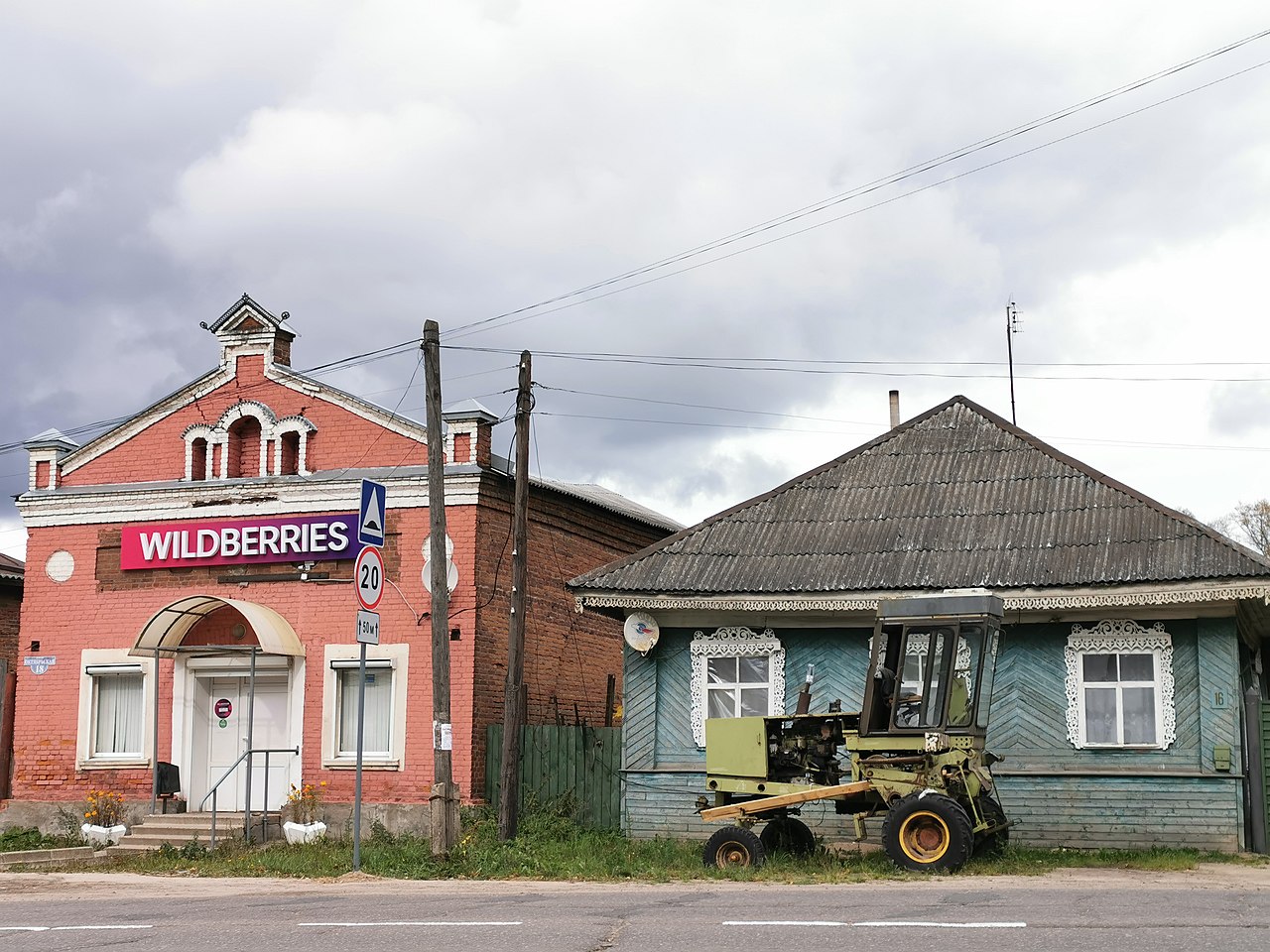
The dispute that soon erupted around the deal revealed how much was at stake. Bakalchuk described the merger as an asset grab, Chechen leader Ramzan Kadyrov became involved, and in September 2024 the confrontation ended in a shootout outside Wildberries’ Moscow headquarters that left two people dead and seven wounded. On the surface, it was a marital and ownership dispute. Behind it, however, lay a struggle for control of one of Russia’s most important new pieces of economic infrastructure.
After the merger, the RWB Group continued expanding far beyond e-commerce. It acquired Magas Airport in Ingushetia, a stake in Uzbekistan’s postal service UzPost, the Rive Gauche cosmetics chain and the Fun&Sun tour operator. In spring 2026, it bought three ride-hailing and delivery companies, putting it in direct competition with Yandex. During 2025, the group recorded net profits of 175 billion roubles and invested 310 billion roubles in logistics, information technology and new projects.
Of particular importance is its agreement with the state-owned bank VTB, which in May agreed to acquire an initial 5% stake in WB Bank, with the option of increasing its share later. Wildberries gained access to the branches, cash machines, loans and other products of Russia’s second-largest bank, while VTB gained access to the platform’s technology and tens of millions of active users. Together, VTB branches and Wildberries pick-up points are intended to form the largest physical financial and retail network in Russia. It is an extraordinarily ambitious attempt to create a domestic combination of Amazon, Alibaba, a bank, an advertising network, a delivery service and a digital identity provider.

This is precisely where the dividing line lies between genuine economic diversification and its attractive illusion. Wildberries creates jobs outside the energy sector, broadens the tax base, develops domestic financial and logistics technology, and makes it easier for small companies to do business. But the platform cannot replace the revenue generated by oil and gas exports. It largely moves goods and money around within the existing economy, while many of the products sold through it still depend on imports, Chinese industry and the purchasing power of Russian households.
The First Revolt Against the Algorithmic Gosplan
Long before Ukrainian drones exposed the vulnerability of Wildberries’ enormous warehouses, a revolt had broken out at the opposite end of its logistics system: inside the small purple parcel collection points. In March 2023, the owners of partner outlets and some employees began closing their doors after the company introduced a rule requiring them to reimburse the full value of any item returned by a customer as damaged, counterfeit or substituted. Liability could be assigned to a pick-up point even when there was no way to prove where the product had actually been damaged or exchanged.The penalties were deducted automatically from earnings. Some workers claimed that their entire pay had been confiscated, while their debt to the platform could amount to several times their monthly income. In one case, a deduction of as much as 500,000 roubles was reported. A person could come to work, spend eight or ten hours handing out parcels and discover at the end of the shift that not only had they earned nothing, but they now owed the company money. The algorithm recorded the discrepancy, assigned responsibility and closed the case, with very little opportunity to appeal.
The protest spread from Moscow and St Petersburg to the Urals, Siberia and the Russian Far East. Notices appeared on the doors of closed collection points stating that they would not reopen until wages were paid and the penalties withdrawn. Wildberries denied that a genuine strike was taking place and described the closures as an "uncivilised form of dialogue". Some participants claimed that their accounts had been blocked, that they had been threatened with termination of their contracts and that police had visited them. Only after the revolt spread, attracting the attention of the State Duma and prompting prosecutors to announce an investigation, did the company temporarily suspend the disputed rules and cancel more than 10,000 penalties that it admitted had been "incorrectly imposed".
The conflict revealed what a planned economy run not by the state but by a private platform looks like in practice. The Soviet Gosplan at least formally operated in the name of a general social objective, however often bureaucracy distorted that goal and turned it into an inefficient mechanism. Wildberries’ algorithmic Gosplan has no equivalent declared obligation. Its purpose is not to distribute risk fairly, provide stable employment or meet social needs, but to accelerate the flow of goods and protect the platform’s profitability.
Wildberries controls access to millions of customers, determines commission rates, ranks products, allocates shipments and can unilaterally change the terms of cooperation. The owner of a small collection point is formally an entrepreneur, but in reality depends on the company almost as completely as an employee depends on an employer—without employment protections, collective bargaining or any genuine influence over working conditions. The platform has found a way to centralise data, supervision and profit while decentralising debt, mistakes and responsibility.
The 2023 revolt was therefore more than a dispute over badly designed penalties. It was the first serious warning that Wildberries’ digital efficiency rested on people whose lives could be transformed overnight by an algorithm. Three years later, the same principle has reappeared in a far more dramatic form. After drones destroyed the warehouses, wartime risk once again began travelling downwards—to sellers whose stock had burned, workers who had lost their jobs and small businesses that could no longer repay their loans. The algorithmic Gosplan proved highly capable of organising a market, but far less willing to accept responsibility for a catastrophe it had failed to calculate.
Russia’s problem is also that Wildberries has become too important. The logic of the platform demands concentration: vast warehouses, automated centres, huge quantities of goods under one roof and as few steps as possible between seller and customer. In peacetime, such a system reduces costs. In wartime, it creates highly visible, highly flammable and extraordinarily expensive targets. What was yesterday the pinnacle of logistics efficiency is today a coordinate in the navigation system of a Ukrainian drone.
The consequences of the attacks are therefore serious. Sberbank has reported that around 300 companies connected to Wildberries have already requested loan restructuring. Russia’s largest bank is considering increasing its provisions for potential losses as the credit quality of online retailers and their suppliers deteriorates.
Behind the language of banking lie very real individual stories. A pet-food seller from St Petersburg, for example, told Reuters that she had lost stock worth around 1.5 million roubles in the fires. Wildberries initially gave her just 8,000 roubles in credit that could be spent on advertising on the platform. The company said it would need at least 30 days to assess the full extent of the damage, reduced some storage fees and promised assistance to affected sellers. The Russian government, meanwhile, is considering loans from state banks, tax relief and subsidies, with VTB likely to play a central role in the programme.
Before the public’s eyes, a private company is being transformed into an institution the state can no longer allow to fail. This is not merely a story about rescuing a billionaire or a corporate balance sheet. Behind Wildberries stand tens of thousands of small businesses, warehouse workers, couriers and households that rely on the platform for essential supplies. State intervention may therefore be necessary. At the same time, it reveals how much power has been concentrated inside a system that increasingly resembles public infrastructure, yet remains privately managed and governed by algorithms over which sellers, workers and customers have almost no control.
For Ukraine, that concentration is precisely what makes the company attractive as a target. Denys Shtilerman, co-founder and chief designer of Ukrainian arms manufacturer Fire Point, described Wildberries as an exceptionally large debtor and argued that its collapse could pull down banks, including VTB. Under Russian accounting standards, the company has reported around 830 billion roubles in debt. Shtilerman is not a government official, and his words should not automatically be treated as official Ukrainian strategy. But they reveal the thinking of at least part of Ukraine’s military-industrial community: the explosion is supposed to travel from the warehouse into the banks, the state budget and the public mood.
The attacks are unlikely to bring down either Wildberries or the Russian economy. Losing 10% of warehouse capacity is a serious blow, but the company can redistribute goods, build new centres and receive state assistance. Russia still possesses the financial, construction and logistics capacity required for reconstruction. Yet the true success of Ukraine’s strategy would not be measured by an immediate collapse. It is enough to force Russia to spend more on air defences, insurance, reserve storage facilities, dispersed inventories and the protection of thousands of civilian sites. Every such expense diverts resources from some other part of the state.
"Everything for the SVO": The Category That Disappeared After the Attacks
Before Ukrainian drones began setting its warehouses ablaze, Wildberries made little effort to conceal the fact that the war had its own dedicated shopping category. Under the heading "Everything for the SVO"—the abbreviation used by the Russian authorities for the war in Ukraine—there were reportedly more than 200,000 listings. They included not only conventional military equipment but an entire consumer ecosystem of war: body armour, helmets, radios, medical kits, rucksacks, patches, flags, FPV drones and their components. Some products were advertised as "SVO-tested" or "the fighters’ choice", transforming battlefield experience into a commercial endorsement, almost like a quality label.After the series of strikes, the category disappeared. Searching for "Everything for the SVO" no longer produced results, but the products themselves had not been removed from sale. Body armour and helmets could still be found among sporting goods, while FPV drones, cameras and components had been moved into television, audio and video equipment. Other search terms associated with the war continued to lead to first-aid kits, radios, military rucksacks and symbols. Wildberries had not demilitarised its inventory; it had merely removed the sign above the shelf.
This apparently cosmetic change exposes a sensitive point in Ukraine’s justification for the attacks. Wildberries is not a military warehouse in the conventional sense. Its primary function is civilian, and the overwhelming majority of its goods are intended for households and everyday consumption. Yet the platform itself linked part of its inventory to the war and facilitated the sale of products that could be used directly or indirectly on the battlefield. In an economy of mass production, the line between civilian and military goods is becoming increasingly blurred in any case: the same battery, camera, drone, cable or radio can end up with a tourist, a security guard, a filmmaker or a military unit.
The disappearance of the category is therefore more symbolically important than practically significant. The physical flow of goods has not stopped, but the digital trail that Kyiv could use as political and propaganda evidence that Wildberries was more than an innocent online shop has been removed.
Wildberries was supposed to demonstrate what Russia might look like after the age of oil dominance, Western platforms and foreign financial networks. It was never a complete alternative to the old resource economy, but it represented something Russia rarely creates: a civilian technological system capable of expanding across borders, connecting small producers and building its own financial and logistics infrastructure. Now its warehouses are burning precisely because it became important.
Here lies the deepest contradiction of Russia’s wartime economy. The state is attempting to fight a long and increasingly expensive war while simultaneously building technological sovereignty and preserving a normal life for its population. Ukraine, with the fullest possible backing of the West, is trying to prove that all three cannot be sustained without an ever-rising price. The greatest danger for Moscow is therefore not merely the loss of goods, but the possibility that the war will begin devouring precisely those parts of the economy that were supposed to represent the future that would come after it. And the greatest tragedy of such a strategy remains painfully ordinary: before economic pressure reaches the people at the top, it passes through warehouse workers, small traders, debtors and families who receive nothing from grand geopolitical schemes except bills they can no longer afford to pay.
Sources
- Financial Times Russian online retailer Wildberries becomes target for Ukraine’s drones https://www.ft.com/content/5c9ae967-8e85-470f-974b-43667cc6f1c1
- Reuters Wildberries, 'Russia's Amazon', becomes a target for Ukraine https://www.reuters.com/business/retail-consumer/wildberries-russias-amazon-becomes-target-ukraine-2026-07-22/
- Associated Press Ukraine hits Russia’s largest online marketplace, hurting small businesses and bringing the war home https://apnews.com/article/d69c6db025a0ff779db9606b9982b1d9
- Themoscowtimes.com Wildberries & Russ Buys 3 Ride-Hailing and Delivery Companies in Direct Challenge to Yandex https://www.themoscowtimes.com/2026/04/02/wildberries-russ-buys-3-ride-hailing-and-delivery-companies-in-direct-challenge-to-yandex-a92404
- Wsj.com Drone Attacks on Russia’s Biggest Online Retailer Bring War Home to Middle Class https://www.wsj.com/world/russia/drone-attacks-on-russias-biggest-online-retailer-bring-war-home-to-middle-class-2e98507e
- Akit.ru 11,5 трлн рублей: АКИТ подвела итоги интернет-торговли за 2025 год https://akit.ru/news/11-5-trln-rublej-akit-podvela-itogi-internet-torgovli-za-2025-god
- En.thebell.io Wildberries set for new Putin-approved shareholders https://en.thebell.io/wildberries-set-for-new-putin-approved-shareholders/
- Interfax.com Wildberries & Russ looking into possibility entering Africa https://interfax.com/newsroom/top-stories/112121/
Comments