
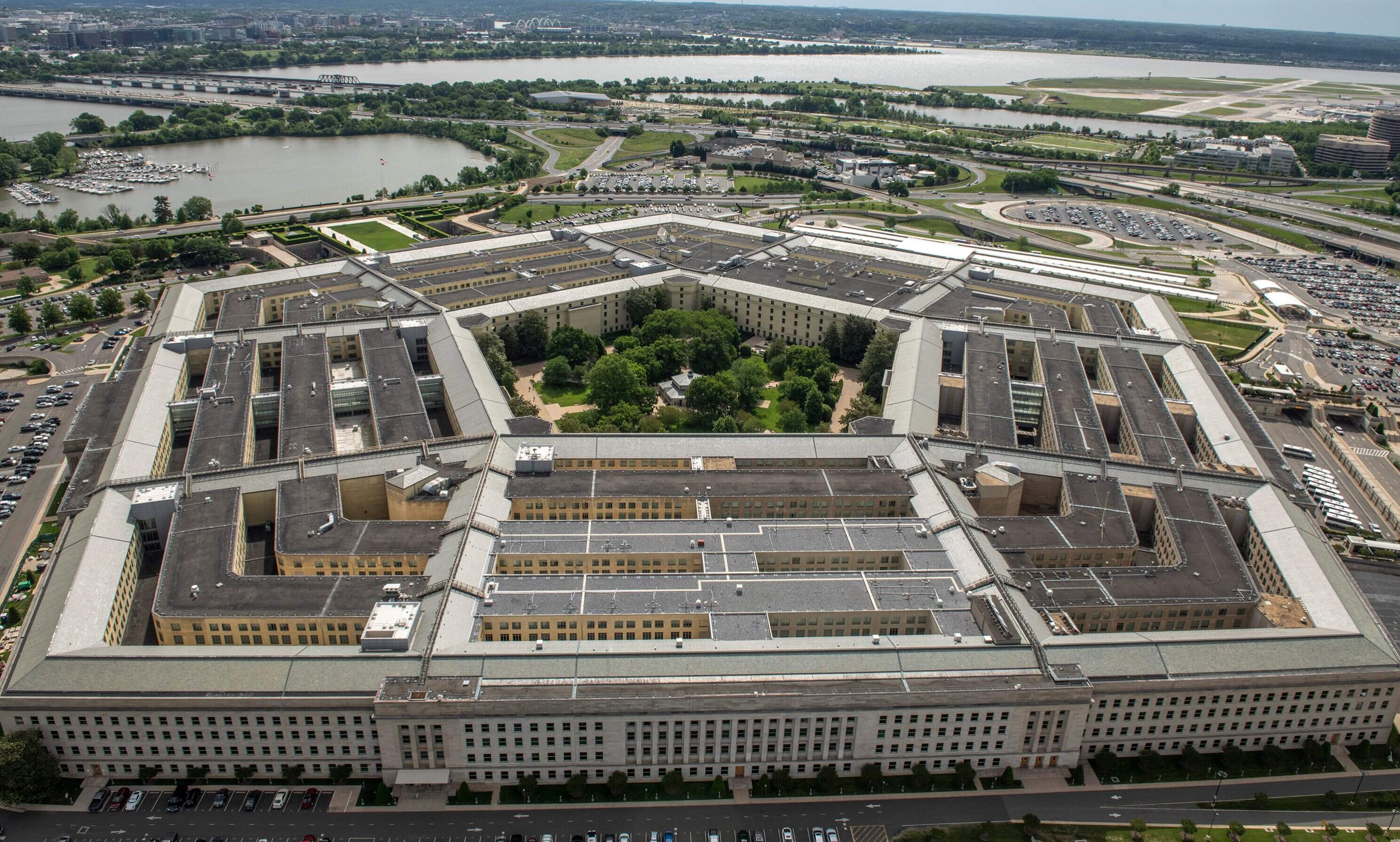
The most recognizable building of American military power was born not of grand strategy, but of a mundane shortage of office desks. When construction began on the future Pentagon in Arlington on September 11, 1941, the date carried no special weight. It was merely a Thursday on the administrative calendar of a country rapidly preparing for a war it had not yet officially entered.
Exactly sixty years later, the hijacked Boeing 757 operating as American Airlines Flight 77 struck the western side of that same building. Between those two mornings there was, as far as we know, no secret connection, omen or hidden message. There was, however, an almost perfect coincidence of dates.
A state growing faster than its walls
In the summer of 1941, Germany controlled much of Europe, while the administration of US President Franklin D. Roosevelt supplied the countries fighting Hitler. The United States was still formally neutral, but its military bureaucracy behaved as though it already knew what its politicians were not yet permitted to say aloud. The War Department employed more than 24,000 people scattered across 17 buildings in the Washington area. A new building in Foggy Bottom had only just opened, yet it was already too small.
The solution came from Brigadier General Brehon B. Somervell, head of military construction. On Thursday, July 17, he summoned engineer Hugh J. Casey and architect George Edwin Bergstrom. By Monday, he wanted a basic design for an air-conditioned building capable of accommodating 40,000 people, with roughly 372,000 square metres of office space. It had to be low-rise and conserve strategically vital steel. Casey later described the deadline as "a very busy weekend". Yet the plan was ready by Monday.
Even the pentagonal shape had nothing to do with military symbolism or secret codes. The original site, Arlington Farms, was bounded by five roads, so the designers drew an irregular five-sided building that would fit between them. Roosevelt then moved the construction site roughly 1.2 kilometres south because the complex would have spoiled the view between Washington and Arlington National Cemetery. The pentagonal form was no longer necessary at the new location, but the design was already well advanced and the layout had proved practical. The most recognizable geometry of American power is therefore the fossil of an abandoned address, determined by roads surrounding a plot on which the building was never constructed.
They built faster than they could draw
Construction officially began on September 11, 1941, even though the complete plans did not yet exist. Designers issued new drawings at night, while the building site sometimes raced ahead of the technical specifications.
By early December, around 4,000 people were working in three shifts. Six days later, the attack on Pearl Harbor turned America’s preparations for war into open warfare. At its peak, the site employed some 15,000 workers. The first officials moved in during April 1942, while the rest of the Pentagon was still unfinished. The building was completed on January 15, 1943, just 16 months after construction began.
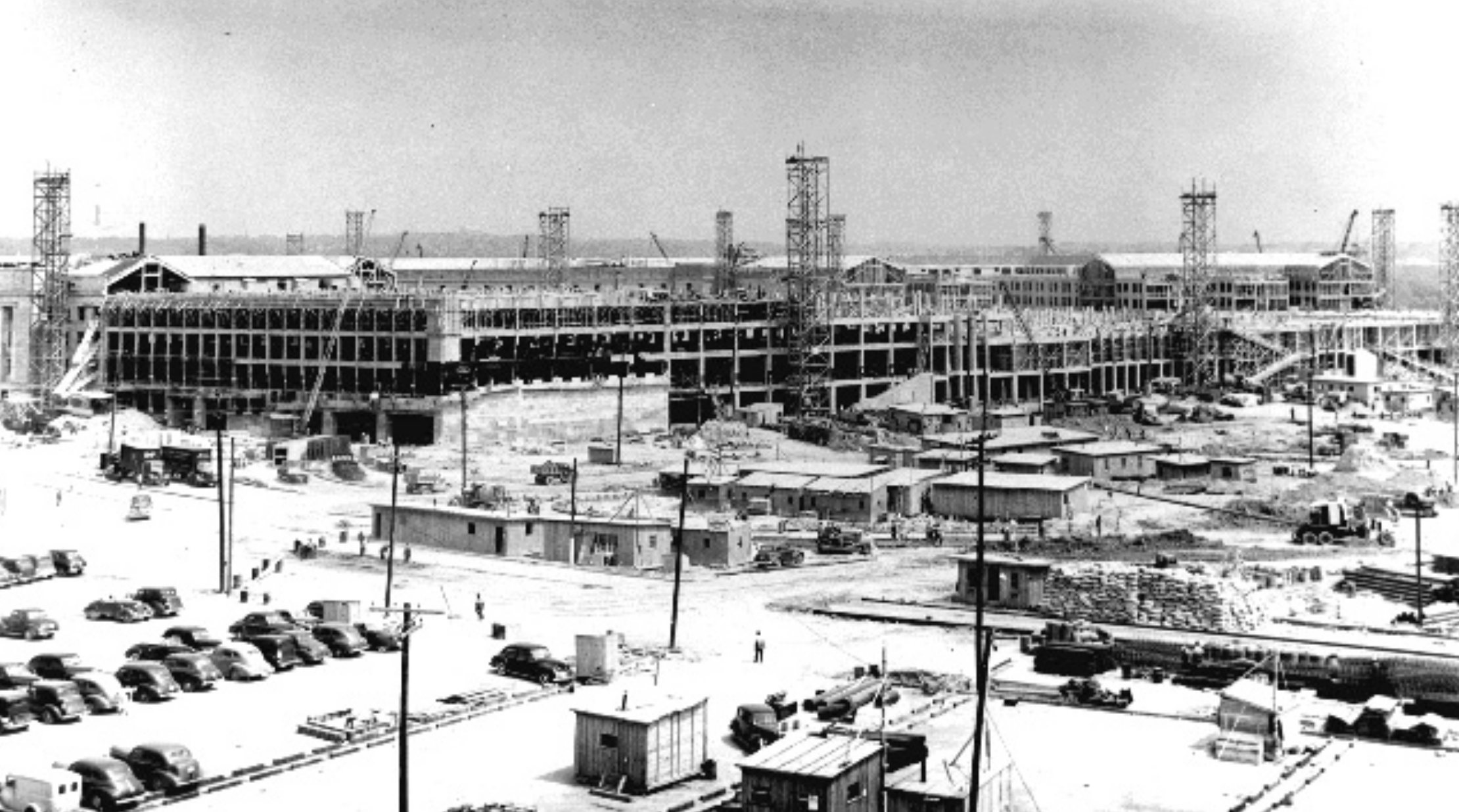
The war also dictated the choice of materials. More than 41,000 concrete piles were driven into the ground, while sand and gravel were dredged from the Potomac River. Concrete ramps largely replaced passenger lifts. Decorative elements requiring metal needed for weapons were abandoned. The five concentric rings contained around 28 kilometres of corridors, but radial passageways made it possible to walk between the two most distant points in approximately seven minutes.
Construction was overseen by Colonel Leslie R. Groves, an Army Corps of Engineers officer known for meeting impossible deadlines. In September 1942, before the Pentagon had even been completed, he took charge of the Manhattan Project. The same man thus organized the construction of the largest military office complex of its time and then the development of the American atomic bomb. He later said that he had hoped to be sent to a combat zone so that he might find a little peace.
That same day, Roosevelt delivered a radio address following an encounter between the American destroyer USS Greer and a German submarine. He announced that American vessels would no longer wait for Axis forces to fire first in waters deemed vital to US defence. Neutrality still existed in law, but in the Atlantic it was rapidly becoming a fiction.
The tenant, not the concrete, was meant to be temporary
It is often said that the Pentagon was intended as a temporary building, but that is not entirely accurate. What was meant to be temporary was its role as a military headquarters. It was not conceived as a disposable wartime barracks, but as a permanent reinforced-concrete structure that would later be given a different purpose. Roosevelt expected the military to shrink again after victory and the War Department to return to an expanded headquarters in Foggy Bottom.
The most concrete proposal was to turn the building into a repository for government and military records. Its floors were therefore designed to bear roughly 730 kilograms per square metre, enough to support rows of heavy filing cabinets. Other suggestions included converting it into a 15,000-bed hospital. As late as January 1945, Roosevelt was proposing that the personnel records of all the armed services be moved into the Pentagon. He imagined it less as a temple of military power than as the world’s largest filing cabinet.
The most dangerous kiosk in the world
For decades, an unremarkable food kiosk stood in the central courtyard of the Pentagon, at the geometrically neatest point in the entire complex. Employees bought hot dogs, coffee and quick lunches there, and during the Cold War it became known as "Café Ground Zero". The Pentagon would inevitably have been among the Soviet Union’s primary targets in a nuclear war, and the kiosk stood almost precisely at its centre.But a much better story circulated through the corridors. According to legend, Soviet analysts examining satellite images noticed crowds gathering around the small structure in the middle of the courtyard every day and concluded that it concealed the entrance to an underground command bunker. In reality, the Americans were merely going to lunch, and no publicly available evidence of this supposed Soviet conclusion has ever emerged. When the old kiosk was scheduled for demolition in 2006, the US Department of Defense itself described the story as a Cold War legend. Even so, it is difficult to imagine a more fitting tale about the Pentagon: a building filled with state secrets was said to have concealed its greatest secret in the place where hot dogs were sold.
The return to pre-war normality, however, never came. The wartime alliance with the Soviet Union gave way to the Cold War, while wartime mobilization was replaced by a permanent global military apparatus. The National Military Establishment was created in 1947, then consolidated by the 1949 amendments into a single executive department and renamed the Department of Defense. The Pentagon became shorthand for the entire system of American military power. The temporary need proved more enduring than the peace that was supposed to make it obsolete.
The date that returned
When Flight 77 struck the Pentagon on September 11, 2001, it was travelling at approximately 850 kilometres per hour, and parts of the aircraft penetrated three of the building’s outer rings. The attack killed 125 people inside the building and another 59 passengers and crew aboard the flight. The five hijackers also died, bringing the total in technical accounts that include them to 189. The Pentagon Memorial contains 184 benches, one for each victim of the attack.
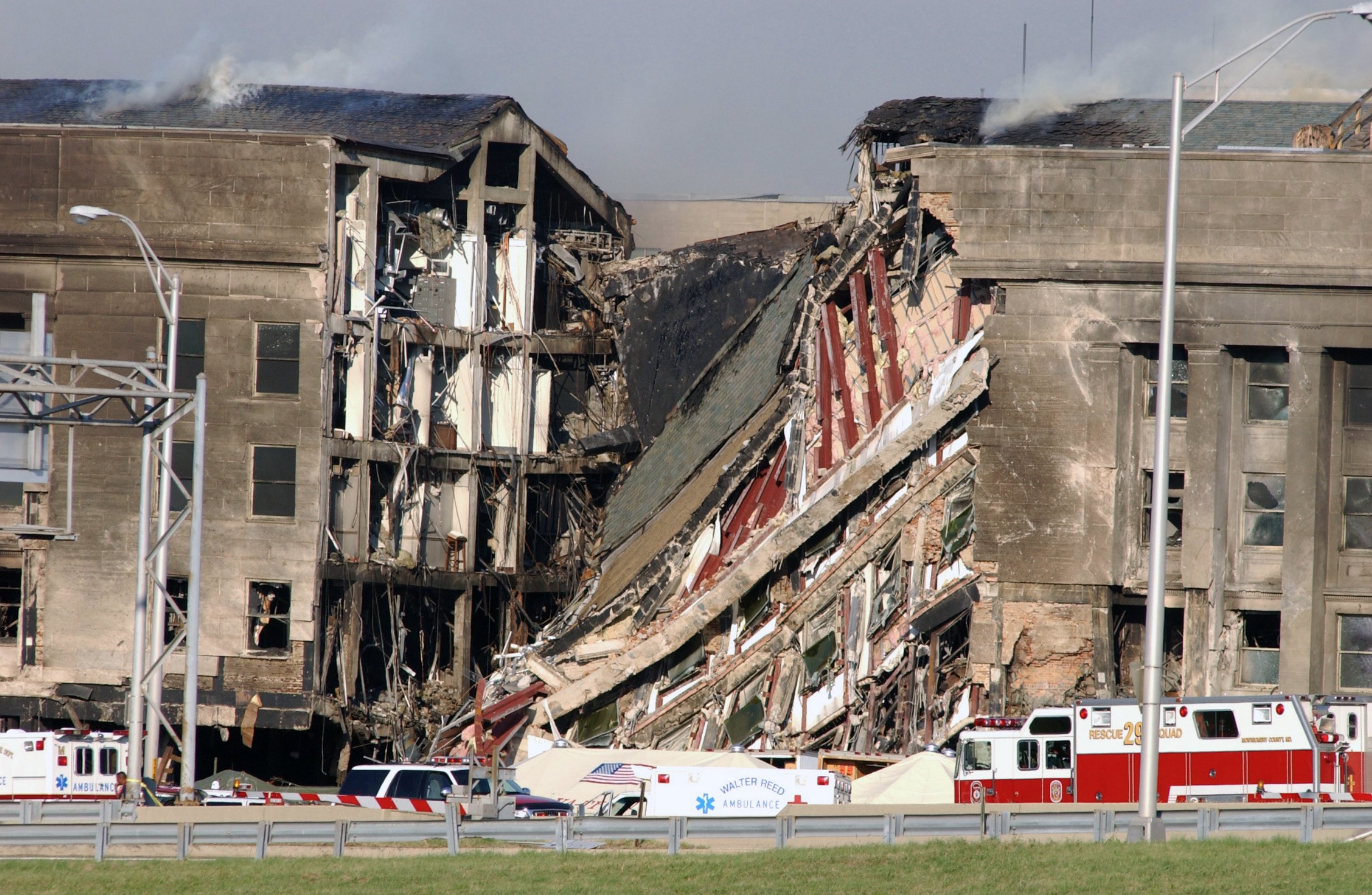
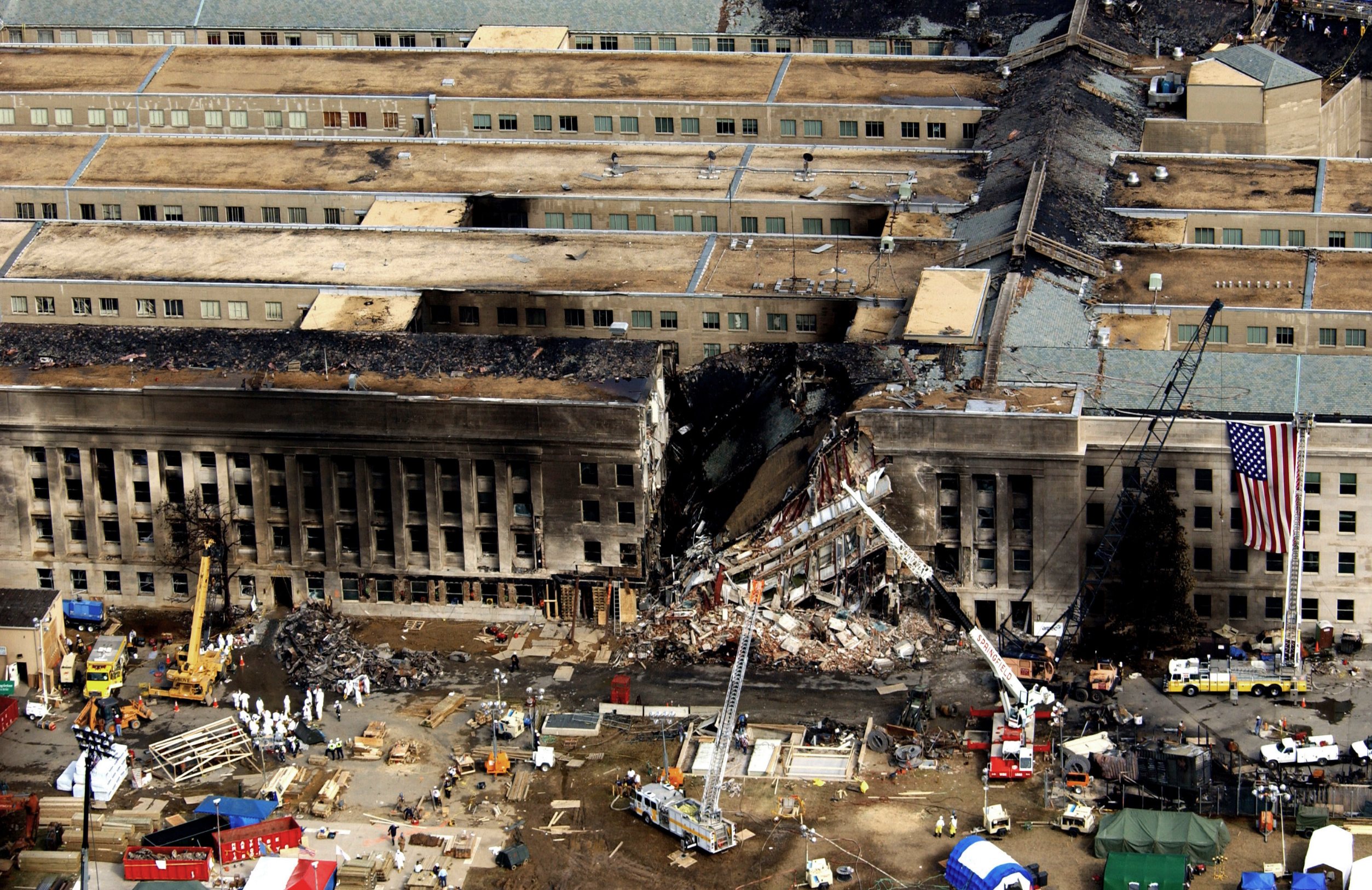
The death toll could have been far higher. The aircraft struck the boundary between a newly renovated sector and an adjoining section that had been largely emptied for further work. Blast-resistant windows, steel reinforcements and upgraded fire-detection and suppression systems limited the damage. So did the original reinforced-concrete structure. Part of the outer E Ring did not collapse until around 10:15, almost 40 minutes after impact, giving people time to escape.
The missile, the missing trillions and the real holes in the story
Conspiracy theories about the Pentagon did not emerge from nothing. The first photographs showed a relatively small hole in the façade, large pieces of the aircraft were not readily visible, and the few released security-camera recordings were grainy and captured from poor angles. From this came the best-known claim: that the Pentagon was struck not by a Boeing 757, but by a missile, a smaller military aircraft or explosives planted inside the building, while Flight 77 disappeared somewhere else. That version cannot withstand the totality of the evidence: the radar-recorded flight path, the felled light poles, aircraft debris and flight recorders, the identified remains of those aboard and eyewitnesses who saw a large passenger jet. Nor is the "too-small hole" particularly mysterious. The wings could not cut a neat aircraft-shaped silhouette through reinforced concrete. They disintegrated on impact at around 850 kilometres per hour, while the strongest part of the fuselage penetrated farther into the building.Other theories claim that air defences were deliberately withdrawn, that the recently renovated and sparsely occupied sector of the Pentagon was chosen on purpose, or that the attack was intended to destroy evidence concerning the $2.3 trillion Donald Rumsfeld had mentioned the previous day. Here, genuine facts are assembled into a false conclusion. The damaged sector had indeed been partially emptied for renovation, and Rumsfeld had indeed spoken of $2.3 trillion in transactions that lacked a proper audit trail, not an equivalent amount of missing money. There is no evidence that the attack was intended to destroy a financial investigation, but the Pentagon’s accounting chaos was real and did not disappear beneath the rubble.
The theory with the greatest basis in reality concerns institutional failure and the subsequent concealment of embarrassing mistakes. After Flight 77’s transponder was switched off, controllers lost track of the aircraft and searched in the wrong direction. The military learned that it was missing only by chance, just minutes before the impact. The 9/11 Commission later found that NORAD’s initial public timelines had been inaccurate. Legitimate questions also remain about contacts between some of the hijackers and certain Saudi nationals or individuals connected to Saudi institutions, although there is no proof that the Saudi state organized or financed the attack. The strongest grounds for suspicion surrounding September 11 are therefore not that the aircraft never existed, but that American institutions failed to connect the warnings beforehand and then spent years awkwardly concealing how little they had known and how poorly they had communicated with one another.
The reconstruction of the destroyed section was named Project Phoenix. The first employees returned to the rebuilt offices on August 15, 2002, almost a month ahead of schedule.
There is no need to search this coincidence for prophecy. Nothing in the established chronology of the attack’s planning suggests that the anniversary of the start of construction played any role. What is fascinating is the way a later event can erase the meaning a date once had. Had the Pentagon become an archive after the war, September 11, 1941, would have remained a minor detail in architectural history. The date became faintly sinister because a military headquarters conceived for temporary wartime circumstances endured, outgrew its original purpose and eventually became a target precisely because of the meaning it had accumulated over the decades.
Sources
- Time Magazine Colossal: LIFE at the Birth of the Pentagon https://time.com/3872253/pentagon-photos-from-the-construction-of-a-colossal-office-building/
- Usace.army.mil 034 - the Corps Built the Pentagon in 16 Months https://www.usace.army.mil/Media/Fact-Sheets/Fact-Sheets-View/Article/4464599/034-the-corps-built-the-pentagon-in-16-months/
- History.defense.gov Pentagon History https://history.defense.gov/DOD-DOW-History/Pentagon/History/
- Associated Press Judge rejects Saudi Arabia’s bid to dismiss claims it supported 9/11 hijackers https://apnews.com/article/51f3692499ade7b1e320bc54b8d218eb
- Vault.fbi.gov 9/11 Material Released in Response to Executive Order 14040 https://vault.fbi.gov/9-11-attacks-investigation-and-related-materials/9-11-material-released-in-response-to-executive-order-14040
- Pentagonmemorial.org 9/11 at the Pentagon - 9/11 Pentagon Memorial https://www.pentagonmemorial.org/9-11-at-the-pentagon/
- Govinfo.gov THE 9/11 COMMISSION REPORT https://www.govinfo.gov/content/pkg/GPO-911REPORT/pdf/GPO-911REPORT.pdf
Comments