
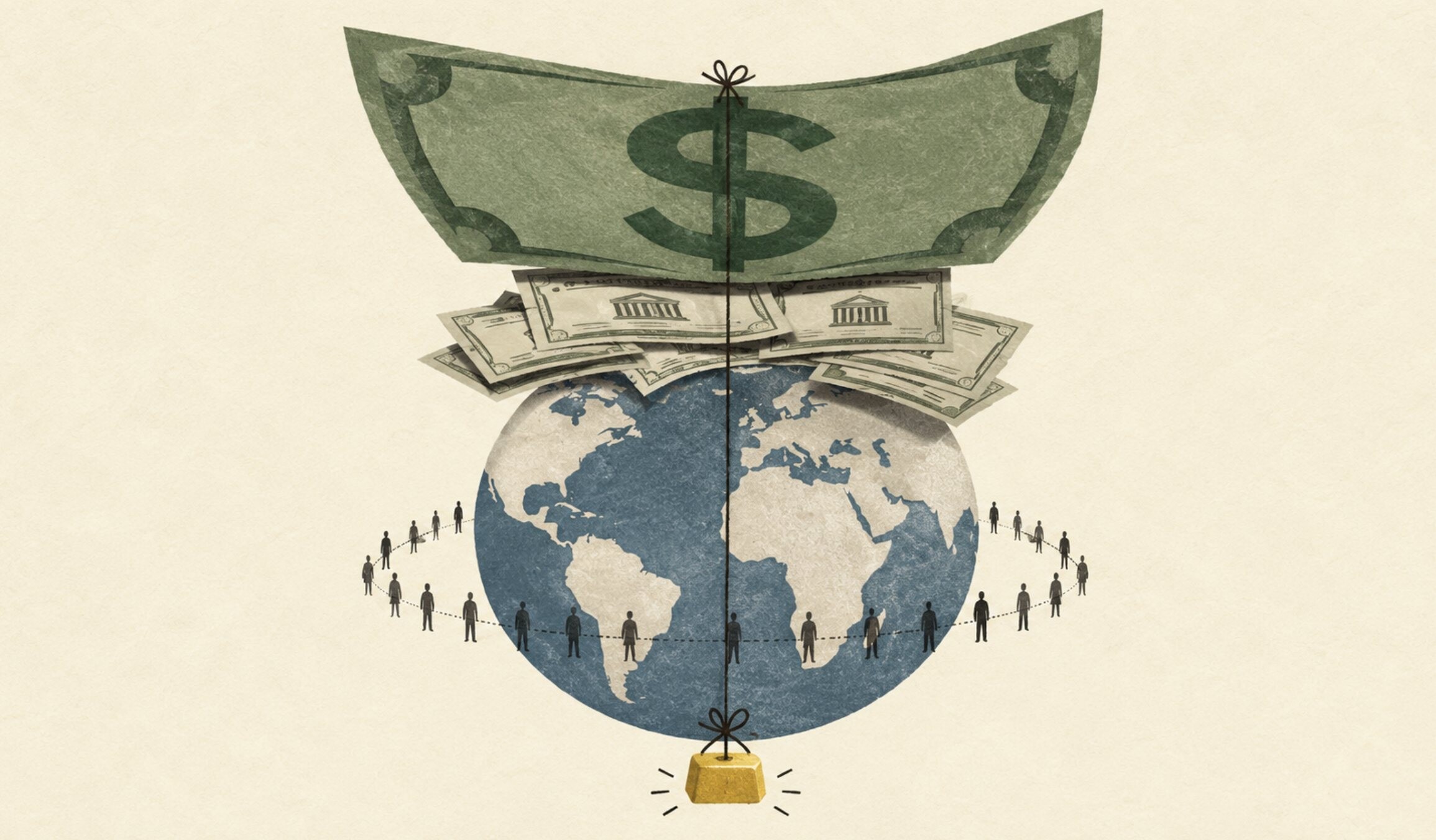
The world's currency rests on a paradox: for everyone to want it, America must create it so much that eventually they start doubting it.
When Richard Nixon announced on August 15, 1971, that the United States would no longer exchange dollars held by foreign central banks for gold, he presented the decision as a temporary measure to defend the American currency. That temporary measure was never reversed. The gold window remained closed, and the monetary order created at Bretton Woods began to unravel.
On the surface, the United States had broken the promise underpinning the postwar system. At a deeper level, that promise had become impossible to keep precisely because the dollar had been so successful. The world needed ever more American currency, while America’s stock of gold was finite.
This was the Triffin dilemma: a global currency must flow out of the country that issues it, but the more of it accumulates abroad, the more obvious it becomes that all those claims can never be redeemed at once. The dollar had to bleed in order to rule.
A system that consumed itself
Bretton Woods did not restore the classical gold standard in 1944. It created a gold-dollar order. Other countries pegged their currencies to the dollar, while the US government promised foreign monetary authorities that it would convert their dollars into gold at a fixed price of $35 an ounce. The dollar became the intermediary between national currencies and gold: global money backed by the American state.
The United States emerged from the war with immense industrial power and vast reserves of monetary gold. Europe and Japan needed dollars to import machinery, energy, food and raw materials. America supplied them through aid, military spending, loans, investment and purchases of foreign goods.
That was where the contradiction began. For international trade to expand, more dollars plainly had to enter circulation. Yet every dollar held in the reserves of a foreign central bank was also, in principle, a potential claim on America’s gold. The more successfully Washington supplied the world with liquidity — the means to pay, save and settle debts — the more rapidly it undermined the credibility of its own supposedly “gold-backed” guarantee.
The United States could reduce the flow of dollars abroad and close its balance-of-payments deficit. That would protect its gold, but deprive the world of fuel. Countries would be forced to restrict imports, suppress demand and compete for scarce reserves. The alternative was to continue creating dollar liquidity and allow America’s foreign liabilities to exceed the gold that supposedly backed them. The first path led towards deflationary pressure; the second towards a crisis of confidence.
The machine could function only by manufacturing its own breakdown.
The man who saw the fracture before the collapse
The Belgian-American economist Robert Triffin systematically described this contradiction in the late 1950s and then in his 1960 book Gold and the Dollar Crisis. His argument was not simply that America would “print too much money.” The problem was institutional: a national currency had been assigned the role of an international public good.

American monetary policy had to serve both the domestic economy and the needs of the entire system. If the Federal Reserve tightened policy and Washington reduced its external deficits to defend the dollar, other countries would be starved of reserves. If America continued exporting dollars, it would raise ever more serious doubts about their convertibility into gold.
The Triffin dilemma is not merely a story about an irresponsible state. It demonstrates that an international monetary system cannot rest comfortably on the promise of a single national government when the entire world is required to accumulate that government’s liabilities. One country’s reserve is another country’s debt. What a central bank in Paris, Bonn or Tokyo recorded as a safe asset, Washington recorded as a liability. At least, that was how the system worked until Nixon.
Nixon did not destroy Bretton Woods. He announced that it had already collapsed
By the end of the 1960s, the volume of dollars held abroad was growing faster than America’s capacity to convert them into gold. The costs of the Vietnam War, domestic expansion, foreign investment and the global US military presence all increased the outflow of dollars, while foreign monetary authorities began testing the credibility of America’s promise with growing seriousness.
Nixon closed the gold window in 1971 to prevent a looming flight from the dollar into gold. A brief attempt to preserve fixed exchange rates followed under the Smithsonian Agreement, but Bretton Woods soon disintegrated. The dollar, however, did not lose its central position. It merely lost the obligation to pretend that it was gold.
Before 1971, the world’s dollar reserves were formally claims on American gold. Afterwards, they became — and this is crucial — claims on the American state, its power to tax, its economy and its financial markets. The anchor was no longer metal stored in a vault. The anchor was US government debt.
That is why the end of gold convertibility did not end the dollar’s dominance. Banks, companies and governments still needed a common currency. The US Treasury market offered immense scale, deep liquidity and assets that could be bought, sold or pledged at short notice. The network reinforced itself: the more trade, lending and reserves were denominated in dollars, the more expensive it became to switch to anything else.
The oil order that emerged in the 1970s strengthened this network further. After the oil shock, cooperation between the United States and Saudi Arabia helped channel part of the oil revenues back into American securities, while oil continued to be priced overwhelmingly in dollars. The “petrodollar” was not a magical agreement that created American power. It was a system for recycling surpluses that supplied fresh fuel to an already established dollar infrastructure.
The privilege is not shared equally
Issuing the world’s principal reserve currency is an enormous privilege. The United States can borrow from the rest of the world in a currency it creates itself. When the world seeks safe assets, it buys US government bonds and helps finance the American state. America imports goods while exporting dollar liabilities that other countries hold as reserves.
Yet that privilege also carries a domestic cost. Global demand for dollars and American financial assets attracts capital, supports the exchange rate and makes imports cheaper. This benefits Wall Street, owners of financial assets, multinational corporations and consumers buying inexpensive imported goods. At the same time, it can weaken export industries and accelerate the relocation of production abroad — which is precisely what happened.
The dollar is therefore a privilege of the American state, but not necessarily of every American, especially the American worker. The financial centre receives cheap capital and global demand for its securities, while industrial cities receive import competition and shuttered factories. Monetary empire generates gains, but does not distribute them evenly. In contemporary America, that has become increasingly difficult to ignore.
The world’s safest asset is produced by American borrowing
In American politics, public debt is routinely presented as a national weakness — a rising counter, a bill left to future generations and proof that the country is living beyond its means. In global finance, the very same debt looks entirely different. US Treasury securities are treated as the benchmark safe asset: the place where central banks store their reserves, financial institutions park their money and markets obtain the collateral required for an immense volume of transactions. What is a public debt for the American taxpayer is an asset for the rest of the system.When Washington borrows, it does not merely create a new liability. It also creates a new Treasury security: a standardised, easily transferable and exceptionally liquid financial instrument that can be held, sold, pledged or reused as collateral for another loan. A single bond can therefore support an entire chain of financial transactions. Federal Reserve research has shown that US Treasury securities are reused as collateral far more extensively than other types of financial assets. Public debt does not merely finance the US budget; it also lubricates the financial machinery far beyond America’s borders.
This creates a paradox resembling a modern version of the Triffin dilemma. The world wants more safe dollar-denominated assets, and America can provide them primarily by borrowing more. When Congress talks about reducing the deficit, markets may welcome it as a sign of fiscal responsibility. But if the US government genuinely stopped issuing enough bonds, the global system would begin to run short of the very asset it uses as a reserve, a pricing benchmark and the foundation of secured lending. Too little American debt can create a shortage of safe assets, while too much may eventually undermine confidence that those assets are truly safe.
The safety of a US Treasury bond rests on the size of the American economy, the state’s power to tax, the depth of its markets, its military and political strength, and the assumption that the Federal Reserve will intervene in an emergency to prevent the system from collapsing entirely. In March 2020, even the Treasury market came under severe pressure as investors desperate for cash began selling the very assets they ordinarily regarded as a refuge. The Fed had to intervene to restore the market’s functioning. The world’s safest asset proved safe partly because an institution stood behind it with the power to buy when nobody else would.
American debt is therefore not merely a “consequence of the dollar empire.” It is one of that empire’s principal products. The world criticises Washington for borrowing while simultaneously demanding its bonds as a place to store its own surpluses. The dollar rules a system in which an American liability becomes someone else’s security — until, one day, the sheer volume of promises begins to erode confidence in the country making them.
The Triffin dilemma should not be reduced to the claim that America “must” run a budget deficit every year. It originally concerned the balance of payments and the growth of external dollar liabilities under gold convertibility. Today, the connection is more indirect: US public debt creates precisely the kind of safe and liquid assets that the global system wants to hold. What Washington presents as a fiscal problem functions as infrastructure in the vaults of foreign central banks.
The modern dollar does not rest on the absence of debt, but on the belief that American debt is the safest in the system. That foundation is more flexible than gold, but it is not limitless. If liabilities continue expanding while the state’s political capacity to manage them deteriorates, the old Triffin fracture will reappear in a new form.
Dedollarisation without a successor
Predictions of the dollar’s imminent demise return with regularity, but the figures still describe a much slower shift. In the first quarter of 2026, the dollar accounted for roughly 57% of the world’s foreign-exchange reserves included in the COFER database, the euro for around 20%, and the Chinese renminbi for less than 2%.
Dedollarisation is nevertheless real. Central banks are buying more gold, some trade is being shifted into local currencies, and American financial sanctions are encouraging governments to reduce their exposure to assets that Washington can freeze. But abandoning the dollar is not the same as finding a replacement for it.
The euro has neither a unified state nor a common public-debt market comparable to America’s. China possesses industrial power and an expanding trade network, but restricts the movement of capital. Gold has no issuer and no political adversary, but it cannot by itself finance the daily volume of global credit. Smaller currencies may absorb parts of the world’s reserves, but they cannot replace the entire system.
Triffin did not want another national currency. He wanted money above nations
When Robert Triffin warned that the dollar could not permanently remain both America’s currency and the foundation of the global monetary system, he was not proposing that it should simply be replaced by the German mark, the Japanese yen or some future Chinese currency. Such a change would merely relocate the same contradiction to another capital. Any new monetary hegemon would still have to supply the world with its own debts, subordinate domestic policy to the needs of foreign users of its currency and eventually confront a crisis of confidence.Triffin envisioned international reserve units that would depend neither on gold nor on the obligations of a single state. They would be created by a common monetary institution, above all a reformed International Monetary Fund, in quantities suited to the expansion of world trade. Global liquidity would no longer arise because America imported more than it exported, financed wars or borrowed money, but through a political decision taken by the international community.
Part of that idea was realised in 1969 with the creation of Special Drawing Rights, or SDRs. These are reserve assets issued by the IMF, whose value is now based on a basket of five major currencies. An SDR, however, is not genuine money that citizens use to buy goods, companies use to pay suppliers or banks use in everyday lending. It has remained a supplement to existing reserves rather than a replacement for them.
The reason was not technical, but political. Money above nations would require authority above national interests — an agreement over who creates it, how much is created, who receives it and under what conditions. States controlling the leading currencies would have to surrender part of their power, while poorer countries would need a stronger voice in an institution that remains dominated by the largest economies. It is not difficult to see why such an idea never took hold.
Triffin’s solution was therefore never truly tested. Instead of creating a neutral reserve currency, the world moved even deeper into the dollar system after 1971. The problem did not disappear. Only the gold that had made it visible was removed. The dollar continued supplying the planet with liquidity, while the international monetary order remained dependent on the debt, institutions and political decisions of a single state. Humanity created a world economy, but not a world currency that belonged to it.
Related: Keynes’s Bancor: The World Currency That Could Have Prevented an American Monetary Empire
Here lies the final irony of the Triffin dilemma. The world distrusts American liabilities, yet still needs them. It wants less dependence on Washington, but no other state can produce enough open, liquid and supposedly safe liabilities for the entire global economy.
The dollar will therefore not lose its power on the day other countries stop liking America. Monetary systems are not built on affection. It will lose that power when the world no longer needs to hold American debt in order to trade, save and survive a crisis — or when the United States itself destroys the institutions that still make its promises appear safer than everyone else’s.
Sources
- History.state.gov Milestones in the History of U.S. Foreign Relations - Office of the Historian https://history.state.gov/milestones/1969-1976/nixon-shock
- Data.imf.org IMF Data Brief: Currency Composition of Official Foreign Exchange Reserves https://data.imf.org/en/news/imf%20data%20brief%20july%201
- Federalreservehistory.org Nixon Ends Convertibility of U.S. Dollars to Gold and Announces Wage/Price Controls | Federal Reserve History https://www.federalreservehistory.org/essays/gold-convertibility-ends
- Federalreserve.gov The International Role of the U.S. Dollar – 2025 Edition https://www.federalreserve.gov/econres/notes/feds-notes/the-international-role-of-the-u-s-dollar-2025-edition-20250718.html
- Brookings.edu Commentary The Fed’s Role in International Crises https://www.brookings.edu/articles/the-feds-role-in-international-crises/
- Ecb.europa.eu The Triffin dilemma revisited https://www.ecb.europa.eu/press/key/date/2011/html/sp111003.en.html
- Ies.princeton.edu GOLD AND THE DOLLAR CRISIS: YESTERDAY AND TOMORROW https://ies.princeton.edu/pdf/e132.pdf
- Bis.org Triffin: dilemma or myth? https://www.bis.org/publ/work684.pdf
Comments