
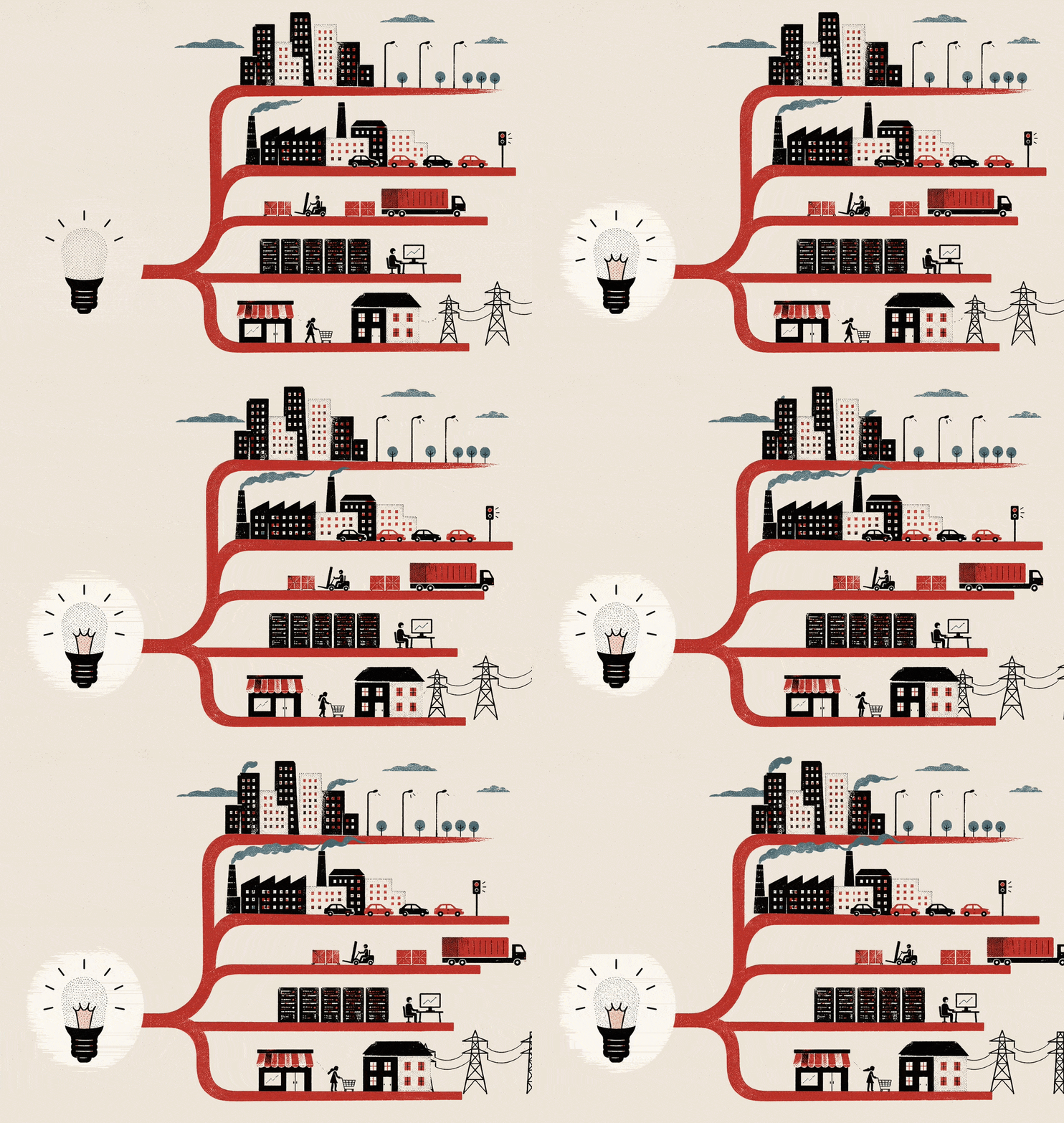
Saving is usually imagined as consuming less. That sounds logical enough, but the economic order has a habit of bypassing logic and turning a potential solution back into the problem.
So let us begin with the logic. Build a more efficient engine and we use less fuel. Install LED lighting and we consume less electricity. Design a better chip and we perform more calculations with less energy. On paper, it sounds perfect: technology works, markets innovate, consumption falls, the planet can breathe more easily, and so can our wallets. But, as you may already suspect, the story is too good to last. Efficiency soon becomes a recurring curse.
William Stanley Jevons warned as early as 1865 that the opposite often happens. In The Coal Question, he argued not only that Britain’s prosperity rested on coal, but also that using coal more efficiently would not necessarily reduce its consumption. On the contrary, it could—and probably would—increase it. If a steam engine requires less coal to perform the same amount of work, steam power becomes cheaper, more useful and more profitable.
And then what happens? Exactly what one would expect. Instead of using fewer machines, society uses more of them. Why? The reason is simple. Savings per unit become an opportunity to expand the entire system. That is why Jevons argued that greater efficiency could accelerate rather than slow the depletion of resources.
This is the essence of the Jevons paradox. It does not claim that efficiency is useless. Still less does it suggest that we should deliberately produce clumsier, more wasteful and more polluting technologies. Its argument is different: in an economy organised around profit, competition and growth, a technical saving rarely remains a saving. It becomes an opportunity to create a new market.
The mechanism is straightforward. Efficiency does not merely reduce the amount of a resource required for each product or service. It also lowers the cost of the service that resource makes possible. A car that uses less fuel per kilometre makes driving cheaper. An LED bulb makes each lumen of light cheaper, and so on.
And when something becomes cheaper, capitalism never says: excellent, now we can stop and slow down. It says: excellent, now we can produce and sell more.
This is where economists speak of the rebound effect. Part of the expected saving is simply swallowed up by increased use.
When cars become more efficient, people may drive farther. When heating becomes cheaper, homes may be heated for longer or kept at higher temperatures. When light becomes cheaper, we illuminate façades, car parks, advertisements, roads, gardens, warehouses and cities that never sleep.
Within a single household, the rebound effect may be small. But Jevons was not writing about consumer psychology. He was writing about the political economy of an industrial system. His question was not whether one stove owner would burn slightly more coal because the stove had improved. His question was what happens when an entire industry discovers that energy has become more productive. The answer is that energy becomes an even more important input of growth.
That is why it is a mistake to reduce the Jevons paradox to the habits of spoiled consumers. The paradox is primarily about the logic of capital accumulation. A company that reduces its energy cost per unit of output does not necessarily reduce its total energy use. It can lower prices, capture a larger market, expand production, drive out competitors and reinvest its profits in further growth. What appears in a technical report as efficiency appears on the company balance sheet as higher margins, expansion and market share.
The Container That Made Transport Cheaper and Goods Travel Farther
Before the shipping container, cargo was loaded in ports almost piece by piece. Sacks, crates, barrels and boxes were carried from trucks into warehouses, from warehouses onto ships, and then unloaded through the same slow process on the other side of the ocean. Ships remained docked for days while entire armies of port workers arranged the cargo and tried to prevent theft, damage and delays.Everything changed on 26 April 1956, when the converted tanker Ideal-X sailed from Newark to Houston carrying 58 metal containers on its deck. The idea of American trucking entrepreneur Malcom McLean was simple: goods would be sealed once inside a standardised box, and that same box could then move between truck, train and ship without being unpacked. Contemporary estimates suggested that loading a tonne of cargo onto the Ideal-X cost roughly 15.8 cents, compared with around $5.83 on a conventional cargo ship.
The container did more than accelerate transport. It changed the calculation of where production could profitably take place. Once shipping became sufficiently cheap and reliable, factories no longer had to be close to consumers, raw materials or final assembly plants. Steel could come from one country, electronic components from another, plastic parts from a third, while the finished product could be assembled on an entirely different continent. The standardised box made it possible to break production into dozens of separate stages and distribute them wherever wages were lower, taxes more favourable, unions weaker and environmental regulations less demanding.

This is the Jevons paradox sealed inside a metal box. The cost of transporting each individual product fell, but the total volume of transport rose because the entire global production system was reorganised around the possibility of moving goods cheaply. Efficiency did not shorten the journey between product and consumer. It allowed capital to stretch that journey across oceans, borders and continents, for as long as a cheaper worker waited somewhere at the other end.
Jevons is deeply inconvenient for technological optimism. He disrupts the comforting story that capitalism can remain exactly as it is while its machines simply become cleaner. He undermines the vision of "green growth" in which GDP, the consumption of goods and digital infrastructure all continue to expand while material pressure on nature and society somehow magically declines. The problem is not that efficiency is an illusion. It is not. The problem is that efficiency without political limits often becomes fuel for further growth.
Consider lighting. LED technology is a genuine achievement. The IEA estimates that lighting in buildings and outdoor applications accounted for around 8% of global electricity consumption in 2024, and that LED technologies have delivered major energy savings and lower bills. A typical halogen bulb produces around 20 lumens per watt, while the LEDs sold today average close to 100 lumens per watt, with the best products achieving considerably more.
But cheaper light does not automatically produce darker nights. The same IEA analysis warns that growing demand for brighter spaces and infrastructure can consume part of the efficiency gains. Satellite studies reveal the broader pattern: global artificial light at night increased by a net 16% between 2014 and 2022. Europe alone recorded a decline, largely because of regulation, more efficient LED systems and policies designed to curb light pollution. In other words, technology can help, but rules make the difference. Reduction is possible where there is a deliberate policy of switching lights off, imposing limits and planning collectively. Where there is only a cheaper lumen, the likely result is more light and less night.
The real question is: who captures the saving?
If workers capture it, then ideally it should mean shorter working hours, lower bills, better housing and less exhaustion. If the public sector captures it, the result can be lower emissions, a more stable grid, affordable transport, renovated buildings and reduced energy poverty. But when capital captures the saving in the form of lower unit costs and higher profit rates, it becomes merely a platform for the next round of expansion. Efficiency then does not release society from the pressure to grow. It makes society more capable of growing further.
The Air Conditioner That Moved America
As late as the middle of the 20th century, heat remained a serious economic obstacle across the American South and Southwest. Office work, factory production and the everyday life of the middle class were far more uncomfortable during the long, humid summers than they were in the north-eastern United States. Air conditioning already existed in cinemas, shops and hotels, but remained rare in private homes: in 1955, fewer than 2% of American households had it. By 1980, more than half of all homes were air-conditioned, and more than a quarter had central cooling.This transformation did more than make summer bearable. It removed one of the main obstacles to the mass settlement of Arizona, Texas, Florida and other states in the so-called Sun Belt. Population and economic activity increasingly shifted away from the industrial Northeast and Midwest towards the warmer South and Southwest. The trend accelerated particularly after the 1960s, alongside the spread of air conditioning. Air conditioning did not move America by itself. It was assisted by motorways, cheap land, military industry, accessible construction, lower taxes and states with weaker union protections. But it removed the climatic barrier behind which capital and property development had long been waiting.

Here the Jevons paradox appears once again. Modern air conditioners use roughly half as much energy as models from 1990, but efficiency did not persuade Americans to reopen their windows. It made it possible to cool more rooms, larger houses and more hours of the day. By 2020, nearly 90% of American households used air conditioning, rising to 93% in the South. Each unit became more efficient, but society built a much greater need for cooling around it.
Air conditioning therefore did not simply cool America. It altered the country’s demographic map, shifted labour markets and investment, and helped create cities in which a power cut can become a matter of physical survival. Technology enabled people to live in extreme heat, and capital transformed that possibility into an obligation to consume energy continuously simply to keep the built environment habitable.
The Jevons paradox is therefore more than a technical clarification. It is a concrete critique of a system that tries to turn every limit into a market opportunity. Energy shortage? Build more efficient machines and expand production. Pollution? Create greener products and sell more of them. Climate crisis? Open new markets for certificates, batteries, data services and "smart" optimisation. Capitalism does not always deny a problem, but it invariably tries to monetise it.
The empirical debate over the size of the rebound effect is complex. Steve Sorrell concludes that the evidence for a full Jevons-style backfire—a situation in which greater efficiency actually increases total consumption—is not conclusive, but that economy-wide rebound effects are probably larger than commonly assumed. A later review of 33 studies concluded that economy-wide rebound effects can often consume more than half of the expected energy savings. That alone is enough to destroy the illusion that the climate and resource crises can be solved solely through better machines, without restricting total production, luxury consumption and the power of capital over investment.
Efficiency without limits is an accelerator. Limits without efficiency can be socially brutal. A serious policy requires both: better technology and absolute limits. Not merely cars that consume less fuel, but cities in which people need to drive less. Not merely LED lighting, but rules governing what may be illuminated, when and for whose benefit. Not merely cleaner production, but a willingness to ask why so much is produced, who needs it and who profits from it.
Jevons does not teach us to reject efficiency. He teaches us that efficiency is not a policy but a tool. Under capitalism, that tool almost always ends up in the hands of whoever can turn it into profit.
The curse of efficiency is therefore not inside the machine. It lies in a social order that cannot imagine any use for a saving except to convert it into new consumption. Until that order changes, every watt saved, every kilometre made cheaper and every more efficient chip will be less a victory over the crisis than a down payment on the next round of growth—and therefore on the further expansion of the crisis we already face.
Sources
- Iea.org Executive summary – Energy and AI – Analysis - IEA https://www.iea.org/reports/energy-and-ai/executive-summary
- Iea.org The next wave of LED lighting: Smarter, circular and more efficient https://www.iea.org/commentaries/the-next-wave-of-led-lighting-smarter-circular-and-more-efficient
- Energyhistory.yale.edu W. Stanley Jevons, “The Coal Question,” 1865 https://energyhistory.yale.edu/w-stanley-jevons-the-coal-question-1865/
- Iea.org The AI and energy nexus continues to evolve rapidly https://www.iea.org/reports/key-questions-on-energy-and-ai/executive-summary
- Sciencedirect.com Energy efficiency and economy-wide rebound effects: A review of the evidence and its implications https://www.sciencedirect.com/science/article/pii/S1364032121000769
- Reuters Satellite data shows Earth is getting ever brighter at night | Reuters https://www.reuters.com/science/satellite-data-shows-earth-is-getting-ever-brighter-night-2026-04-08/
- Sciencedirect.com Jevons’ Paradox revisited: The evidence for backfire from improved energy efficiency https://www.sciencedirect.com/science/article/abs/pii/S0301421508007428
Comments