
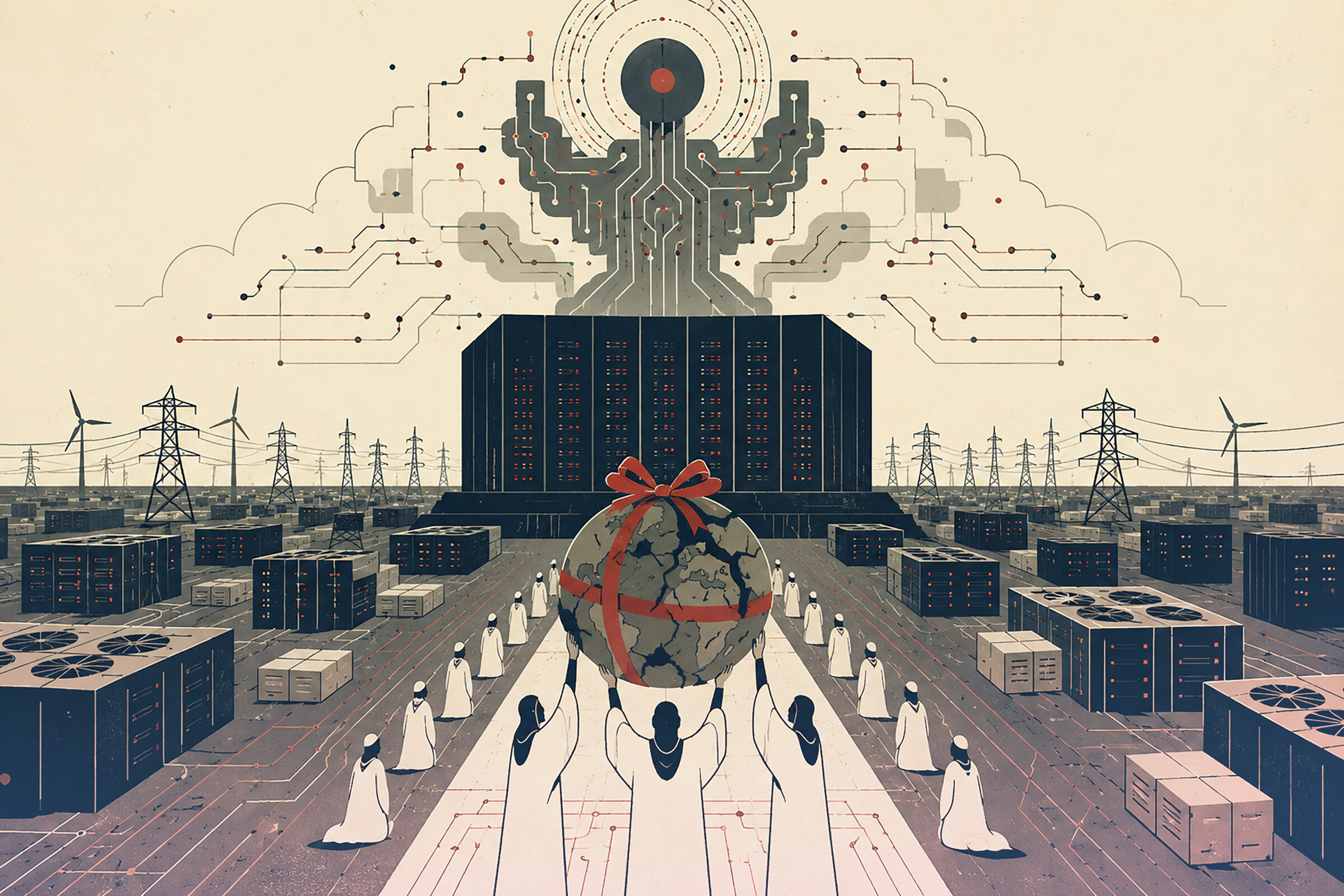
Covering the world with data centers is an obsession that goes beyond the desire for profit, it evolves into antagonism towards the slow and imperfect evolution of mankind.
Once, gods were summoned through fasting, fire, and sacrifice. Our modern high priests, because civilization apparently does make progress of a kind, have discovered a more refined liturgy: windowless halls, cooling systems, and electricity bills discussed as if they were destiny. The temple is no longer on the mountaintop. The temple sits on cheap land, beside a substation, close to water.
Those who say they want to save the world should not be trusted blindly, because perhaps they are more drawn to the desire to destroy it, or have already written it off. This is an antagonism toward slow, often imperfect human evolution, which is no longer being allowed to continue along its “peaceful course.” Opposite that stands the technological obsession with creating God from the machine, a God to whom a ruined planet would be offered as some kind of birthday present.
What is being built is not merely a new industry. A new metaphysical order is being built as well, one in which human beings are gradually persuaded to experience their own thinking as an outdated work habit. Although... if we are being honest, was that not, in a sense, always the goal?
Thinking, yes, provided it is productive, within prescribed limits, never truly “for oneself.” Those who did have the ambition to think for themselves were punished throughout history, and today that “threat” will be pushed even further to the margins. Someone, or something, will think for us.
Naomi Klein, the Canadian author and professor at the University of British Columbia, known for her writing on capitalism and ecology, captured this with rare precision. The idea that thought can be handed over to a machine, she says, is not only a technological dream, but a fascist impulse.
Obviously, a chatbot is not some new Mussolini with a better interface. What she is really arguing is that fascism always begins where human beings are separated from judgment. Responsibility is delegated. Doubt is declared an obstacle. Collective thinking, slow and difficult as it is, is replaced by a command arriving from the system. Klein therefore describes the wider AI race as a model constantly demanding more and more computing power, through a tripod of technology companies, fossil fuels, and the state, whose ultimate myth is a world covered in data centers in an attempt to summon a “digital god.”
Of course, this god is still very modest for now. It hallucinates, invents things, and never, or only with great difficulty, admits that it does not know something. In other words, it is a superbeing still in a rather infantile phase.
But religions do not live on the present. They live on promises. Today’s applications producing “slop” (miserable AI content, which we have written about before: The Internet Is Dead. The Internet Remains Dead. And We Killed It.) matter precisely because they are not the final form. They serve as the “sacrament of future intelligence.” The new believer is not shown “God.” He is shown a sign that God may be coming, provided a large enough power plant is built for him.
And power plants, in this story, are becoming less and less metaphorical. The International Energy Agency estimates that global investment in data centers has almost doubled since 2022 and reached around half a trillion dollars in 2024. That year, data centers consumed around 415 terawatt-hours of electricity, and by 2030 that consumption could more than double, to around 945 terawatt-hours, slightly more than Japan’s entire current electricity consumption (!). In the United States, according to the same report, data centers account for almost half of the expected growth in electricity demand by the end of the decade.
When residents complain, they are given the old phrase meant to disarm them: do not protest, this is progress (we wrote about this in more detail earlier: The Cloud Has Fallen to Earth and Is Devouring Everything Before It). Once, the same sentence was used to defend a factory poisoning a river.
AI in this form, Klein observes, becomes a rescue package for the fossil economy at precisely the moment when that economy had begun to lose its historical certainty.
The state is the third leg of this tripod. Take the American AI Action Plan from 2025. The plan recommends making federal land available for data centers and the power plants that feed them, while accelerating environmental permits and shortening regulatory procedures. In translation, local democracy becomes an administrative nuisance, and the energy hunger of private companies is branded as a national destiny.
This is where we see why the outsourcing of thought is more than a comfortable habit. It creates a political subject who no longer asks what technology is for. He only asks whether he is late in adopting it, and if companies cannot find enough customers for everything they have built, there are always governments, universities, and public services terrified of looking provincial.
A preliminary report by MIT NANDA from 2025 claims that, despite 30 to 40 billion dollars in corporate investment in generative AI, as many as 95% of organizations in its sample see no measurable return on investment (!), while most projects still have no clear effect on the profit and loss statement. But panic has an economy of its own. Nobody wants to be the last person who still thought for himself. That appears dangerous.
And when the Earth becomes too small, the industry’s imagination does not become more modest. It becomes orbital. In 2025, Google unveiled Project Suncatcher, a research “moonshot” (the term for an extremely ambitious idea) that imagines satellite constellations with solar-powered TPU processors and optical links for scaling machine learning in space.
That is the image of our moment. Instead of asking how much computation we actually need, we ask whether computation can be moved off the planet.
Jorge Luis Borges, the famous Argentine writer, once imagined an empire that made a map so precise it eventually became as large as the empire itself. The map thereby became meaningless, because it no longer helped anyone understand the world, but merely duplicated it. Something similar is now happening with the technological fantasy: a machine is being built that is supposed to interpret reality, but to do so it demands more and more of reality itself, more energy, space, water, and political obedience. We seem to have decided to build a computer as large as the despair that produced it.
The darkest mission is not simply to destroy the world for profit. Profit is almost a banal category here, because states will pour in all the money required. The deeper ambition is to prove that the world can be turned into “input.” Climate, labor, language, art, the local community, the river, and the night sky all become raw material for a system that promises it may one day think like God. If the end must come, some would clearly rather greet it as a technical achievement, as a demo version of divinity.
Apart from the most convinced believers, human beings are generally not certain that God created them. Now we have a new category: the human being who believes he will create God, who believes he will reverse the dogma itself. But why? What is all this for? It is obvious that the human creator does not much care for the created human, and therefore not much for himself either.
Comments