
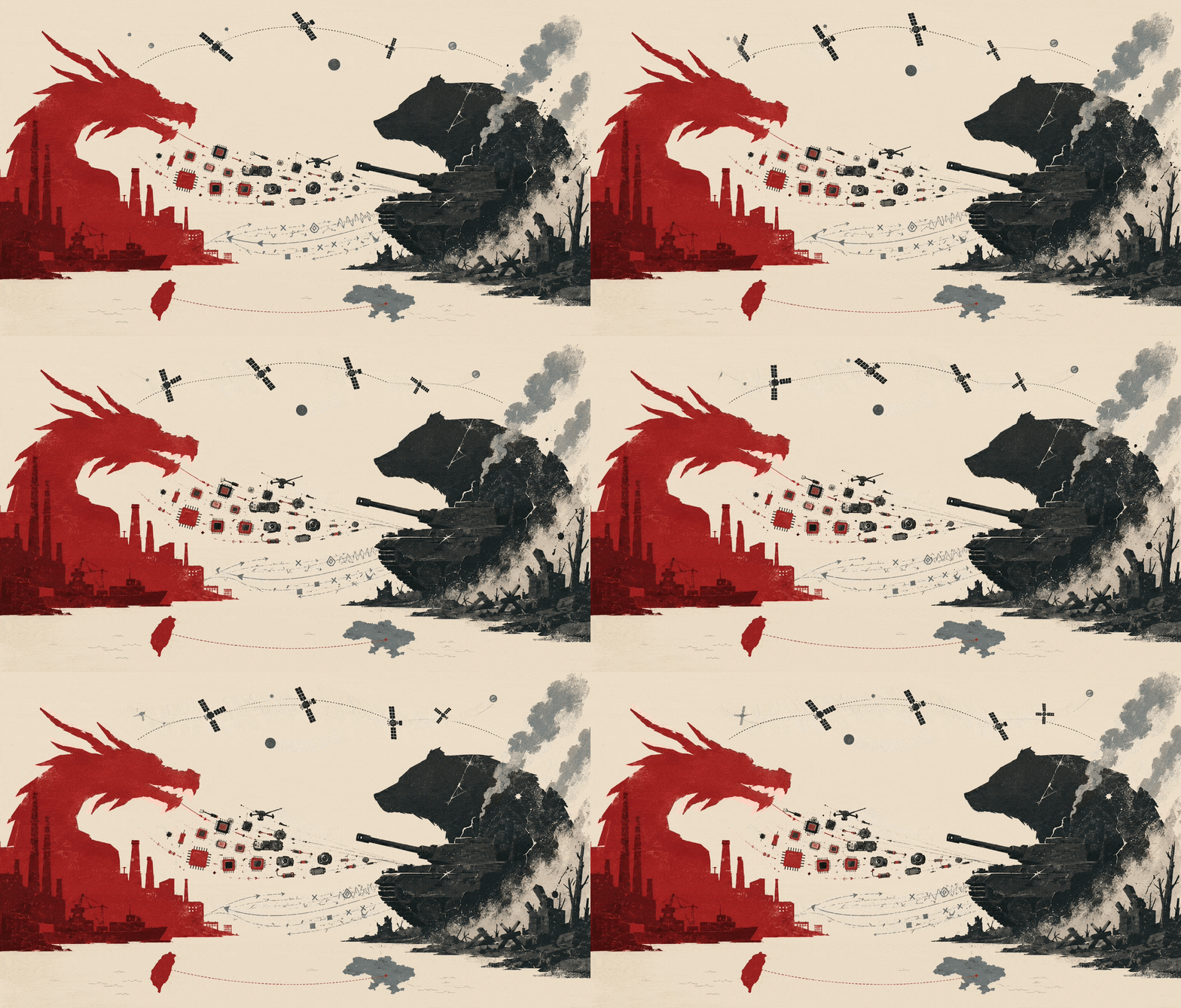
When Germany’s Der Spiegel—one of those publications that likes to take its own reputation for seriousness for granted—opens the subheading of its major investigation into Russia and China with the phrase “The New Axis of Evil,” the reader already knows they are entering a realm where analysis and moral mobilization are becoming dangerously intertwined.
The “Axis of Evil,” of course, is neither a new nor a neutral term. It is an ideological slogan inherited from the early years of America’s “war on terror,” an expression designed less to explain the world than to prepare the public for new military interventions and political adventures. That is unfortunate, because the subject itself genuinely matters. Anyone seeking to understand the war in Ukraine, Russia’s industrial survival under sanctions, a future crisis over Taiwan and the emergence of a new bloc-based world order cannot reduce Russian-Chinese military cooperation either to Western propaganda or to Chinese diplomatic denials. The subject deserves to be examined again on its own terms—and with careful attention to what remains unsaid.
The simplest answer to the question of how much China is helping Russia in its war against Ukraine might be this: more than Beijing is willing to admit, and in ways quite different from what Western wartime rhetoric would have us believe. As far as is publicly known, China is not openly sending Russia tanks, aircraft or missiles bearing Chinese markings. But modern wars are fought not only with artillery. They are also fought with chips, optics, machine tools, drones, industrial electronics, training, financial channels and the continuous ability to fill the gaps created by sanctions. In that sense, Chinese support for Russia does not resemble the old model of supplying complete military formations. It is about sustaining the war-making capacity of a major power.
Der Spiegel, working with the Russian investigative outlet The Insider and France’s Le Monde, says it obtained documents pointing to “significantly deeper Russian-Chinese military-technical cooperation” than was previously known. According to those reports, a closed-door Russian-Chinese Military Technology Forum was held in Yekaterinburg in December 2024, attended by dozens of senior representatives from the armed forces, government agencies and the defense industry. Participants were reportedly forbidden from discussing the substance of the meeting, while all materials had to be returned once the forum ended. Such details do not, by themselves, prove everything implied by the German publication. They do, however, point to something that was already visible even without leaked documents: Moscow and Beijing increasingly see war, technology and the West as interconnected questions.
For Russia, Starlink has already become a painful battlefield lesson. For China, it is a preview of Taiwan.The most important part of this entire story may not be Ukraine itself, but Starlink. Since the beginning of the war, the Ukrainian military has relied heavily on Elon Musk’s satellite internet system for communications, drone coordination, reconnaissance, command and control, and maintaining connections wherever conventional communications have been destroyed or disrupted. For Russia, Starlink has already become a painful battlefield lesson. For China, it is a preview of Taiwan.
What Ukraine received in its struggle against Russia, Taiwan could one day receive in a future confrontation with China. It is therefore hardly surprising that, according to the investigation, Chinese and Russian specialists discussed ways of countering Starlink through jamming, throttling, cyberattacks, signal spoofing and potentially even the physical destruction of satellites in orbit.
This opens a much more important line of inquiry than the usual moralizing about an “Axis of Evil.” Once privately owned American satellite infrastructure becomes a vital component of Western military power, it can no longer be treated as merely a “commercial service.” In Ukraine, Starlink has demonstrated how the boundary between a private corporation, American strategic power and an allied military system can almost completely disappear. Russian and Chinese interest in neutralizing it is therefore not some sinister aberration, but a logical response from adversaries who understand that future wars will be decided not only by the number of tanks, but by who controls the skies, the data, the sensors and the communications networks. The West calls this a “threat to international security.” Moscow and Beijing see it as an attempt to break American technological dominance.
For decades, Russia jealously guarded its most advanced air-defense capabilities.The Spiegel investigation goes even further, claiming that Russia and China discussed the joint development of a new generation of air- and missile-defense systems, including defenses against maneuvering ballistic and hypersonic missiles. If Moscow is indeed sharing such sensitive knowledge with Beijing, it would represent a significant shift.
For decades, Russia jealously guarded its most advanced air-defense capabilities. Nor were the Soviet Union and China ever united by anything resembling idyllic brotherhood: in 1969, they came close to war on the Ussuri River.
The closeness between Vladimir Putin and Xi Jinping today is therefore not a return to some natural alliance. It is the product of historical pressure—sanctions, American military supremacy, NATO expansion and the militarization of the Pacific.
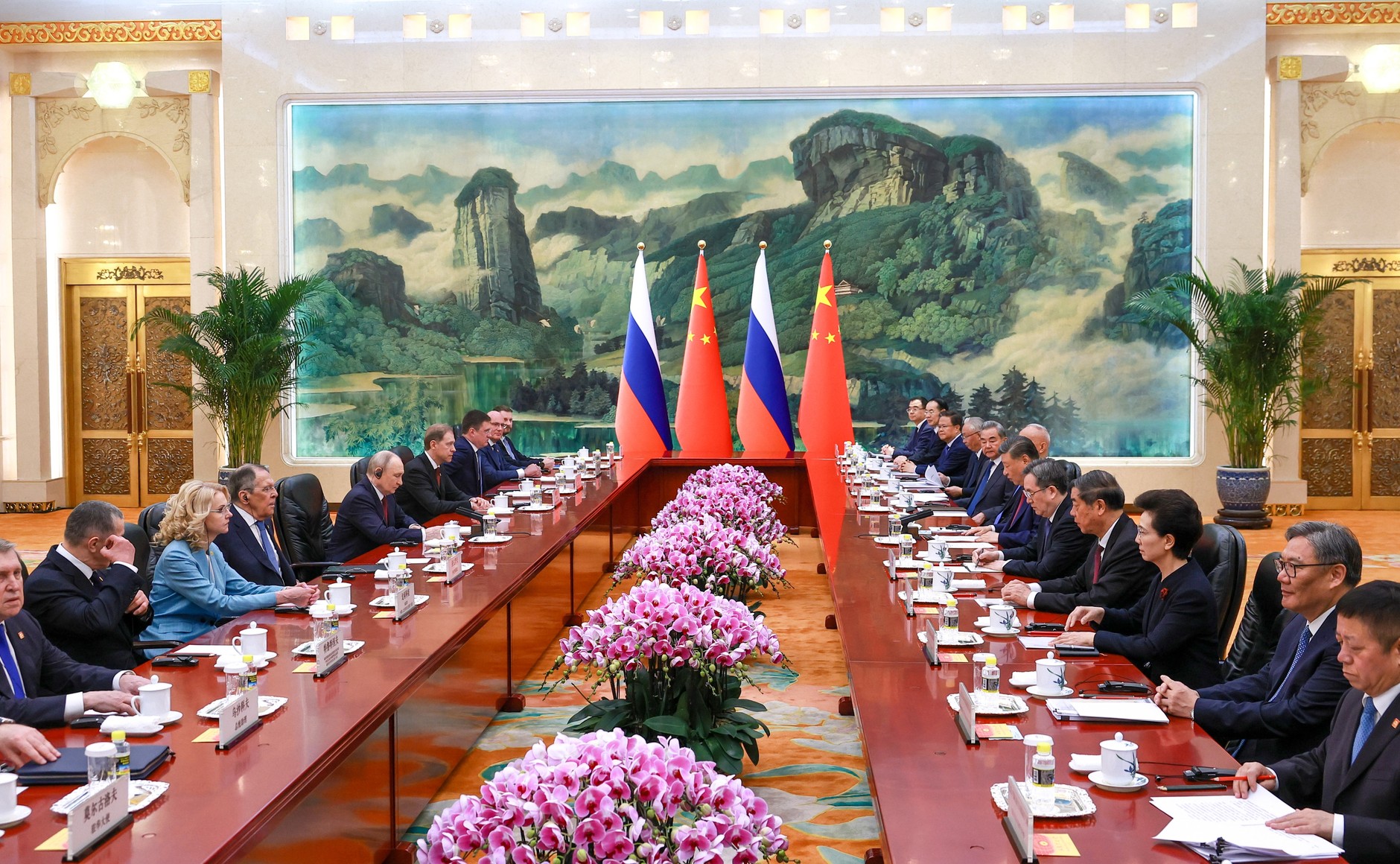
It is important to remain clear-eyed about all this. China’s policy toward the war in Ukraine is not the same as the American or British approach. Washington and London openly provide Kyiv with weapons, financial aid and political support. Beijing operates differently. It formally speaks of peace, refuses to acknowledge itself as a party to the conflict and takes care not to cross a red line that could jeopardize its trade with Europe. At the same time, however, it gives Russia access to industrial and technological channels without which the Russian war economy would be considerably weaker. This is China’s style as a great power: no shouting, no rushing and no assumption of unnecessary costs, but every crisis is used to reshape the long-term balance of power.
In early July, Reuters published a separate report claiming that secret training of Russian forces in China had been approved at a high level, involved Russian and Chinese generals and covered sensitive fields such as radiological, biological and chemical protection. Germany summoned the Chinese ambassador for talks following the new reports, while China’s Foreign Ministry dismissed the allegations as “slander without any factual basis.” The diplomatic pattern is already familiar. The West says it has documents and intelligence. China rejects everything and repeats that its position is “objective and impartial.” Moscow retreats into irony, claiming it has nothing to learn from the Chinese military because China lacks modern combat experience. Yet that very exchange—Chinese technology for Russian experience—lies at the heart of the emerging relationship.
Russia now possesses something China does not: brutal, costly and bloody experience of industrial warfare against a Western-armed opponent. Ukraine has become a vast classroom for the Russian military, where drones, electronic warfare, artillery, air defense, logistics and the capacity to adapt are tested every day. China, meanwhile, possesses what Russia increasingly needs: manufacturing capacity, electronics, components and technological discipline. Within this division of labor, Russia is not merely China’s junior partner, though it is becoming increasingly dependent on Beijing. China is not formally allied with Russia, but it uses Russia as a strategic buffer, a partner in challenging American hegemony and a source of wartime lessons that could one day prove decisive in Asia.
Western media prefer to turn this into a simple picture: authoritarian powers are uniting against democracies. That framing may be politically useful, but it offers little intellectual substance. This is not a fairy tale about good and evil. It is the unraveling of the unipolar moment that emerged after 1991. The Russian-Chinese rapprochement did not arise in a vacuum; it developed in response to that order. This does not make Moscow and Beijing noble champions of a more just world. It does mean, however, that the Western narrative of a “new Axis of Evil” is an attempt to reduce a complex historical transformation to a moral caricature.
In Ukraine, Russia is buying time and experience at a terrible price.For Europe, this is particularly uncomfortable. If the war in Ukraine and a future crisis over Taiwan are beginning to merge into a single strategic whole, Europe can no longer pretend that China is primarily an economic partner while Russia is an isolated security problem on the continent’s eastern edge. Washington has been promoting precisely this vision for years: the European and Indo-Pacific theaters as two fronts in the same confrontation. Within that framework, NATO is gradually transforming from a North Atlantic defensive alliance into a global military-political infrastructure. The phrase “new Axis of Evil” is useful precisely because it serves that transformation. If there is a new axis, then there must also be a new mobilization.
The question “Is China helping Russia?” is therefore already somewhat outdated. It is. The real question is what “help” even means in a war where civilian and military technology are merging into the same infrastructure. When a chip from a civilian device ends up inside a drone, the old categories cease to function. Modern warfare no longer has a clean boundary between the front and the factory, between the military and the corporation, or between national policy and the global supply chain.
Der Spiegel may have chosen a poor and ideologically loaded frame. But the subject it has raised should not be dismissed because of that framing. If deeper Russian-Chinese military cooperation is confirmed on anything like the scale now being described, it will not be a passing episode but a sign of a new era. In Ukraine, Russia is buying time and experience at a terrible price. China is watching, learning and supplying whatever brings it strategic advantage without immediately drawing it into a war with the West. The West, meanwhile, is turning all of this into a new grand narrative of global threat, because preserving its own dominance requires a vision of the world in which every act of defiance can be folded into the familiar image of a hostile bloc.
Sources
- Reuters EXCLUSIVE: Russia approved secret China military training at top level, sources say | Reuters https://www.reuters.com/business/aerospace-defense/russia-approved-secret-china-military-training-top-level-sources-say-2026-07-01/
- Der Spiegel The New Axis of Evil: DER SPIEGEL Investigation Reveals Deep Military Cooperation between Russia and China https://www.spiegel.de/international/world/the-new-axis-of-evil-der-spiegel-investigation-reveals-deep-military-cooperation-between-russia-and-china-a-12dc295a-413d-4a2f-b44f-2922092270e3
- Theins.press Shooting Starlink: The “no limits” partnership between Russia and China is taking aim at Elon Musk — The Insider https://theins.press/en/inv/294635
- Der Spiegel Militärkooperation zwischen China und Russland: Die neue Achse des Bösen https://www.spiegel.de/ausland/china-und-russland-recherchen-zeigen-ausmass-der-militaerkooperation-a-46fa7894-0b2c-411b-ba21-cc7c6b053c3f
- Merics.org China-Russia Dashboard: Facts and figures on a special relationship | Merics https://merics.org/en/china-russia-dashboard-facts-and-figures-special-relationship
- Le Monde Entre Pékin et Moscou, de très secrets forums de coopération militaire https://www.lemonde.fr/m-le-mag/article/2026/07/09/entre-pekin-et-moscou-de-tres-secrets-forums-de-cooperation-militaire_6722048_4500055.html
Comments