
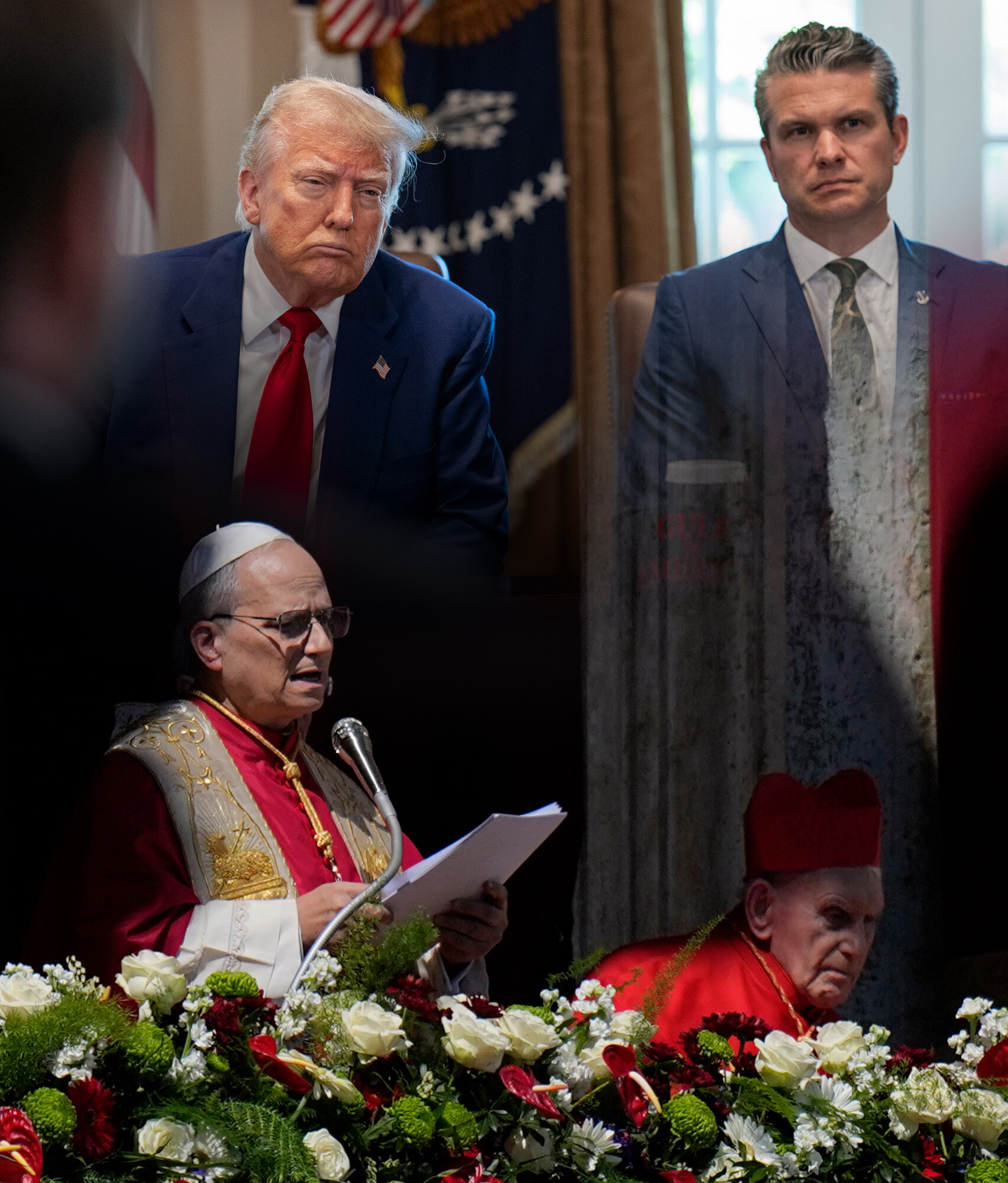
In the way Pope Leo XIV has been speaking about the war these days, there is a rare degree of clarity. In the days before Easter, from St. Peter’s Square and Castel Gandolfo, he repeatedly called for a ceasefire, a return to negotiations and a way out of the U.S.-Israeli war against Iran. On Palm Sunday, he openly said that "Jesus is the King of peace" and that his name "cannot be used to justify violence". In doing so, he drew a line that runs deeper than daily politics. Unlike many state leaders who condemn aggression with extreme selectivity, Leo speaks as the head of a Church that sees war as a moral fracture in the world. His statements are a clear warning to Washington, Tel Aviv and everyone who turns religious language into fuel for bombing. At the same time, Trump and his war secretary Hegseth are cynically flirting with every sacred symbol in order to manufacture their own, rather grotesque, justification for war.
The pope’s tone comes from his personal temperament, but even more from a long Catholic tradition that places war under increasingly strict moral conditions, though, of course, many Catholic leaders have also strayed badly on this question. Today, on Easter, it is worth recalling that the Catechism speaks of legitimate defense only after all other means have been exhausted, when the damage is lasting, grave and certain, when there are serious prospects of success, and when the use of force does not produce an evil greater than the one it seeks to eliminate. It is precisely here that aggression against Iran enters very difficult moral territory, because preventive logic and the idea of striking before a threat has fully materialized raise, at the very least, deep suspicion in Catholic ethics.
For that reason, if one can speak collectively, Catholic resistance to aggression against Iran today appears stronger than most other Christian reactions, at least at the level of hierarchy and official teaching, thanks also, of course, to the fact that the Vatican currently has a pope who is not afraid to take a clear position. This resistance goes beyond the usual peace appeals from the Vatican. Archbishop Timothy Broglio, who heads the U.S. military archdiocese and provides pastoral oversight for Catholic chaplains in the armed forces, publicly stated that the current war "fails the criteria of just war". The president of the U.S. bishops’ conference, Paul Coakley, supported the pope’s call for a ceasefire and negotiations. Among American Catholic laypeople, especially white Catholics, the political picture remains divided and support for Trump is still significant, but the tone of the hierarchy remains clear and directed toward de-escalation, talks and stopping the war.
The reason also lies in the very structure of the Catholic Church. It is a transnational community with a single magisterium, a developed diplomatic network and deep roots in the Middle East, from Jerusalem to Antioch. From that perspective, the holy places form a space of living communities that endure the consequences of war, occupation, displacement and economic collapse. In recent weeks, numerous church voices have warned of the burden that war and regional militarization place on Christians in the Holy Land and the wider Levant. Pope Leo therefore looks at Iran, Israel, Lebanon, Gaza and Ukraine within the same moral whole, as parts of a wounded world in need of peace and political restraint. Of course, many will say that in an age of hardened Trumpism, where "I do not follow international law, I follow my own law", the pope’s peaceful messages do not mean much. But that is not quite true. At a moment when we have an administration openly trying to subordinate faith itself to its military-industrial aims, every act of disagreement is already an important act of resistance.
But does Catholic condemnation go further than others? When speaking about Protestants, precision is needed. Much of the Protestant world is also strongly opposed to the war. Anglican, Lutheran, Methodist, Reformed and broader ecumenical alliances jointly condemned the expansion of the war to Iran in March, stressed that the U.S.-Israeli attacks violate international law, and said that Christians recognize no divine permission for killing, destruction and displacement. The Episcopal Church and other mainline Protestant churches in the United States follow the same line, seeing the war as a moral and constitutional collapse and demanding urgent de-escalation.
Still, the somewhat recurring question of whether Protestants are more supportive of war largely refers to one specific bloc, one we have mentioned several times in this context already: white American evangelicalism. This is precisely the bloc that has for years been most loyal to Trump, and it remains his strongest major religious base today. American public opinion research shows that white evangelicals are far more willing than Catholics and mainline Protestants to approve of Trump’s policies. Historically Black Protestant churches stand far outside Trump’s political circle and do not give Protestantism as a whole a hawkish tone. In the evangelical bloc, a political reflex meets a theological pattern in which Israel, biblical prophecy and eschatological expectation are tightly connected. The same research has long found that evangelicals are far more likely than Catholics to believe that the land was given to the Jews by divine decision and that the modern state of Israel carries prophetic meaning, while Catholics are noticeably less likely to accept the idea that humanity is living in the "end times". Within such a framework, war can much more easily be presented to these groups as a historically "necessary act".
This is where Christian Zionism enters the picture, one of the most influential religious-political currents in contemporary America. For its adherents, the state of Israel has an almost sacramental importance in the course of salvation history, while Iran often enters the narrative as part of a final confrontation. That is why some evangelical preachers and activists interpret the war against Iran as confirmation that the prophetic clock is speeding up. The organization "Christians United for Israel" openly supports military operations and describes them as a means of bringing down Iran, while its founder John Hagee said after the start of the war that events were moving "exactly according to the prophetic schedule". Here we see just how wide the rift within Christianity has become, from Pope Leo to evangelical militarism. Leo returns Christ to the language of peace, while Christian Zionism turns the Bible into a strategic map of the Middle East.
In the whole story of war and religion, Pete Hegseth appears as a figure crossing a line that even the hardest American politicians long avoided. His language about war openly reaches for religious legitimacy, turning military operations into a "moral mission". When a defense secretary publicly "prays that the bullets hit their targets" and invokes "violence without mercy", we are no longer dealing with rhetoric, but with an ideological project that erases the distinction between politics and holy war. This is a paradigm shift.
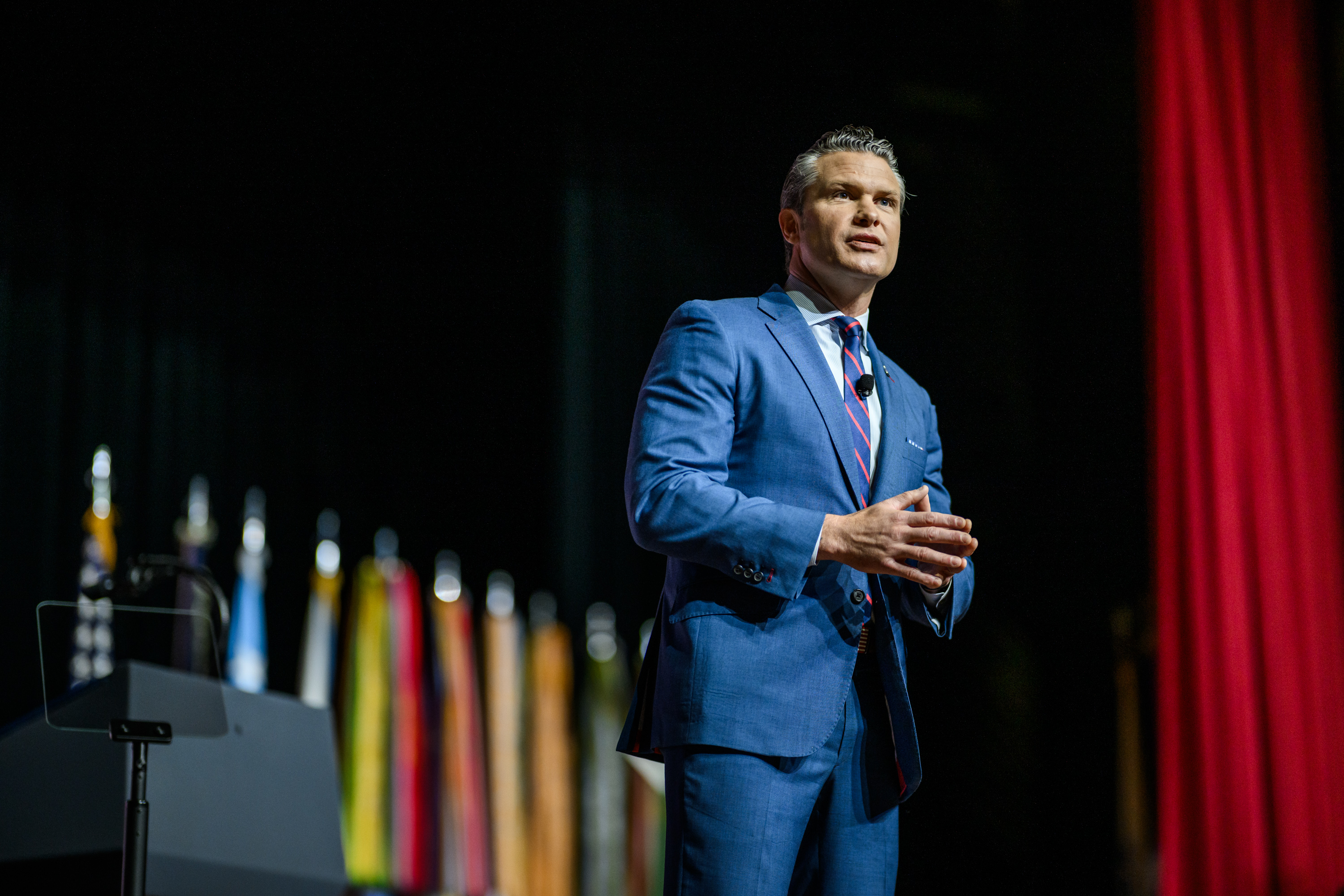
Such an approach destroys one of the key assumptions of a modern military: the rational control of force. An army acting in the name of the state can be brutal, but it is at least formally constrained by law, strategy and political responsibility. An army that begins to believe it is acting with divine approval enters a far more dangerous space, one in which every action can be justified.
A Purge in the Military
In the background of the war against Iran, a process is unfolding that rarely comes to the forefront, but carries far-reaching consequences for the very structure of the U.S. military. This is the extensive personnel reconstruction of the military’s top ranks being carried out by Donald Trump’s administration through Defense Secretary Pete Hegseth. Numerous senior officers have been dismissed, including key figures within the chain of command, and the changes have also affected the military chaplaincy system. This dynamic goes beyond ordinary rotations and increasingly resembles the political reshaping of an institution that has traditionally aspired to remain apolitical. In practice, it means the creation of a more loyal and ideologically homogeneous military leadership at a moment when war and aggression are becoming the central focus.Formally speaking, there is no evidence that selection is being conducted on the basis of religious affiliation. Catholics, Protestants and members of other religions are part of the same institutional network and are subject to the same personnel decisions. But when the wider context is taken into account, a statistical pattern emerges. The Catholic hierarchy, led by Pope Leo XIV, has taken a distinctly critical position toward the war with Iran. Similar messages are coming from some American bishops. If such views are also reflected within the officer corps, which is reasonable to assume given the connection between personal convictions and professional judgment, then officers more inclined toward caution about the war can be expected to come into conflict more often with a political leadership advocating escalation.
In that sense, even without formal discrimination, indirect selection takes place. The decisive question is not necessarily who is Catholic and who is Protestant, but who accepts the dominant narrative about the necessity of war. Still, since part of the Protestant spectrum, especially within American evangelicalism, shows a greater willingness to ideologically justify conflict, such views fit more easily into the new structure of power. By contrast, traditions that insist on moral limits to war now become an obstacle in a system demanding militarism.
Other Christian groups offer even stronger antiwar voices. Quakers immediately condemned the attacks on Iran and warned of a dangerous war for regime change. Mennonites repeated that their "allegiance belongs to the Prince of Peace" and that God’s will must not be used as a justification for war. The World Council of Churches, which includes many Protestant and Orthodox churches, also condemned the attacks and called for a return to international law and negotiations.
Catholics at this moment, viewed through the pope, the Vatican and the top of the bishops’ hierarchy, are among the strongest Christian opponents of aggression against Iran. Protestants as a whole do not constitute a war bloc, but American evangelicalism, in which Christian Zionism, nationalism and closeness to Trump’s project of power are fused together, represents a very concrete danger. At a time when statesmen once again invoke God as an ally of the bombers, the pope’s message restores an old truth: the name of God demands peace, responsibility and a boundary that political power must not cross.
Sources
- Vatican.va PALM SUNDAY: PASSION OF THE LORD – COMMEMORATION OF THE LORD’S ENTRANCE INTO JERUSALEM AND HOLY MASS https://www.vatican.va/content/leo-xiv/en/homilies/2026/documents/20260329-palme.html
- Oikoumene.org WCC statement on Iran https://www.oikoumene.org/resources/documents/wcc-statement-on-iran
- Pewresearch.org Americans Broadly Disapprove of U.S. Military Action in Iran https://www.pewresearch.org/politics/2026/03/25/americans-broadly-disapprove-of-u-s-military-action-in-iran/
- Press.vatican.va Holy See Press Office Press Release: Telephone conversation of the Holy Father with the President of Ukraine, 03.04.2026 https://press.vatican.va/content/salastampa/en/bollettino/pubblico/2026/04/03/260403c.html
- Tnbaptist.org SOUTHERN BAPTIST SCHOLARS BACK IRAN STRIKES AS MORALLY JUSTIFIED UNDER JUST WAR THEORY https://tnbaptist.org/southern-baptist-scholars-back-iran-strikes-as-morally-justified-under-just-war-theory/
- Vaticannews.va Pope appeals to Trump and world leaders: Find solutions to end war - Vatican News https://www.vaticannews.va/en/pope/news/2026-03/pope-trump-world-leaders-war-castel-gandolfo.html
- Unitedmethodistbishops.org United Methodist Bishops Call for Prayer and Peace in the New Middle East War https://www.unitedmethodistbishops.org/newsdetail/cob-pastoral-call-on-new-mideast-war-19640420
- Yougov.com Which Americans support and oppose bombing Iran? https://yougov.com/en-us/articles/52439-which-americans-support-and-oppose-bombing-iran
- Samaritanspurse.org Pray for the Middle East https://samaritanspurse.org/our-ministry/april26/
- Al Jazeera Why are the US and Israel framing the ongoing conflict as a religious war? https://www.aljazeera.com/news/2026/3/4/why-are-the-us-and-israel-framing-the-ongoing-conflict-as-a-religious-war
- Americamagazine.org On Good Friday, Pope Leo speaks with presidents of Israel and Ukraine, calling for an end to war https://www.americamagazine.org/vatican-dispatch/2026/04/03/pope-leo-israel-ukraine-zelensky-herzog/
Comments