
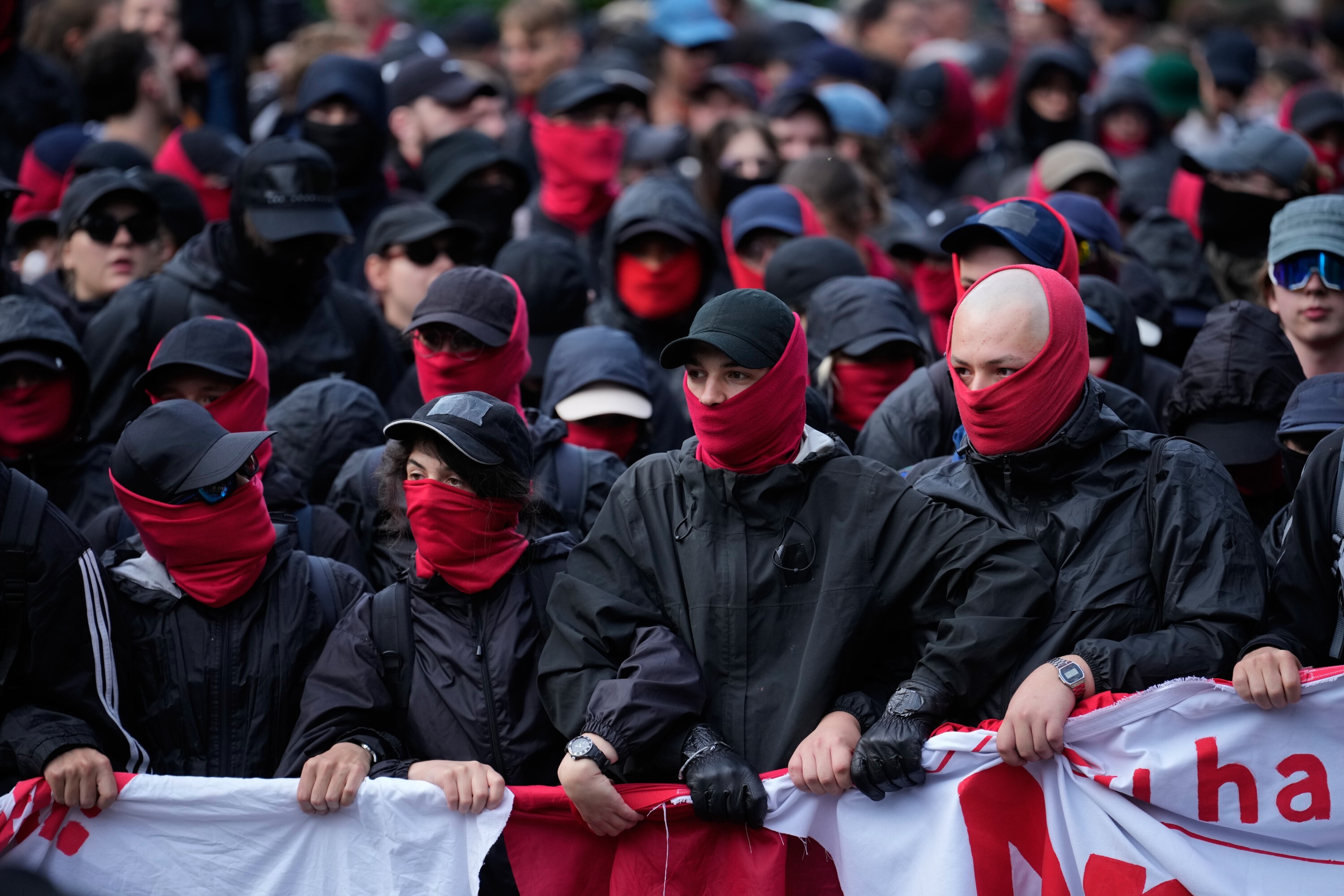
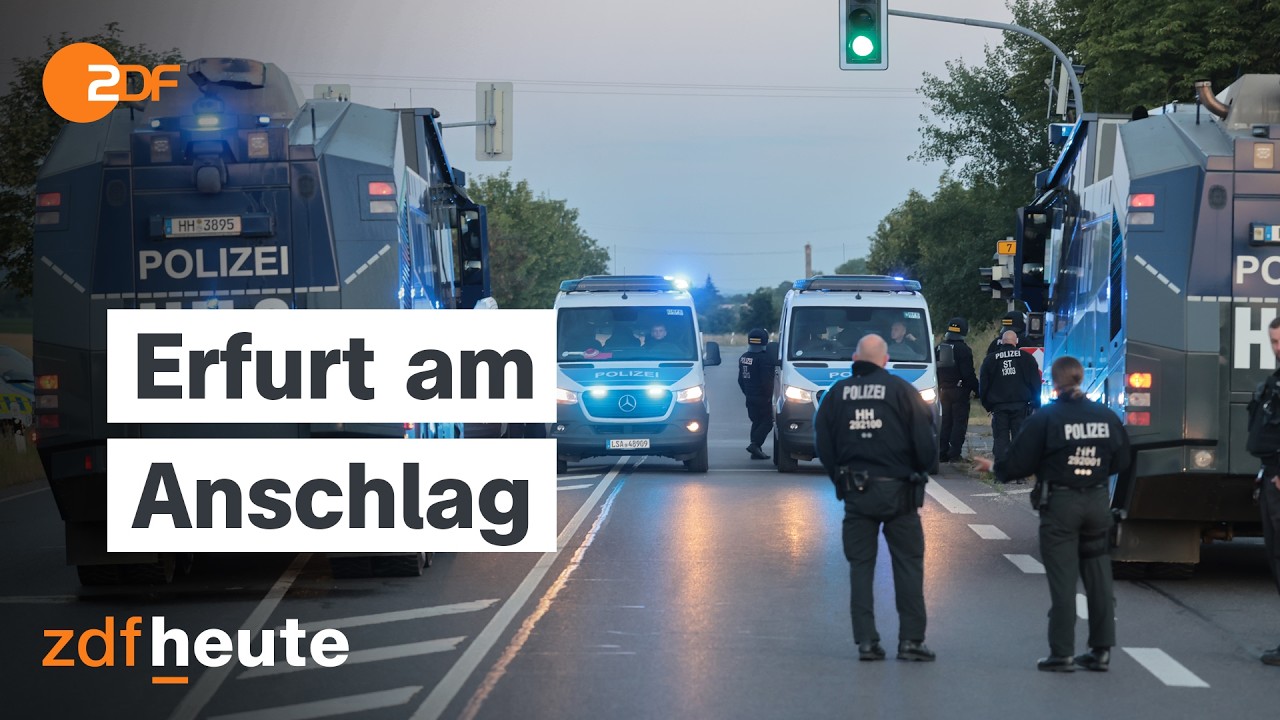
Germany is moving toward an inevitable explosion, and the scene in Erfurt last weekend showed that this explosion no longer belongs to the abstract realm of political forecasts. It is already on the streets, outside congress halls, on blocked roads, in the chants of protesters, and in the self-confidence of a party that no longer sees itself as an incident, a protest vote, or a marginal phenomenon. The AfD now looks like a government merely waiting for formal confirmation.
A party that for years was treated as an anomaly in the German system now speaks the language of historical inevitability, while its opponents try to slow down in the streets a process that has already penetrated deep into the country’s political body.
Around 15,000 protesters in Erfurt is no small number, especially given the mobilization of trade unions, the left, civic groups, and anti-fascist organizations. The image of blocked roads and riot police is a reminder that German politics is increasingly moving out of the realm of parliamentary procedure and into a space of physical tension. The protests against the AfD carry energy and a powerful historical memory, but their political effectiveness is becoming increasingly uncertain. The more visible the resistance becomes, the easier it is for the AfD to portray its rise as a struggle against the system, the media, the elites, and organized pressure from the streets. That dynamic has been feeding the European right for years, and in Germany it takes on a particular form because of a history that turns every move toward harder national politics into a seismic event.
Alice Weidel and Tino Chrupalla have once again been elected to lead a party that, according to polls, is now ahead of the CDU and CSU of Chancellor Friedrich Merz, who today is backed by only 13% of respondents. The mere fact that the AfD is reaching around 29% support at the national level changes every calculation. In Western European countries, the rise of the right has often been interpreted as a corrective to established parties, as pressure that would force the center to tighten migration policy, reduce bureaucracy, or acknowledge economic frustration. The German case goes further. The AfD is no longer seeking influence over the agenda alone. Chrupalla openly says the party will govern, first regionally and then nationally. A few years ago, such a statement would have sounded like a provocation. Today it sounds like a reading of the political calendar.
For decades, Germany was presented as Europe’s rational machine. That machine no longer works the way it once did.Eastern Germany remains the most fertile ground for this rise. Yet it would be superficial to explain everything through nostalgia, authoritarianism, or resistance from the eastern states toward the liberal center. Behind it lies a deeper sense of humiliation, economic marginalization, and distrust toward a system that promised equality after reunification, then spent decades producing social distance between east and west. When the AfD speaks of national decline, of insecurity in parks, the housing crisis, migration, and the humiliation of the ordinary person, it is speaking to people who have long felt that Berlin sends them moral lectures instead of material solutions. That is where the party’s strength lies, however crude, harsh, and politically fantastical its answers may be.
Germany’s ruling center opened the space that the AfD is now occupying. Years of economic stagnation, the energy shock after relations with Russia were severed, costly wartime engagement over Ukraine, rising prices, industrial insecurity, and migration tensions have created an atmosphere in which the promise of stability no longer sounds convincing.
For decades, Germany was presented as Europe’s rational machine, a country in which crises are processed through procedure, compromise, and administrative discipline. That machine no longer works the way it once did. An industrial model that depended on cheap energy, exports, technological advantage, and relative social peace no longer has the same strength. The AfD recognized the crack and stepped into it with slogans that link identity, the economy, and fear.
The war in Ukraine is an especially important question. Chrupalla supports ending military aid to Kyiv and resetting relations with Moscow. In the German context, that message carries more weight than it does in many other European countries. Germany’s economic strength was tied for decades to Russian energy, and the sudden rupture of that relationship was a geopolitical decision with enormous economic consequences. The AfD has built around this a narrative that appeals not only to nationalists, but also to workers, entrepreneurs, and pensioners who ask why Germany must pay the price for a strategy shaped in large part by Washington. If the AfD one day finds itself in a position to truly influence policy toward Eastern Europe, this issue could determine whether the party remains a protest phenomenon or becomes the vehicle for a serious strategic turn.
The AfD could lose support if it turns into a comfortable party of power, radical on the campaign stage and obedient in the budget corridors.This is also the paradox of the AfD’s rise. Right-wing parties often grow most easily in opposition, where all blame belongs to others and every promise remains untouched by reality. Power is different. Power requires budgets, coalitions, bureaucracy, international pressure, industrial compromise, and a confrontation with the fact that society cannot be governed by the rhetoric of deportations and national pride alone. If the AfD comes to power in one of the eastern states, its voters will see for the first time how capable its program is of touching everyday life. Can it bring back industrial jobs, lower energy prices, and at the same time avoid an institutional war with the rest of the state? The history of the European right often shows such movements wearing out quickly after entering government. Yet Germany is entering a phase in which even that scenario is not guaranteed. Regional power is not the same as national power, of course, and even there the AfD can always score points by claiming that Berlin is blocking everything, thereby opening a wider path for itself precisely toward Berlin.
The AfD could lose support if it turns into a comfortable party of power, radical on the campaign stage and obedient in the budget corridors. That has been the fate of many forces that promised to “bring down the system,” only to settle quickly into its privileges. But there is another possibility as well. If the AfD succeeds in linking social dissatisfaction, resistance to war policy, criticism of migration, and deep distrust of the liberal center, a more durable political structure could emerge, one capable of changing Germany as a whole. That would be the moment when the European order would feel a blow far stronger than the usual rise of the right in smaller states.
Germany is a special zone of sensitivity because every major political shift there is read through the historical experience of the twentieth century. That is why the so-called firewall against the AfD is so important to the political center. It serves as a moral and institutional barrier, an agreement under which the party is kept out of coalitions and executive power. We have already written about this topic in much greater detail here: The AfD and Europe’s Firewall: The Numbers Have Gone Too Far, It Is Time to Open the Biggest Taboo Topic. But the firewall becomes weaker as the AfD grows stronger. When a party reaches almost a third of the electorate, its permanent exclusion begins to produce a new tension. AfD voters can then conclude that a political operation is being waged against them, while the AfD’s opponents can conclude that any concession would amount to a betrayal of the democratic inheritance. Between those two positions, there is less and less room for a peaceful transition.
That is why the scene in Erfurt matters for all of Europe. It shows a future in which elections alone will no longer be a strong enough outlet for social anger. One side takes to the streets because it believes a dangerous right is being normalized before its eyes. The other side fills congress halls because it believes it is being denied the right to power. The police stand between them as a symbol of a state that still maintains order, but is finding it increasingly difficult to maintain trust. In such circumstances, physical clashes, blockades, counter-mobilizations, and pressure on institutions become ever more likely. Germany’s tradition of stability still exists, but its authority is no longer beyond question.
If the AfD wins in Saxony-Anhalt and Mecklenburg-Western Pomerania, Europe will be watching the beginning of a new phase. Small and medium-sized countries will quickly recognize their own versions of the German scenario. Every migration crisis, every rise in energy prices, every new allocation for war, and every further weakening of industry will become fuel for similar movements. Germany was long the anchor of the European Union. If that anchor begins to jerk loose, the ship will not remain calm. The AfD is not yet in power, but it already acts as a force reshaping the entire political space. Germany is moving toward an outcome that can no longer be stopped with old formulas. The question is whether that outcome will be an institutional turn, a street-level escalation, or a painful exposure of the emptiness behind the great slogans. Either way, Europe will feel it.
Sources
- Tagesschau.de Bundesparteitag: Zehntausende protestieren gegen AfD in Erfurt | tagesschau.de https://www.tagesschau.de/inland/innenpolitik/afd-parteitag-erfurt-demonstrationen-100.html
- Politpro.eu Germany Election Polls & Voting Intentions 2026 https://politpro.eu/en/germany
- Reuters Thousands protest in Germany as far-right AfD sets sights on power https://www.reuters.com/world/thousands-protest-germany-against-far-right-afd-2026-07-04/
- Associated Press Far-right Alternative for Germany party reelects leaders as protesters and police clash https://apnews.com/article/5841f5e40a52bee3a56798807fda83fe
- Politpro.eu Saxony-Anhalt Election Polls & Voting Intentions 2026 https://politpro.eu/en/saxony-anhalt
- Reuters German court grants injunction to AfD party, suspending 'extremist' label by spy agency https://www.reuters.com/world/europe/german-court-grants-injunction-afd-party-suspending-extremist-classification-by-2026-02-26/
Comments