
When war becomes a system, replacing the man at the top is no longer just politics: armies, capital, technology and future power all move with him.
For more than four years, Volodymyr Zelensky and the war in Ukraine seemed like two halves of the same political picture. Ministers and generals could fall, the government could be criticized, but every discussion about a successor ran into the same obstacle: as long as Russia's assault continued, changing the man at the top appeared either impossible or dangerously reckless. Now that boundary has been crossed by someone who did not emerge from the old opposition or an oligarchic circle, but from the very heart of the system Zelensky himself built.
Mykhailo Fedorov has not announced a presidential run because he hardly needs to. When a dismissed defense minister begins talking about a "systemic crisis of governance," corruption, resistance to reform and the need for elections during wartime, the speech already contains all the elements of a campaign launch. Especially when it comes just as Zelensky is trying to secure approval for a new defense minister and close the political crisis triggered by Fedorov's dismissal. Instead of containing it, he may have created an alternative center of political gravity.
Ukrainian law does not allow elections under martial law. Part of the country is occupied, millions of citizens are abroad, soldiers are fighting at the front. Yet Fedorov argues that "democracy must not become a hostage to Russia." If Zelensky now refuses elections, he risks looking like a president using the war to prolong his rule. If he accepts them, he opens a process he could very well lose — and one that could further destabilize the country.
In one recent poll, Fedorov ranks third in a hypothetical first round, yet among decided voters he would defeat Zelensky by roughly two to one in a hypothetical runoff. Polls conducted without an election date or an actual campaign are hardly prophecy, but they reveal something that until recently seemed almost unimaginable: Zelensky is no longer a politician without a serious alternative.
The story of Fedorov's rise begins with his dismissal after just six months as defense minister. The official explanation was essentially that he could not work with commander-in-chief Oleksandr Syrskyi. Fedorov then publicly attacked the way the war was being conducted, thousands took to the streets demanding his return, and Zelensky soon removed Syrskyi as well — but did not bring Fedorov back.
Fedorov himself says the real reason was his attempt to overhaul the military procurement system through which billions of dollars flow. His ministry, he claims, was introducing more competitive tenders, cost audits and a model in which drone orders would be driven by battlefield data (we have already written about this in greater detail, see: Drones and Generals: By Dismissing Fedorov, Zelensky Chose the Past — and It Leads to Defeat). Every such move can be presented as a fight against corruption, but it also takes a contract, a commission or political influence away from someone. In wartime, doctrine and money almost always meet in the same place.
At that point, the conflict stops being a personal feud between a minister and a general. Syrskyi, at least in the eyes of his critics, represented the old military hierarchy: rigid command structures, mass warfare and tight control from headquarters. Fedorov represents databases, sensors, algorithms and autonomous AI systems (see: Minister of the Experimental War: Fedorov and the AI Interests Turning Ukraine into an American Laboratory). Once such a system begins deciding which drone works and which manufacturer receives the next order, power shifts toward those who define the data, the criteria and the software. Old-fashioned corruption may shrink, but politics does not disappear — it simply migrates into a new infrastructure.
The Mathematics of Death: Hit the Target, Earn Points, Buy Another Drone
War has always produced statistics, but Ukraine has turned them into something resembling a marketplace. Under the "Army of Drones Bonus" system, combat units submit video footage or other evidence of a successful strike, the result is verified through a military digital platform, and electronic points are then credited to the unit's account. A destroyed target is no longer merely a mark on an operational map. It becomes a kind of currency that can finance the next attack.The logic is brutally simple. A Russian soldier may be worth a certain number of points, a drone operator more, a damaged tank less than one completely destroyed, while priority targets or more difficult missions carry additional weight. The system changes over time according to battlefield needs: the value assigned to strikes on drone operators has been increased, multipliers have been introduced for operations at greater distances, and scoring has expanded to cover snipers, mobile air-defense teams, reconnaissance and other activities. Fedorov has described the entire concept as creating a "mathematics of war."
Then comes the part that, only a decade ago, would hardly have looked like military procurement at all. A unit opens Brave1 Market, browses a catalogue of domestically produced drones, ground robots, electronic-warfare systems and components, and uses its points to order what it needs. By the end of June 2026, more than 400 Ukrainian combat units had used the system to order over 500,000 drones. Manufacturers, in turn, receive almost immediate feedback from the front: equipment that works gets reordered; equipment that fails rapidly disappears from demand.
This may be the clearest expression of what Fedorov means by a technological army. The traditional system asks how much equipment a brigade is supposed to receive according to a predetermined table. The new system tries to measure performance, reward the most successful units and automatically redirect resources toward those producing the best results. Militarily, it amounts to radical decentralization and dramatically faster procurement. From a human perspective, the picture is far more unsettling: death, injury and the destruction of machines are converted into points on a digital account, rankings and purchasing power.
That is why the phrase "gamification of war" is more than a journalistic flourish. Mechanics familiar from video games — scores, points, rankings, rewards, better equipment and another attempt — have been transferred onto a real battlefield. The only difference is that the icon earning those points is not a computer-generated enemy. And this fusion of algorithm, marketplace and lethal efficiency may prove to be one of the most consequential legacies of the war in Ukraine, regardless of who eventually occupies the presidential office.
As minister of digital transformation, Fedorov built his reputation as the man turning the state into an app. During the war, he became one of the main political patrons of drones and defense-tech companies. Brave1, the state-backed cluster created under this model, now brings together thousands of companies and projects working on everything from unmanned systems and electronic warfare to artificial intelligence, missiles and robotics.
The network, naturally, extends far beyond Ukraine's borders. Fedorov has discussed artificial intelligence and data analysis with Palantir CEO Alex Karp (for more on Palantir, see: Musk, Palantir and the Pentagon Have Opened the Door to Dystopia), while NATO and Brave1 are connecting Ukrainian companies with Western partners. The Ukrainian battlefield provides something no military exercise ever can: real-world data showing how weapons perform against Russian air defenses, electronic jamming and an enemy that is constantly adapting.
For a soldier, that is a matter of survival. For a technology company, the same data can become the foundation of a new product, a new contract and a new export market. A company does not have to want the war to continue in order to benefit from its continuation. It is enough that war raises its valuation and opens access to budgets that would never exist in peacetime. The old military-industrial complex sold weapons to the state. The new one wants to sell the state the very system through which it sees and understands war.
Fedorov is almost the perfect political face of that transition. He is young, speaks the language of efficiency, carries little of the baggage of Ukraine's old oligarchic politics and does not challenge the country's Western orientation. For European governments, NATO structures, investors and defense companies, he offers a change of face without a change of geopolitical direction.
There is no evidence that some Western power center has decided to replace Zelensky with Fedorov. "The West" is not a single office in any case — Trump's White House, European governments, NATO bureaucracies, traditional arms manufacturers and technology funds do not necessarily want the same Ukraine or the same end to the war. But political change does not require a unified conspiracy. It is enough for different interests to temporarily converge around the conclusion that the current president has become exhausted, inconvenient or insufficiently adaptable.
Washington has already raised the prospect of holding Ukrainian elections relatively quickly and linked them to peace negotiations. Fedorov is now voicing from Kyiv a more democratically palatable version of a similar demand. That is not evidence of coordination, but it is an important convergence. Some may want a new government because they believe it could compromise and end the war. Others may see in Fedorov a man capable of continuing it more effectively — with more drones, deeper strikes and tighter integration with Western technology.
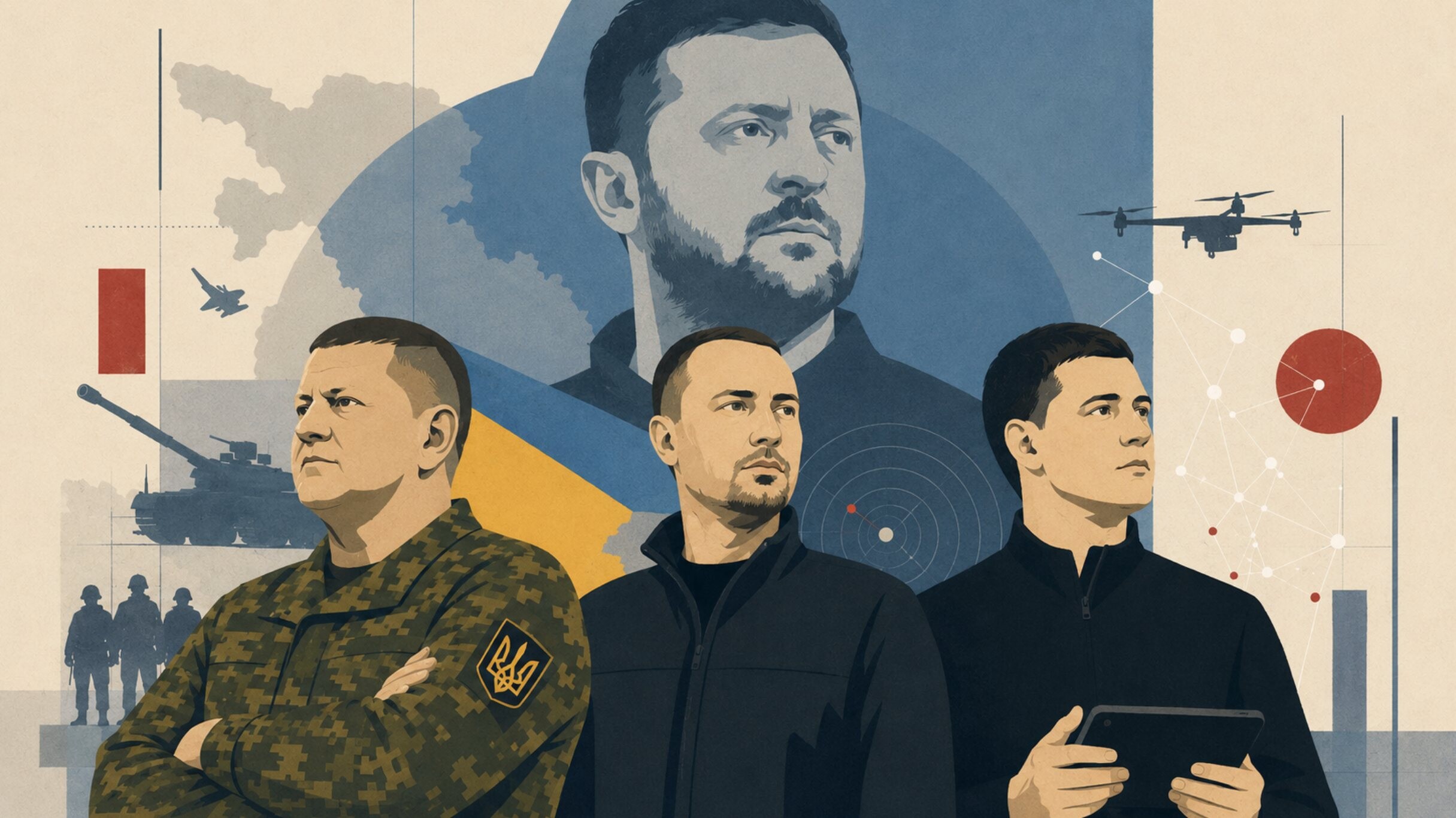
Fedorov is not the only possible successor. Valerii Zaluzhnyi represents the authority of the popular general, Kyrylo Budanov the world of intelligence warfare, and Fedorov the politics of algorithms and production cycles. What is being chosen is not simply a person, but a different version of the state: military, security-driven or techno-military.
Zelensky was the face of a war fought through televised addresses and enormous aid packages. Fedorov could become the face of a war run through dashboards, autonomous drones, private databases and investment funds. One model mobilized the world's emotions and enjoyed extraordinary media sympathy. The other wants to measure, optimize and commercialize every lesson the battlefield can produce.
For ordinary Ukrainians, the more important questions are whether they will ever return home and whether there will still be a country left that can be rebuilt when the war is over. Those interests do not necessarily coincide with the interests of generals, foreign governments or companies using Ukraine to test the future of warfare. Fedorov may be able to reduce corruption and make the country's defenses more effective. But a more efficient war is still a war, and technological progress is not the same thing as a political way out.
Perhaps Fedorov will never run at all. Perhaps his demand for elections is merely leverage to secure his return to power or settle accounts with the structures that pushed him out. But the political boundary has already been crossed. The man Zelensky brought in to digitalize the state is now positioning himself as a possible manager of its next phase. The first great battle over post-Zelensky Ukraine may therefore not be about who can bring peace, but about who inherits the right to manage the war.
Sources
- Reuters Ukraine's ousted defence minister calls for wartime elections https://www.reuters.com/business/aerospace-defense/ukraines-ousted-defence-minister-calls-wartime-elections-2026-08-18/
- Nato.int NATO and Ukraine announce new joint-initiative to accelerate defence innovation: UNITE – Brave NATO https://www.nato.int/en/news-and-events/articles/news/2025/11/26/nato-and-ukraine-announce-new-joint-initiative-to-accelerate-defence-innovation-unite-brave-nato
- Rusi.org The Dismissal of Ukraine's Defence Minister https://www.rusi.org/explore-our-research/publications/commentary/dismissal-ukraines-defence-minister
- Pravda.com.ua Poll finds Zelenskyy would lose to Zaluzhnyi, Budanov and Fedorov in second round of elections https://www.pravda.com.ua/eng/news/2026/08/06/8047607/
- Airbus.com Airbus and Brave1 partner to boost Ukrainian defence innovation https://www.airbus.com/en/newsroom/press-releases/2026-07-airbus-and-brave1-partner-to-boost-ukrainian-defence-innovation
- Mod.gov.ua AI and Ukraine’s defence strategy: Mykhailo Fedorov and Palantir Technologies discuss cooperation to strengthen security https://mod.gov.ua/en/news/ai-and-ukraines-defence-strategy-mykhailo-fedorov-and-palantir-technologies-discuss-cooperation-to-strengthen-security
- Financial Times Ukraine’s ousted defence minister calls for wartime election https://www.ft.com/content/7bf79169-f84f-44a2-b64d-c1a3d1fb7d08
- En.interfax.com.ua Parties led by Zaluzhny, Fedorov would outperform Servant of the People; seven would enter Rada – poll https://en.interfax.com.ua/news/general/1191347.html
Comments