
American power has for decades rested on an old and remarkably durable doctrine of maritime power. Alfred Thayer Mahan, the great theorist of the sea from the late 19th century, argued that national supremacy grows out of the ability to control trade routes, chokepoints and oceanic communications. That idea became the skeleton of America’s view of the world, from the Pacific to Hormuz, from the Panama Canal to the Red Sea. And even today, when more than 80% of global trade in goods by volume still travels by sea, it is clear why Washington does not see the sea merely as a stage, but as the circulatory system of the world economy. Yet maritime hegemony is not a romantic story about admirals. It is a mechanism that has for decades ensured that global trade flows under rules written by Washington and its allies. That mechanism still exists today, but it no longer operates like a law of nature.
Where Mahan sees the sea, Halford Mackinder sees the land. The British geographer from the early 20th century argued that the strategic center of the world was shifting toward the interior of Eurasia, toward the vast "heartland" that gives a land power depth, resources and a defensive advantage. Hidden in that old debate is a surprisingly fresh perspective through which today’s conflicts can be understood. Mahan’s sea and Mackinder’s land are no longer classroom categories - they are two models of power once again pushing against one another.
The war with Iran is part of a broader attempt to halt China’s continental integration of Eurasia. This is the old dispute between maritime logic and land-based logic. The maritime power wants key exchanges to remain on routes it can monitor. The continental power wants a network of railways, roads, ports and internal links that reduce dependence on the ocean and on navies.
In that sense, today’s conflict looks almost archaic, as if a map from the age of empires has resurfaced. Except that today, instead of British colonial administrators and German geopolitical theorists, the actors on the stage are Chinese logisticians, Russian energy planners, Iranian railway projects and American carrier strike groups. Technology has changed the tempo. Geography has remained stubbornly the same.
China and the New Map of the World: Land Corridors That Are Changing the Rules of the Game
Things become clearer when we look at how Eurasian corridors have developed in recent years. Railways will not swallow the oceans. That is a fantasy that not even serious Chinese planners are selling. Maritime trade still carries the bulk of global commerce. What is changing lies in a more sensitive layer of the world economy, where speed, predictability, political security and the ability to bypass crisis points matter more than the lowest freight cost. For industries operating on the rhythm of JIT (just in time) production, and for states seeking to reduce dependence on the sea, land routes possess disproportionately high strategic value.
Several years ago, CSIS wrote that north-south corridors, overshadowed by China’s Belt and Road Initiative, were gradually gaining importance and that Iran was their indispensable anchor. In the summer of 2024, the UIC recorded the revival of block trains between Iran and China on the southern route of the old Silk Road, with the explicit ambition of using such trains to strengthen fast and secure trade from China toward Europe. Within the same set of ideas, routes are also being developed that would give Asia an additional land connection to European markets via Iran, the Caspian Sea, the Caucasus and Turkey. This is not one miraculous railway, but a network of corridors, agreements, tariffs, customs rules and political guarantees. That is precisely why the process is slow, but persistent.
Here we can now see Chinese east-west routes, north-south corridors linking India, Russia and Iran, and wars that break or redirect those links. In this interpretation, this war becomes much more than an attack on Iran. The war becomes the severing of a route.
Iran as an Unavoidable Hub of Eurasian Integration
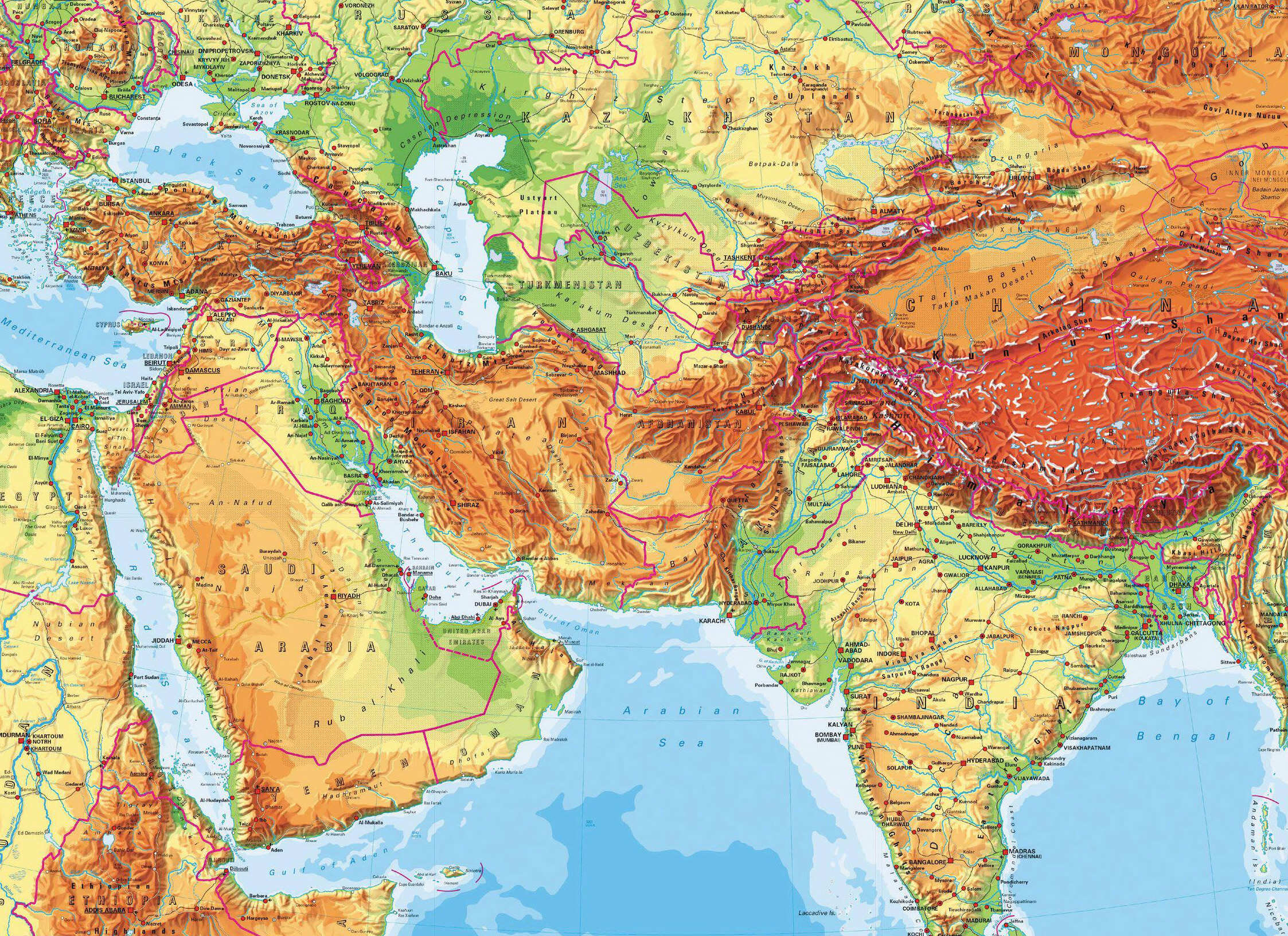
It is enough to look at a map without any ideological lenses. Iran sits between the Persian Gulf and the Caspian Sea, touches Iraq, Turkey, Armenia, Azerbaijan, Turkmenistan, Afghanistan and Pakistan, opens toward the Gulf of Oman and the Indian Ocean, and its territorial mass closes and opens several different directions at once. It is no coincidence that analysts of Eurasian corridors call it a "hinge" without which the entire structure collapses, or at least remains incomplete. Iran stands at the center of a network connecting Mumbai, Bandar Abbas, Russia and onward toward Europe.
There is an interesting anecdote involving Mahmoud Ahmadinejad, told by retired U.S. colonel Larry Wilkerson, that sounds like a short lesson in political geography. He says that at the beginning of the century, after hearing a proposal for an agreement on incidents at sea modeled on U.S.-Soviet protocols, the Iranian president replied with a very simple question: "Iran has an enormous coastline along the Persian Gulf, while the United States does not have a single millimeter. Why are you here?" That sentence condenses the entire Iranian perception of the region. Tehran sees the Gulf as its immediate neighborhood, and the U.S. Navy as a force that has come from far away and wants to turn that neighborhood into an international highway under its own supervision.
In such a place, geopolitical projects take on a very hard material form. Bandar Abbas is not just a port. Astara is not just a border town. The Rasht-Astara railway is not just a construction project. These are pieces of a possible Eurasian whole that gives Iran a completely different role from the one Western discourse likes to assign to it. Instead of an "isolated regime", Iran appears as a bridge - indispensable to some, unacceptable to others.
Ukraine as a Severed Artery Between Asia and Europe
Before 2022, the northern Eurasian railway "land bridge" was growing at an astonishing pace. Academic analyses note that by 2017 some routes between Chongqing and Duisburg had been reduced to around fifteen days, while the sea route on the same line often required between 35 and 50 days. For industries living by the rhythm of delivery, that was a serious advantage. Rail was not cheaper than shipping, but it offered speed and precision.
Russia’s invasion of Ukraine and the sanctions imposed on Russian railways changed the political economy of that corridor. After February and March 2022, the main routes through Russia stalled, customers abandoned the northern corridor because of legal, insurance and reputational risks - and precisely because of that, alternatives south of the Caspian Sea and through the Middle Corridor suddenly began to be sought with far greater urgency. Ukraine, then, is not "a war over one railway", as some commentators like to simplify it. But the war in Ukraine certainly broke one of the most important continental bridges between China and Europe, and in doing so gave new value to all more southerly routes, including those leading toward Iran.
Wars can have many causes, many actors and many layers. Still, their consequences often come down to something very tangible. One route closes, another imposes itself, a third is rapidly financed. Geopolitics then no longer looks like an abstract debate about spheres of influence. It looks like the rewriting of timetables, ports and warehouses on the scale of an entire continent.
Hormuz, Bab el-Mandeb and the Control of Global Chokepoints
The Persian Gulf and the Red Sea can today be seen as the same story written in two places. Hormuz carries around one fifth of the world’s oil flows and one fifth of LNG trade. Bab el-Mandeb, together with Suez, remains crucial for the movement of Gulf energy toward Europe and the Atlantic. The EIA estimates that in the first half of 2025 around 4.2 million barrels per day were still passing through Bab el-Mandeb, even after the sharp drop caused by attacks and the rerouting of vessels around the Red Sea. If that point is seriously disrupted, tankers go around the Cape of Good Hope and the route to Europe is extended by around fifteen days.
Iran will not easily surrender that lever, because Hormuz gives it its strongest card both in war and in potential negotiations. Even when an occasional ship passes through, the very fact that passage depends on Iranian tolerance, diplomatic bargaining and war-risk premiums already changes the balance of power.
Straits are not just places on a map. They are switches. Whoever holds them controls not only energy, but also the perception of power. A country may have a weaker economy, a weaker air force and fewer allies, and still force the world to look first thing in the morning at its coastline. That is exactly what Iran is doing.
If Iran Does Not Lose, Which Is Enough for It to Win, What Does the World Look Like After an American Withdrawal?
Iran only needs not to lose in order to win. That statement, now accepted by many, contains the entire asymmetry of this war. Washington needs a measurable outcome, an open shipping lane, proof that the opponent has been disciplined and an image showing that American power is still sufficient for rapid coercion. Tehran, by contrast, needs endurance, the ability to retain its key levers and to emerge from the war without strategic collapse. The moment the White House seriously considers ending the war without the full reopening of Hormuz, that asymmetry becomes a political fact.
The world after such an outcome would not be a world in which the sea suddenly loses all importance. The sea will continue to carry the bulk of trade, and the U.S. Navy will not disappear from the oceans for a long time. But it would be a world in which maritime power no longer automatically produces political obedience; a world in which one regional power can seriously shake the global energy system; a world in which land corridors acquire new strategic value precisely because the sea is no longer unconditionally "safe" under imperial control. For China, it would be an additional incentive to build redundancy. For Russia, confirmation that Eurasian depth has a price. For the Gulf monarchies, a message that reliance on a single protector is no longer enough.
And that brings us back to the beginning. The war against Iran can no longer be seen merely as another episode in the violent storm of the Middle East. It increasingly looks like a struggle over whether the 21st century will continue to flow through routes controlled by oceanic powers, or whether it will move more and more onto the land connections of Eurasia, onto railways and continental networks that cannot be blocked by a single aircraft carrier. In that perspective, Iran is the hinge on a door someone is trying to close, while the world watches to see whether that door will remain under America’s hand or open toward a different order.
Comments