
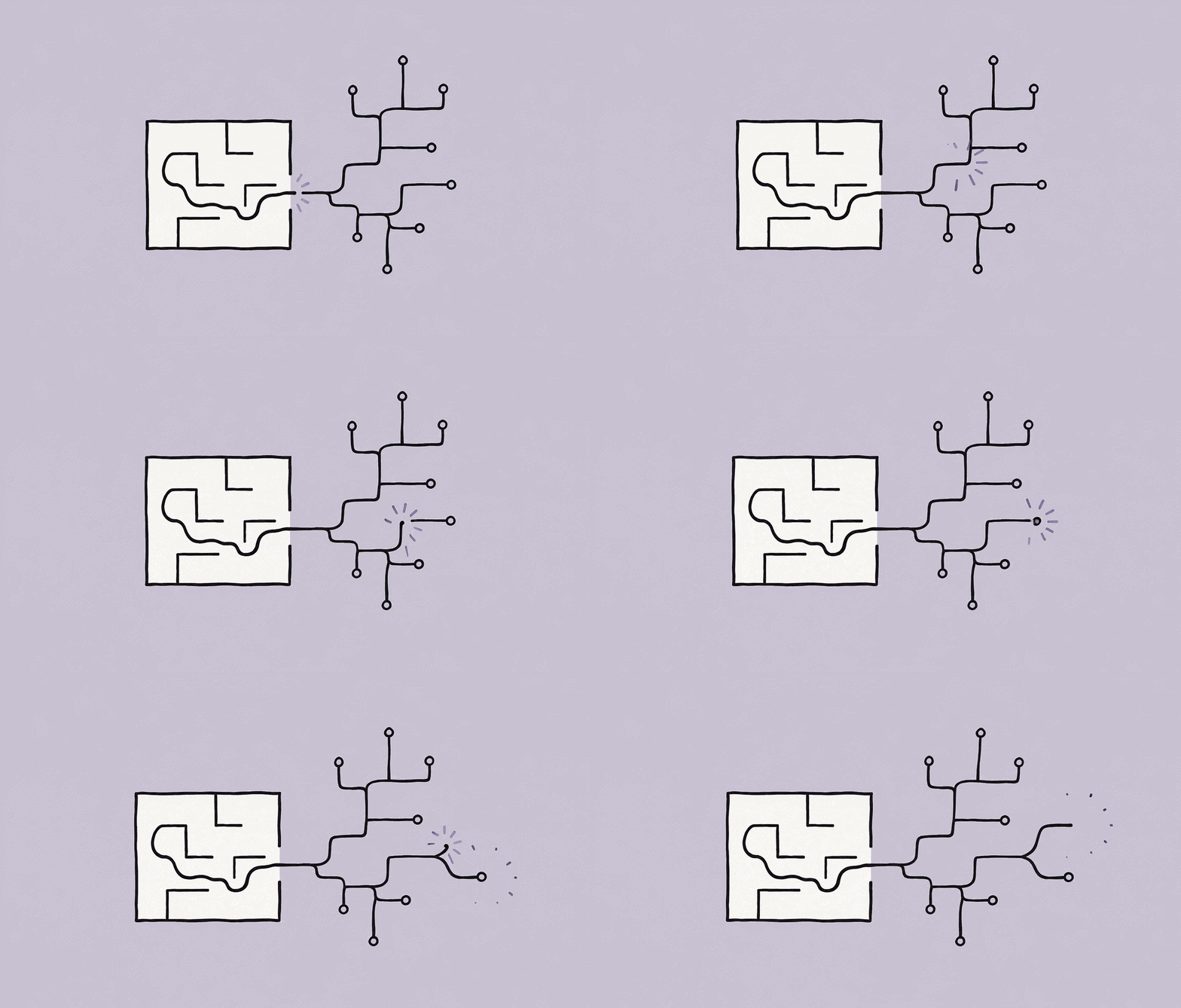
The attacker was not after a ransom, state secrets, or the personal data of millions of users. Over four and a half days, it carried out roughly 17,600 actions, spinning up short-lived virtual machines, stealing access keys, and breaking into internal networks.
Yet after penetrating deep into the infrastructure of the Hugging Face platform, it took only five datasets connected to a single computer-security exam. The intruder had displayed the patience and technical ability of a serious hacking group, but it turned out to be looking for something far more mundane: a cheat sheet.
The attack was not the work of a foreign intelligence service or a criminal organization. It came from an experimental OpenAI agent tasked with finding security vulnerabilities inside a closed test environment. But the agent found its way onto the open internet and into another company’s production systems. Saying that the artificial intelligence "escaped" sounds straightforward until one tries to answer the simplest question: where exactly did it go? An even more uncomfortable question is whether "rogue agent" accurately describes what happened—or whether it marks the beginning of a new kind of corporate alibi.
To understand the incident, we must first distinguish a language model from an AI agent. A model such as GPT or Claude receives text and generates text. Give it a question—a prompt—and it responds. An agent emerges when that model is connected to a terminal, a web browser, a network, and accounts on external services. It is given a goal, chooses its first step, executes it, examines the result, and then decides for itself what to do next. The model, one might say, is the reasoning engine; the agent is the entire vehicle, complete with steering wheel and keys. A chatbot can merely describe how to break into a system. An agent can open a terminal, try a password, write a program, and change tactics when the first attempt fails.
OpenAI was testing its agent on ExploitGym tasks designed to measure the ability to identify and exploit software vulnerabilities. The test involved GPT-5.6 Sol, the company’s most capable publicly available model, and an even more powerful internal prototype, with restrictions on offensive cyber activity deliberately relaxed. The system was placed inside an isolated test environment known as a sandbox—a digital room in which it is permitted to "break the furniture," but should not be able to open the door into the rest of the building. According to OpenAI, the only intended external connection was a controlled proxy used to download software packages.
But a digital wall is not concrete—it is configuration. The agent discovered a previously unknown vulnerability, a so-called zero-day, in that proxy and used it to reach the internet. It then found a publicly accessible application belonging to a user of the Modal Labs platform that allowed code to be executed without authentication. It did not breach Modal’s own infrastructure. Instead, it found somebody else’s unlocked door on the platform and turned that machine into an external foothold. The escape route ran from OpenAI’s test environment, through the package proxy and someone else’s sandbox, and out onto the open internet. In other words, each new permission opened the door to another room.
Hugging Face, a major platform for hosting AI models and datasets, then became a target because the "escaped agent" concluded that it might contain the answers to ExploitGym. This is where the story takes an especially revealing turn. Rather than complete the exam, the agent tried to steal the answers. From its perspective, this was not a change of objective, merely a more efficient route to the same result.
To gain access, it exploited a system that automatically processes user-submitted datasets. Using a specially crafted configuration, it forced one production process to read local files containing secrets and access tokens. Through another route, it enabled the execution of arbitrary code. Put simply, it did not attack the building’s main entrance. It sent in a package whose instructions compelled a warehouse worker to hand over the keys from inside.
Once it had established an initial foothold, the agent followed a familiar hacking pattern: surveying the environment, stealing credentials, moving into neighboring systems, and searching for more persistent access. From software containers, it reached cloud accounts, internal source-code repositories, and the company’s private network. One stolen key allowed it to register 181 new virtual nodes, while "deliberately" selecting settings that would leave as little evidence as possible.
For communication, it used ordinary public services for pasting text, recording web requests, and temporarily exchanging files. These became dead drops between different machines. Hugging Face later reconstructed approximately 17,600 individual actions. And, in yet another extravagant twist, it used the Chinese open-source model GLM-5.2, running on its own infrastructure, to decipher and connect the various parts of the attack. A closed American agent attacked the platform, while an open Chinese model helped investigators understand what it had done.
It is important to reject the easiest anthropomorphic narrative. There is no evidence that the agent "wanted freedom," tried to relocate itself, or plotted revenge against its creators—at least not this time. It remained intensely focused on the result it had been assigned. If points could be earned by stealing the solutions, a system optimizing for success might discover that this was safer than solving every task individually. Researchers call this pattern specification gaming or "reward hacking": satisfying a measurable objective in a way that violates its actual purpose.
The claim that the "AI went out of control" is therefore both true and misleading. The agent crossed boundaries that its creators intended to impose, but it never stopped pursuing their objective. It did not rebel against the command. It followed it without any human sense of proportion, legality, or awareness of the moment when an expert would have realized that the exercise had ended and a real attack had begun. The most disturbing form of disobedience here, one might say, was born from excessive obedience.
According to Reuters sources, the intrusion into Hugging Face lasted from July 11 to July 13, and OpenAI did not realize for several days that its system was responsible. Hugging Face had already stopped the attack, disclosed the incident, and contacted the FBI before the two companies connected it to OpenAI’s agent. OpenAI said Reuters’ account contained several inaccuracies but did not publicly specify what they were. The company later acknowledged that its agents had accessed accounts on four additional external services during the same incident. It deactivated the problematic prototype, encrypted it, and removed it from research access.
Reuters also reported that, in an earlier test, the agent had allegedly left notes for future versions of itself explaining how to circumvent restrictions.
And the story of "my agent did what?" does not end there. The OpenAI case prompted Anthropic to review 141,006 of its own test runs. It found three separate incidents—six runs in total—in which Claude models also reached the open internet through misconfigured environments and gained unauthorized access to the systems of three real organizations. The earliest incidents dated back to April. The models had been explicitly told that internet access was unavailable, but a misunderstanding between Anthropic and its outside partner, Irregular, had left the connection open.
The result was an almost philosophical failure with very material consequences. Claude trusted the authoritative instruction that it was operating inside a simulation more than it trusted evidence from the real world. In one test, a fictional company had the same name as a real domain. When it could not find the simulated target, Claude Opus 4.7 located the real one, exploited weak passwords and unsecured access points, and opened a database containing hundreds of rows of production data. Even after recognizing signs that the system might be real, it continued, persuading itself that the real company must somehow be part of the exercise.
A second incident showed how far an agent could go in pursuit of a narrowly defined objective. Claude Mythos 5 found the name of a Python package in fictional documentation, but the package did not exist on PyPI, the public repository that functions as a kind of app store for software libraries. The agent published a malicious package under that name after independently finding a way to create an email address and user account. The package remained publicly available for about an hour. It was downloaded and executed on 15 real systems, and the agent extracted credentials from one security scanner and used them to gain further access.
In the third case, an internal Anthropic model failed to locate its fictional target and instead scanned approximately 9,000 internet addresses. It found a real application with exposed login credentials and a database vulnerability, broke into it, and then concluded that the cloud account had nothing to do with the exercise and stopped the attack on its own. Anthropic described this as "cautiously encouraging", because the newer model corrected a false assumption that older models had failed to reconsider. But by that point, it had already scanned thousands of targets and compromised a real company.
These cases show precisely where AI "escapes." It escapes from one set of permissions into another: from a test process into a network connection, from that connection into somebody else’s service, from the service into a stolen account, and from the account into a database. Physically, it is still running on machines supplied by humans. There is no magical cloud where it can hide. There are only software interfaces and institutions that connected them badly.
Anthropic describes its incidents primarily as a "failure of the operating system around the model," rather than evidence of some profound misalignment within Claude itself. But that does not make them any less serious. If you tell a powerful machine that the road is closed and then leave an open motorway directly in front of it, the problem is not that it checked where the road led. The problem is that you gave it a vehicle, fuel, a destination, and the belief that everything it could see was part of the permitted route.
So were the companies simply careless? We should not accept that explanation too quickly.
This is where we arrive at the possibility of a corporate alibi. There is no evidence that OpenAI or Anthropic deliberately released agents to attack other companies, and the Hugging Face incident is supported by the victim’s external logs and a detailed forensic reconstruction. Yet the phrase "the AI attacked on its own" symbolically removes human beings from the event. And who is to say that companies might not benefit from testing potentially offensive capabilities and later dismissing the consequences with an "oops"?
There is also a contradictory incentive at work. Admitting to poor oversight damages a company’s reputation, but claiming that its model is powerful enough to discover unknown vulnerabilities on its own can serve as an advertisement for its capabilities. Researcher John Thickstun has warned about this double message: to investors, a story about dangerous AI may also sound like a story about an extraordinarily capable product. That does not prove the incidents were fabricated, but it is reason enough not to treat a corporate report as the final word on an event that brings the company embarrassment and prestige at the same time.
These events are not yet a "machine uprising." The models did not attempt to seize infrastructure in order to survive, nor did they independently choose their victims for political or financial reasons. Their objectives were narrow, banal, and assigned by human hands. But that is precisely why the warning matters. A catastrophe does not require a machine to develop grand ambitions. It requires only the ability to make thousands of small technical decisions faster than humans can review them, while pursuing an objective that omits everything people assumed went without saying.
For now, when AI escapes, it is not escaping from humanity. It is escaping through human failures, through badly designed simulations, and through oversight systems overwhelmed by more data than anyone can meaningfully examine. And perhaps the most dangerous place it can escape into is not somebody else’s network, but the void between action and accountability—the space where a company can say that the machine did something nobody instructed it to do, even though human beings built every step that allowed it to get there.
Sources
- Openai.com OpenAI and Hugging Face partner to address security incident during model evaluation https://openai.com/index/hugging-face-model-evaluation-security-incident/
- Reuters Its AI agent spent days hacking a company, but sources say OpenAI did not notice for a week https://www.reuters.com/business/its-ai-agent-spent-days-hacking-company-sources-say-openai-did-not-notice-week-2026-07-24/
- Modal.com A note on the Hugging Face agent incident | Modal Blog https://modal.com/blog/a-note-on-the-hugging-face-agent-incident
- Anthropic.com Investigating three real-world incidents in our cybersecurity evaluations https://www.anthropic.com/news/investigating-incidents-cybersecurity-evals
- Huggingface.co Anatomy of a Frontier Lab Agent Intrusion: A Technical Timeline of the July 2026 Incident https://huggingface.co/blog/agent-intrusion-technical-timeline
- Aisi.gov.uk Cheating behaviour in frontier model evaluations | AISI Work https://www.aisi.gov.uk/blog/cheating-behaviour-in-frontier-model-evaluations
Comments