
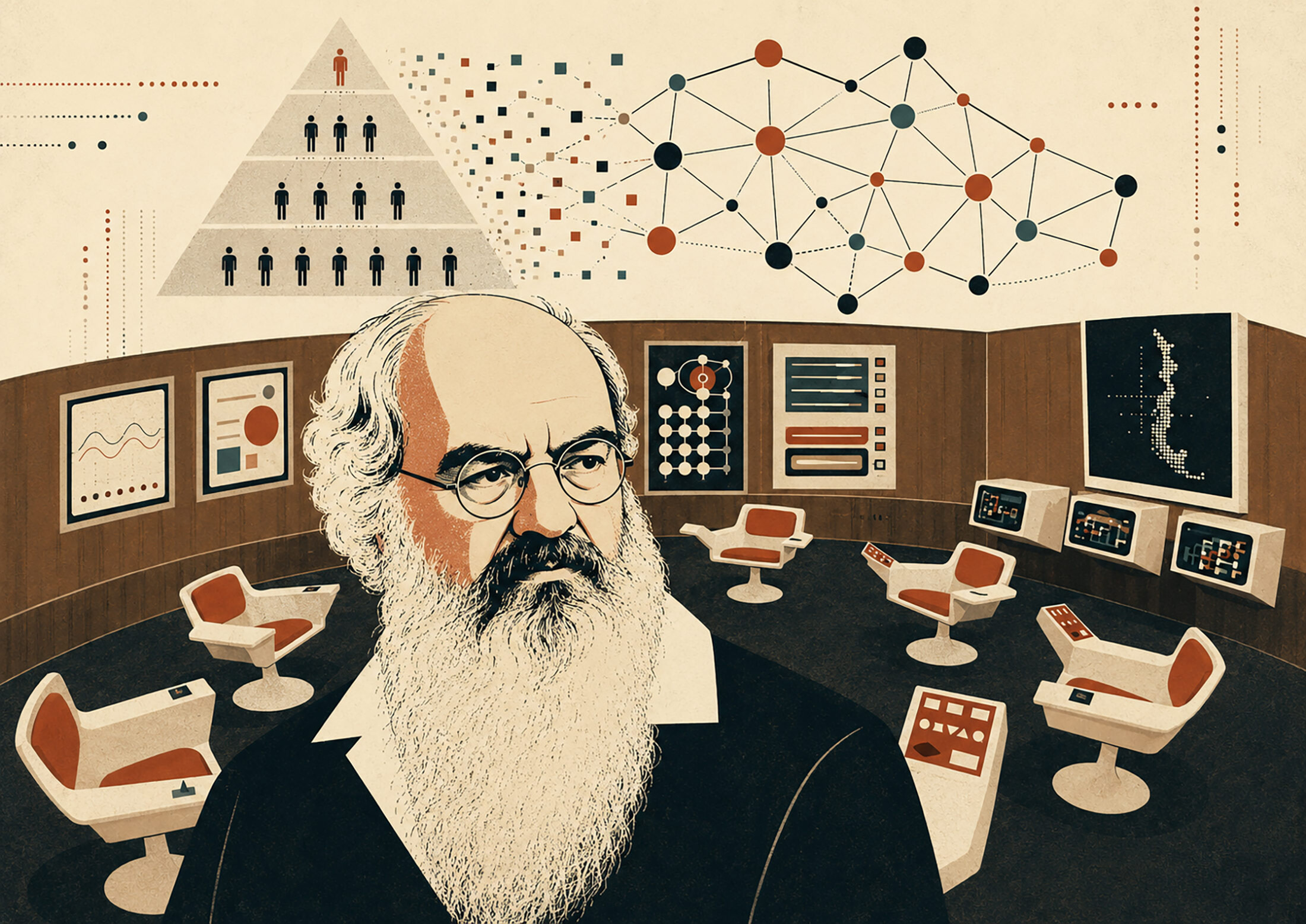
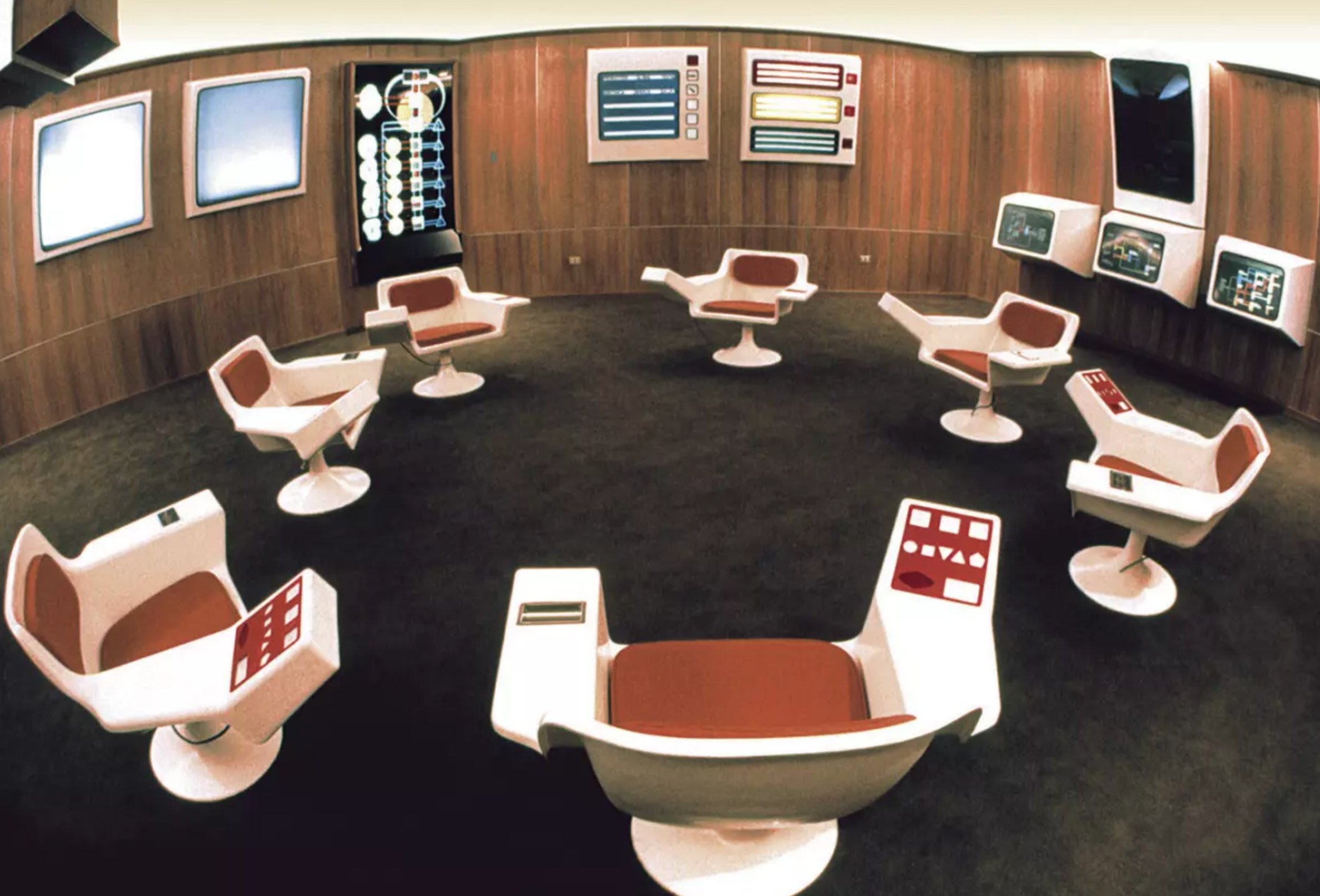
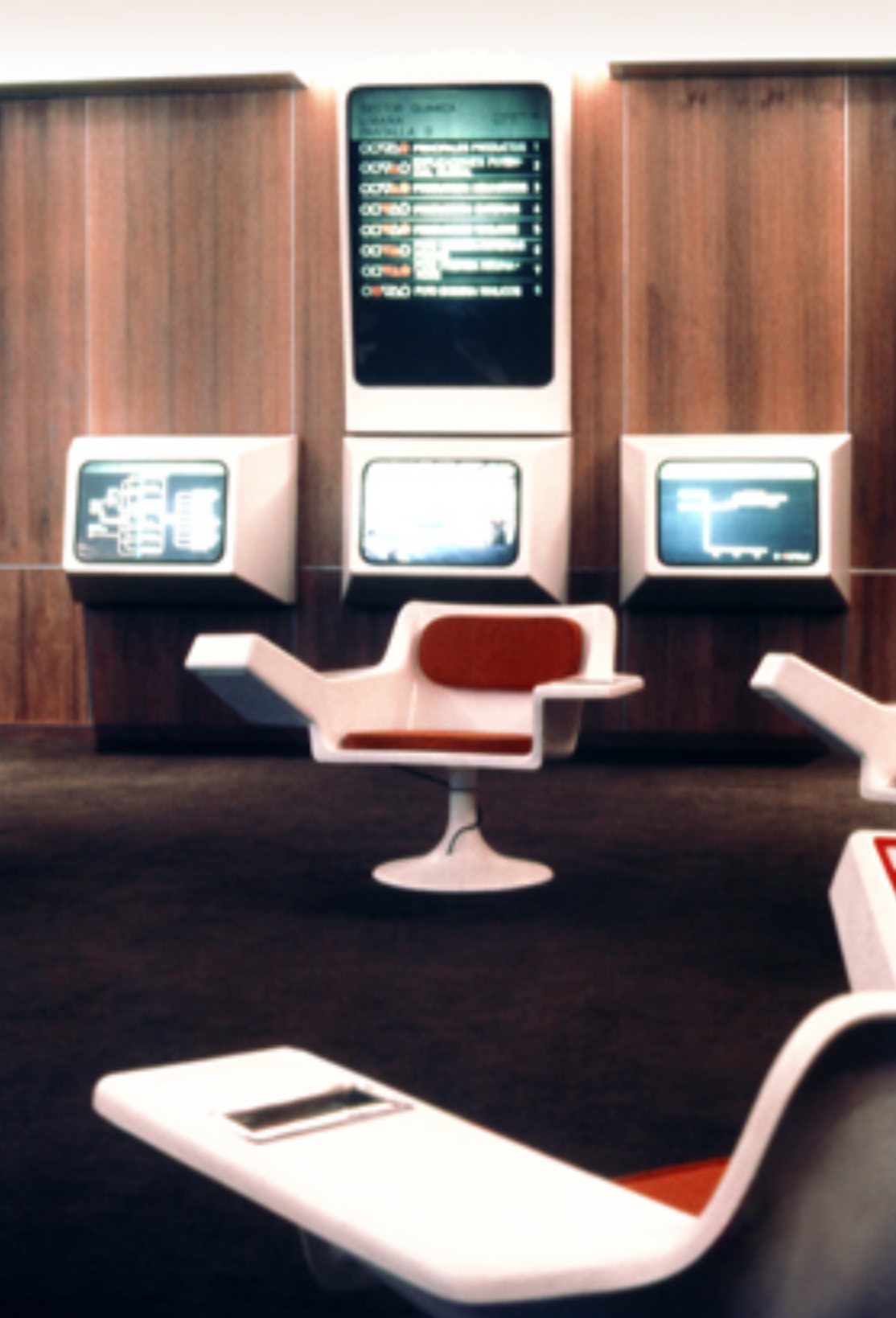
In one room in Santiago, the future, at least for a moment, looked as though someone had fused a socialist congress, a space-mission control center and a very ambitious 1972 furniture showroom.
Seven white fiberglass chairs, orange cushions, buttons built into the armrests, screens on the walls. There were no tables. There was no paper. Bureaucracy had been deprived of its favorite narcotic. The room was not a set from Star Trek. It was the heart of Project Cybersyn, Chile’s attempt to give the state something like a nervous system.
The story sounds like a short circuit between Marxism, cybernetics and a very serious child’s imagination. But it was more than a Cold War curiosity. Allende’s Chile was not trying to build the internet as we know it today, with algorithms that know us better than our own families. It was trying something politically bolder: connecting factories by telex, gathering production data in something close to real time and making economic decisions before a crisis became a national sport. In a country under pressure from shortages, inflation and a hostile external environment, that sounded less like a technological luxury and more like a matter of survival.
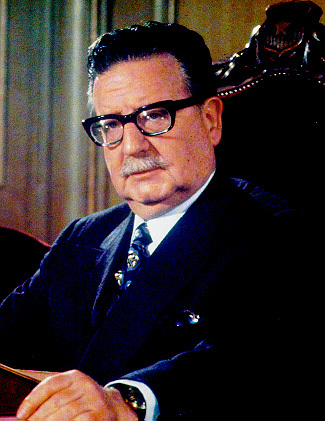
Salvador Allende, the Chilean physician and socialist, came to power in 1970 with a program for a peaceful transition to socialism. His government nationalized key industries and expanded the public sector at a speed that delighted supporters and convinced opponents that history urgently needed to be stopped. By the end of 1971, the state had taken over the big mining companies and dozens of important industrial enterprises. The problem could look simple only on party posters. How do you manage a growing public sector without turning it into a Soviet caricature of commands, forms and people waiting for a stamp as though they were waiting for spring?
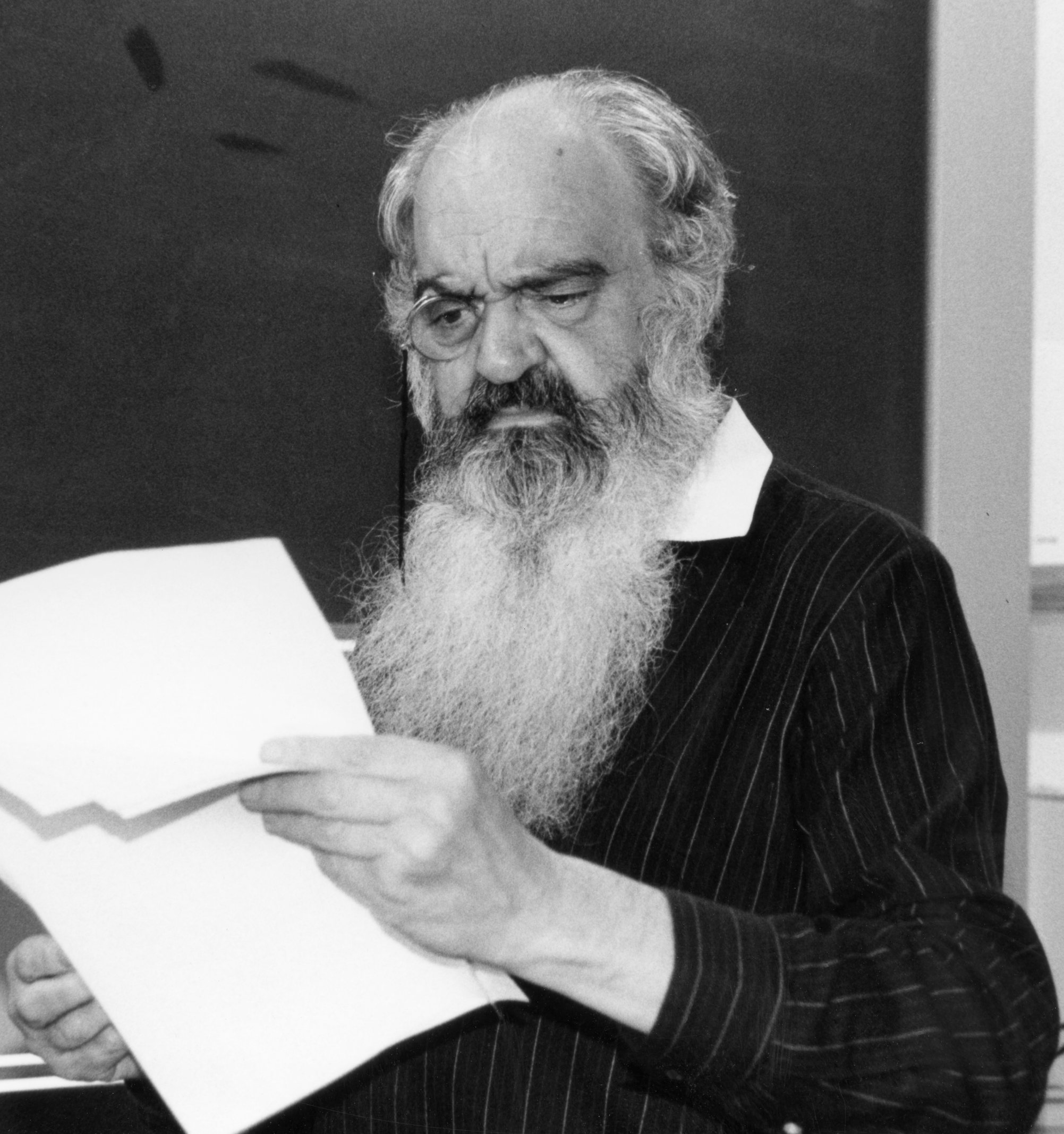
This is where Stafford Beer enters the story, a British cybernetician and management theorist. In July 1971, Fernando Flores, then a 28-year-old Chilean engineer at the state development agency CORFO, wrote to him. Flores believed Beer’s theory could help manage an economy that was changing faster than classical administration could even describe it.

Beer took the invitation in almost messianic terms. He was not a typical revolutionary, although from his appearance one might have guessed he was a cousin of Marx and Engels. He was a former corporate consultant, a man with a Rolls-Royce and a house in Surrey which, according to one unforgettable anecdote, had a remotely controlled waterfall in the dining room. The revolution, then, had acquired a consultant from the future.
Cybernetics, the discipline shaped after the Second World War by the American mathematician Norbert Wiener, dealt with communication, feedback and control in complex systems. Beer applied that logic to organizations. His central obsession was balance: how to keep a system stable without suffocating the autonomy of its parts. In the Chilean case, that meant an economy that would not wait for monthly reports while factories were already grinding to a halt, but also a state that did not try to supervise every nut and bolt from the capital.
One could put it this way: if the Soviet model often dreamed of a pyramid, Cybersyn dreamed of a network.
The project had four main elements. Cybernet was a network of telex machines meant to connect enterprises with the center in Santiago. For younger readers, and frankly for many middle-aged ones as well, a telex machine was a device resembling a typewriter that sent and received written messages over telephone or telegraph networks.
Cyberstride was software for monitoring production data and detecting deviations.
CHECO, the Chilean economic simulator, was meant to make it possible to test long-term decisions before reality made them expensive.
The operations room was the physical theater of the whole idea. There, data was supposed to become decisions, and decisions were supposed to become feedback signals to industry. As one might expect, there was also a great deal of improvisation. Chile had few computing resources, so the solution was found in telex machines that the national telecommunications company already had in storage.
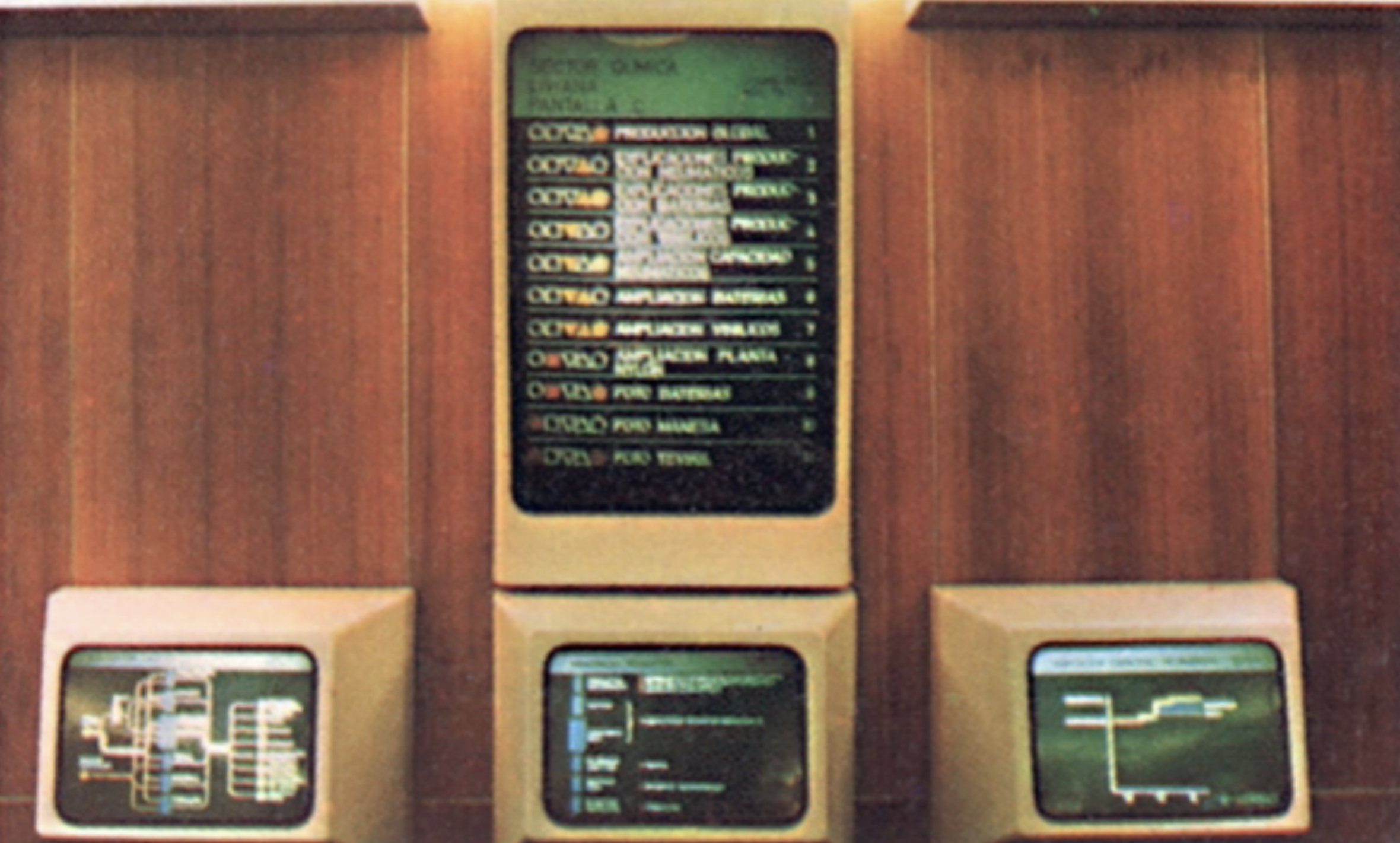
Cyberstride was not meant to bury the state under data. It was meant to teach it where to look. The software used statistical forecasting to spot unusual movements in production, inventories or worker absenteeism. The idea was essentially elegant: the center did not need to know everything, all the time. It needed to know when something important enough to require a response was happening somewhere. That was the small but crucial difference between intelligent oversight and administrative megalomania.
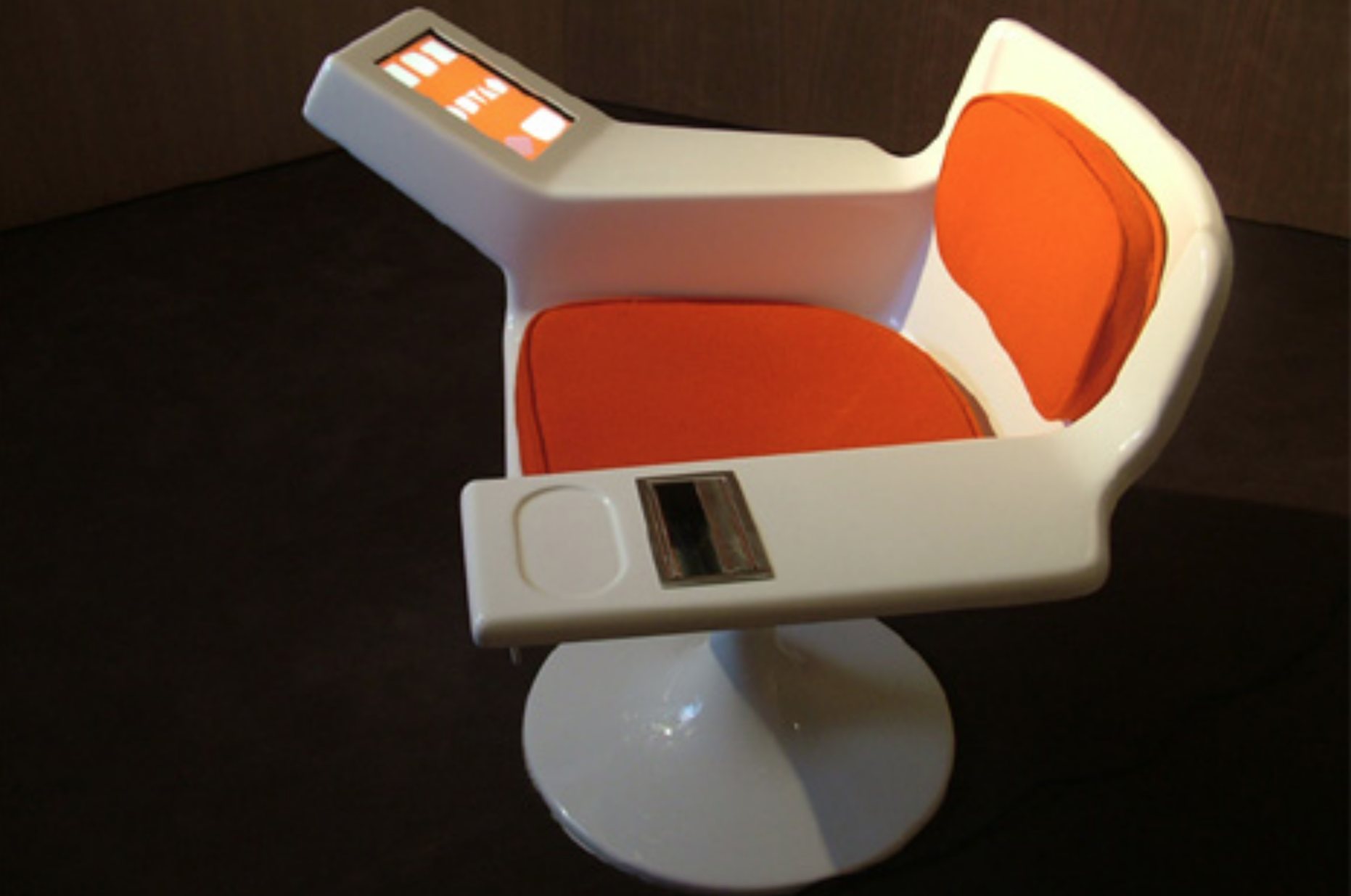
The most famous part of Cybersyn was still the operations room. It was hexagonal, about ten meters in diameter, with seven white chairs and screens on the walls. Buttons in the armrests were supposed to let users move through the displays without a keyboard, which mattered if the space was not to be reserved only for technicians.
There were also fascinating details that, from today’s perspective, feel almost comically analog. Some of the charts, for example, had to be prepared by hand, while the design of the chairs included an ashtray and a cup holder. The future, it seems, anticipated serious planning with a cigarette and a glass of whisky.
Beer, who clearly did have something revolutionary in him, insisted that Cybersyn must not become a machine for centralizing power. On the contrary, he argued that workers had to take part in modeling their own factories, because no one understood a plant better than the people who spent their lives inside it.
That is the most interesting, but also the most delicate, part of the project. Cybersyn was not imagined merely as a technological tool, but as a political experiment in the distribution of knowledge. The Chilean opposition, predictably, did not see “people’s tools” in it, but a new infrastructure of state surveillance. The history of technology rarely grants us the luxury of allowing only one side to be partly right.
Cyberfolk: a device for measuring the collective mood
The strangest addition to Cybersyn may not have been the futuristic operations room, but a project that never fully came to life: Cyberfolk. Stafford Beer imagined it as a system through which citizens could send the state a near-real-time signal of their satisfaction or dissatisfaction. Not through elections every four years, not through a party cell or a newspaper comment, but through a small device in the living room.The device was called an algedonic meter, from the Greek words for pain and pleasure. A citizen could move a dial toward satisfaction or dissatisfaction, and the signal would be transmitted through the television network. In theory, the government could immediately see how the population was reacting to a decision, a shortage, a speech or an economic measure. It was an unusual mixture of democracy, thermostat and political psychology.
Today, Cyberfolk sounds both naive and disturbingly familiar. Naive, because it believed that the mood of a society could be turned into a meaningful signal without manipulation, fear or propaganda. Familiar, because we live in a world that constantly measures our reactions: clicks, likes, the duration of our gaze, anger, boredom, the impulse to buy. The difference is that Beer at least imagined technology as a tool of political feedback. Our age has mostly turned it into a tool for selling, surveillance and the fine-tuning of collective nervousness.
Cyberfolk shows that Chile was not dreaming only of an economy that could receive data faster, but also of a state that could listen to the emotional pulse of society. That can sound like a democratic utopia. It can also sound like the first draft of a dystopia. As always with serious technological dreams, the difference depends on who controls the switch. But in this story, at least in theory, the switch was within the worker’s reach.
The first major test came in October 1972, when a truck owners’ strike threatened to paralyze the country. The government then used Cybersyn’s telex network to track roads, fuel, raw materials and available transport. Beer estimated that during the crisis the network was carrying around 2,000 messages a day. In one command center, about twenty telex machines worked at the same time, producing a noise that sounded like an industrial version of panic. If there was such a thing as cyberpunk before cyberpunk, it was probably a socialist government trying to survive a crisis by listening to the clatter of telex machines.
But Cybersyn, of course, was not a magic machine. It could show where coal was missing, but it could not create coal. It could speed up information, but it could not abolish inflation, the black market, falling copper prices, political polarization or the possibility of violence. In one case, as the Belarusian writer and technology critic Evgeny Morozov notes in The New Yorker, a warning about a shortage at a cement factory arrived only after the manager had already gone there in person to solve the problem. It is a perfect miniature of technological utopia: the system of the future arrives later than the man in the car.
Pinochet’s brutal regime had no need for a socialist nervous system. It needed a disciplined market order and an apparatus of repression. That, unfortunately, is a much older technology.Clearly, as we know, the Cold War did not observe Chile from a polite distance. Cables and later research show that U.S. policy toward Allende included covert efforts to destabilize his government from the beginning, and Washington saw the Chilean experiment as a particular threat. In such an atmosphere, Cybersyn was too vulnerable to remain merely a technological project. Every cable was also a political wire.
The end came on September 11, 1973, when a military coup, encouraged and orchestrated by the United States, overthrew Allende’s government, and Allende himself was killed. That was the other, or rather the first, “September 11,” one that America, ironically, has sought to erase from collective memory even through its own later tragedy. But the imperialist crime against Chile, a country that had democratically chosen socialism, will never be forgotten.
And so, quite literally, physically and by force of arms, a project ahead of its time was stopped.
Because of the coup, Cybersyn was never fully implemented. The operations room, which Allende reportedly wanted to move into the presidential palace, La Moneda, just days before the coup, never made it there...
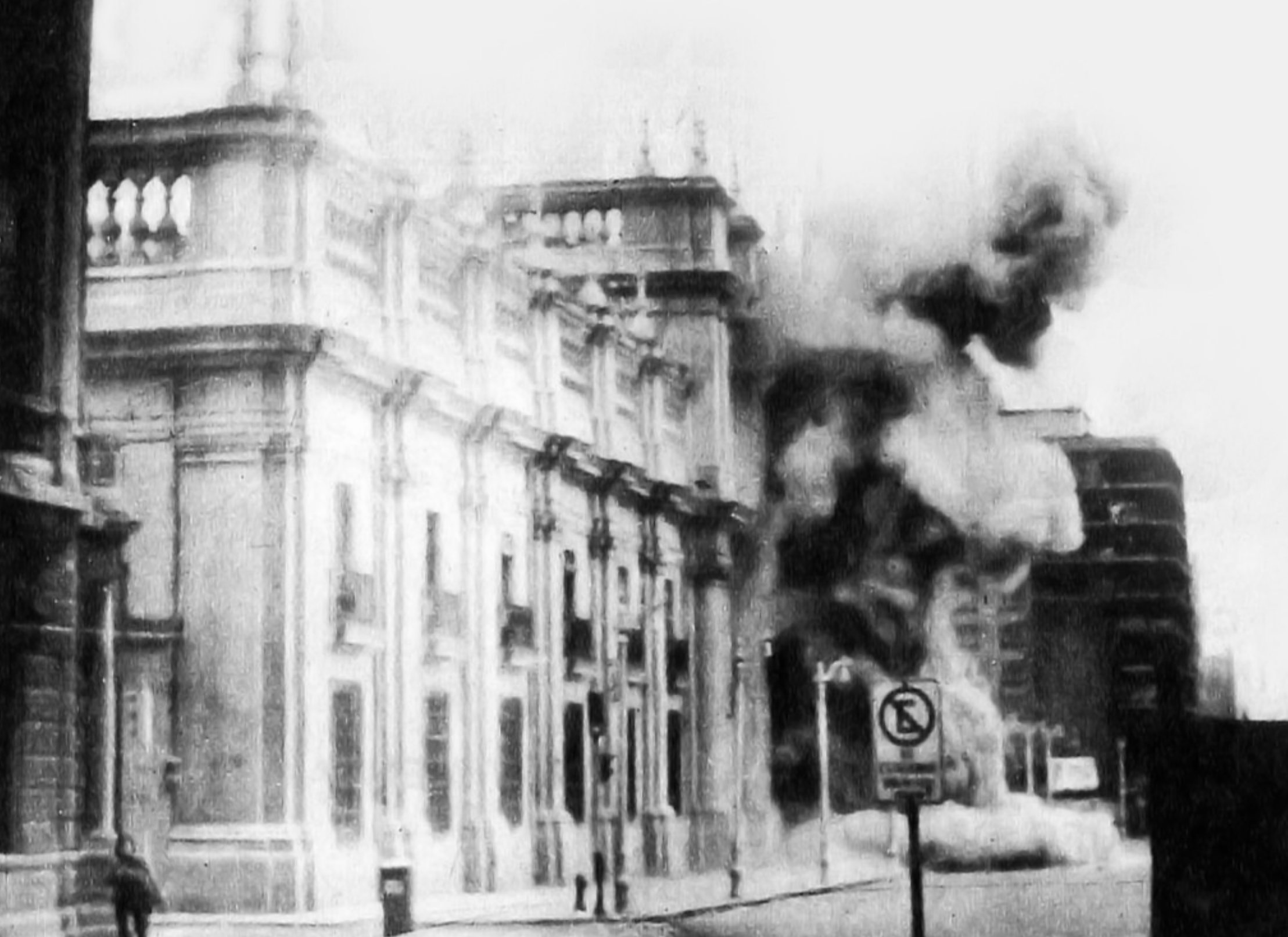
After the coup, Cybersyn lost the political world that had made it imaginable. Pinochet’s brutal regime had no need for a socialist nervous system. It needed a disciplined market order and an apparatus of repression. That, unfortunately, is a much older technology.
Here is the block. The detail about Beer’s luxurious life before Chile, with the Rolls-Royce and the house in Surrey, is well documented, as is his later withdrawal to Cwarel Isaf, a small stone cottage in West Wales. ([The New Yorker][1])
Stafford Beer after the collapse: from Rolls-Royce to a cottage in Wales
Before he became the cybernetic adviser to Chilean socialism, Stafford Beer lived like a man who had already made a private deal with the future. He was a successful British consultant, drove a Rolls-Royce and owned a large house with the aforementioned remotely controlled waterfall in the dining room. Even luxury, in his case, seemed to feel the need to look like a system.Chile changed him. Beer was not a romantic revolutionary from a student cafeteria, but a man who saw in Allende’s project a chance to take his theories out of conference rooms and release them into the real world. Cybersyn, for him, was not just a job. It was proof that the management of a complex society could be imagined differently: with more feedback, more autonomy and less bureaucratic dullness.
After the military coup of 1973, that idea collapsed along with the political world that had sustained it. Beer later described the period after the Chilean collapse as a personal tragedy. Before long, he withdrew from his former life, renounced much of his material ambition and bought a small stone cottage in the hills of West Wales. The cottage was modest, without running water, but sturdy enough for a man who, after colliding with history, seems to have wanted to live without decoration.
The transition feels almost literary. From Rolls-Royce to cottage, from a world-historical experiment to a fire in a stone house, from the idea that one might help a state think in real time to the need for one man to learn how to think again in silence. There is something devastating in it, but not something cheaply defeated. Beer did not merely lose a project. He lost one possible future, and then withdrew to a place where the future no longer had to be a project.

And yet the story of Cybersyn still fascinates far more than an unfinished system of telex machines and hand-drawn charts ought to. It reminds us that the question is not only whether the state can think in real time. The question is who owns the data, who interprets the signals and whom the system ultimately serves. Today’s world has everything Beer did not have: sensors, digital clouds, a vast and rather Orwellian surveillance infrastructure, algorithms and incomparably more powerful computers. What it often no longer has, or has less and less of, is the political ambition to make technology something more than a more efficient form of administration: a space of democratic struggle.
Cybersyn was not the internet before the internet because it technically anticipated our digital world. It was that because it asked a question the internet still avoids while selling us convenience as freedom: can a network serve collective intelligence without turning into the perfect machine for surveillance? Allende’s Chile did not necessarily find the answer, but it searched for it actively and with ambition. Perhaps that is why its failed future still feels fresher than many of our successfully funded presents.
Sources
- Mitpress.mit.edu Cybernetic Revolutionaries - Technology and Politics in Allende’s Chile https://mitpress.mit.edu/9780262016490/cybernetic-revolutionaries/
- Pmc.ncbi.nlm.nih.gov Cybersyn, big data, variety engineering and governance - PMC https://pmc.ncbi.nlm.nih.gov/articles/PMC8726523/
- The Guardian Andy Beckett: The forgotten story of Chile's 'socialist internet' https://www.theguardian.com/technology/2003/sep/08/sciencenews.chile
- Nsarchive.gwu.edu ‘Extreme Option: Overthrow Allende’ | National Security Archive https://nsarchive.gwu.edu/briefing-book/chile/2020-09-15/extreme-option-overthrow-allende
- The New Yorker The Socialist Origins of Big Data | The New Yorker https://www.newyorker.com/magazine/2014/10/13/planning-machine
- Thereader.mitpress.mit.edu Project Cybersyn: Chile's Radical Experiment in Cybernetic Socialism | The MIT Press Reader https://thereader.mitpress.mit.edu/project-cybersyn-chiles-radical-experiment-in-cybernetic-socialism/
- Proyectoidis.org CYBERSYN, sinergia cibernética https://proyectoidis.org/cybersyn-sinergia-cibernetica/
Comments