
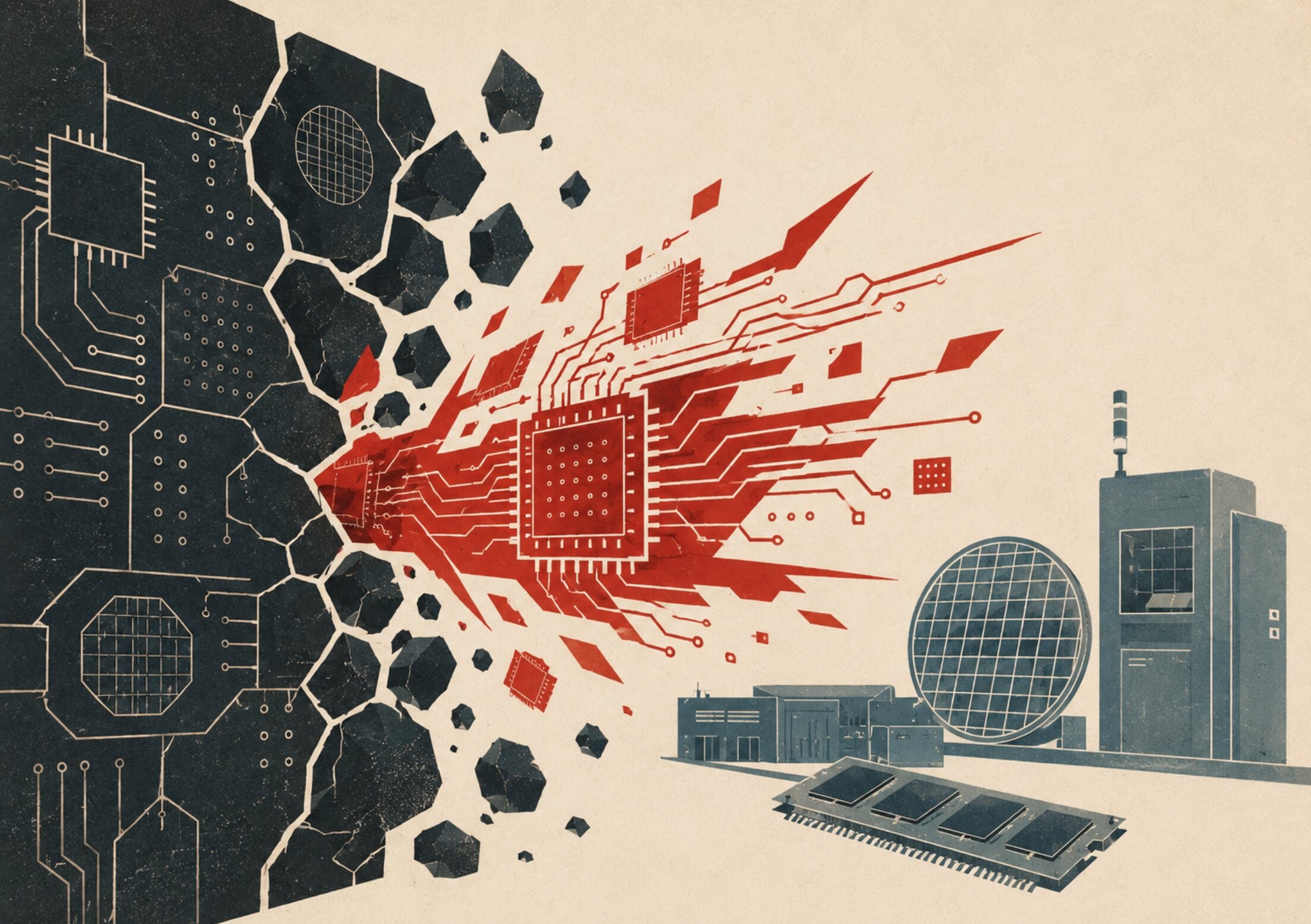
A scene unfolded in Shanghai on Monday that would have seemed almost unimaginable only a few years ago. Shares in Chinese memory-chip manufacturer CXMT were offered at 8.66 yuan and closed their first trading day at 49 yuan. The 466% surge lifted the company’s market capitalisation to approximately 3.3 trillion yuan, or nearly $488 billion, allowing CXMT to overtake Chinese banking giant ICBC and become the most valuable company listed on mainland Chinese exchanges. The share sale itself raised 57.9 billion yuan, around $8.6 billion, in Asia’s largest IPO of the year.
Yet the 466% figure says more about expectations and the structure of the offering than about any sudden technological breakthrough. That, too, is part of the story, as we shall see. Only 6.73% of the company’s total equity was available for unrestricted trading, while the initial price had been set below the valuations of comparable global manufacturers. A limited supply of shares, enormous demand and the political appeal of anything associated with Chinese technological self-reliance created ideal conditions for an explosion. Even analysts who believe in CXMT’s long-term prospects warned that the first day of trading had taken on the characteristics of speculative euphoria.
Stock-market capitalisation and industrial power, however, are not the same thing. The share price could halve tomorrow, but the $8.6 billion in fresh capital can already be converted into factories, research centres, equipment and engineers. Chinese investors were not merely buying the memory manufacturer’s current earnings. They were buying the possibility that the world’s largest industrial power might remove one of the last remaining points at which its adversaries can still close the door.
The old distinction between state and market has disappeared from the chip war. Washington decides who may purchase certain technologies, Beijing directs public and private capital towards strategic sectors, and the stock exchange becomes another instrument of industrial policy. CXMT did not emerge as a romantic "garage start-up" that happened to outperform its competitors. Its rise is part of a deliberate national project designed to reduce China’s vulnerability to American technological pressure.
The chip everyone uses but almost nobody notices: Why memory has become a strategic weapon
When people talk about chips, they usually imagine processors made by Nvidia, Intel, AMD or Huawei. CXMT produces a less glamorous but indispensable component: DRAM, the working memory in which a device temporarily stores the data it needs for immediate operations. A processor may be extraordinarily powerful, but if it cannot receive data quickly enough, much of that power remains unused. This is true of a home computer, a smartphone, a military system and a vast artificial-intelligence model.
HBM, the high-bandwidth memory that has become essential for AI accelerators, also belongs to the DRAM family. Memory chips are stacked vertically and connected through extremely wide data pathways, enabling them to deliver enormous quantities of information to the processor. In a modern AI system, the question is no longer simply how quickly the processor can calculate, but how quickly the memory can feed it. The silicon race is therefore no longer being fought solely over the machine’s "brain", but also over what might be called its circulatory system.
For years, the market was almost entirely dominated by Samsung, SK Hynix and the American company Micron. Together, they controlled 89.7% of the global DRAM market in the first quarter of 2026, while CXMT reached fourth place with a 7.6% share. The Chinese company still trails the leading trio, particularly in advanced HBM, and most of its sales remain domestic. Nevertheless, a country that was until recently almost exclusively a customer in this sector now has a manufacturer large enough to influence supply, prices and the decisions of its competitors.
Memory is also used in surveillance, guidance and communications systems, as well as in the processing of satellite data and many other applications. This means that China may design its own processors and assemble supercomputers, but as long as it depends on companies subject to American rules for essential memory components, its independence remains conditional. CXMT is therefore not merely a manufacturer of RAM. It represents an attempt to transform a potential embargo lever into a domestic industry. Military applications, artificial intelligence and advanced computing are, after all, the official American justification for the steadily expanding export controls imposed on China.
AI has swallowed the memory market: Why RAM is becoming more expensive even as consumers buy fewer computers
Artificial intelligence is turning data centres into enormous consumers of HBM, server DRAM and high-speed SSDs, while Samsung, SK Hynix and Micron are directing capacity towards the products that offer the highest margins.
TrendForce estimated that contract prices for conventional DRAM rose by between 90% and 95% quarter-on-quarter in the first quarter of 2026, followed by a further increase of between 58% and 63% in the second. Growth was expected to slow in the third quarter, but still remain extremely high at between 13% and 18%. At the same time, computer and smartphone manufacturers are receiving fewer chips under increasingly expensive contracts as production shifts towards servers.
AI is not the only cause. The memory industry is intensely cyclical. After a period of oversupply, manufacturers restricted investment and began phasing older generations such as DDR4 and LPDDR4X out of production. A new factory, moreover, cannot be created at the press of a button. It requires years of work and billions of dollars. When demand for AI infrastructure suddenly accelerated, the industry entered a new cycle without sufficient spare capacity, while its largest customers began signing long-term contracts simply to guarantee deliveries.
That is why RAM prices can rise even while sales of personal computers and smartphones stagnate. It is enough for data-centre developers to pay more for the available silicon. The AI industry is consuming manufacturing capacity, and the cost then spills over into laptops, mobile phones, graphics cards and consumer electronics. The technological revolution advertised as a path towards cheap and universally accessible intelligence is, for now, also producing very tangible hardware inflation.
For CXMT, however, this represents a historic opportunity. While the leading manufacturers prioritise HBM and server products, the Chinese company can fill gaps in the conventional DRAM market, expand its share and finance its technological advance. In the long term, increased Chinese production could disrupt the oligopoly and reduce prices. In the short term, CXMT’s value is rising precisely because memory remains scarce.
A monopoly without a single owner: Taiwan, the Netherlands and the invisible alliance controlling silicon
It is often said that Taiwan holds a monopoly over chips, while the Netherlands holds a monopoly over the machines used to manufacture them. It would be more accurate to describe a series of interconnected monopolies and bottlenecks. In the first quarter of 2026, Taiwan’s TSMC accounted for around 72% of global chip-foundry revenue and an even greater share of the most advanced manufacturing processes. The Dutch company ASML is the sole supplier of EUV lithography systems required for the economical production of the most advanced logic and memory chips.
The United States, meanwhile, dominates the design of AI processors, electronic chip-design software and much of the equipment used for deposition, etching—the removal of material from a surface through corrosive processes—and measurement. South Korea and the United States control most of the memory market, Japan is indispensable in materials and specialised machinery, and ASML itself relies on thousands of suppliers spread across Europe, North America and Asia. No country controls the entire chain, but a handful of countries and companies hold the points without which the chain cannot function.
American power comes from its ability to connect this dispersed architecture politically. Washington does not need to manufacture every machine. It is enough to control crucial software, patents, components, financial systems and the security alliances to which the other manufacturers belong. The restrictions introduced in December 2024 covered 24 categories of semiconductor-manufacturing equipment, three categories of software tools, HBM memory and 140 additional Chinese entities placed under restrictions. The stated objective was to prevent China from developing advanced military and AI capabilities.
This is the "silicon wall": not a single prohibition that can be bypassed by purchasing from another supplier, but a system in which the absence of one optical component, spare part, software update or chemical can slow an entire factory. The West’s advantage rested not only on having better chips, but also on the assumption that China could not replace every part of the system simultaneously.
That alliance does not come without a cost. ASML and South Korean and Japanese companies are losing customers, while Taiwan’s semiconductor industry operates under steadily increasing geopolitical pressure. China, however, does not need to outperform every Western product immediately. It would be enough to provide alternatives at a sufficient number of critical points and thereby increase the cost of maintaining the embargo.
Five machines against ASML: How the technological wall begins to crumble
Almost simultaneously with CXMT’s stock-market debut came another announcement that attracted less attention but may prove even more important from an industrial perspective. The Chinese state-owned company Shanghai Aishengna has begun producing domestic immersion DUV lithography machines. It plans to manufacture around five of them in 2026 and approximately twenty the following year, with SMIC, Hua Hong and CXMT itself expected to be among the first customers.
Five machines do not constitute a threat to ASML. The Dutch company delivers hundreds of lithography systems every year, and its machines are the product of decades of development and experience gained in the world’s most demanding factories. In lithography, it is not enough to draw an extremely fine line on a silicon wafer once. The machine must repeat the process at high speed and with almost unimaginable precision across thousands of cycles, while maintaining a high yield of functional chips. Layer alignment, productivity, reliability and servicing are all decisive factors. The Chinese system has yet to prove itself in every one of these areas.
It is also important to explain that DUV is not the same as EUV. Immersion DUV uses a layer of water between the lens and the wafer to print smaller structures, while multiple-patterning techniques can push it towards more advanced processes. This, however, requires more stages, more time and creates more opportunities for error. EUV remains essential at the industry’s cutting edge. China has developed a prototype, but according to available estimates it is still years away from producing a machine suitable for mass production.
The importance of the first domestic DUV machines should therefore not be measured by their present performance. Once a machine enters a factory, it begins producing something more valuable than its first wafers: experience. Every breakdown, poor yield and deviation generates data for the next version. China develops its own service technicians, suppliers, optical specialists, programmers and production routines. What was once a question of imports becomes a domestic engineering problem, and engineering problems can be solved through thousands of iterations.
American restrictions have slowed China at the technological frontier, but they have also destroyed the illusion that critical equipment would always remain available for purchase. In doing so, they have created a vast protected market for domestic alternatives, even when those alternatives are slower and more expensive. Beijing can combine them with multiple patterning, advanced packaging, larger numbers of processors and software optimisation.
Such a system may not be as elegant or energy-efficient as the best Western solution. It does not need to be. It only needs to be good enough to ensure that the embargo can no longer function as a switch capable of shutting down China’s technological development.
From CXMT to Kimi K3: The final barrier to a technologically sovereign superpower
The same logic is visible in artificial intelligence. China’s Moonshot AI has introduced Kimi K3, an open-weight multimodal model with 2.8 trillion parameters and a one-million-token context window, designed for extended programming, research and autonomous tasks. Size alone does not prove that Kimi is more intelligent than the best American systems, and many of the initial benchmarks come from the manufacturer itself—in other words, a degree of scepticism is warranted. Nevertheless, the fact that a Chinese company operating under restricted access to the most advanced processors can build and publicly release a model of such scale demonstrates that hardware pressure has not produced software capitulation.
A month earlier, the Chinese LineShine supercomputer took first place on the TOP500 ranking with a performance of 2.198 exaflops. The Shenzhen-based system uses China’s LingKun platform, LingQi network architecture and Kylin operating system—the names alone suggest an emphasis on indigenous technology. Some will point out that a single benchmark does not prove overall technological superiority, just as 2.8 trillion parameters do not guarantee the best AI model. Fair enough. But taken together with CXMT and domestic DUV machines, these examples reveal the direction of travel: China is not trying to build one miraculous product, but an entire parallel technological ecosystem.
Complete self-sufficiency is probably impossible, and perhaps not even desirable. Neither the United States, Taiwan nor the Netherlands is self-sufficient; their strength comes from their networks. China’s objective therefore does not need to be the world’s best version of every screw, laser and chip. It is enough to build a system in which the absence of a Western component causes additional cost and delay, but not paralysis. That is the difference between a technologically powerful state and a technologically sovereign one.
The silicon wall certainly remains high, and at the very peak of semiconductor manufacturing the West and its Asian allies retain a significant advantage. But the wall is no longer impenetrable.
Sources
- South China Morning Post Chinese memory module makers ramp up production as CXMT DDR5 breakthrough hits market https://www.scmp.com/tech/tech-trends/article/3353464/chinese-memory-module-makers-ramp-production-cxmt-ddr5-breakthrough-hits-market
- Bis.gov Commerce Strengthens Export Controls to Restrict China’s Capability to Produce Advanced Semiconductors for Military Applications https://www.bis.gov/press-release/commerce-strengthens-export-controls-restrict-chinas-capability-produce-advanced-semiconductors-military
- Reuters China starts production of home-grown immersion DUV chipmaking tools - source https://www.reuters.com/world/china/china-starts-production-home-grown-immersion-duv-chipmaking-tools-source-2026-07-28/
- Financial Times Chinese chip champion CXMT soars 466% in market debut https://www.ft.com/content/8e82e939-908b-42bf-a314-0bb02a3f1b07
- Csis.org China’s Localization Drive in Semiconductors Gains Impetus from Allied Chip Export Controls https://www.csis.org/analysis/chinas-localization-drive-semiconductors-gains-impetus-allied-chip-export-controls
- Forum.moonshot.ai Kimi K3 is here: our most capable model https://forum.moonshot.ai/t/kimi-k3-is-here-our-most-capable-model/480
- Asml.com Lithography principles https://www.asml.com/technology/lithography-principles
- Top500.org LineShine Debuts at No. 1 as the TOP500 Enters a New Global Exascale Era | TOP500 https://top500.org/news/lineshine-debuts-no-1-top500-enters-new-global-exascale-era/
- Trendforce.com AI Server Demand Continues to Support Memory Prices in 3Q26, but Gains Moderate as Consumer Demand Weakens and High Base Effects Take Hold, Says TrendForce https://www.trendforce.com/presscenter/news/20260703-13134.html
Comments