
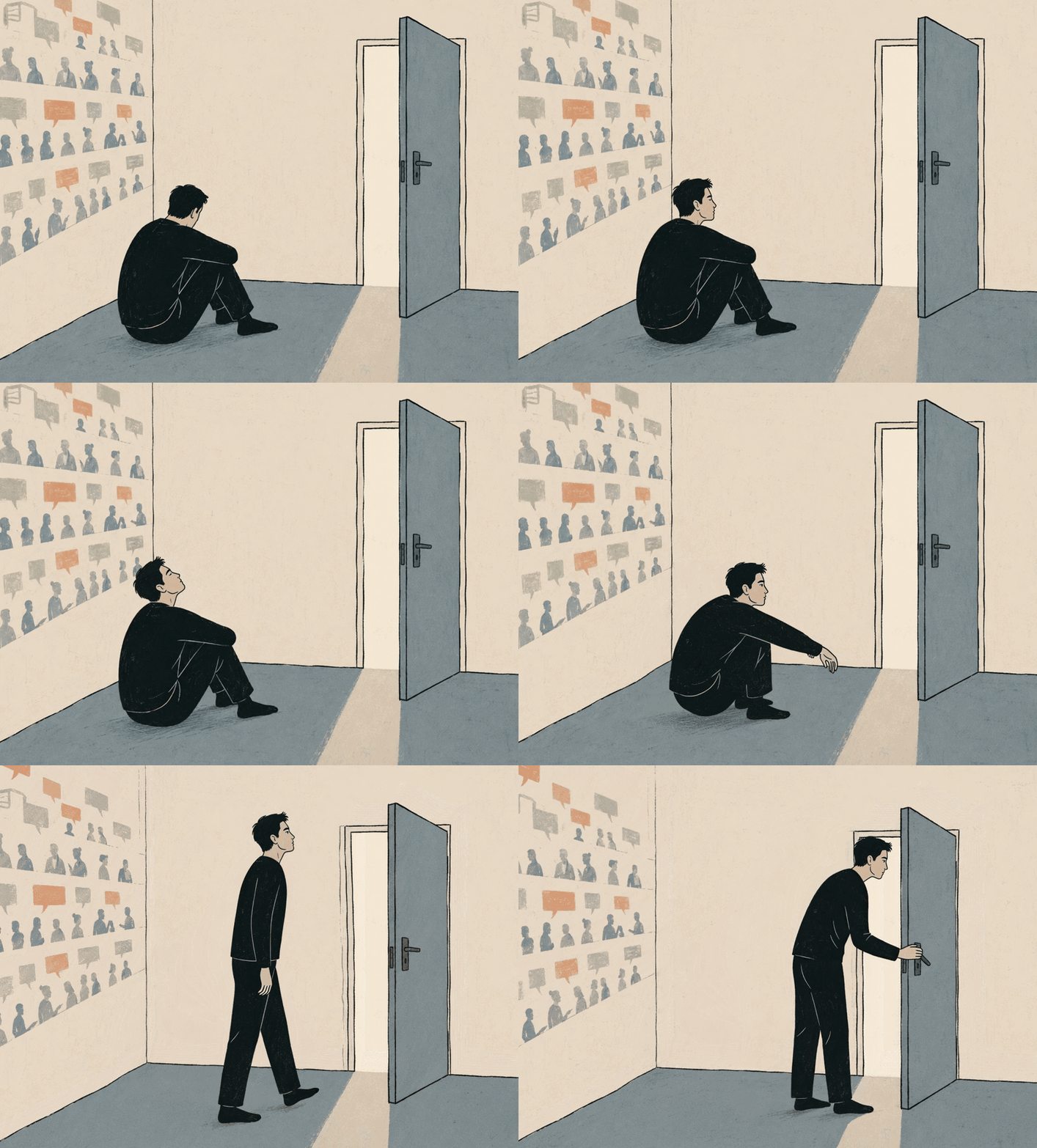
The most dangerous moment is not when a person loses, but when after enough defeats, they stop believing that their next move makes any sense.
The doors are not actually locked. They simply refuse to open for long enough that eventually a person stops trying the handle. After that, even the lock itself becomes unnecessary. The prisoner maintains the prison on his own. He is not weak or stupid. He has simply drawn a conclusion from experience that darkens his entire view of the world: trying changes nothing.
Our age is full of people who still speak, comment, argue and vent their anger, yet no longer expect any consequences to follow. After all, who says apathy has to look like silence? A person can spend all day cataloguing scandals, delivering razor-sharp political diagnoses, and by evening congratulate himself on the fact that nothing changed anyway. The modern cynic is not someone without opinions. Quite the opposite: he has an abundance of opinions and almost no belief that anything can actually be changed.
Psychology calls this transition from failed effort to surrender "learned helplessness." The concept was developed in the late 1960s by American psychologists Steven Maier and Martin Seligman, in an era when experiments involving considerable cruelty to animals were still routinely conducted. Dogs that had previously been exposed to electric shocks they could not control would later often fail even to cross a low barrier, despite escape now being possible. They had not lost the ability to move. They had lost the expectation that moving would make any difference.
Almost half a century later, Maier and Seligman did something rare in science, and rarer still in public life: they partially turned their own theory on its head. More recent neurobiological research, primarily in animal models, suggests that after prolonged stress over which it has no control, an organism may not have to specifically "learn" passivity at all. Passivity may instead be the initial, automatic response to a situation in which nothing the organism does changes the outcome. What actually has to be learned is the opposite: a sense of control. Through experience, the brain must discover that a particular action produces a particular consequence. It is not enough for an exit to exist objectively. We have to learn that our own actions really can open the door.
That correction changes how we should look at people who have stopped trying. Telling them to "try a little harder" is about as useful as explaining to someone sitting in darkness that light technically exists. The problem is clearly not some lack of moral fibre, but a broken connection between action and outcome. After enough rejected job applications, ignored complaints or humiliations in a relationship, a person is no longer merely conserving energy. He begins redrawing his own map of what is possible.
This is where a newer and particularly intriguing interpretation comes in. Belgian psychologists Yannick Boddez, Pieter Van Dessel and Jan De Houwer have suggested that failure does not necessarily remain attached to a single behaviour, but can spread across goals that a person experiences as related. Failure to find a job, for example, may stop being merely a problem of employment and become evidence that the person is incapable of achieving independence. Withdrawal can then spread into social life, self-care or new projects, because in that person's internal hierarchy all of them serve the same higher goal: the feeling that he can direct his own life.
It sounds reasonable and deeply uncomfortable at the same time, doesn't it?
Somewhere around here lies the boundary between sensible surrender and helplessness. Persistence is not always a virtue. Sometimes the door really has been bricked shut, the job is degrading, the relationship beyond repair, or the institution deliberately structured to exhaust you before it ever gives you a meaningful answer. A mature person has to know when to abandon a bad goal. Learned helplessness begins when the lesson from one locked room becomes a general theory of the entire building — when "this didn't work" becomes "nothing ever works."
But if this can happen to an individual, it can eventually happen to an entire society.
Societies either create or destroy the experience of agency. A citizen signs a petition, only for it to disappear into the vacuum of some bureaucratic drawer. He reports an irregularity and receives an automatically generated reply that tells him nothing. He joins a protest that becomes little more than evening scenery for the television news. He watches a scandal dominate the headlines for three days before another one replaces it (painfully familiar, isn't it?). After enough such cycles, political withdrawal is no longer indifference. It is a learned prediction.
One small victory can inoculate us against future helplessness
The experiments conducted by Steven Maier and his colleagues revealed an almost optimistic second half to the story of learned helplessness. An animal that had previously learned it could stop an unpleasant stimulus through its own actions later coped much better when placed in a situation it could no longer control. Researchers called this phenomenon "behavioral immunization." A single experience of control seemed to leave behind a residue: the world may be hostile, but it is not necessarily completely indifferent to everything we do.Later research in animal models showed that this was more than a convenient psychological metaphor. The experience of control changes how prefrontal regions of the brain respond to future stress. In other words, an earlier victory does not have to teach a person or an animal that they will "always" win. It is enough for it to seriously undermine the far more dangerous assumption that trying never makes sense. In some experiments, the protective effect of earlier control appeared even when the later unpleasant situation was different from the one in which that sense of control had originally been learned.
An OECD survey conducted in 2025 found that only 31 percent of respondents across the countries surveyed believed the political system allowed people like them to have a genuine say in what governments do. As many as 40 percent cited as an obstacle the feeling that elected officials simply do not care what people like them want. That is almost a textbook description of an environment in which the link between action and consequence is gradually worn down until it becomes invisible.
Cynicism, meanwhile, is the perfect emotional defence. If you declare in advance that they are all the same, that every protest is staged and every initiative will end in betrayal, why risk disappointment at all? The cynic suddenly looks like a realist because he always predicts defeat. His little intellectual trick is that he later presents his own refusal to try as proof that trying would have been pointless anyway. It is the same learned helplessness, only now dressed for dinner — elegant, witty and politically completely harmless.
Will politicians say, "All right, we failed, we're leaving," when voter turnout collapses to absurdly low levels? Of course not. Across Europe, "statesmen" stroll around with grotesquely low levels of public support and simply do not care: they behave and carry themselves like kings (a couple of examples: Macron has an approval rating of 18 percent, Merz 19 percent).
The digital environment, naturally, feeds this pattern even further. Before breakfast, a person can already have dozens of problems delivered to his screen over which he has no power whatsoever, from war to corruption, at home and across the world. He is expected to react emotionally to all of them, but is rarely offered a convincing — or any — route toward producing an effect. A click, a comment or a share creates a brief sensation of participation, yet afterwards the world has not moved a millimetre. The result is something genuinely unsettling and peculiarly characteristic of our age: a combination of chronic agitation and practical immobility. In other words, society is permanently aroused but never organised.
To be clear, none of this means citizens simply need to "fix their attitude." That would be yet another familiar neoliberal sleight of hand in which the system is permitted to remain exactly as it is while the individual is instructed to "work on his inner dialogue." The walls are often real. Wages are too low, hiring processes are rigged, institutions are slow and political choice is narrow. Psychology must not be used to translate material powerlessness into a personal defect, although that is precisely what is so often attempted.
The real way out does not begin with a motivational speech, but with the restoration of genuine causality. On a personal level, that means confining defeat to the area where it actually belongs. A rejected job application must remain a rejected job application, not become a referendum on the value of an entire life. At the social level, what is needed are visible, even if limited, victories — a neighbourhood that saves its park, workers who win a better schedule, an initiative that actually forces an institution into measurable change. A small victory is not sentimental consolation. It is proof that the handle responds when you turn it. More than that, it becomes an inspiration to others. One real and positive story can have an enormous effect, provided it actually makes it through the media filter — which is by no means guaranteed.
In the usual black-and-white interpretation of the world, people will say that "democracy is failing" when citizens are prevented from acting. Yes, it obviously fails then — but not only then. It also fails when it allows people to act again and again without ever producing a response. A system that constantly invites citizens to "participate," then turns their efforts into procedural vapour, is effectively conducting its own experiment in the systematic extinction of behaviour. The result? Fantastic for the ruling political and economic structures — after a while, they no longer even need repression! It is enough to preserve the conviction that nothing is worth the effort.
The opposite of learned helplessness is not optimism. Nor is it blind persistence, that favourite religion of business manuals. Its opposite is agency — the lived experience that a connection still exists between what we do and what happens in the world. Doors do not become real because we believe in them hard enough. They become real when, after we press down on the handle, something on the other side finally moves.
Sources
- Pmc.ncbi.nlm.nih.gov Behavioral control, the medial prefrontal cortex, and resilience - PMC https://pmc.ncbi.nlm.nih.gov/articles/PMC3181837/
- Biblio.ugent.be Learned helplessness and its relevance for psychological suffering : a new perspective illustrated with attachment problems, burn-out, and fatigue complaints https://biblio.ugent.be/publication/01GM601ZWPXBTFVTSXX87FTTXH
- Pubmed.ncbi.nlm.nih.gov Failure to escape traumatic shock - PubMed https://pubmed.ncbi.nlm.nih.gov/6032570/
- Frontiersin.org Frontiers | From helplessness to controllability: toward a neuroscience of resilience https://www.frontiersin.org/journals/psychiatry/articles/10.3389/fpsyt.2023.1170417/full
- Oecd.org OECD Survey on Drivers of Trust in Public Institutions 2026 Results https://www.oecd.org/en/publications/oecd-survey-on-drivers-of-trust-in-public-institutions-2026-results_9eb63fec-en/full-report/political-voice-barriers-to-participation-and-implications-for-trust-in-government_08533950.html
- Pmc.ncbi.nlm.nih.gov The Hopelessness Theory of Depression: A Quarter Century in Review - PMC https://pmc.ncbi.nlm.nih.gov/articles/PMC4689589/
- Pubmed.ncbi.nlm.nih.gov Helplessness: a systematic translational review of theory and evidence for its relevance to understanding and treating depression - PubMed https://pubmed.ncbi.nlm.nih.gov/21835197/
- Ppc.sas.upenn.edu Learned Helplessness at Fifty: Insights From Neuroscience https://ppc.sas.upenn.edu/sites/default/files/learnedhelplessnessat50.pdf
Comments