
The system knows how to deal with a rebel. The real problem begins when a person stops asking it for anything—even a better life within it.
Some rebellions begin with a gunshot, others with a manifesto. One of the most unsettling rebellions in modern literature begins with a sentence that sounds almost polite, even deferential. It goes something like this: a Wall Street lawyer asks his scrivener to help him check a document. Bartleby does not raise his voice or make any demands. He simply replies, calmly: "I would prefer not to." With that mild phrase, the entire order of the office begins to tremble. Authority can cope with disobedience because it knows how to punish it. A preference is more dangerous: it withdraws from the game in which the employer commands and the employee either complies or refuses.
Today, even rebellion would probably have to present itself as a personal brand. It would come with a visual identity and a mug bearing an inspirational slogan. That makes Bartleby almost scandalously useless to our age. He offers no manifesto, gathers no followers and makes no attempt to monetise his refusal. He does not even ask for a better job. But his "I would prefer not to" gradually spreads to everything—checking copies, performing minor tasks, leaving the office, finding another occupation. That is why Bartleby is more than a precursor to today’s quiet quitting. He is a darker figure: a man who has reached the point where he no longer has the strength even to imagine what he might prefer to do instead.
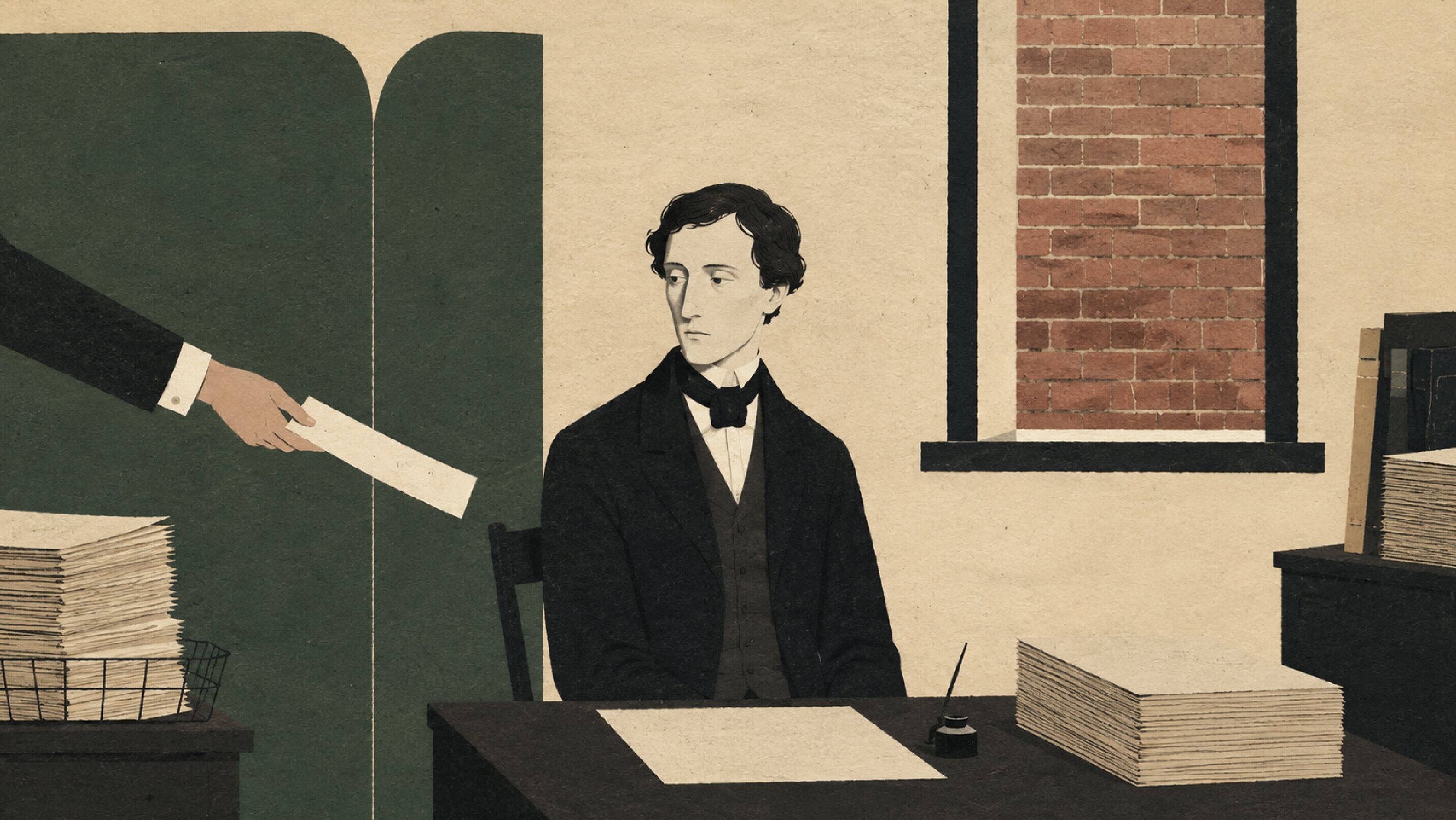
Herman Melville published Bartleby, the Scrivener anonymously in two instalments of Putnam’s Monthly Magazine in late 1853. The story is set where modern America was already practising its most important religion: Wall Street. A scrivener was essentially a human photocopier. He copied legal documents by hand and then compared them with the originals, word by word. Bartleby is paid four cents for every hundred words. At first, he produces a vast quantity of text, working day and night, "silently, palely, mechanically." He sits behind a green folding screen beside a window that faces a wall only a few feet away. Privacy and surveillance merge in a space that resembles an early ancestor of the office cubicle. There is no small irony in the fact that this story was written by an author under financial pressure, whose ambitious books could no longer find enough readers.
Bartleby’s employer is not a cartoon tyrant. The narrator is an elderly lawyer who prides himself on prudence, method and his work for wealthy owners of bonds, mortgages and property. He particularly enjoys repeating the name of John Jacob Astor, the American business magnate and contemporary symbol of immense wealth, because it sounds to him like gold. He tolerates one employee’s drunkenness and another’s neurotic ambition for as long as both remain useful. He even tries to help Bartleby. He offers him money, alternative employment and a place in his own home. That is precisely what makes the story so disturbing. Melville does not merely attack the cruel master. He exposes the decent man whose humanity lasts only until it threatens his schedule, his reputation and his peaceful lunch.
In a celebrated essay, the French philosopher Gilles Deleuze observed that Bartleby’s formula is neither an affirmation nor a negation. He does not simply say, "I won’t." He speaks of what he would prefer, but never completes the thought with a positive choice. "I would prefer not to" leaves a blank space where some other desire ought to be. Grammatically correct yet strangely unfinished, the sentence paralyses the lawyer. He cannot easily punish it as insolence, nor can he turn it into a negotiation. More curious still, the word "prefer" soon infects the entire office. The employer and the other scriveners begin using it unconsciously themselves.
This produces an almost comic reversal of power. Bartleby has no money, no position and no credible threat. Yet the lawyer eventually moves his entire practice because he cannot get rid of an employee who no longer works but refuses to leave. Capital knows how to deal with a striker demanding higher wages, because demands can be negotiated. It also knows how to handle a resignation, because an empty position can be filled by someone else. Bartleby is something worse: a body that remains present but can no longer be converted into a function. He occupies space without producing anything, revealing how the right to exist in the workplace is granted only for as long as a person continues to perform a task.
It would be too comforting, however, to turn Bartleby into a hero of the anti-work movement. Quiet quitting generally means remaining employed, fulfilling the duties in your contract and ceasing to donate unpaid portions of your life to the company. You finish your shift, close the laptop and continue to exist outside work. Bartleby has no such "outside." He has no known home, family, political programme or hobby waiting for him at the end of the working day. He lives in the office, stares at a wall and gradually abandons every form of activity. A modern human resources department might describe his disappearance from the world as "declining engagement."
That leads to the central question: is Bartleby a rebel or a broken man? Melville refuses to give us a diagnosis. We can interpret him as depressed, radically passive, engaged in civil disobedience or wholly alienated. None of these explanations is sufficient. Rebellion usually assumes that a person wants a different world. Bartleby no longer says what he wants. Deleuze describes this as the growth of a "nothingness of the will," and it is here that the story ceases to be romantic. His refusal gives him a peculiar power over his employer, but it does not lead him towards freedom. In the end, it leads him to prison, starvation and death beside the wall of a prison yard.
Bartleby as the Opposite of Kafka’s Hero
In Kafka, the system is incomprehensible to the individual. In Melville, the individual becomes incomprehensible to the system. That apparently minor distinction separates two of the great literary nightmares of the modern age.Josef K. in Kafka’s The Trial tries to discover what he has been accused of, who is judging him and what procedure might allow him to prove his innocence. He remains convinced that somewhere there must be a proper office, a responsible official or at least a form that, if completed correctly, could resolve the misunderstanding. The more vigorously he attempts to defend himself, the deeper he is drawn into a mechanism he cannot understand. His tragedy lies not only in the absurdity of the system, but in the fact that he retains, until the end, his faith that some kind of procedure must exist behind the absurdity.
Bartleby does almost the opposite. He does not try to understand the office, perhaps because he has understood it all too well. He asks for no explanation, files no appeal and makes no attempt to prove that he is right. His "I would prefer not to" denies the system the very things it needs in order to function—a reason, a demand, a conflict that can be recorded and processed. Kafka gives us a man desperately searching for an entrance into the logic of an institution. Melville gives us an institution desperately trying to penetrate the logic of a single man.
The difference between them can therefore be expressed in almost banal terms. Kafka’s hero keeps knocking on a door behind which there may be no one. Bartleby sits on the other side and refuses to open it. Both ultimately lose, but they move in opposite directions. Josef K. becomes completely consumed by the system’s judgement, while Bartleby gradually ceases to recognise that such a judgement matters at all.
In Kafka, bureaucracy is a monster that has deprived the individual of an intelligible world. In Melville, something perhaps even more disturbing occurs: the individual deprives bureaucracy of the ability to interpret him. For a moment, this makes him appear free. The problem is that his freedom has nowhere to go.
Near the end comes perhaps the most devastating detail of all. The narrator has heard a rumour that, before coming to Wall Street, Bartleby worked in the Dead Letter Office in Washington. This was where messages ended up when they could not reach their intended recipients. Among them were money sent to the poor, a ring meant for someone who had since died and a pardon addressed to a person no longer alive to receive it. The letters were burned in heaps. After working with words that never reached another human being, Bartleby arrives at an office where words circulate perfectly but no longer carry anything human. Once, he sorted dead letters. Then he began producing dead copies.
"I would prefer not to" is not a political programme, nor should it be turned into career advice. It is an alarm that sounds when a person no longer has enough energy even for productive rebellion. Bartleby defeats his employer only in the limited sense that he forces him to flee, but he loses his own life. His silence indicts a world that knows what to do with the useful worker and the open rebel, but has no place for someone who has stopped justifying his existence. When he can no longer work, explain himself or disappear politely, the system eventually finds the only administrative response it has left: it calls the police.
Although the story belongs to the nineteenth century, this is precisely where its extraordinary modernity lies. Today’s worker no longer copies documents with a pen, but endlessly reproduces spreadsheets, presentations, reports and "content" whose meaning often consists solely in the fact that it has been properly submitted. Technology has eliminated the labour of copying, but it has not necessarily removed Bartleby’s wall. It has merely transformed it into a screen. People are no longer expected simply to work. They must also be engaged, flexible, cheerful and permanently available, as though good spirits were another clause in the contract that we somehow missed while reading the small print.
Sources
- Nasjournal.org View of Melville’s Majestic Missive: “Bartleby, the Scrivener: A Story of Wall Street” | New American Studies Journal: a Forum https://nasjournal.org/NASJ/article/view/642/607
- Jstor.org Charity as Purchase: Buying Self-Approval in Melville’s “Bartleby, the Scrivener” https://www.jstor.org/stable/10.1525/ncl.2014.69.2.233
- Hub.jhu.edu What is 'quiet quitting'? https://hub.jhu.edu/2022/09/12/what-is-quiet-quitting/
- Gutenberg.org Bartleby, The Scrivener | Project Gutenberg https://www.gutenberg.org/files/11231/11231-h/11231-h.htm
- On-curating.org Bartleby; or, The Formula - ONCURATING https://www.on-curating.org/issue-40-reader/bartleby-or-the-formula.html
Comments