

Every drawn-out war produces talk of a "wonder weapon" that might turn the tide. Sometimes that is just wishful thinking. Sometimes it really does mark the start of a new phase. Oreshnik belongs somewhere in that conversation. It has been part of the war in Ukraine, at least politically, since its first known use in 2024. So far, it has appeared only three times, including the strike on Kyiv last Sunday, May 24, 2026. That makes it worth looking at from all sides: how Russia presents it, how Ukraine and the West assess it, and what can actually be said about the weapon itself.
Russia has portrayed Oreshnik as proof of its technological superiority and as a missile the West has no way to stop. Ukraine, together with many Western commentators, has focused on something else: the demonstrative nature of the strikes, the limited damage seen so far, and the fact that this is an expensive system unlikely to become a routine weapon of war. Both readings contain some truth. Both can also become propaganda very quickly when each side selects only the parts that serve its political message.
A serious assessment has to begin with the basics. Oreshnik is a medium-range ballistic missile that can carry either a conventional or a nuclear warhead. That distinction matters enormously. Drones and cruise missiles are part of the daily war of attrition. Oreshnik belongs to a category of weapons built around strategic deterrence. Its impact is therefore never purely military. Every launch sends a message not only to Kyiv, but also to European capitals and to Washington, because it raises the question of how far a conventional war has moved into the shadow of nuclear escalation.
The word "hypersonic" also needs to be handled carefully, without the usual drama. Hypersonic simply means faster than Mach 5, or roughly more than 6,000 km/h. Oreshnik is said to fly at more than Mach 10, which would put it, broadly speaking, above 12,000 km/h. For ballistic missiles, that alone is not especially unusual. They spend much of their flight at very high altitude, and their warheads then fall back toward the target at extreme speed. What makes Oreshnik significant is not speed by itself, but the combination of long range, mobile launch capability, and a payload that can break apart in the final phase of flight into multiple descending elements, as seen in footage. For air defense, that creates a serious problem. Instead of tracking one missile, the system suddenly has to deal with several incoming targets, moving extremely fast, with very little time to react.
That is why Oreshnik deserves a sober assessment. It is a dangerous weapon, but not always for the reasons emphasized on Russian television. At the same time, it cannot simply be dismissed as an expensive stunt with little military value, as Ukrainian officials and sympathetic commentators sometimes suggest. For Moscow, its value may be military, psychological, political, and nuclear-strategic all at once. Right now, those layers are difficult to separate.
What Is Oreshnik, Exactly?
The most convincing public assessment is that Oreshnik grew out of Russia’s RS-26 Rubezh program, and more broadly from the same family of missiles associated with Yars and the modernization of Russia’s strategic forces. That would make it most likely a road-mobile, solid-fuel system. Missiles of that type can be kept at a fairly high level of readiness, moved across large areas, and launched without the long preparations required by older liquid-fuel systems.
Oreshnik’s full range has not been publicly confirmed. If it is indeed derived from Rubezh, a realistic estimate would put it at several thousand kilometers.Medium-range missiles, generally understood as systems with ranges of 1,000 to 3,000 kilometers, and intermediate-range missiles, roughly 3,000 to 5,500 kilometers, have always been a particularly sensitive category. They are designed not for full intercontinental war, but for strikes across Europe and Asian theaters. During the Cold War, this very class of weapons helped produce one of the most dangerous missile crises in Europe. With the collapse of the INF Treaty, the space for producing, deploying, and potentially using such weapons has reopened.
Oreshnik’s full range has not been publicly confirmed. Its use against Ukraine does not reveal its maximum reach, since a missile launched from inside Russia may have flown only a fraction of the distance it was designed for. If it is indeed derived from Rubezh, a realistic estimate would put its range at several thousand kilometers. That makes it a weapon relevant to Ukraine, but also one whose shadow extends across much of Europe.
The second key issue is the warhead. Oreshnik is often described as a missile capable of carrying six warhead blocks, each of which may contain additional smaller elements that descend toward the target. Public discussion quickly reaches for the term MIRV. That refers to a system in which a single missile carries multiple warheads that, after separation, can be independently guided toward different targets. This technology is familiar from strategic nuclear missiles, where one missile can threaten several separate targets.
With Oreshnik, however, some caution is needed. The available evidence more clearly points to a separating payload: a missile that releases multiple descending elements in the final phase of flight. How precisely those elements can be guided, and whether they can truly be directed independently at separate targets, remains uncertain. Even that simpler version, however, creates a serious challenge for air defense. One missile launch can turn into several incoming objects in the terminal phase, all of which must be detected, tracked, and possibly intercepted within a very short window.
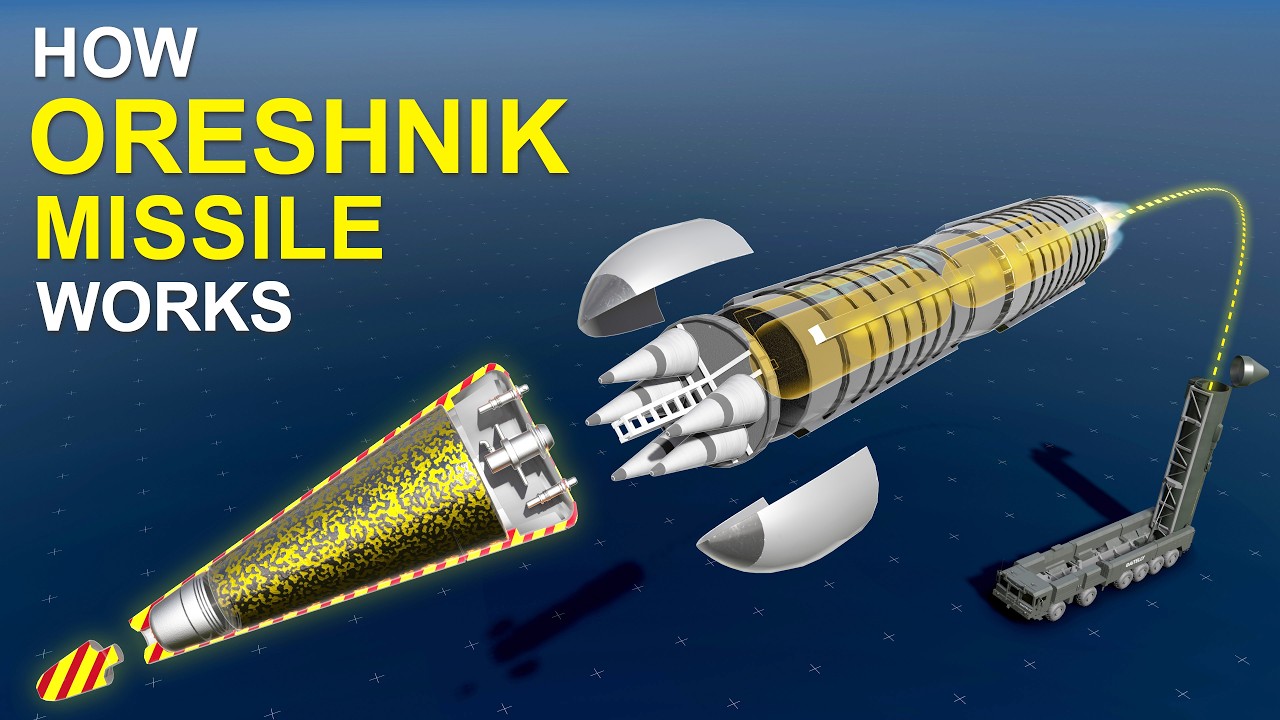
In a conventional role, such a payload could be used against a large industrial site, an airfield, a factory, a depot, or an infrastructure hub. In a nuclear role, of course, the logic is completely different. The same platform then becomes part of a deterrence system, and every deployment carries a meaning that goes far beyond the Ukrainian battlefield.
Previous Strikes and the Pattern of Use
Oreshnik’s first known combat use came in November 2024, in a strike on the city of Dnipro, in an area connected to the large industrial and missile-making legacy of the former Soviet Yuzhmash complex. Russian President Vladimir Putin then announced publicly that Russia had tested a new medium-range missile under combat conditions, in a non-nuclear hypersonic configuration. Moscow presented the strike as a response to Ukraine’s use of Western long-range missiles against targets inside Russia.

That first strike had a strong political effect, partly because Ukraine initially described the weapon as an intercontinental ballistic missile. Later, American and other assessments pointed instead to an intermediate-range missile. But the very uncertainty over what kind of missile it was shows why Moscow chose such a system. In that moment, Oreshnik was not just a weapon. It was also a demonstration and a warning.
The second known use came in January 2026 in western Ukraine, in the Lviv area. Available reports again described the damage as limited, and the warhead blocks were said not to have carried a conventional explosive charge. That matters, but it has to be understood in context. A strike with inert or training payload elements tells us more about testing, signaling, and intimidation than about the system’s full destructive potential.
The third known case took place a few days ago, on May 24, 2026, during one of Russia’s largest combined attacks on Kyiv and the surrounding area. Russia used hundreds of drones and a large number of different missiles in that assault. Oreshnik was only one part of a much larger salvo, and according to available analyses its payload broke apart into several dozen descending elements. The reported target was in the Bila Tserkva area, south of Kyiv.
This pattern tells us a great deal. For now, Russia is using Oreshnik rarely — very rarely — and only when it wants to add extra political weight to an attack. It appears as the top layer of a much broader strike package built around drones, cruise missiles, shorter-range ballistic missiles, and other systems. That strongly suggests limited availability, caution in using the missile, and a deliberate effort to make every Oreshnik launch carry a message beyond the immediate target.
Oreshnik’s Destructive Power: Between Physics and Partisan Interpretation
The debate over Oreshnik’s destructive power quickly became political, as expected. Ukrainian and pro-Ukrainian sources pointed to limited visible damage, small craters, and the fact that the descending elements apparently did not explode like conventional warheads. Russian sources and some commentators emphasized something else: speed, penetration, thermal stress, and the possibility that a full combat version could do far more damage.
If a payload of several hundred kilograms hit the target at several kilometers per second, its kinetic energy could roughly equal one to several tons of TNT.These two interpretations are not necessarily talking about the same thing. If the missile carries inert warhead blocks, most of the damage comes from kinetic energy. In plain terms, a very fast descending object punches through roofs, concrete, floors, or earth. Such a strike may look unimpressive compared with a large explosion, but it can still be devastating if it hits the right part of an industrial facility. Photographs of craters alone do not always show what happened inside a building or below the surface.
Oreshnik’s explosive power in a conventional configuration is still unknown. There is no publicly confirmed figure for the mass of its warhead. Estimates based on Rubezh range from several hundred kilograms to roughly 800 kilograms of total payload. That does not mean 800 kilograms of explosive. The payload also includes the structure of the warhead block, thermal protection, separation mechanisms, possible guidance systems, and the explosive or penetrator element itself.
A rough physical estimate helps frame the issue. If a payload of several hundred kilograms hit the target at several kilometers per second, its kinetic energy could roughly equal one to several tons of TNT. But that energy would be spread across multiple impact points, so it would not behave like one large bomb. If conventional explosives were added, the local damage could be much greater, especially against factory halls, depots, airfield infrastructure, or underground sections of a facility.
Comparisons with nuclear weapons, however, are much more political than technical when we are talking about a conventional Oreshnik. Nuclear explosions are measured in kilotons or megatons of TNT equivalent. A conventional Oreshnik, even in a more complete combat configuration, belongs to a completely different category of destructive power. Its advantage lies elsewhere: speed, penetration, surprise, and the ability to hit several points within the same target area.
In military terms, that makes it especially dangerous against fixed, valuable, and heavily defended targets. For the routine destruction of urban districts, trenches, vehicles, or tactical positions, Russia has far cheaper and more plentiful weapons. Oreshnik makes most sense when the target has enough political, military, or industrial value to justify using a rare strategic missile in a conventional role.
How Hard Is Oreshnik Really to Stop?
Claims of "unstoppable" weapons are always part of psychological warfare. Every great power likes to present its newest systems as weapons that make the enemy’s defenses obsolete. Oreshnik is, in reality, an extremely difficult target. Its warhead blocks arrive at very high speed, the reaction window is short, the trajectory is ballistic, and the separation of the payload increases the number of objects that radars and interceptors have to track.
For Ukraine, this is a particularly serious problem. Its defense against ballistic missiles relies above all on a limited number of Patriot systems and their interceptors. Those systems can stop some ballistic threats, but they cover only limited areas and depend on stocks of expensive missiles. When Russia launches hundreds of drones, cruise missiles, Kinzhals, Iskanders, and potentially Oreshnik at the same time, Ukraine’s air defense has to decide what to protect and how many interceptors it can afford to spend.
Even if part of the payload were intercepted, enough descending elements could still get through to hit the target area. Operationally, that makes Oreshnik an exceptionally demanding target.
But absolute "unstoppability" belongs more to propaganda than to military analysis. Modern upper-tier missile-defense systems, such as the American SM-3 or Israel’s Arrow 3, are built precisely to intercept ballistic missiles and their warheads outside the atmosphere or in the upper layers of flight. Whether they could succeed would depend on radar coverage, the geometry of the attack, warning time, the number of interceptors available, and the type of warhead involved. These are expensive, complex, and limited systems, far beyond standard air defense.
The example of Kinzhal is also worth remembering. Russia also described that missile as impossible to stop, while Ukraine later claimed to have intercepted it with Patriot. That does not mean every Kinzhal is easy to shoot down. But if those interception claims are accurate, it does show that the word "hypersonic" does not magically cancel the physics of missile defense. Oreshnik presents a more complex problem because of its class and its separating payload, but the principle remains the same. The deeper, better supplied, and more technologically advanced the defense, the more Russia’s claim of total unstoppability becomes a political statement rather than a technical fact.
Put simply: what looks unstoppable today may not remain unstoppable tomorrow. Offensive and defensive weapons are always chasing each other.
Cost and Production: An Expensive Message or a Turning Point in the War?
The figure of $50 million per missile often appears in media reports and public debate, but it has not been officially confirmed. It should therefore be treated only as a rough estimate, useful mainly for understanding the scale of the system. Oreshnik comes from the world of strategic missiles: mobile launchers, solid fuel, complex guidance, thermally protected warhead blocks, and an expensive industrial base. This is not a weapon from the same economic universe as cheap attack drones.
The comparison with drones reveals the main operational dilemma. Cheap strike drones can be produced in large numbers, launched in swarms, used to exhaust air defenses, and force the opponent to waste expensive interceptors. Oreshnik plays a different role. It bypasses part of the usual defensive logic and can be used against a target Moscow wants to mark as especially important. Such a missile makes sense when the target is worth far more than the missile itself — or when the political signal is more important than the physical damage.
Russia says Oreshnik is in serial production and has linked it to plans for deployment in Belarus. That increases its strategic significance, especially for Europe. Still, the limited number of launches so far points to caution. If Russia had large stockpiles and low production costs, Oreshnik would probably be appearing more often. Perhaps that will change if there is substance behind recent talk of "systematic strikes" on Kyiv.

Could Russia strike Kyiv intensively with Oreshnik? Technically, Kyiv and its surroundings are certainly within range. Operationally, however, such a campaign would require enough missiles, ready launchers, secure launch areas, reliable intelligence on high-value targets, and a willingness to accept a major increase in political risk. That is especially true if foreign embassies were to become potential targets, a possibility Moscow hinted at when it suggested that European diplomats leave Kyiv — a suggestion they rejected. For now, the more realistic scenario is occasional use within large combined salvos, with Oreshnik serving as the most expensive and most politically charged part of the attack.
As a conventional weapon, Oreshnik is unlikely on its own to change the course of the war in Ukraine. This war is still being decided by artillery, drones, infantry, air defense, logistics, industrial output, and political endurance. A rare missile, however advanced, does not capture territory and does not solve a shortage of manpower. Its value grows when it is viewed as a tool for pressuring Western decision-makers, a reminder of Russia’s nuclear arsenal, and a sign that Europe has entered a new era of missile competition.
Oreshnik should therefore be taken seriously, but not mythologized. It is not just empty advertising. Its speed, range, and separating payload create a real military problem for the other side. At the same time, its conventional destructive power is limited by payload mass and by the physics of explosives. Its greatest role for now lies somewhere between the battlefield and strategic intimidation. It is an expensive weapon for expensive messages, for occasional strikes against high-value targets, and for reminding Europe that the disappearance of the old missile treaties has reopened a space that increasingly resembles the most dangerous periods of the Cold War.
That is what can be said about Oreshnik today. If it really does become a widely produced system, or if serious talk begins about using it in a nuclear configuration, then we will be dealing with a very different and far more destructive story.
Sources
- Defense.gov Russians Launch New Missile at Dnipro, U.S. Provides Ukraine With New Tactical Weapons https://www.defense.gov/News/News-Stories/Article/Article/3975321/russians-launch-new-missile-at-dnipro-us-provides-ukraine-with-new-tactical-wea/
- Reuters What is the Oreshnik missile that Russia has fired at Ukraine? https://www.reuters.com/business/aerospace-defense/what-is-oreshnik-missile-that-russia-has-fired-ukraine-2026-01-09/
- Rusi.org The Oreshnik Ballistic Missile: From Russia with Love? https://www.rusi.org/explore-our-research/publications/commentary/oreshnik-ballistic-missile-russia-love
- Associated Press Putin touts Russia’s new missile and delivers a menacing warning to NATO https://apnews.com/article/russia-ukraine-intercontinental-missile-war-putin-d50183ccfc28b10c71e93f3e68159a61
- Missilethreat.csis.org Oreshnik https://missilethreat.csis.org/missile/oreshnik/
- Missilematters.substack.com The Oreshnik Problem for Europe https://missilematters.substack.com/p/oreshnik-is-overhyped-but-poses-a
- En.defence-ua.com Ukraine-Tested Senator MRAP is Now Equipped with Falcon Shield Anti-Drone System https://en.defence-ua.com/weapon_and_tech/impact_site_analysis_challenges_russian_claims_about_oreshniks_kinetic_superweapon-14655.html
- Forbes Oreshnik Threat: ‘Rods From God’ Are Not As Dangerous As Putin Thinks https://www.forbes.com/sites/davidhambling/2024/12/02/oreshnik-threat-rods-from-god-are-not-as-dangerous-as-putin-thinks/
- Financial Times Russian producers of Oreshnik supermissile used western tools https://www.ft.com/content/990bbc2f-6b6f-4990-b022-3bf4cd090686
- TASS Oreshnik missile to go into serial production, Putin says https://tass.com/politics/1876563
- Armyinform.com.ua «Орєшнік», «Циркони» та балістика: комбінована атака на Київ коштувала росіянам $361 млн https://armyinform.com.ua/2026/05/24/oryeshnik-czyrkony-ta-balistyka-kombinovana-ataka-na-kyyiv-koshtuvala-rosiyanam-361-mln/
- Understandingwar.org Russian Offensive Campaign Assessment, May 24, 2026 https://www.understandingwar.org/backgrounder/russian-offensive-campaign-assessment-may-24-2026
Comments