
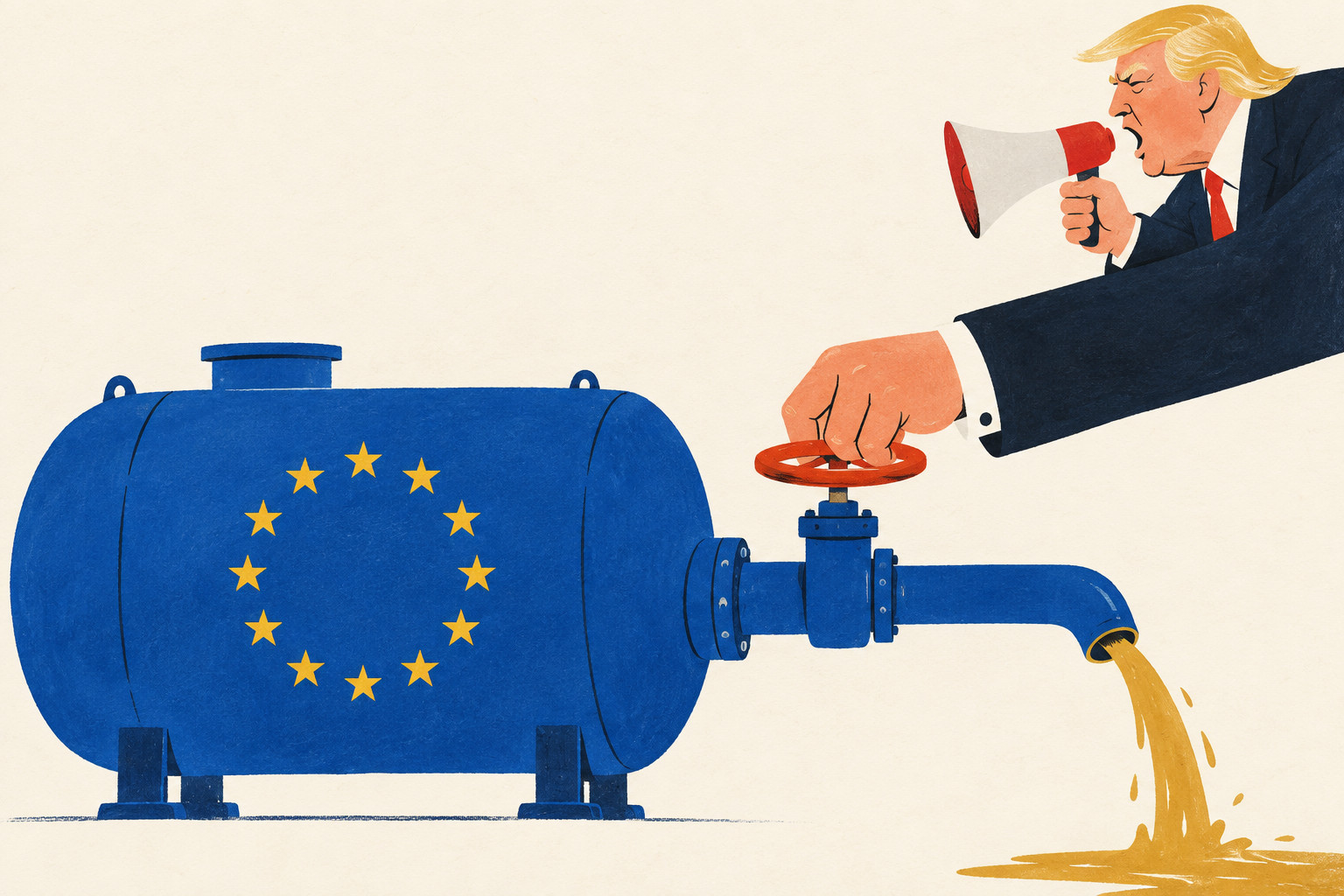
Dangerous Subservience: At America’s Command, Europe Opens Its Emergency Diesel Reserves for Trump’s Gulf War and the Illusion of Stability Before the Midterms—But What Happens Next?
One hundred million barrels can temporarily lower prices. It's harder to measure how much European political autonomy has been spent along with them.
Published
Today’s story tells us almost everything we need to know in its very first sentence: the decision to open Europe’s emergency reserves was announced by the president of the United States. There is, of course, more to the story, but this is a deeply troubling opening. Donald Trump announced that Europe had agreed to release a "massive amount" of diesel before European governments had even explained to their own citizens what had been agreed. Once again, the alliance has revealed itself for what it is—a hierarchy: Washington commands, Europe complies.
And the American message—this is crucial—was not an appeal for solidarity, but an ultimatum. Open the reserves or we will halt US diesel exports, Trump had warned shortly beforehand. European stocks, intended to protect the public and the economy in the event of an even more severe supply disruption, are thus being used to soften the political cost of Trump’s war against Iran ahead of the US congressional elections. European barrels for American ballots. This is another dark moment for Europe, and we will explain why.
Suez, 1956: An ally turns off the tap
Europe has already learned how quickly an "alliance of equals" can become a relationship between creditor and debtor. After Gamal Abdel Nasser nationalized the Suez Canal in July 1956, Israel invaded Egypt, with Britain and France joining the operation under a plan agreed in advance. Dwight Eisenhower opposed the intervention—yes, the times and the geopolitical circumstances were rather different. He feared that a colonial war would strengthen the Soviet Union’s position in the Arab world, undermine Washington’s condemnation of the Soviet intervention in Hungary and widen the conflict. But diplomatic objections were not what ultimately broke London.The closure of the canal and reduced deliveries from the Middle East disrupted Europe’s oil supply just as the pound came under pressure. Britain needed dollars, American oil and access to International Monetary Fund assistance. Washington refused to provide any of them until London accepted a ceasefire and withdrawal. It even considered selling US sterling reserves, which would clearly have placed the British currency under still greater pressure. Anthony Eden’s government had to choose between continuing the military operation and facing a financial crisis that would make it difficult for the country to pay for essential imports. Withdrawal became the only viable option, while France could not sustain the joint intervention alone.
The parallel with today’s crisis is not exact, and the moral roles are almost reversed. In 1956, Eisenhower used economic leverage to stop a war launched by allies without his approval. Now, from Europe’s perspective, Washington is using an economic threat to force its allies to ease the consequences of an American war. The mechanism, however, is familiar. Military banners—especially NATO’s blue flag—may proclaim partnership, but whoever controls the currency, the credit or the last available energy tap ultimately decides how much that partnership is truly worth in a crisis.
Eleven days of security released onto the market
France’s initial proposal called for the release of 50 million barrels of European diesel, alongside another 50 million barrels of crude oil from member countries of the International Energy Agency.[1]Following the G7 meeting, the agreement was formalized as a coordinated release of 100 million barrels over four months, with a substantial volume of diesel expected to reach the market within the first twenty days.[2] The final statement also included a pledge that G7 members would not restrict energy exports to one another—something Europe had sought in return. But that offers little reassurance about what happens afterward—by which we mean after the US elections, with the war against Iran highly likely to continue.
Europe did not freely decide how quickly to draw down its own safety buffer. It did so under threat from a supplier on which it is becoming increasingly dependent.In some other, hypothetical context, releasing reserves would not necessarily be an unreasonable move. Reserves exist to be used in a crisis, and the announcement immediately pushed diesel prices lower in both Europe and the United States. Lower prices clearly benefit European hauliers, farmers and consumers. But the political circumstances are deeply troubling: Europe did not freely decide how quickly to draw down its own safety buffer. It did so under threat from a supplier on which it is becoming increasingly dependent.
The proposed 50 million barrels represent roughly 17 percent of Europe’s emergency stocks of diesel and related middle distillates, and approximately three percent of its annual consumption. In other words, the amount is sufficient to cover about eleven days of Europe’s total demand. A simple calculation shows that the corresponding diesel safety cushion would shrink from roughly 64 days of consumption to about 53.
That does not mean Europe would run out of fuel after 53 days. Imports and refineries would continue operating, while the statutory requirement applies to the combined basket of crude oil and refined products rather than to diesel alone. Member states must maintain stocks equivalent to at least 90 days of net imports or 61 days of domestic consumption, whichever is greater. Yet in a crisis defined by a shortage of finished diesel, a barrel of crude is no complete substitute for a barrel of fuel that can immediately be pumped into a truck or a piece of agricultural machinery.
More importantly, this is not the first withdrawal. In March, the IEA agreed to a record release of 400 million barrels[4], roughly two-thirds of which has already entered the market. Strategic reserves can bridge a disruption, but they cannot permanently replace closed export routes, damaged refineries or supplies lost to an ongoing war. Every new release buys time, but it also shortens the time available when the next blow comes. We have made this point repeatedly since the current crisis began.
If Russia’s export ban remained in place, China continued reserving fuel for its domestic market and fresh attacks once again reduced flows from the Gulf, Europe would clearly enter the next phase of the crisis with smaller reserves than it has today. The consequences would not stop at filling stations. Diesel powers trucks, agriculture, construction, parts of industry and backup systems. A shortage would therefore quickly translate into more expensive food and transport, renewed inflation and recessionary pressure. In a more severe scenario, priority supplies for essential services, consumption limits and some form of rationing would follow.
As we wrote yesterday, an increase in the volume of crude passing through the Strait of Hormuz does not mean the fuel crisis is over. Diesel still has to be refined, stored and delivered to market, while the global refining system is already under immense strain. Tankers may therefore resume carrying substantial quantities of crude even as the price of finished diesel remains extremely high.
The dependency took decades to build, the ultimatum arrived overnight
Europe did not fall into this trap overnight. It turned away from Russian refined products, spent two decades reducing its own refining capacity and increasingly sought replacements in the United States and the Middle East. The war against Iran weakened one supply route, Russia’s export ban another, while China closed off a third. Washington then realized that it controlled one of the last major taps—and that threatening to close it could force Europe to make concessions. Today it demands this, tomorrow it can demand whatever it wants.
A complete US export ban, which Trump threatened to impose, would not be painless for the United States either. American refineries produce diesel, gasoline and other refined products simultaneously. If diesel could no longer be exported and domestic storage tanks filled up, refineries would have to reduce throughput, cutting gasoline production as well. The ban could therefore come back to haunt Trump through fresh disruptions and higher prices. But a threat does not have to make economic sense to be politically effective. Europe merely has to believe that Trump is prepared to take a step that would inflict greater and more immediate harm on it.
An ultimatum recast as allied coordination
The lesson is not to exchange one form of unilateral dependence for another, but to abandon a model in which a single foreign capital can dictate European policy simply by turning off the tap.The final G7 statement attempts to turn this into a story of collective action. It condemns Iran, thanks the United States for supposedly "ensuring freedom of navigation through the Strait of Hormuz" and reaffirms the continuation of sanctions against Russia. What disappears is the inconvenient fact that European reserves are now being used to cushion the consequences of a war launched by Washington and Tel Aviv. In the document, Trump’s threat of an export ban is transformed into voluntary coordination among allies. That is already the language of vassalage.
Moscow has yet to comment directly on Europe’s capitulation today, but Vladimir Putin effectively delivered his response last night at the Valdai Forum. He said Russia had sufficient diesel supplies, but that none would reach the global market while bans and sanctions on Russian oil and refined products remained in force. Russia has extended its export ban until the end of October, partly to protect its domestic market following Ukrainian attacks on refineries.
Russia’s interpretation will be predictable, but not entirely unfounded: in the name of political loyalty, Europe discarded a major nearby supplier, replaced it with a more distant American one and is now being told by that new supplier how to use its own reserves. Russia is, of course, neither a benevolent actor nor a would-be savior of Europe. It, too, is keeping fuel at home and using exports as political leverage. But Russia, Europe tells us, is the "enemy," so such behavior is understandable. What, then, is the United States?
Energy autonomy—or another tribute paid in submission
Since Europe was evidently forced to do as it was told, it should at least have made some attempt to defend its own interests—perhaps by agreeing to the release only in exchange for a firm US guarantee against an export ban, a precisely defined division of the burden and a prearranged plan for replenishing the reserves. The G7’s formal commitment not to restrict trade among its members is a step in that direction, but it is hardly ironclad protection. Trump has demonstrated many times how little international pledges mean to him when he concludes that domestic political interests require something else.
Europe will not run out of diesel today. It may even enjoy slightly lower prices for a few weeks. But then what? Has no one in Europe heard that Trump is preparing another attack on Iran after the elections? Have they not read about the latest US military buildup in the Gulf? These are rhetorical questions, of course. Europe knows what is coming—and will obediently sacrifice itself for an American objective.
The time bought by this release will be spent solely on calming the market until the US elections. By then, storage tanks will be emptier, the war will still be raging and Trump will know that the threat works.
What a disgrace for Europe. Washington decided when Europe must release its reserves and what political purpose they should serve. This will not, of course, produce energy or political autonomy. Today’s 100 million barrels will not be the price of security, but yet another tribute paid in European submission.
Sources
- Reuters Europe agrees to release diesel stocks, Trump says https://www.reuters.com/business/energy/europe-discussing-plan-diesel-stock-releases-after-us-pressure-source-says-2026-10-02/
- G7 / UK Foreign, Commonwealth & Development Office G7 Leaders’ Statement on global energy security and market stability https://www.gov.uk/government/news/g7-leaders-statement-on-global-energy-security-and-market-stability
- Associated Press G7 nations agree to release 100 million barrels of oil, including diesel, a boost for Trump https://apnews.com/article/trump-europe-diesel-fuel-prices-774a360d1646d9ce8aba764fdd9959d2
- International Energy Agency IEA Member countries to carry out largest ever oil stock release amid market disruptions from Middle East conflict https://www.iea.org/news/iea-member-countries-to-carry-out-largest-ever-oil-stock-release-amid-market-disruptions-from-middle-east-conflict
- Eurostat Oil and petroleum products - a statistical overview https://ec.europa.eu/eurostat/statistics-explained/index.php?title=Oil_and_petroleum_products_-_a_statistical_overview
- International Monetary Fund Northwest of Suez: The 1956 Crisis and the IMF https://www.imf.org/external/pubs/ft/wp/2000/wp00192.pdf
- U.S. Department of State, Office of the Historian The Suez Crisis, 1956 https://history.state.gov/milestones/1953-1960/suez
- Reuters Putin says Russia won't supply diesel to global markets until sanctions are lifted https://www.reuters.com/business/energy/putin-says-russia-wont-supply-diesel-global-markets-until-sanctions-are-lifted-2026-10-01/
Comments