
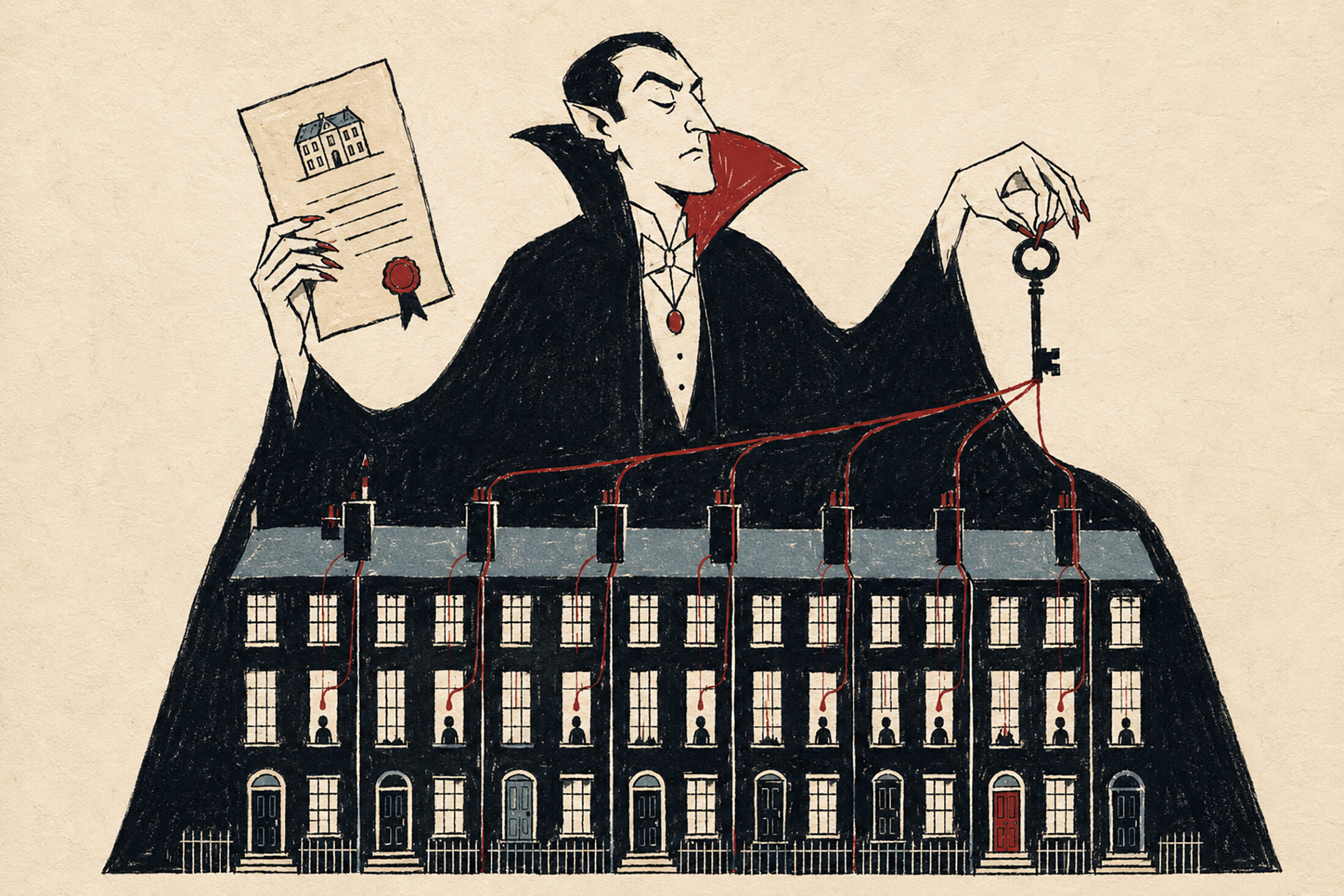
Dracula never goes to work. We never see him rushing to a meeting in the morning, dark circles under his eyes, clutching a bad bakery coffee, though of course that depends on the bakery. He produces nothing, repairs nothing, invents nothing. His genius is much older and much colder: he owns.
He owns a castle, a title, land, time, other people’s bodies and, most importantly, the ability to keep extracting life from all of it. In that sense, Count Dracula is not merely a monster of Gothic literature. He is the most honest portrait of the rentier the Victorian imagination ever managed to create: a dead man who lives forever on other people’s blood.
Bram Stoker, the Irish writer who published the cult novel Dracula in 1897, probably did not sit down at his desk intending to write an allegory about property bubbles, inherited wealth and a financial class that feeds on society like an elegant mosquito in evening dress. But great literature often knows more than its author.
Stoker’s count comes out of the feudal past, from a rather poorly maintained castle on the edge of Europe, and moves toward London, the center of empire, banking, trade and modernity. He does not arrive with an idea, a product or a project. He arrives with boxes of earth and legal documents. Like any serious parasite, he first takes care of the property paperwork.
This is where his modernity begins. Dracula does not attack London like a wild beast that fails to understand civilization. On the contrary, he understands it frighteningly well. He knows that in the modern world power no longer has to announce itself with a sword, a whip or a family crest over the gate. A contract, a title deed, an intermediary and a good location are enough. Jonathan Harker, a young solicitor’s clerk, does not travel to Transylvania as a hero setting out to fight evil, but as a man carrying the documents for a real estate purchase. The horror begins with administration.
Here Stoker is almost comically precise. The count buys properties in England, especially the neglected Carfax estate near London. He brings with him crates filled with Transylvanian soil, because a vampire cannot exist without his own native earth. At first glance, that detail seems purely Gothic. Today, it sounds like a grotesque metaphor for offshore capital. Dracula globalizes his fiefdom. He exports his own tomb, turns soil into portable infrastructure and relocates to wherever there is more fresh blood. The old castle is no longer enough. He needs the metropolis.
Rentier capitalism rests on a simple, unpleasantly elegant idea: you do not have to create value if you can charge people for access to something you already own. Land, an apartment, a patent, debt, a platform, an inherited portfolio — all of these can generate income without the owner doing any work. In the classic industrial fantasy, the capitalist at least organizes something: a factory, machines, workers, production. The rentier does not even have to do that. He merely sits on a right. Like Dracula in his coffin, he may seem inactive, but from that horizontal position he extracts a surprisingly strong return.
That is why the vampire is such a powerful figure for the modern age. He does not kill immediately. He drains. His victims grow pale, lose energy, become less themselves, as though someone were slowly drawing interest out of their lives. Lucy Westenra, one of Dracula’s victims, does not vanish in a burst of spectacular violence. She declines through a series of visits, weaknesses and mistaken diagnoses. The vampire attack is not an explosion. It is a model of extraction. A little each night. Enough not to be recognized at once, enough for the system to last.
Karl Marx, the German philosopher and economist, described capital as dead labor that lives only by sucking living labor. That sentence could be written above the entrance to Dracula’s castle. The dead live off the living. The past lives off the present. Inherited power lives off other people’s time. In Dracula, this is literal: an aristocrat from past centuries preserves his body by draining the blood of young people in the present. In the economy, it is only less theatrical. Instead of fangs, we have contracts, interest, rents and "market conditions." Civilization is often just violence with better typography.
Dracula is an aristocrat, but not the romantic, refined kind nostalgia likes to sell to tourists. He is not a guardian of tradition, but proof that tradition can be a very sophisticated form of plunder. His noble title does not signify culture, but the right to other people’s bodies. His age is not wisdom, but accumulation. He has survived empires, wars and changes of regime because he knows how to adapt. That may be the most frightening part of the novel. Dracula is not a remnant of the past that modernity will easily sweep away. He is the past that has learned how to use modernity.
That is why London does not erase him. It attracts him. In Stoker’s novel, the Victorian metropolis feels like an organism full of blood vessels: railways, ships, post, telegraph, hospitals, solicitors’ offices. Everything is connected, everything circulates, everything accelerates. And every system of circulation is ideal for a parasite. The count understands logistics better than those pursuing him. He reaches England aboard the Demeter, landing at Whitby, hidden among crates of earth. He does not arrive as a medieval demon breaking down the door, but as a shipment. Even then, evil had a good supply chain.
The literary theorist Franco Moretti, an Italian historian of literature, once wrote about Dracula as a figure of monopoly capital. The vampire does not merely want to survive. He wants everything. He cannot tolerate competition, does not create community, does not enter into equal relationships. His logic is endless expansion. Every new victim can become a new vampire, every new property a new foothold, every new night another opportunity for growth. Capitalism likes to present itself as a system of dynamism, innovation and risk. But its rentier shadow looks much more like Dracula: it does not risk too much, it avoids the light and it cares deeply about inheritance.
There is also an uncomfortable class detail here. Dracula does not have to explain himself. His power precedes the conversation. When Harker meets him, the count is already an authority: host, nobleman, owner of the space, the man who sets the rules. Harker, a representative of the modern professional class, is educated and rational, but he is trapped in someone else’s house. It is a scene today’s renters might understand rather well. Formally, you are free. In practice, you live in someone else’s property.
The rentier does not have to be a cartoonish count in a cape. He can be a fund buying up apartments in a city where people can no longer afford to live. He can be an heir renting out square meters he never earned. He can be a platform that produces no content, but charges passage between those who create it and those who need it. He can be an entire economic order in which labor increasingly behaves like a guest, while ownership plays the immortal host. Dracula is simply more honest than all of them. At least he does not claim to be "connecting people."
In the classic reading, Stoker’s novel is about fear of the foreign, sexuality, disease, degeneration and the intrusion of the East into the heart of the British Empire. All of that is there. But today it is hard not to read it also as a story about a class that was supposed to die, but did not. A feudal count enters the modern capitalist city and does not feel lost there. On the contrary, he understands that only the décor has changed. Once, the lord took a tithe; today, rent is collected. Once, the serf was bound to the land; today, the worker is bound to a loan. Progress sometimes means the vampire no longer even has to wear a cape.
It is interesting, very interesting, that Dracula can ultimately be defeated only collectively. There is no single great hero who saves the world alone. A coalition of people with different forms of knowledge gathers against him: a doctor, a solicitor, a professor, a fiancé, friends, and Mina Harker, with her precision and her ability to organize information. They collect documents, compare traces, track shipments and close off his hiding places. The fight against the vampire is not only moral, but logistical. His network has to be understood. The places where he restores himself have to be taken away.
Here the novel becomes surprisingly political. The vampire is not invincible because he is strong, but because the people around him are scattered, confused and often recognize the pattern too late. He lives off the fact that each victim thinks their weakness is a private problem. Lucy is ill, Harker is nervous, Mina is worried, the doctors are uncertain. Only when their experiences are connected does the monster take shape. That lesson reaches well beyond the Gothic novel. Exploitation loves nothing more than being experienced individually.
That is why Dracula is still alive, even though a stake has been driven through his heart for more than a century. He keeps returning because the world that produces him keeps returning: a world in which ownership is often more important than work, inheritance more important than talent, and access to the basic conditions of life has been turned into a source of passive income. In such a world, the vampire is no longer a superstition. He is a business model.
Perhaps that is why Stoker’s count has endured for so long. He did not frighten us only because he comes out at night and casts no reflection in the mirror. He frightened us because he has too many reflections in reality. Every time some dead structure continues to live off someone else’s vitality, every time the past charges the future an entrance fee, and every time someone who creates nothing tells those who do that they must be "realistic," Dracula shifts a little in his coffin. And, of course, checks London property prices.
Comments