
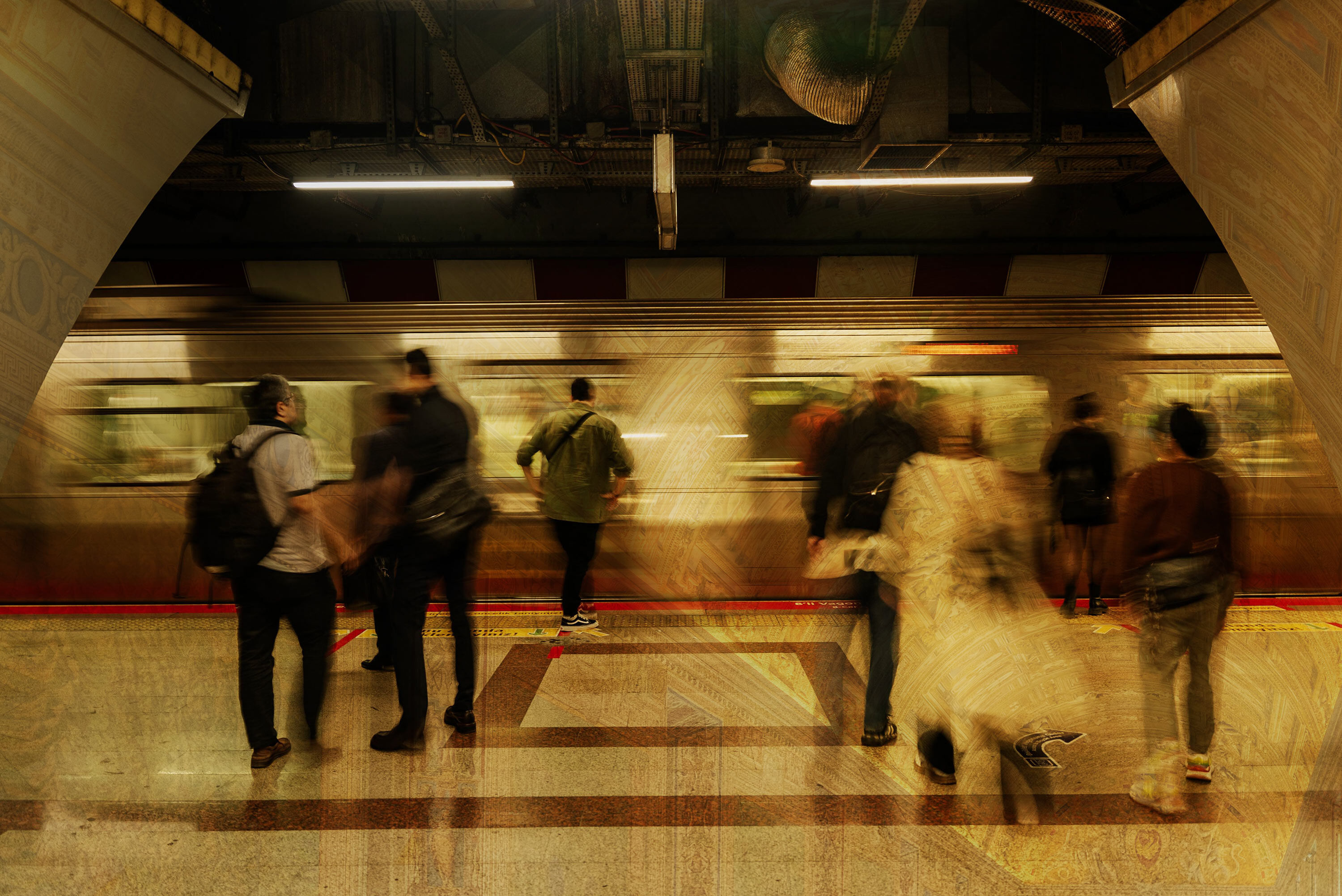
Do you ever get the feeling you are riding a long, perfectly straight railway line that seems to stretch forever, while nothing particularly meaningful or beautiful passes outside the window—perhaps only tall grey walls erected to shield nearby neighborhoods from the noise? The train feels chronically stripped of character, almost clinical. No surprises, still less joy, just the same stations repeating themselves without the slightest promise of exhilaration.
Of course, we are not talking about an actual train—it can still surprise us (usually by being late)—but about, well, everything. All of this. As though something has become stuck, as though it keeps going without actually moving anywhere, while even the supposed "progress" fails to inspire much excitement. Anyone who can still get thrilled by essentially the same phone in its twentieth iteration is doing well—or sleeping. But what about the rest of us, those who are awake and still dream of great stories and great phenomena?
Have you seen The Time Machine, the 1960 classic? Watch it if you haven't. And if you have, you may remember the scene in which George sits inside his time machine, racing through time but not through space, trapped inside a dark chamber. Years flash across the dial, then entire centuries, yet nothing seems capable of breaking through the claustrophobic stagnation. Until suddenly the barriers collapse and he finds himself in some impossibly distant world—in the year 802,701, to be precise.
That is roughly what our own waiting feels like. Waiting for what? For a new Renaissance, naturally. The problem, of course, is that we lack a time machine, while the relative brevity of the human lifespan seems badly mismatched with the sheer scale of our desires. And yet one of the defining conditions of the present age—something that probably causes us an enormous amount of conscious and unconscious frustration—may, for once, be working in our favor.
Change is fast, even when we dislike where it is taking us. Nothing feels permanent or stable anymore, and even the illusion of stabilization lasts for less and less time. Fine. If that is how things must be, could this acceleration propel us more quickly toward a new Renaissance? Especially if acceleration itself is not linear, but everything keeps speeding up together.
Let us entertain that pleasant possibility, at least as a thought experiment, and try to give it some shape. What would a "new Renaissance" actually look like?
Does something have to happen before it can begin? Not necessarily. And the first thing that comes to mind—a machine that thinks ever more and ever better—hardly evokes the Renaissance at all. It sounds much more like techno-dystopia. But the greatest civilizational shifts do not always begin with an invention. Sometimes they begin at the moment people finally notice what has been in front of them all along.
Stone had volume before Brunelleschi. Faces knew sadness before Giotto. The human body did not wait for Leonardo before becoming an intricate machine of muscles, bones and movement. The Renaissance did not invent any of these things. It merely gave them cultural permission to be seen.
So what is sitting before our eyes, beneath our noses and inside our minds today that we may still be failing to see? Perhaps the next Renaissance could arise in much the same way. Not from a new device, an efficient fuel or an intelligent machine, but from a change in what we consider real. Perhaps its great discovery will be frighteningly simple. Perhaps, in fact, we can already glimpse it in the realization that we have acquired more and more of everything while possessing less and less of a life we can recognize as our own.
That feeling that something is beginning to appear, that isolated minds across the world are slowly feeling their way toward a similar realization—those are the roads that lead to a Renaissance. There must be a period of transition; such things do not happen in an instant. The Middle Ages were not some blind night in which everyone painted nothing but God until the Italians suddenly opened the windows. Gothic cathedrals are full of animals and monsters, while Giotto gave figures weight long before the Renaissance acquired its textbook label. The transition was not a switch being flipped. It was a shift in the boundaries of what people were permitted to see.
Still, something enormous really did happen. The world of this life acquired greater value in its own right. Artists began to study the body not merely as a temporary shell for the soul but as a challenge worthy of investigation. Some of the stories were quite bizarre. According to Giorgio Vasari, the Florentine artist Antonio Pollaiuolo skinned dead bodies in order to understand their muscles (!). Yet by the beginning of the sixteenth century, the anatomical investigations of certain artists had surpassed much of what was still being taught at universities. Piero della Francesca, the Italian painter and mathematician, wrote the earliest known treatise on perspective by a painter, attempting to explain mathematically how a flat surface could become convincing space. These were not merely new techniques. They represented a new agreement between the eye and the world.
And that is precisely the kind of new agreement we need today.
We like to think of ourselves as people without dogmas, which happens to be one of our age's favorite dogmas. We may no longer believe in a cosmic hierarchy, but we certainly believe that more is usually better than less. Time must be used, talent monetized, personality endlessly developed. Medieval man had to justify his soul before God. Modern man must justify his day before the calendar.
Even rest has become suspicious if it does not produce a result. We sleep so that we can work better. We walk with step counters. We read in order to improve ourselves. We meditate to increase concentration. Notice the uncomfortable pattern? Eventually there is no activity left that exists for its own sake. Every one of them has been recruited into the administration of an expanding empire whose capital nobody can quite locate anymore.
The first great change, then, might occur in our understanding of time. The French philosopher Henri Bergson distinguished clock time from lived duration, the durée in which moments do not line up like identical coins but flow into one another, changing one another's meaning. Five minutes waiting for medical test results are not the same as five minutes spent with someone we love. A Sunday afternoon from childhood may occupy more space in memory than an entire year of adult life. A clock knows how much time has passed, but it does not know how much time there was.
Our civilization recognizes almost exclusively the first kind of time. It can be divided, sold and recorded. The German sociologist Hartmut Rosa has described modernity as a system of social acceleration in which faster transport, communication and production do not create an abundance of free time, but instead increase the number of things expected of us. Acceleration also shortens the present: the world remains stable for ever shorter periods, never quite long enough for us to settle comfortably inside it. We invented a faster route so we could arrive sooner at the next obligation.
A new Renaissance of time would therefore mean more than simply living slowly. Slowness itself can easily become yet another self-improvement program, complete with a precisely calibrated morning ritual and a ceramic wabi-sabi cup purchased specifically to look as though nobody purchased it. The deeper change would be to abandon the idea that time is primarily a raw material. Time is not a container into which we are supposed to cram as many experiences as possible. It is the substance experience is made of.
The second change would concern a word our society seems almost incapable of uttering without discomfort: enough.
We have a sophisticated theory of scarcity and an endlessly elaborate theory of growth. Between the two lies a vast conceptual emptiness. When someone says they have "enough," the system hears a malfunction of ambition. Why would you not want a bigger apartment, a more successful career, another upgraded version of yourself?
Enough, of course, is not a romantic synonym for poverty. Preaching modesty to someone who cannot afford heating is not philosophy; it is insolence. Nor is today's luxury minimalism particularly revolutionary. A new "culture of enough" would therefore have to be political as well. It could not ask the majority to renounce what they do not have so that a minority might enjoy what it has accumulated with a clearer conscience. It would ask how much a person needs before they can stop living in self-defense against tomorrow.
This brings us back to William Morris, the nineteenth-century English artist, designer and socialist, who in 1884 distinguished useful work from useless toil. Worthwhile work, he argued, must contain the hope of rest, the hope of producing something worthwhile, and at least some pleasure in the act of working itself. Even then he was suspicious of the moral glorification of employment for its own sake, particularly when the praise came from people living comfortably off the labor of others. Morris therefore sounds more contemporary than many of today's productivity gurus, which is quite an achievement for a man who died before the dawn of the twentieth century.
A new Renaissance would not merely ask how much work can produce. It would ask what kind of person work produces. It would no longer see every object as future waste or every skill as a market niche. It might rediscover objects with biographies and crafts in which the human hand is not merely an accessory to a machine. And to avoid misunderstanding, none of this requires retreating into some pastoral postcard. "The simple life" usually sounds most beautiful to people wealthy enough to rent it temporarily.
Our idea of freedom would change as well. Today we mostly imagine freedom as the size of the menu. The more options there are, the freer we supposedly become. But the menu has expanded so enormously that life can easily turn into a waiting room for some better possibility. We are haunted not only by what we are forbidden to do, but by the thousand lives we supposedly could have lived.
The German-American political philosopher Hannah Arendt did not understand freedom primarily as choosing among available alternatives. For her, freedom was the capacity to begin something new, an act by which a human being brings into the world something that could not have been fully predicted from what came before. That kind of freedom is not consumer choice between ready-made options. It is authorship.
Perhaps the freedom of the future would therefore sound different. Not "I can have everything," but "I do not have to want everything I am offered." Not "I can be anyone," but "I can become someone without constantly having to prove that I could have become someone else." It may sound like a minor inversion of words, but look more closely and it becomes an utterly revolutionary concept of existence.
Hartmut Rosa, mentioned earlier, uses the term "resonance" for a relationship with the world in which the world is not merely a mute stockpile of resources. It is a relationship in which another person, nature, music or work can touch us and change us, yet can never be fully manufactured or controlled. That very inaccessibility matters. A world made perfectly available to us eventually stops answering us. It becomes a catalogue.
Such a Renaissance would not mean returning to the Middle Ages, nor should it become yet another reactionary fantasy about a lost order. The old world contained depth, but it also contained brutality. It had community, though often without the right to leave it. It had slowness, but slowness was rarely a choice. It had belonging, but it strictly determined who was allowed to belong. What we are imagining here is a vast upgrade accompanied by equally vast removals.
There is much in our present that is good and progressive—let all of it remain. Let what suffocates us disappear and become history.
We began by hoping for acceleration. So could such a transformation happen faster than the first Renaissance? Its symbols and ideas can certainly spread almost instantaneously. But perception itself has an inconvenient habit of refusing to accelerate. We can learn a new word quickly, but we cannot command ourselves to experience an hour, our own body or the person across the table in a different way. A new Renaissance might spread quickly, but it could not be lived at high speed.
Nor is it guaranteed. Civilizations do not become wiser simply because they grow tired. Exhaustion can produce renewal, but it can also produce rage, a cult of strength and longing for the man who promises a simple world on the condition that everyone surrender its complexity to him.
If it does come, we may not recognize it by some grand manifesto. It will begin when certain habits we now regard as normal lose their aura of inevitability. When it begins to seem grotesque that we spend decades living for some future period in which we will supposedly, finally, have time. When we stop confusing availability with intimacy, choice with freedom, and busyness with purpose. When a person who says "enough" is no longer regarded as defeated or insane.
Fragments of that future are quietly awakening around us—very quietly, but perhaps inexorably. One early sign of the transition might be meeting people who take pride in not owning a mobile phone rather than in owning the newest one.
Future generations may look back at our entire age with the same bewilderment with which we look at old cosmic hierarchies. They may wonder why we turned every moment into an investment, and how we managed to gain access to almost everything while so rarely being where we actually were.
Perhaps that will be the new perspective: to exist in a finite body, among other people, for time that is not a resource but life itself.
So let us send our greetings to that near or distant generation, should it somehow be reading us from the future. And let the record show that we already had the idea, all the way back in 2026. We waited and waited for it to become broad enough to live inside, because none of us could walk through those doors alone without ending up as eccentrics.
But we were already one of you.
Comments