
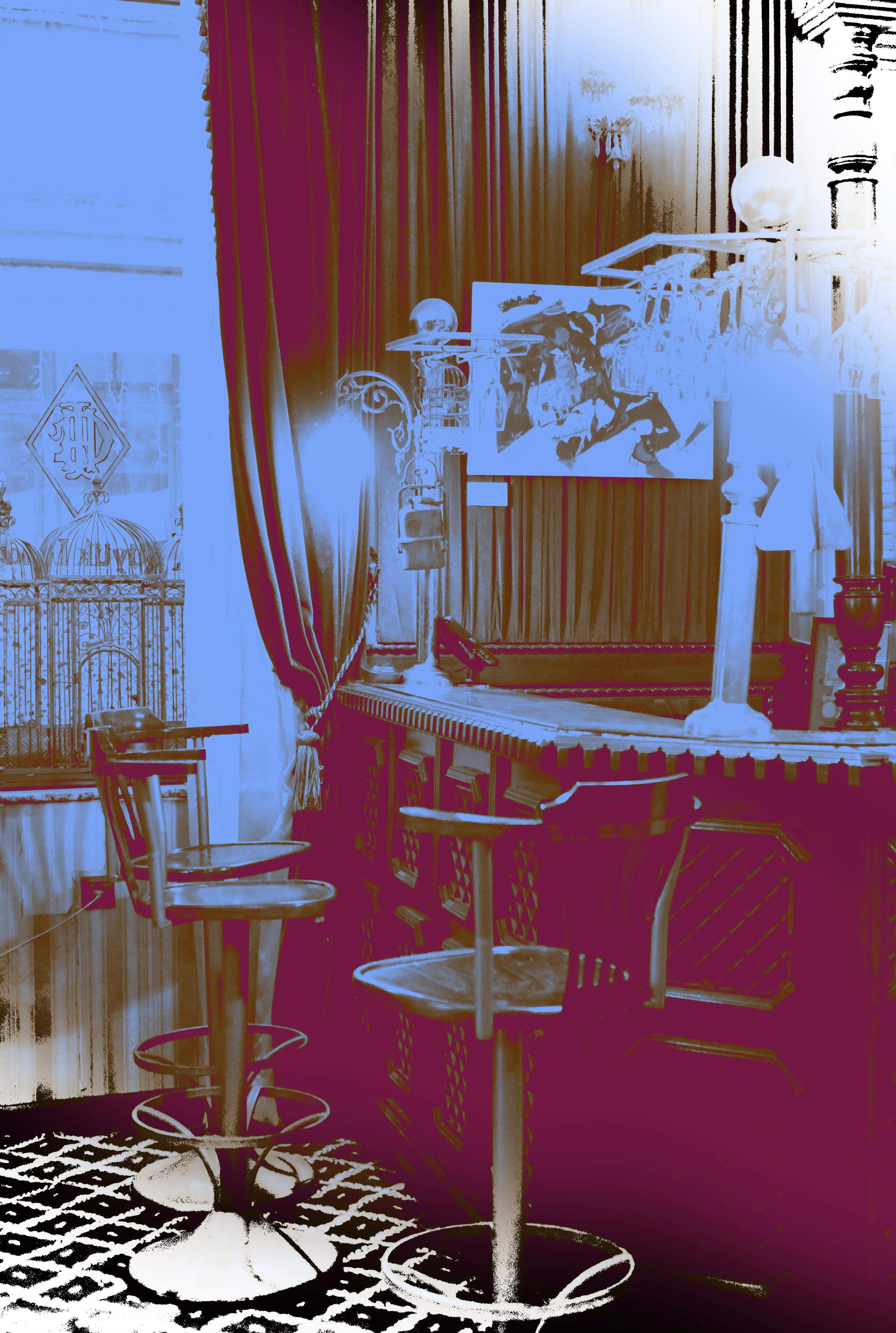
A few people are sitting in a café. The café is not especially polished, and neither, to be fair, are the guests. In fact, if there were not some kind of sign above the entrance, one that may once even have lit up, you might mistake it for someone having simply left the door of their basement apartment open. But since it has a name, and a picture of one of those well-known beers, probably the kind that falls into the "working-class" category, you go inside. Once you appear at the threshold, the conversation inside briefly stops. All eyes turn toward you, because you do not usually come in here. Who are you all of a sudden? Do not worry, one indifferent "good afternoon" is enough, let it scatter into the room. Someone there is the waiter, but you cannot tell at first glance who, not like this, caught off guard. Sit at an empty table, or at the bar, if it is not already full, or if that free bar stool does not look as if it already carries someone’s invisible name, because its owner may have only stepped out to the toilet or gone to buy cigarettes.
The murmur will soon reset, and you will blend in, as an observer, with an atmosphere that feels more like someone’s living room than strictly a "hospitality establishment". And now what? Someone will come to serve you eventually, there is no hurry. And then? Nothing. Enjoy it, take it in, because you are watching live an entire world that will soon no longer exist. A whole sociological category that people will soon only talk about, even mourn. Of course, you may not necessarily notice that today, not here, because territorially we are a little late with "progress". Especially not if you yourself are fairly often part of the "furniture" in such a place. But what you are watching today is the firehouse party you only ever heard stories about. And one day you will only talk about it, and someone will envy you, and you will find it strange, wondering why anyone would glorify "hanging around cafés", and then, eventually, you will see it for yourself.
And indeed, that scene largely no longer exists if we head west. In the glittering metropolises of Western Europe, it is very hard to find a café in the sense in which you still know it here. There, it will truly be, in the proper sense of the word, a "hospitality establishment": come in, be served, consume what you intended to consume, move on.
And where is everything in between? Where is the person reading the newspaper, the one commenting on the match, the one arguing about politics, and the woman who simply sits in silence and looks out the window? The waiter does not know who takes coffee without sugar, if the waiter is still a person and not a machine. Where is the man who did not really come to see anyone, but knows he will run into someone?
It is hard to decide whether to write about all this in the present or the past tense. Because something has already disappeared irreversibly, while something still survives, though without great chances. Such places did not look like the infrastructure of society. They looked like ordinary life. That café on the corner. But also the library. The community hall. The pensioners’ club. The neighborhood playground. And the video store? Do you remember those? Can you see now, from today’s distance, that it was not merely a film catalogue like a Netflix subscription? Someone was there, someone commented on the film with you, recommended what to rent.
But what was all that together? What kind of places were those? Not home. Not work. Then something third. We were neither guests in someone’s intimacy nor workers under supervision. We could buy something small, a coffee, but we did not necessarily have to. In the park, we simply appeared, uninvited, because someone would be there, us to begin with, and we would already be someone familiar to someone else, enough for them to come down, to pass by. The reason? Why would there need to be some special reason beyond the fact that we exist?
Yes, the third place. What we took as a natural extension of life had already been studied deeply and scientifically by someone, because in many places it no longer exists. The American sociologist Ray Oldenburg called such spaces "third places". The first place is home. The second is work. The third is what lies between.
And when we talk about the breakdown of community, we too often imagine grand causes. Economic crises, wars, pandemics. All of that stands, and all of it destroys. But beneath it there is something deeper and more uncomfortable, especially once we realize that it did not necessarily begin with smartphones or the pandemic, or even with the internet. It began earlier; the later things were only catalysts. For quite some time now, people have been meeting one another without a plan less and less often. Less and less do they share a space in which they have not already been sorted in advance by job, status, interest or purchasing power.
Once, a neighborhood had places where a person appeared because that was normal. There was no need to send a message, arrange a time, check a calendar. If you wanted to see people, you went where people were. Today, even a meeting has become a kind of project. It has to be organized. Time has to be found. A table has to be reserved, a ticket bought, a membership paid, a dating app downloaded, the right WhatsApp group joined. Spontaneity did not disappear because people suddenly became cold. It disappeared because it lost its spaces.
Paradoxically, but also entirely understandably, third places were important precisely because they were not too important. Official politics did not happen there, but what comes before politics did. Conversation. Grumbling. Gossip. Disagreement. A wrong piece of information someone corrects. An acquaintance that turns into some shared plan. From such small contacts comes the feeling that a person is not alone in the world.
Society is not made only of institutions. It is also made of habits of encounter. If there is no place where neighbors can accidentally see one another, the neighborhood becomes only an address, nothing more, a dormitory. If there is no bench, there is no old woman sitting on it. If there is no local café, there is none of that strange mix of people who would otherwise never find themselves in the same room. A worker, a professor, a taxi driver, a student, a widower, the owner of several dogs, someone who always exaggerates and someone who always brings him back down to earth. They are not necessarily great friends. That is actually the point. The third place does not require intimacy. It requires repetition.
Where people repeat themselves, trust emerges. Not immense trust. More like practical trust. A face. A voice. In a time when people are increasingly experienced as a threat, an audience, competition or a profile on a screen, even that is already a lot.
These places are retreating. Not everywhere at the same pace, of course. But enough to be felt. City centers are becoming too expensive. Premises that could live off regular guests are being replaced by spaces aimed at tourists, quick consumption or elegant emptiness. Neighborhood libraries work reduced hours or barely work at all, community halls decay, parks are arranged so they look good in photographs, but no one stays in them. Benches disappear or become uncomfortable, stupidly "smart". Squares turn into backdrops. Everything is tidy, but there is no life. There is consumption, there are tourists who will take pictures in front of some better-restored architecture, and that is basically it.
It is not only that coffee has become more expensive. Though it has. The point is that public and semi-public spaces increasingly behave like a market. You must justify your presence. If you sit, buy. If you do not buy, you are in the way. If you linger too long, you are taking up space. If you are loud, you disturb the experience. If you are poor, you spoil the image. The city is slowly being cleansed of people who simply exist in it.
Third places could once be unattractive. A little smoky, a little too loud, with bad chairs and even worse décor on the walls. But that is exactly why they were permeable. They did not demand a perfect person. Today we are increasingly given spaces that look beautiful but are socially narrow. A café where you can sit if you have money. A coworking space if you have the right kind of job. A club if you belong to the scene. An event if you fit the theme. Even social life is becoming curated.
So, have we largely moved into the digital? Yes, but that is not the whole story. The digital world did not simply replace third places. It used the emptiness created by their disappearance.
Social networks promised constant connectedness. In a certain sense, they delivered it. It has never been easier to contact someone, follow someone’s life, enter a debate, find people with the same interests. But digital space does a poor imitation of accidental encounter. It is always filtering. It pushes us toward people like us, or toward those with whom we will fight. The algorithm does not like ordinary conversation that goes nowhere. It does not like silence. It does not like an acquaintance that develops slowly, over ten encounters without any grand statement.
In a physical third place, you cannot fully control who will be present. That is its flaw and its value. Someone will interrupt you. Someone will say something stupid. Someone will have a different rhythm, a different worry. You have to endure other people a little. Not too much, but enough. In fact, one could even say that democracy, the real and everyday kind, perhaps begins right there. In that ability to share space with people we did not choose.
Without that, politics too becomes abstract and furious. People no longer meet as neighbors, but as positions. Not as the person standing in front of you in line, but as a representative of some category. Left, right, elite, people, peasant, hipster, freeloader, migrant, boomer, zoomer. All of these are just words that save us the effort of encounter. When there is no shared space, social imagination becomes poor. The other person becomes an image. Usually an ugly one.
Third places were not always idyllic. That needs to be said, because nostalgia can be deceptive. Many spaces were exclusionary. Some were uncomfortably male. Some were class-closed. In some, everyone knew who was allowed to speak and who was only there to serve. A local community can be warm, but it can also be suffocating. Everyone who grew up in a small place knows both sides of that story. But bad third places are not an argument against third places. They are an argument for better ones. Because what is the alternative? That slightly eerie thing: apartment, work and screen. And that is a spiritually very modest life, however technologically advanced it may be.
When the spaces between home and work disappear, it is not only one type of venue or one urban habit that disappears. What disappears is the possibility that society can breathe outside the schedule. The small, stubborn infrastructure of chance disappears. And without chance, people remain locked inside what they already are, with those they already know, inside thoughts they have already heard.
The question of third places is not at all a sentimental question about old cafés and better times. Nor is it nostalgia for smoke, cheap coffee and a bar that remembers more than it should. It is about something more serious. About where society will be society at all, without being endlessly optimized.
We have allowed so much simply to disappear, irreversibly. We did not agree to it, we were not asked, it just happened. And now what? What we always do: wait. Perhaps people will one day grow tired of antisocial life and once again want something ordinary: a physical place, familiar faces, conversation without a plan. Or we can use the fact that we are still somewhere where third places are not yet relics of the past for sociological research. We are still present, just at the end of that long journey; let us enjoy it while it lasts. See you for coffee. Or in the park!
Comments