
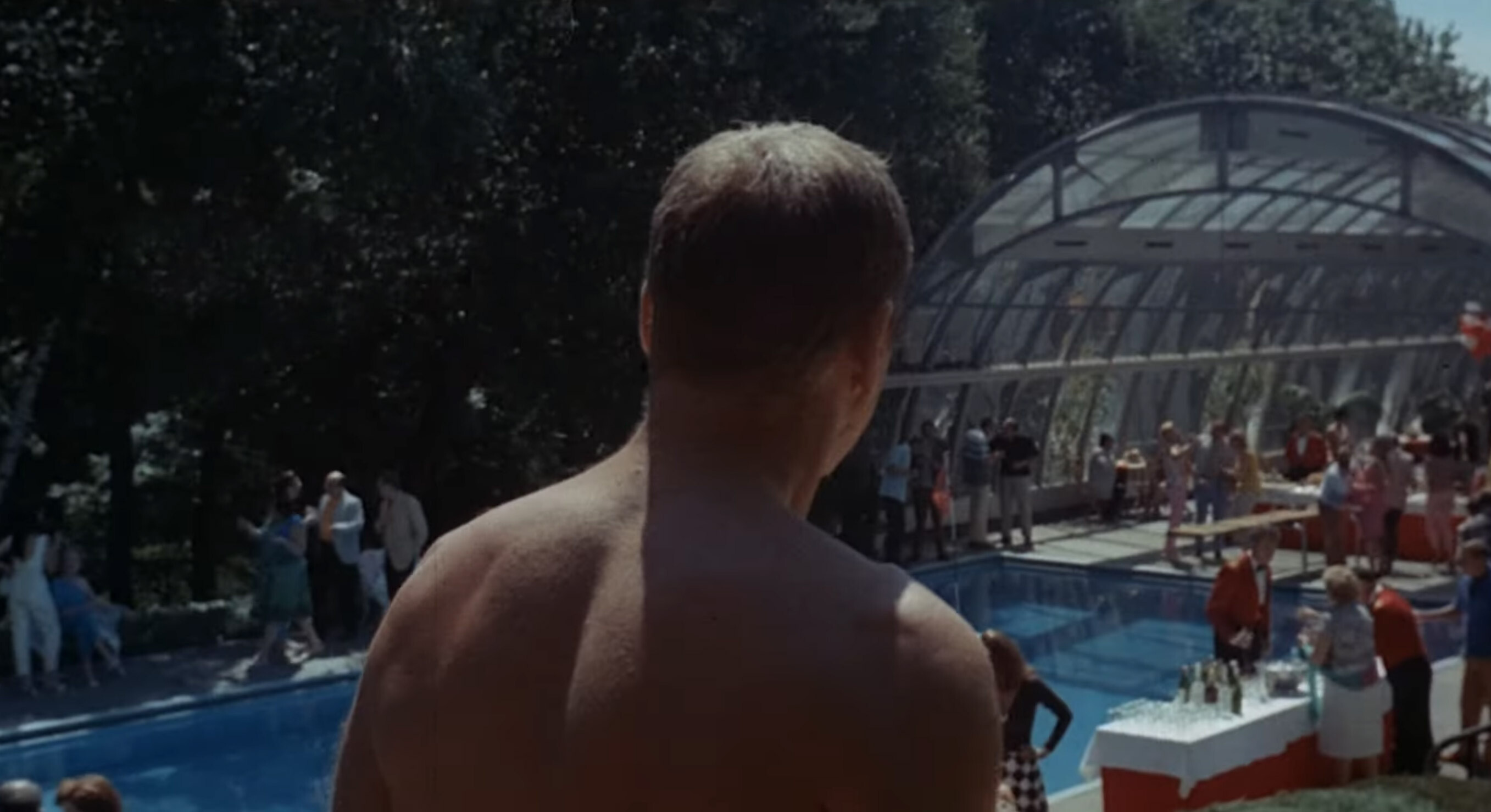
Once, in a beautiful Connecticut suburb, one could swim through the private seas of the middle class. But each one led deeper into an uncomfortable truth.
If the neat white fences and everything hidden beneath them in Lynch’s "Blue Velvet" are almost too explicit a description of what lies behind the curtain of idyll, it can be done more subtly, earlier, and in a way, once the surreal element is removed, even more brilliantly. Because to make a film that begins as a whim and ends as a diagnosis of an entire civilization is a masterstroke. Frank Perry’s 1968 film "The Swimmer" is exactly that kind of film. At first glance, it is a bizarre, almost charming story about a man who decides to get home by swimming through his neighbors’ pools. Not by road, not by car, not on foot, but pool by pool. As if the American suburb were some kind of archipelago, and he an Odysseus in swim trunks.
Except this is not an Odyssey of return. This is the Odyssey of a man discovering that neither "home" nor the illusion of home exists anymore. It is a story that repeats itself, through a new aesthetic, straight through the heart of what remains of today’s middle class.
Burt Lancaster plays Ned Merrill, a man who appears one sunny afternoon at a friend’s pool somewhere in a prosperous Connecticut suburb. He is tanned, smiling, physically almost unreal in his vitality. He looks like a man personally drawn by the American dream for a weekend-leisure catalogue: broad shoulders, a smile, healthy energy, the casual confidence of someone who still believes the world turns around his good will.
Then he looks across the surrounding houses and pools and has an idea. He can get home by swimming through his neighbors’ pools. He names that chain of pools the "Lucinda River", after his wife. The idea is absurd, certainly, but at first it seems almost poetic. The suburb becomes a mythological landscape. Lawns turn into shores, hedges into the borders of kingdoms, and pools into the private seas of small family dynasties. Ned sets off like a boy who has suddenly decided that the world can still be an adventure.
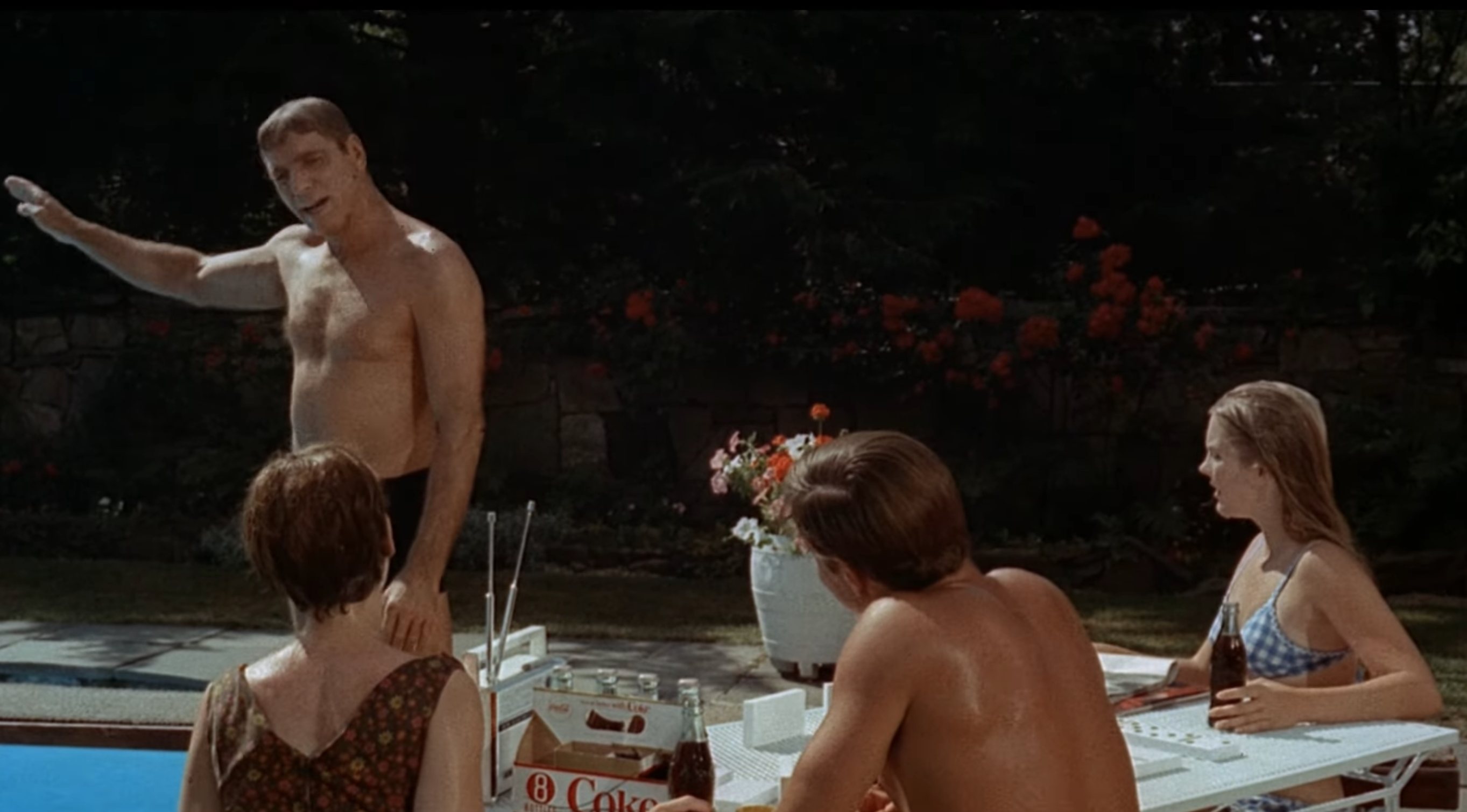
But "The Swimmer" is not a film about adventure. It is a film about a man arriving late to his own ending.
After only a few pools, a certain unease begins to appear. Not the explicit, cinematic kind in which someone breaks a glass or reveals a great secret. Here the unease is subtler, and therefore much heavier. It is social unease.
Because everyone around Ned, it seems, knows something Ned refuses to admit to himself.

He behaves as if everything is fine. He talks about his wife, his daughters, his house, old friendships, summer days, plans... He speaks like a man living inside a version of life that perhaps once really existed. His neighbors look at him with a certain mixture of discomfort, pity, fatigue and concealed cruelty. Some want to avoid him. Some humiliate him. Some demand payment for old debts. Some behave as if he had long ago "fallen out of the club", only no one had the courtesy to send him the official notice.

No one actually has to say the truth out loud. The suburb is a master of passive aggression. It does not kill with a knife. It kills by no longer offering you a drink.
In that sense, "The Swimmer" is one of the strangest films about the American dream because it does not present that dream through grand symbols - skyscrapers, Wall Street, advertisements, wars, flags - but through something much more intimate and banal: the private swimming pool.
Because the pool in the American suburb is more than a place to swim. In fact, it is often least of all that, a place to swim. The pool is a status object, a small turquoise confirmation that you have "made it". Proof that you have a house, a yard, leisure time, a body to maintain, guests to impress and enough money for "water behind the house" just for you. The pool is luxury presented as ease. Capital in the form of weekend pleasure. A private lake of the middle class.
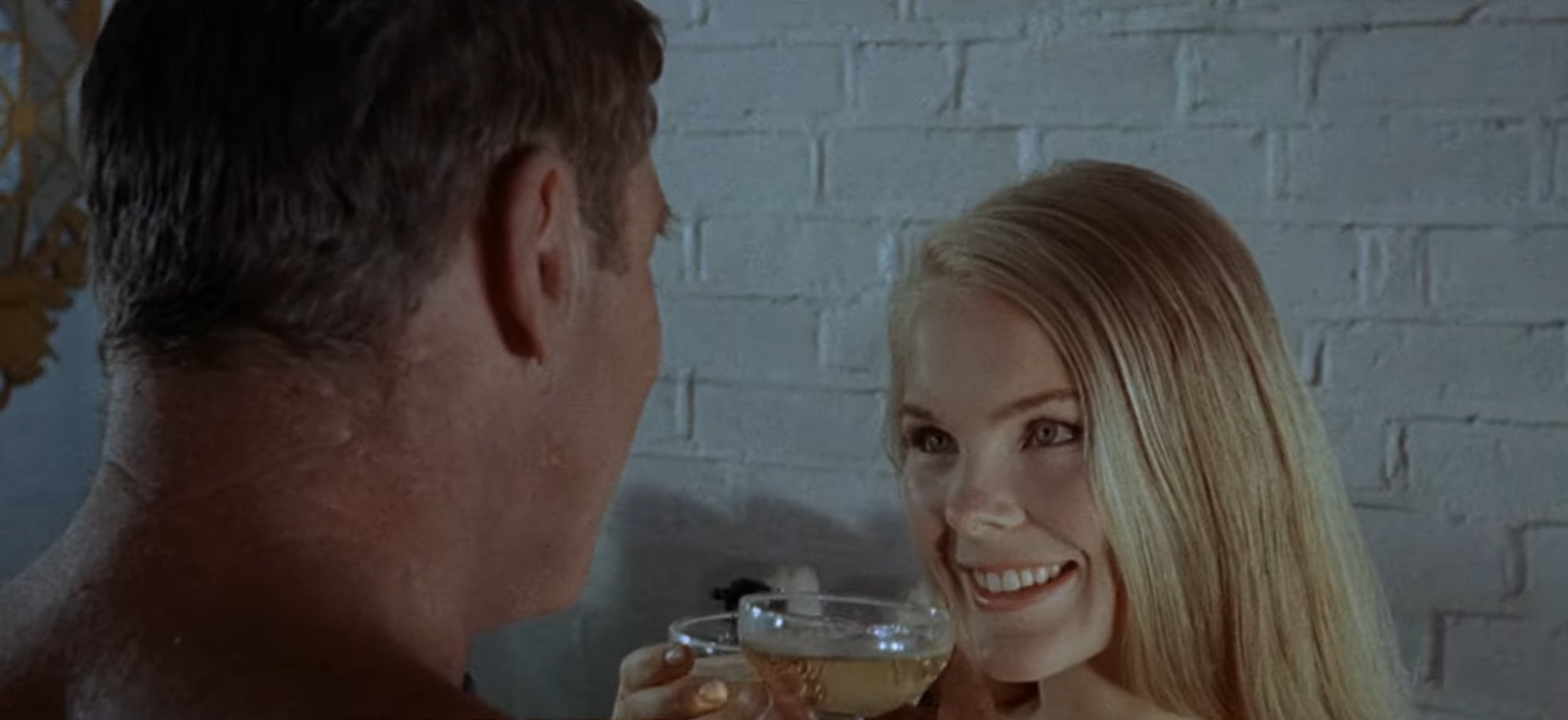
That is why Ned’s idea is so brilliantly wrong. He thinks he is swimming through the neighborhood. In reality, he is swimming through a social hierarchy.
Each pool is, in fact, one station of his former life. Each encounter reveals something. The journey that began as an eccentric game slowly becomes a trial without a judge. Ned does not move through space, but through his own collapse. One pool is memory, another debt, a third failed love, a fourth lost reputation, a fifth class degradation. The closer he gets to home, the less water there is, and the more truth.
Frank Perry brilliantly directs the suburb as horror without darkness. That is one of the film’s greatest strengths. There are no dark streets, rainy windows or claustrophobic underground corridors. Everything happens under the open sky, among beautiful houses. The camera looks at green lawns, sunlight, picnic baskets, cocktails, deck chairs, oiled necks and white fences. On the surface, it is almost an advertisement for the good life. And that is exactly why the horror runs deeper.
Frank Perry: A Director for Those Tired of Tidy Cinematic Journeys
Frank Perry was an American director who never fully belonged to the Hollywood mainstream, although he sometimes came dangerously close to it. Born in New York in 1930, he began in theater and documentary film, then broke through in the early 1960s with "David and Lisa", a sensitive drama about two young people in a psychiatric institution. Already there, one could see what would follow him throughout his career: he was interested in characters who still function somehow on the outside, while their entire inner system is falling apart.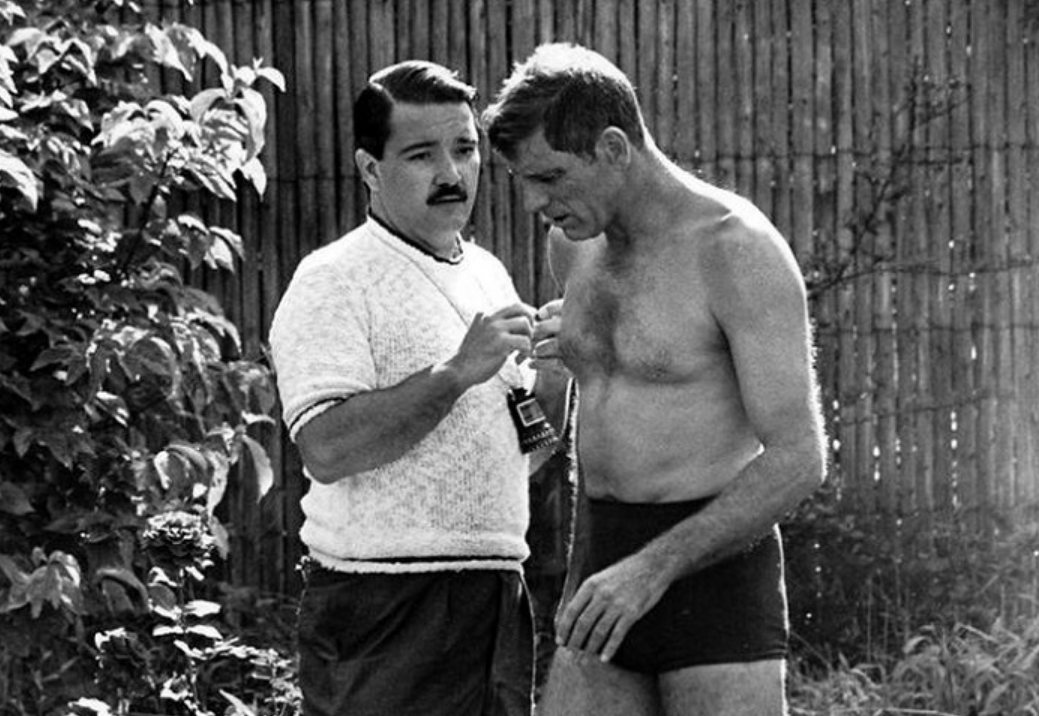
If you are starting with him, "The Swimmer" is perhaps the best entry point. After that, "David and Lisa" is worth seeing for its early sensitivity and passion toward outsiders, followed by "Diary of a Mad Housewife", a bitter but very intelligent satire of marriage and urban dissatisfaction. "Play It as It Lays", based on Joan Didion’s novel, is another excellent title: cold, fragmented and fascinatingly poisonous in its portrait of Hollywood emptiness. And for those who want to see Perry in his most famous, broader pop-cultural phase, there is also "Mommie Dearest", a film that turned from biographical drama into a camp classic, perhaps against its own will.
Because "The Swimmer" understands something that even many "horror" films do not: the scariest places are not always abandoned houses. Sometimes they are houses that are a little too orderly. Sometimes the real chill lies in the fact that everything is mowed, washed, ironed and socially acceptable.
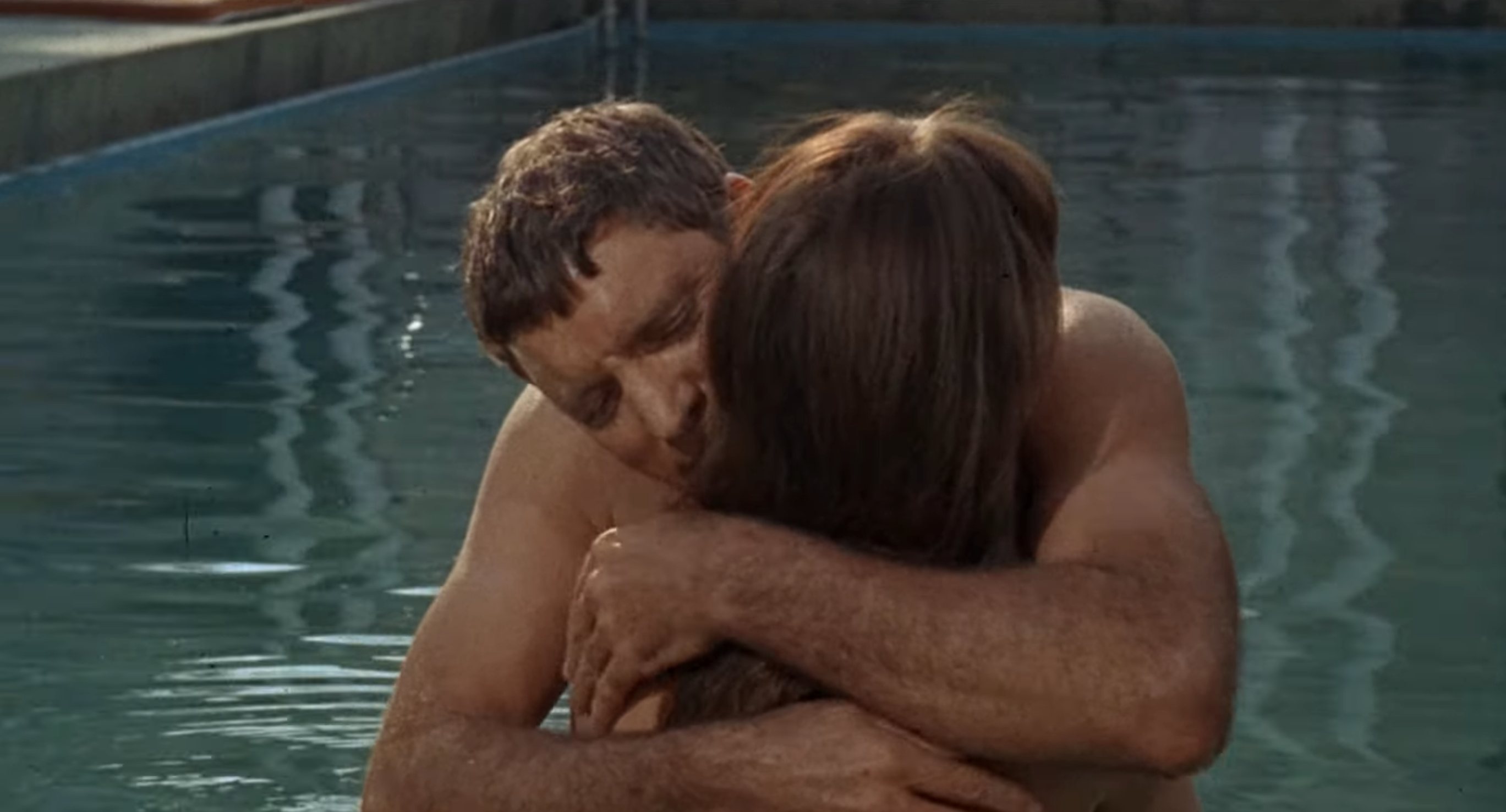
Ned Merrill is a tragic figure because he is not simply a ruined man. He is a man still performing the "role" of a successful man. He does not fall apart because he lacks money, love or status - although, as the film progresses, we realize he has lost almost everything. He falls apart because he cannot stop believing in the story he tells about himself.
And that story is the story of the postwar American man: active, attractive, family-oriented, socially desirable, somewhat childishly self-confident, always ready for a sporting gesture, a joke and a fresh start. Ned is a man who learned that life must look like an advertisement for life.
But reality in this film is not polite. Only the people are. Which makes it worse.
Burt Lancaster is actually perfect here precisely because his body carries the remnants of a "heroic America". He looks like a man who could have been the "winner" in some other film, as indeed he often was. In classical Hollywood, his body would signify strength, control, vitality. In "The Swimmer", that same body becomes... sad. The muscles are there, the smile is there, the energy too, but the world in which those things guaranteed victory is no longer there. Lancaster looks like an ancient hero who has wandered into a real-estate catalogue.
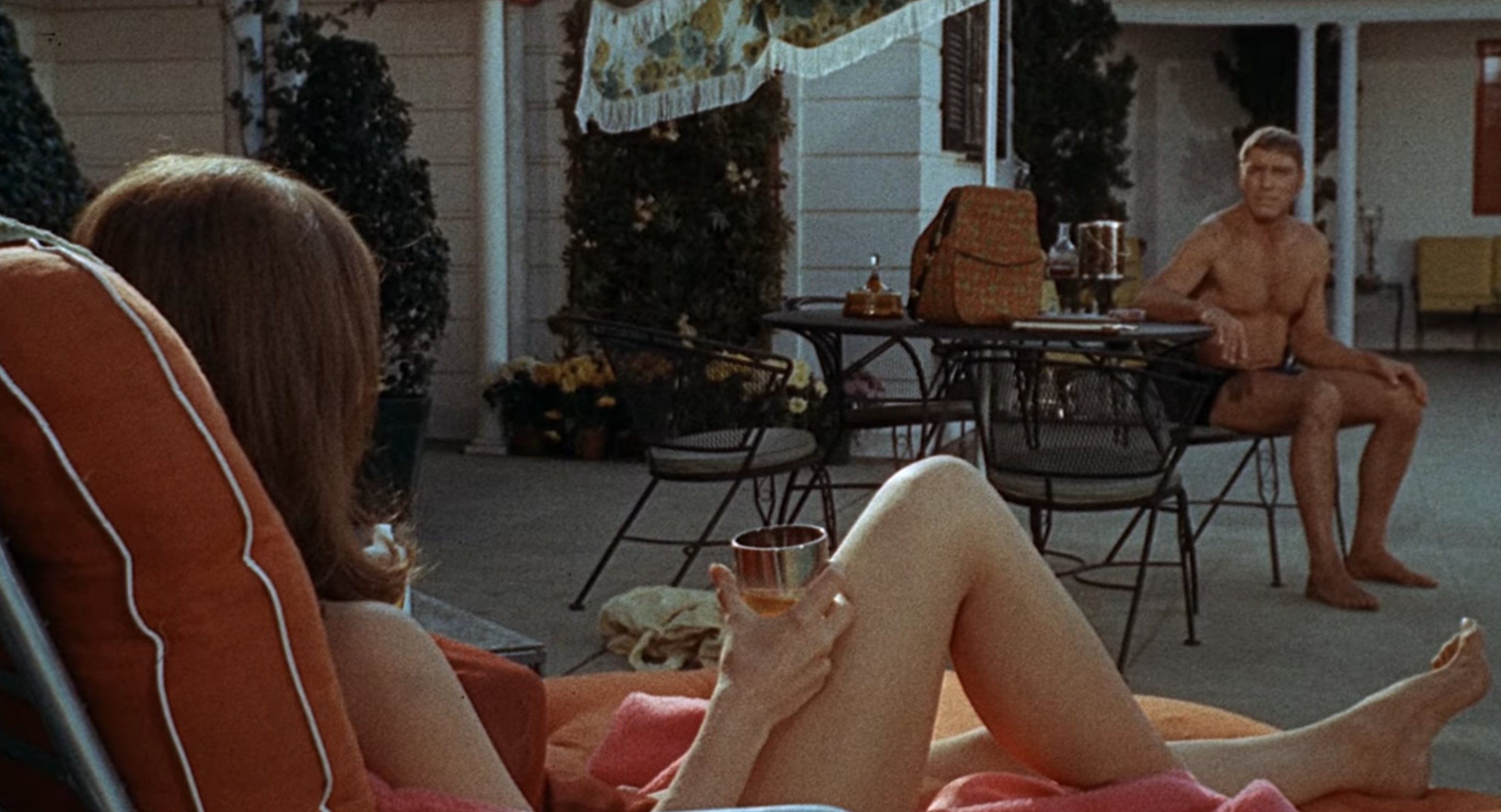
The film came out in 1968, which is a very important detail. This was the year in which America could no longer convincingly perform its own innocence. The war in Vietnam, political assassinations, racial unrest, student revolt, the collapse of trust in institutions - all of this was already eating into the national myth. But "The Swimmer" does not enter those great historical themes directly. It does something subtler: it shows the inner room of the American dream, the place where the myth continues to be maintained even after it has already begun cracking from the outside.
While history trembles, the suburb serves cocktails.
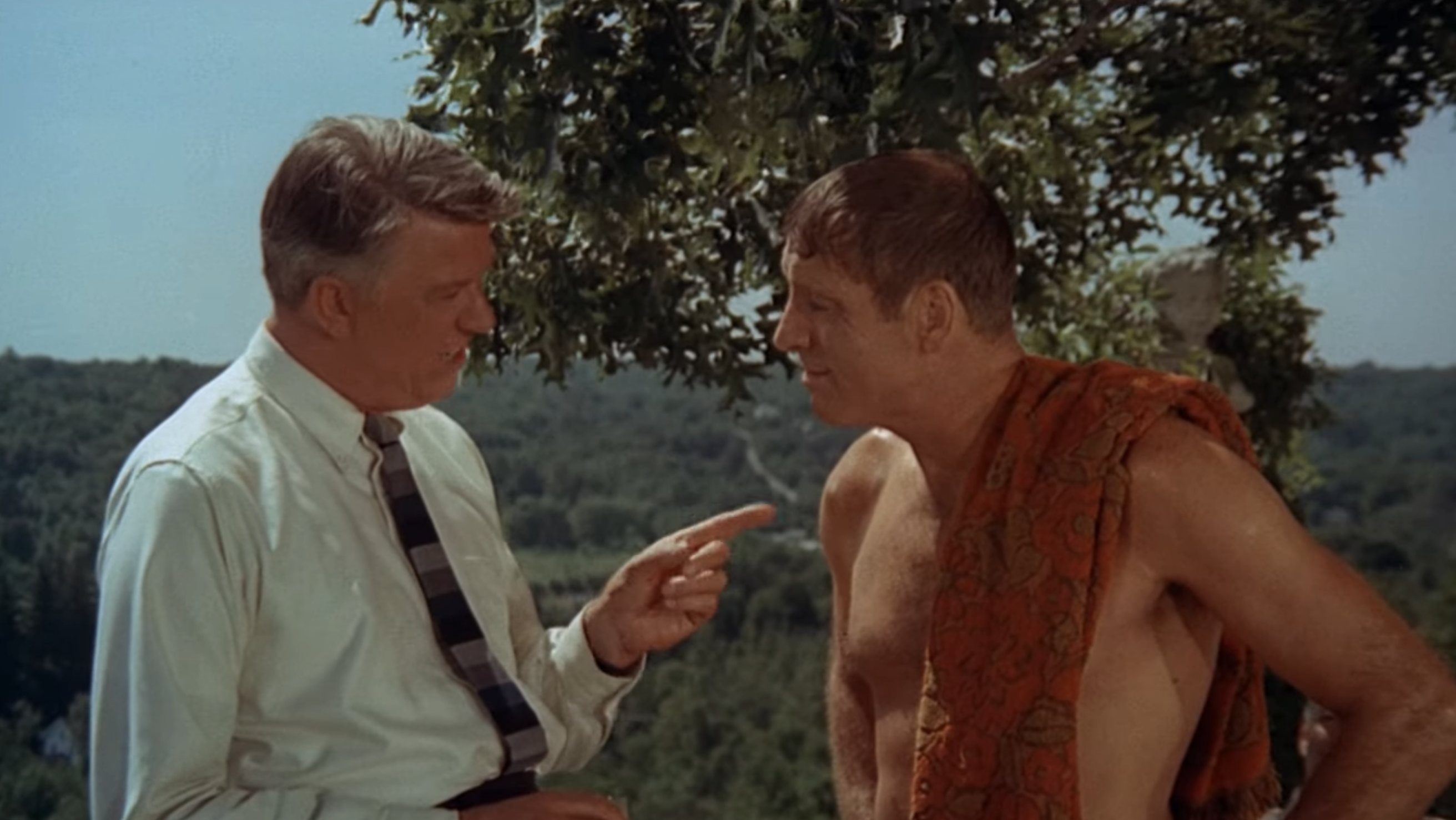
That is precisely why the film feels so modern. Today we may not dream of a pool in Connecticut, but the logic has remained the same. Status has changed, the scenery has become digital, but the need to present one’s life as a "successful project" has not disappeared. Once, pools were proof that you belonged to a certain class. Today, perhaps, it is travel photos, carefully framed kitchens, fitness routines...
Ned Merrill today might not swim through the neighborhood. He might scroll through his own life. From post to post, from memory to memory, from a picture with the children to a picture from vacation, from an old business success to a new attempt to maintain the impression of continuity. He would still be moving through a series of surfaces that reflect the sky, but reveal no depth.

That is what makes the film so strangely current: "The Swimmer" is not only the story of one man’s collapse. It is the story of a society that teaches people that the most important thing is not to interrupt the show. Even when the marriage has failed. When the house has been lost. When friends are no longer friends. Even when everyone looks at you like a man who does not understand that the party is over.
The saddest thing about Ned is not that he is "blind". The saddest thing is that his blindness was socially produced. He merely took to its end what the culture had told him to do.
And so Ned swims.
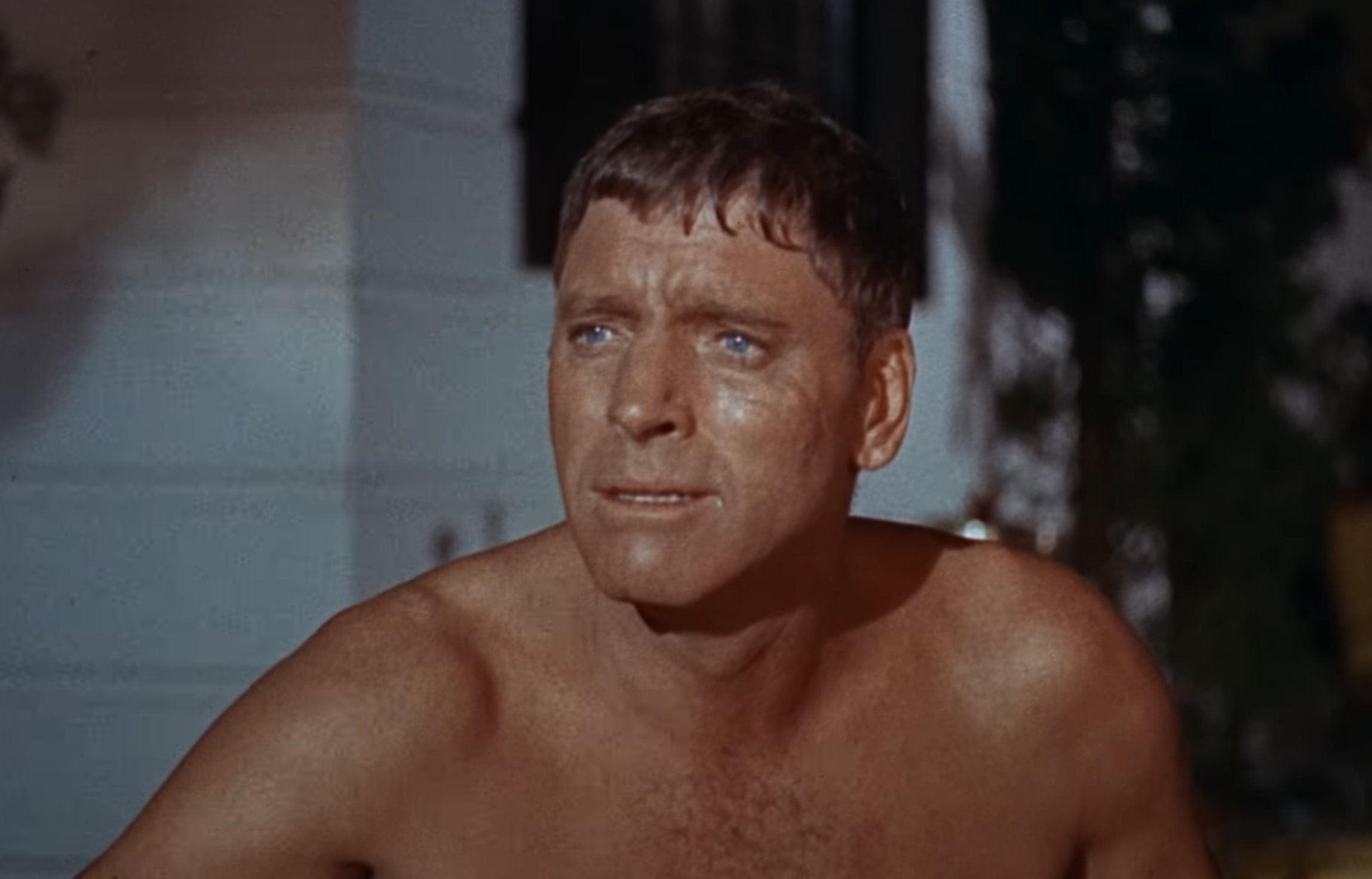
In the end, when he reaches home, what awaits him is not return, but emptiness. The American dream ends at a locked door.
"The Swimmer" is one of those somewhat forgotten films that speaks again with particular force today. Its genius lies in that balance between absurdity and tragedy. Beneath its strangeness is a precise incision straight through the heart of the modern middle class.
Because what is the suburb in this film, if not a grand architecture of denial? A place where everyone pretends to be calm, successful and satisfied. A place where problems are hidden behind fences, behind curtains.
Ned Merrill does not swim toward ruin because he strayed from the path. He swims toward ruin because he followed the map society gave him all along. And he does not swim alone; the entire middle class is sinking with him, pool by pool.
Comments