
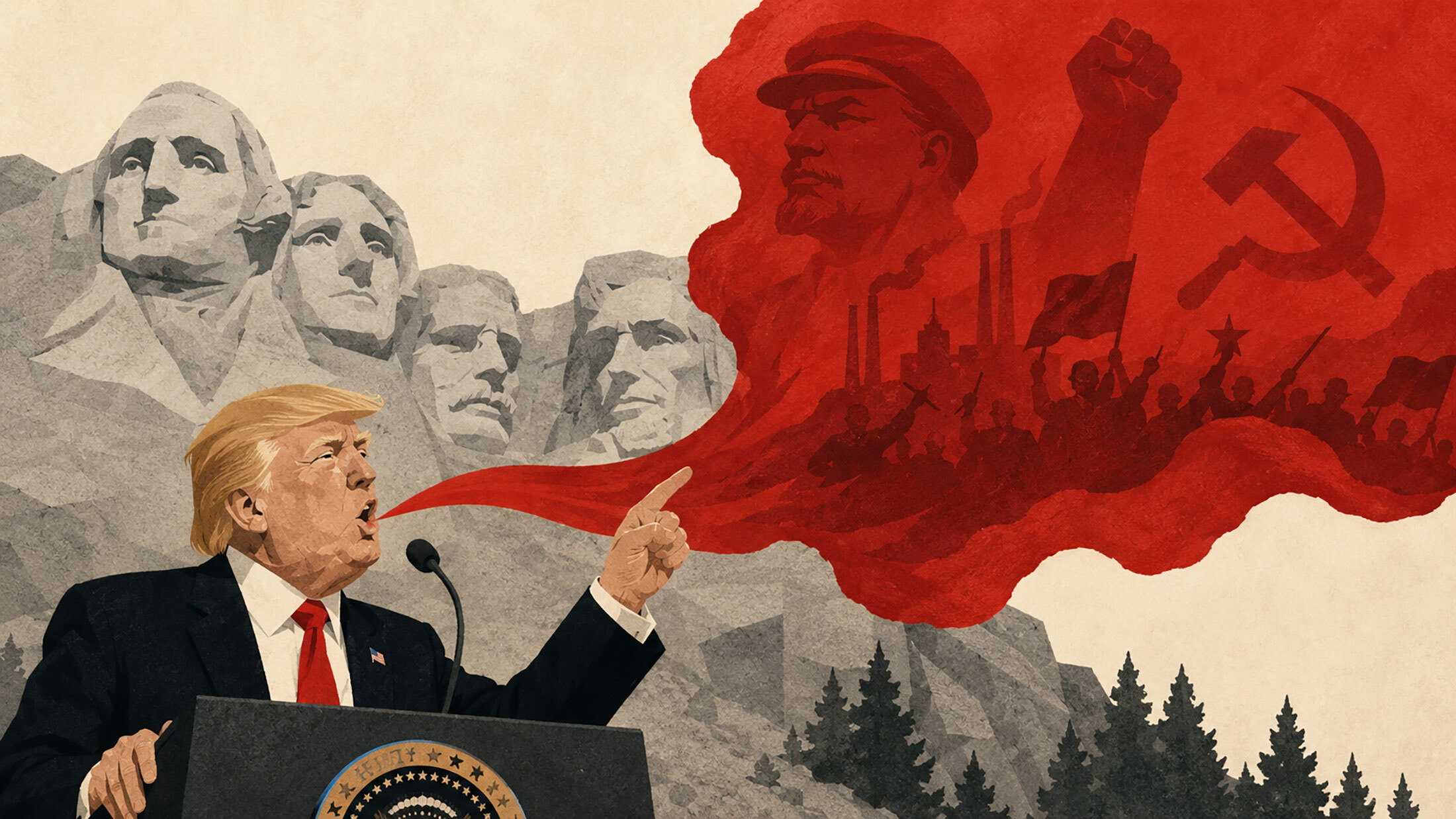
Donald Trump staged what may have been the purest form of political theater of his second presidential era at Mount Rushmore. Beneath the stone faces of Washington, Jefferson, Lincoln, and Theodore Roosevelt, against a backdrop that already suggests the monumentality of the American myth, he turned the commemoration of 250 years of independence into a speech about the enemy. America, in his telling, is the oldest republic, the most successful country in history, the freest people on Earth, a "miracle" under God, and the only civilization that has given the world so much good. In such a mythologized vision, any criticism of the order can easily become sacrilege.
The central part of the speech rested on manufacturing a threat to the present. Trump claimed that the "communist threat" is reemerging in America, including among newcomers who, he said, embrace ideas opposed to the American way of life. He immediately tied that rhetoric to migration, suggesting that communism is entering the United States as a foreign body that can be expelled across the border. It is an old American formula, from the first Red Scares to McCarthy, always useful when class discontent needs to be translated into fear of the outsider.
But where exactly does Trump see all this red, apart from the glow on his own face? And what does "communism" even mean to him?Trump went much further than the usual Republican label of "socialism." He called communism a mortal threat to American freedom, an enemy of the Constitution, and an enemy of July 4, 1776. He placed the First and Second World Wars, Pearl Harbor, and September 11 on the same emotional plane, then declared that U.S. citizens must "quickly defeat communism." He spoke of expulsion, of sending enemies away, of a gang of thieves, radicals, and lunatics that would supposedly rob the nation.
Naturally, if you ask Trump, loyalty to Karl Marx, the German philosopher and theorist of communism, and loyalty to America cannot coexist.
But where exactly does Trump see all this red, apart from the glow on his own face? And what does "communism" even mean to him?
Perhaps he means China? Although, ironically, when we talk about communism these days, actual communism, China may be the last thing that comes to mind.
In the American case, communism is an old scare tactic with a new dose of Trumpism. But it has not appeared out of nowhere, nor is it entirely disconnected from reality, even if we set aside the fact that "communism," in Trump’s vocabulary and in the broader American one, clearly does not, at least for now, mean revolutionary Marxism.
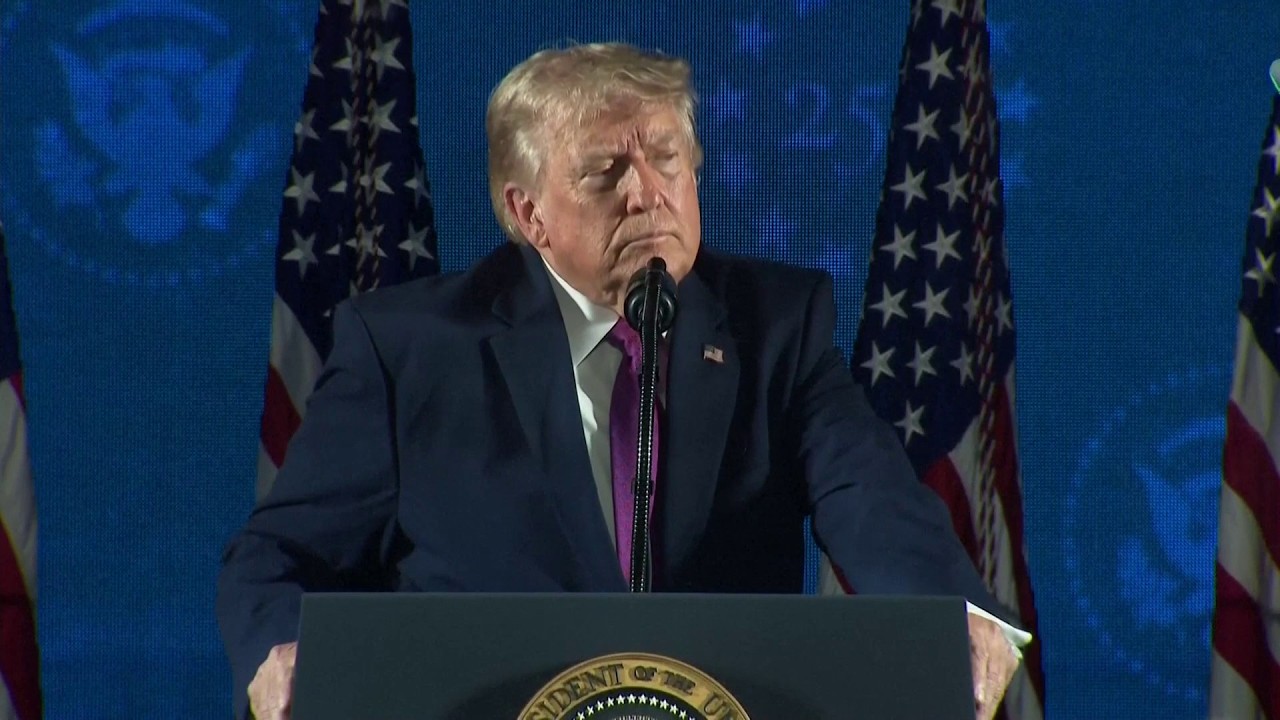
His remarks come after progressive candidates, including democratic socialists, won Democratic primaries in New York, Colorado, and several other states. And with that, the Republican strategy got itself a new poster.
Debates over food prices, housing, healthcare, energy costs, and fatigue with war are pushed aside by the image of a civilizational clash. A democratic socialist, which in European terms would be something like a somewhat more concrete social democrat, becomes a "communist"; the communist then becomes a criminal; the criminal is an immigrant; and the immigrant becomes proof that America is losing itself.
Behind this attack lies a very concrete calculation. Republicans are heading into the congressional elections burdened by inflation, high fuel prices, and the political cost of the war in the Middle East. Any campaign that stays focused on household budgets, rent, medical bills, and food prices creates space for the question of who profited during the years of crisis and why things are the way they are. That is why Trump is trying to change the subject before it becomes a class issue.
The hyper-capitalism Trump represents has reached the point of self-parody.Because America today clearly has no organized communist force capable of threatening the state order. It has no mass communist party, no revolutionary unions paralyzing industry. There is no Soviet bloc in the background, no Red Army on the horizon. What it does have are young voters burdened by debt, workers exhausted by housing costs, families buckling under medical expenses, and students who have concluded that the free market is producing less and less freedom for their generation. Trump now wants to recast them as enemies before their frustrations become a real, stable political movement.
The hyper-capitalism Trump represents has reached the point of self-parody. Wealth is presented as proof of moral worth, poverty as personal failure. Of course, America has always been like that to some extent, but never this explicitly, one might even say this vulgarly.
In that atmosphere, the return of McCarthyite rhetoric feels almost predictable. When the existing order is so thoroughly identified with wealth, every demand for redistribution is treated as an attack on the nation itself. Anti-communism functions as a protective wall around privilege, a way of pushing social demands beyond the boundaries of acceptable politics.
Perhaps the most interesting moment in the speech was Trump’s call to abolish the filibuster and immediately pass the SAVE America Act, along with his claim that Republicans would then not lose elections for the next hundred years.
And what exactly is that? In a statement that was perhaps meant to sound like a defense of democracy, a fantasy of permanent power broke through.
The exploited, instead of settling for crumbs from the table, might one day decide to break into the kitchen.Communism was accused of destroying free elections, while the president, at the same time, was dreaming of an institutional arrangement that would guarantee his party a century-long advantage. That is the logic of authoritarian capitalism.
A "communist," meanwhile, can be anyone who gets in the way: a candidate calling for universal healthcare, an undocumented migrant, an anti-ICE activist, a critic of the war in Gaza, a professor who talks about stolen land, a union organizer demanding higher wages. Such an elastic definition allows the repressive state and the media machine to always find a new target.
Trump’s obsession with communism actually says first and foremost something about the condition of American capitalism. The class he represents knows that its true natural opponent lies in a politics that puts wealth and property back on the table. That opponent has been defeated, scattered, disciplined, and suppressed for decades, but it is nevertheless slowly returning in the forms the American establishment finds hardest to tolerate: through questions that concern the very survival of workers. That is why Trump is acting preemptively.
Mount Rushmore was the perfect stage. Stone behind the president, a crowd before him, and in the speech God, guns, the Founders, Iran, Venezuela, immigrants, and communists. The entire American mythology compressed into one political logorrhea. The defense of the capitalist order is proclaimed as the defense of 1776. Trump has become such a capitalist caricature that his return to the Red Scare sounds like a confession. In the belly of America’s "golden age", one can hear the fear that those who have been exploited for decades to sustain its false shine might one day start demanding an accounting — or even, as the old, real communists would have put it, instead of settling for crumbs from the table, decide to break into the kitchen!
Sources
- Rollcall.com Protected: Factbase Transcripts https://rollcall.com/factbase/trump/transcript/donald-trump-remarks-mount-rushmore-250th-birthday-semiquincentennial-july-3-2026/
- Reuters Trump extols America, rails at communism in US 250th celebration https://www.reuters.com/world/us/trump-extols-america-rails-communism-us-250th-celebration-2026-07-04/
- Al Jazeera After progressive US primary wins, Trump takes aim at ‘godless communists’ https://www.aljazeera.com/news/2026/6/26/after-progressive-us-primary-wins-trump-takes-aim-at-godless-communists
- Axios Trump's "communist" midterm message https://www.axios.com/2026/06/27/trump-midterm-democratic-socialists
- Eisenhowerlibrary.gov McCarthyism / The "Red Scare" https://www.eisenhowerlibrary.gov/research/online-documents/mccarthyism-red-scare
- Reuters Progressive surge complicates Democrats’ midterms focus on prices | Reuters https://www.reuters.com/world/us/progressive-surge-complicates-democrats-midterms-focus-prices-2026-07-02/
Comments