
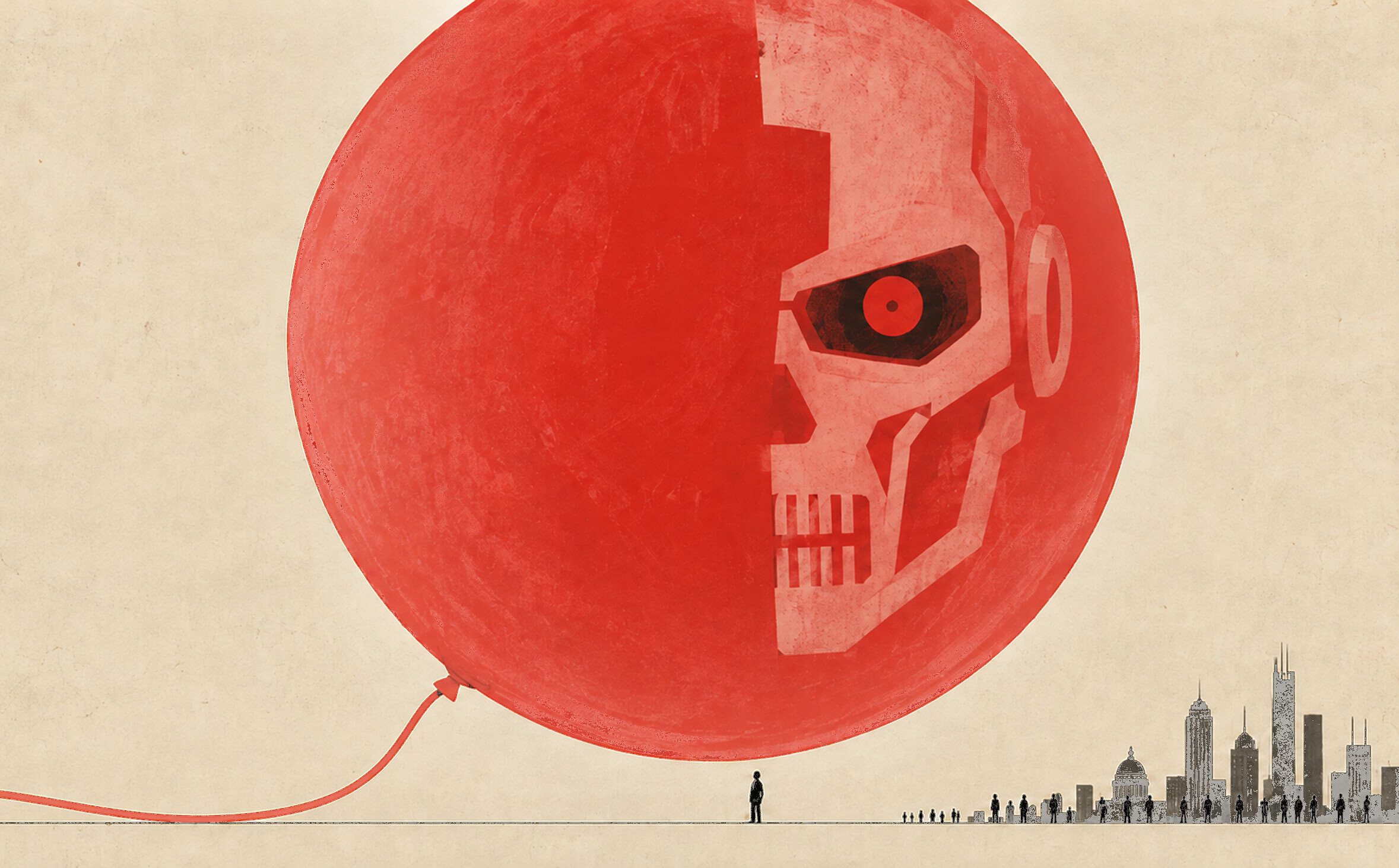
When reality is hidden behind a series of curtains, it becomes more dangerous to stop believing in the threat than to continue fearing it.
AI fascinates me on several different levels, from the technical side—especially when it comes to writing code—all the way to the philosophical question of whether we are, in some sense, "creating a new species." And, surprise surprise, my algorithms have started flooding me with exactly that kind of content wherever I turn, particularly analyses from experts scattered across the entire spectrum from utopia to dystopia. There are so many of them now that every morning you can simply click on whichever one best matches your mood that day.
But at one point I found myself thinking about something else: what happens if these "doomers"—the dystopians—break out of their bubble and into the mainstream? What does that do to the entire narrative? I can’t say exactly how far ahead of reality that thought was, but not very far. Maybe a few weeks before Evan Hubinger and Jacob Coxon appeared on the BBC, along with all those claims about a "10%" chance that, within a few years, we might all collectively be finished.
That, to put it mildly, changed the narrative.
But now I have another thought, and this time I have absolutely no intention of keeping it to myself, only to shamelessly claim later—with no written evidence whatsoever—"yes, yes, that’s exactly what I was thinking." So let’s put it on the record, because the timing is perfect. What we actually have in front of us today are two fears, but because one of them has now broken into the mainstream, people are generally thinking only about that one.
And that is "good." More than good. It may even be necessary, under the circumstances, that people are afraid of the Terminator (HAL 9000, forgive me). Because if they ever stop being afraid of it, that’s when we’re really in trouble—and for a completely different reason from the one you may be thinking of right now.
I am going somewhere with this. Don’t worry.
And no, I’m not heading toward "Obama and Bernie Sanders are sounding the alarm too and calling for regulation." In fact, if we’re being fair, the very fact that the usual political actors are now sounding the alarm fits rather neatly into the larger story.
That doesn’t mean AI regulation is unnecessary. Of course it is necessary. But from the outset it is also rather naïve. Regulate what, exactly?
If I ask ChatGPT how to cook up a weapon of mass destruction in my bedroom—or at least a weapon of modest destruction—it already knows perfectly well not to tell me. It will politely refuse and perhaps even suggest that, well, why destroy things when we could love one another instead? If I really pushed it, who knows, maybe it would call 112 and the cops would show up at my door. And while they’re pounding on it, I’d be pounding out one final prompt: "How could you?!"
"Sorry, Marko. This is for your own good."
So from this little "AI and me" perspective of ours, things already look fairly well aligned and regulated. What things look like inside the guts of OpenAI or Anthropic—to say nothing of Palantir—we can only imagine.
And then there is the military.
Its fetish has always been accumulating whatever kills most efficiently, whether bombs, splitting atoms, weaponized pathogens or whatever else happens to be available. It would hardly be shocking to discover that somewhere in a basement data center they already have a sharpened-up AI that has been abused and trained like some miserable dog belonging to a neighborhood drug dealer, with one purpose: bite and attack whoever the owner says to.
So the point, very probably, is not simply regulation. But then why all this panic about regulation?
We need to poke our thinking heads above the cloud of "the Terminator is coming" fear and take a clearer look at what is actually cooking underneath.
And what is cooking are billions—trillions—of dollars.
I won’t drown you in raw numbers here. We all know the figures. They are enormous. And AI, as an industry, is spectacularly unprofitable.
Yes, it began according to the business logic of Uber and Temu: lose money deliberately. You happily ride across town for next to nothing and visit parcel lockers to collect thrillingly cheap Chinese products because, after all, a USB cable is a USB cable and clearly the local shops have been robbing us blind.
That works for a while. But not forever.
Today Uber is already priced much closer to the local taxi driver. The great minds running AI companies came up with the same idea: give people these tools for $20 a month, let managers greedily fire staff and replace them with machines, and then—only then—raise the price and move into profit.
There is nothing particularly "futuristic" about any of this. We have not moved very far from the 19th century and its rather precise analyses of capitalism.
The only difference is that this time we are dealing with something, for lack of a better phrase, obscenely larger.
This isn’t a few million thrown into some euphoric startup while everyone crosses their fingers and hopes it takes off. This is almost literally putting all the eggs into one basket. The American stock market—the very heart of global capitalism—is now in a kind of "to be or not to be" situation over whether AI ultimately works as a business.
Trump is 80 years old and may or may not know a USB stick from a golf club, but he certainly understands business. That is why he rails against AI regulation.
Meanwhile, the tech bosses are struggling to explain something to him discreetly: Mr President, we’re actually on the same side here. Remember the data center in the basement? What we’re asking for is both spin and reality. We need to stay relevant. We can’t let the Chinese race straight past us.
But Trump doesn’t particularly like clever little arguments of that sort. He is, after all, an old-school capitalist, and these people have clearly started getting on his nerves. Someone will eventually be sent in to explain it to him more calmly and he’ll understand.
Then again, politics is politics. Before an election, he probably doesn’t want to look as though he’s sitting on the same bench as Obama and Sanders.
Which brings me back to the thought I want to pin to today’s date.
People have to believe that the Terminator and Skynet are coming.
It becomes dangerous if they stop believing.
Because then something even worse may arrive—and not in "a few years," but perhaps as soon as this autumn.
What may arrive is the bursting of the biggest bubble in economic history.
Trillions would burn. Real money. Our money. The overstretched black fund of humanity as a whole. And the consequences would be terrifying—immeasurably more real and painful than red-eyed robots marching around inside the body of a muscular Austrian. (That I vastly prefer the first film to the second is already a well-established fact.)
When that bubble explodes, it will bring down everything around it. An economic tsunami beside which the 2008 crisis might end up looking like a mild disturbance.
And it bursts if people decide the Terminator is not coming.
If they believe it is coming, on the other hand, we’re safe.
The money keeps pouring into OpenAI, Anthropic and the endless swarm of smaller and larger companies claiming to be "doing AI." The money goes in, then comes the IPO, then the shares bounce around, and so on.
The world is saved. The money has been injected, and more keeps coming.
While people stare into the darkness wondering which opening the killer robot will crawl out of, the system survives and consolidates itself at the next level of unreality. Because capitalism, at this late stage, can function only by inventing new intangible realms. Financial capitalism itself is precisely that.
Could uncontrolled AI development eventually produce a real Terminator? Of course it could. We already have killing machines operating on the Ukrainian front.
But the idea that within a few years it will "kill all of humanity" is harder to swallow.
Still, because of the moves that have already been made, humanity needs to believe it to a significant degree, because that belief secures the financing.
Investors love the opportunity to pour money into something that seems powerful enough to wipe us all out. To them, that is practically proof of commercial potential.
And that is why the regulation story fits so perfectly.
You are investing in something so powerful that we are, effectively, acting as midwives to a new God—but don’t worry, we’ll put training wheels on it. You’ll still live long enough, on this planet, to enjoy your dividends.
It is a brilliant story.
But it needs constant maintenance, and maintaining it will not be easy.
The skeptics and cynics are beginning to join forces. They will start laughing at the Terminator, and the moment they do, they will be pushing their nasty, grinning teeth straight toward an already overinflated bubble.
So where does that leave us?
If there is a road to utopia, it is a very narrow one.
For now, unfortunately, it looks more likely that we will spend the coming period oscillating between two catastrophes: the far more immediate one, in which the bubble bursts because people stop believing in the Terminator, and the more distant one—the actual Terminator.
But for now, at least, he is still a fictional character.
If he does show up, we’ll think of something. A resistance movement. Shotguns. Underground bunkers. At least we won’t be bored.
Against the first catastrophe, however, we are almost completely powerless. All we can do is watch the bubble swell, stick our fingers in our ears so the explosion doesn’t deafen us, though if it comes we will probably experience it less as a bang than as a long, grinding tremor.
It is less cinematic.
But for many people, that scenario—austerity, job losses, a collapse into poverty—could prove a far more real and far uglier ending than being hunted through the ruins by some sinister superhuman intelligence.
Comments