
Fear the Day When Young People Will No Longer Believe It's Worth Rebelling
While we build armies and intelligent machines, we expect the youth not to notice that the future we are handing to them more closely resembles a threat than a promise.
Published
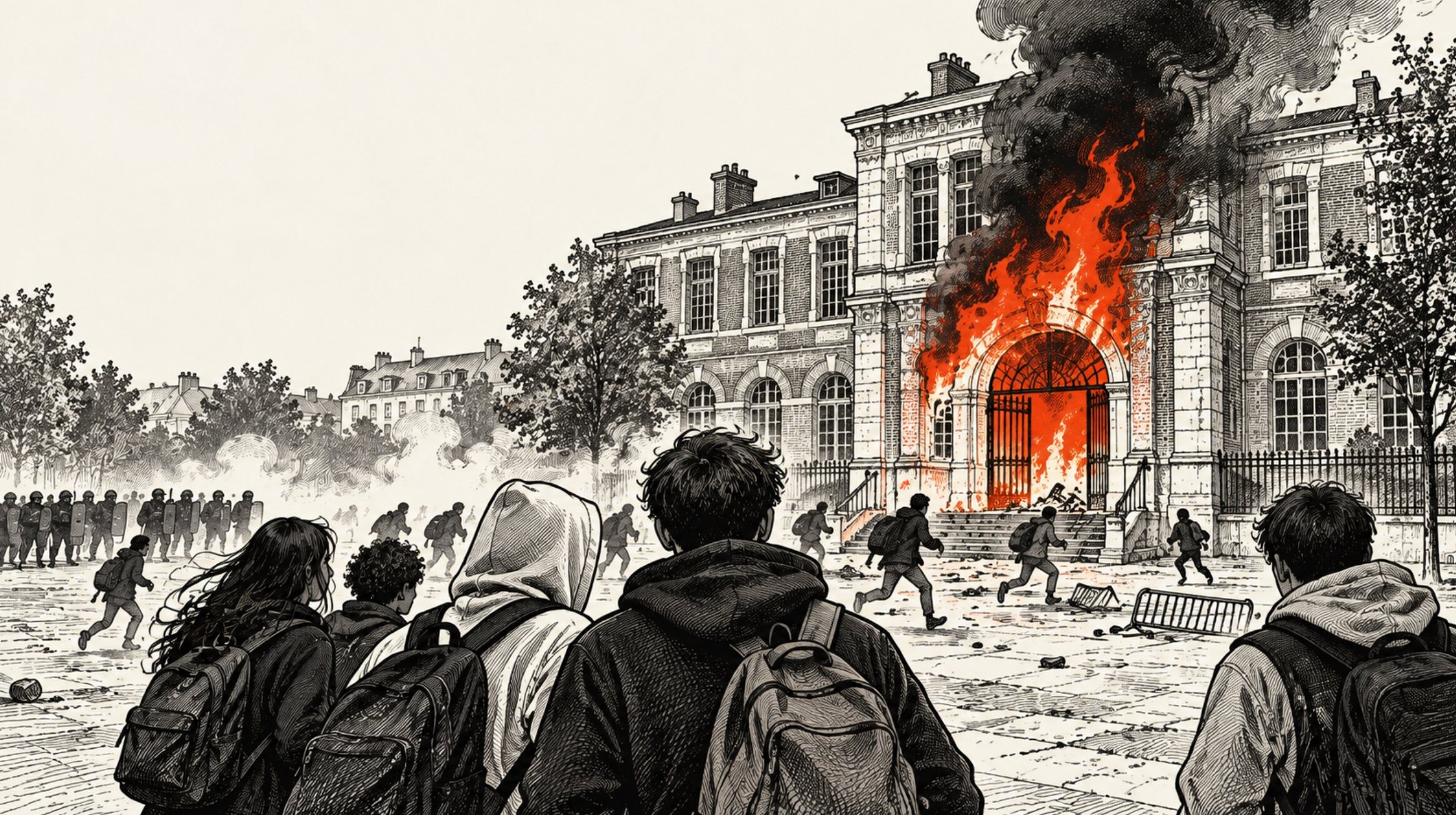
When a school is on fire, everyone suddenly becomes an expert on education. The minister will talk about public order, television and the media will replay the flames endlessly, and the public will be handed a simple, immediate moral task: be horrified. It is much harder to look at a fire that has been burning for years, without smoke or sirens.
Absolutely, the French students deserve our support. So do their very real and important demands. That does not, of course, mean supporting the burning of schools, cars or buses. A burned-down school is not a liberated school, and an injured teacher is not a symbol of revolution. But condemning violence is not the same thing as understanding what happened. Around 400 French educational institutions remained closed after protests triggered by shortages of substitute teachers, deteriorating buildings and poor conditions. Violence did break out, as it so often does in France, but it is neither the entire movement nor the whole story.
Blaming an agitator is cheaper than fixing a school
The French authorities have already reached for a familiar explanation. There is a violent minority, some of its members may not even be students, and the so-called "radical left" may be behind it all. Perhaps there really are organised groups taking advantage of the protests. Political parties rarely miss an opportunity to climb aboard someone else’s anger and then claim they invented it. But a provocateur can set fire to a rubbish bin. They cannot invent the teacher who has been missing for months, the wall that is falling apart, or the feeling that children from poorer neighbourhoods have long been treated as a budgetary inconvenience.
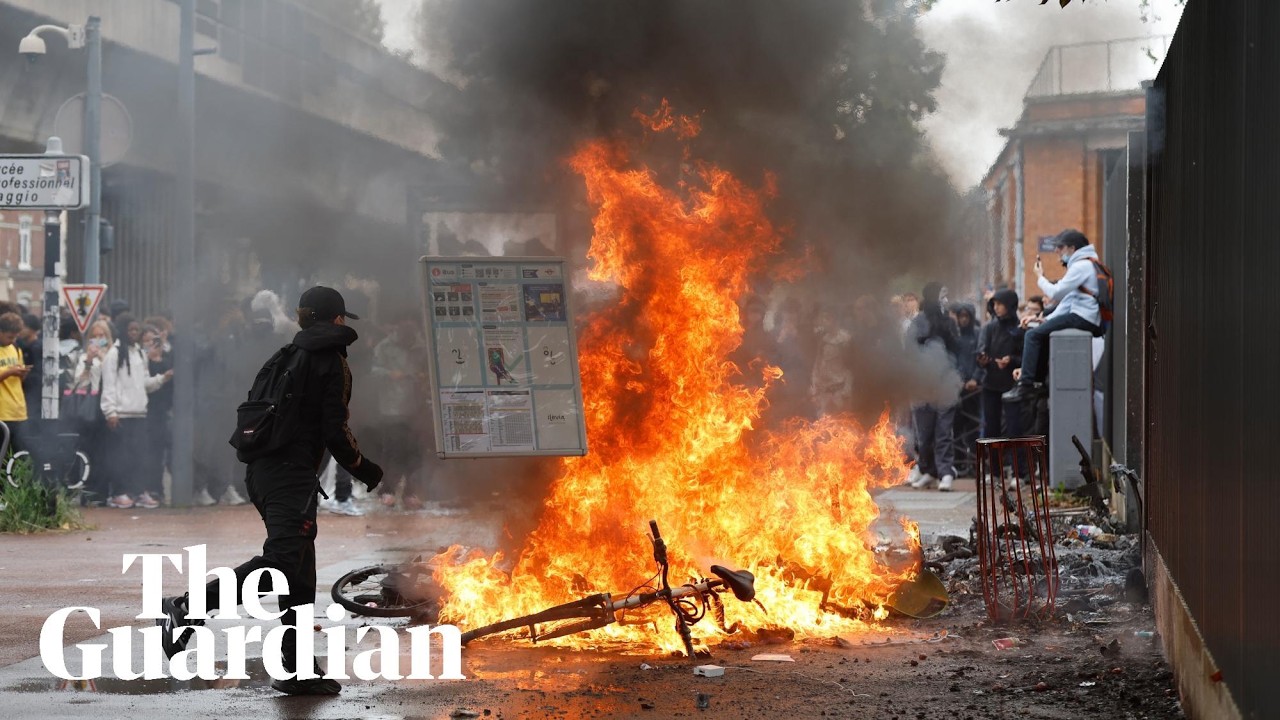
Blaming an agitator is much cheaper than fixing a school. Once a social problem is translated into the language of public order, the solution becomes wonderfully simple. More police, more cameras, more arrests. The Ministry of Education can temporarily behave like a branch office of the Interior Ministry, while the question of why students took to the streets disappears behind the question of who threw the first stone.
What are the students actually demanding?
The protesters’ demands are remarkably concrete: urgently filling vacant teaching posts and providing substitutes, reducing class sizes, renovating deteriorating school buildings, and investing more in teaching and support staff. They are also calling for more humane timetables, better conditions during periods of extreme heat, and equal educational opportunities for students from poorer suburbs and wealthier parts of the cities. Some student organisations are also demanding a fundamental reform, or outright abolition, of Parcoursup, the opaque university admissions system that adds another layer of uncertainty to students’ lives.A generation educated about the disasters waiting for it
They are expected to become outstanding candidates for a world that may soon stop advertising vacancies altogether.And yet French students are not rebelling only against crumbling buildings. Behind their concrete demands lies a much broader anxiety felt by an entire generation to whom adults no longer know how to describe a desirable future. We tell them to study because education is "the most important investment," while American technology corporations build AI systems whose central commercial promise is to replace human beings. We ask them to plan their lives decades in advance while simultaneously offering them a future made up of ecological disasters, precarious work and ever louder preparations for another major war.
Perhaps no generation before them has been so thoroughly educated about the catastrophes awaiting it. They know what rising sea levels look like, what an AI-powered kamikaze drone can do, and how quickly an algorithm can take over an entry-level job. What nobody can convincingly explain is where they fit into that future. They are expected to become outstanding candidates for a world that may soon stop advertising vacancies altogether.
A school for the literate, disciplined and loyal subject
And this brings us to the uncomfortable question of school itself. Some will tell you that the modern education system was created in imperial Germany to produce obedient workers. The history is somewhat more complicated, though not much more comforting. Important roots of state-run mass education reach back to the Prussia of Frederick the Great, whose General School Regulations were introduced in 1763, more than a century before the German Empire was founded. The objective was not merely to produce workers. Above all, the state needed a literate, disciplined and loyal subject.
American political scientist Agustina Paglayan has shown in her research on the spread of mass education that governments often expanded schooling after rebellions and periods of social unrest. School was not simply a place for transmitting knowledge, but also for teaching obedience, respect for the law and acceptance of the existing order. Democracy, equality and social mobility often arrived later, if they were invited at all.
That does not mean public education is one great conspiracy against the free mind. It brought literacy to millions of people, opened doors that had previously been reserved for the wealthy, and allowed children to escape lives that had once been predetermined by birth. That is precisely why its failures today are so painful. Curricula have changed, yet the deep grammar of schooling has proved remarkably resistant. The same rhythm for everyone, a bell that interrupts thought, a grade delivered like a verdict, and the reproduction of content as the main proof that learning has taken place.
School was not designed as a copy of the factory, but educational and industrial discipline quickly recognised themselves in each other. The body must be in the right place at the right time. The task must be completed according to instructions. Authority asks the question, and the subordinate is expected to produce the answer that authority already knows. Such a system can produce excellent students. It is much less capable of recognising a child who thinks differently.
An uninterested student therefore easily becomes a "bad student." Their boredom is treated as a character flaw, although sometimes it may actually be feedback about what we are offering them. Of course school cannot turn every lesson into a spectacle, nor can children learn only what already interests them. But there is an enormous difference between the discipline required for learning and a system that has turned indifference to learning into the normal state of affairs.
Perhaps nowhere is this clearer than in the way literature is taught. A student is asked who said what, when a certain character appeared, and through questions like these we try to establish whether the book was really read. Much less often do we ask whether the book disturbed them, changed them, or forced them to see the world through someone else’s eyes. The system checks whether the student has stored the book in memory. It almost seems impolite to ask whether the book has entered the student. According to the 2025 PISA results, as many as 26 percent of French students said school had been a waste of time, compared with an OECD average of four percent. That does not prove they learned nothing there. It shows that school failed to explain why what they were learning deserved their time.
The teacher as educator, psychologist, administrator and security guard
If an algorithm can solve the assignment effortlessly, perhaps the problem is not only the student who cheats. Perhaps the problem is also an assignment that never required genuine thought in the first place.Teachers, meanwhile, are not the students’ adversaries. More often than not, they are the first victims of the same system. They are expected to be educators, psychologists, administrators and, increasingly, security guards, often all within the same lesson. Digitalisation has not necessarily given them their time back. In many cases it has merely moved paper bureaucracy onto a screen and added a password that must be changed every three months. The more technologically capable among them will soon hire ChatGPT to fill out mandatory forms that nobody reads anyway. That will not be laziness, but a perfectly rational form of self-defence against an institution that sometimes values a correctly entered data field more highly than a conversation with a child.
The greatest irony is AI itself. Schools worry that students will use machines to write essays, but rarely ask why they are assigning essays that a machine can produce convincingly in a matter of seconds. If an algorithm can solve the assignment effortlessly, perhaps the problem is not only the student who cheats. Perhaps the problem is also an assignment that never required genuine thought in the first place.
None of this means education is becoming unnecessary. Quite the opposite: in a world of artificial intelligence, it becomes even more important. It simply cannot continue to be based on imitating a database. Children need to learn how to verify a claim, recognise manipulation and change their minds when better evidence appears. They need to learn how to speak, how to listen intelligently, and how to create something that is more than the statistically most likely continuation of the previous sentence.
Nor is STEM a magic word capable of blessing every outdated curriculum. Science, technology and mathematics will be crucial, but if we sell them merely as a ticket to secure employment, AI is already voiding the guarantee in the small print. Tomorrow’s engineer will need philosophy to understand the consequences of what they build. A programmer will need history to recognise an old ideology hiding inside new code. Everyone will need the ability to remain human in an environment that will constantly encourage them to outsource their thinking to machines.
A society defending an empty fortress
And then there is militarisation. Perhaps defence is necessary. The world did not become harmless simply because we would rather spend money on libraries. But a budget is always a moral document as well. A continent that can rapidly summon political urgency for tanks, drones and air defence, while endlessly searching for "fiscal space" to provide smaller classes and substitute teachers, is sending young people a very precise message about its priorities. A society capable of defending its borders but incapable of offering a future ultimately finds itself defending an empty fortress.
So let us imagine the schools of the future, except in the present. Smaller classes in which the adult at the front actually knows the children sitting before them. Teachers who are well paid and freed from bureaucracy masquerading as accountability. A school that does not force a choice between technology and the arts, but shows why human beings need both. A school that develops practical independence, intellectual scepticism and emotional resilience. Not as three more subjects and six new forms to complete, but as an entirely different idea of what it means to be an educated human being.
Freinet’s classroom without the school machine
Célestin Freinet returned from the First World War with a severe lung injury. When he began working as a teacher in the Provençal village of Le Bar-sur-Loup in 1920, long lectures were physically difficult for him. Rather than trying to control the classroom by speaking louder, he began changing the distribution of voices inside it. He took children on walks and observation trips, then turned their experiences into texts that the class edited together. School content no longer always had to descend from above. It could begin with something a student had seen, wondered about or considered worth writing down.The decisive tool was a small printing press that Freinet acquired in the 1920s. Students set lead type, printed class newspapers and exchanged their texts with other schools. This was not merely a charming precursor to the school blog. Suddenly a text had a real reader, which gave spelling, clarity and fact-checking a purpose entirely different from earning a grade. At the same time, the children were learning technical skills, language, cooperation and responsibility for something that would leave the classroom with their names attached to it.
Freinet’s pedagogy did not abolish work or demanding standards. He called it education through work and organised it around cooperation, independent tasks and collective decision-making. Its radicalism lay in refusing to imagine the student as an empty vessel and the teacher as a talking machine. A century before generative artificial intelligence, Freinet offered a simple test of a good assignment: a child should produce something that has meaning beyond proving that they followed instructions.
In a paradoxical turn, French students may now be holding one of their most powerful lessons in citizenship outside the locked doors of their schools. They are learning how to organise, how to speak in their own name, and how to turn individual frustration into a collective demand. A violent minority can rob them of legitimacy, just as the state can try to rob them of their voice by reducing the entire movement to that minority. Both should be rejected.
French students have changed politics before
French secondary-school students did not discover yesterday that they could become political actors. The first comités d’action lycéens, or secondary-school action committees, emerged in late 1967 out of campaigns against the Vietnam War and school rules that treated young people as subjects without a voice. In May 1968, they operated in hundreds of occupied schools, worked alongside university students and workers, and published their own newspapers. The uprising did not stop at the university gates: for the first time, French secondary-school students had an organised voice that did not speak through parents, teachers or political parties.That pattern returned in different forms. In 1986, secondary-school coordinating groups joined the mass mobilisation against the Devaquet university reform. The legislation was withdrawn after enormous protests and the death of Malik Oussekine, a student beaten by police officers. Students mobilised again in 1990 to demand safer schools and greater funding, and in 2005 against the Fillon education reforms. The following year, they became an important part of the wider movement against the CPE, an employment contract that would have made it easier for employers to dismiss young workers during their first two years on the job. Dominique de Villepin’s government eventually withdrew it.
None of this history means that every student demand is automatically justified or that a blockade automatically becomes a democratic act. It shows something simpler: French students are not merely spectators of education policy. When adults make decisions about their schools, their examinations and their future employment, students periodically organise themselves as a group with interests of their own and their own repertoire of political action. In a country that claims to take civic education seriously, perhaps it should not be surprising when young people occasionally decide to practise it outside the classroom.
We older people like to grant the young permission to rebel, provided their rebellion is quiet, orderly and over before the rush hour begins. We recognise anger only once it no longer inconveniences anyone. But by then it is no longer anger. It is an extracurricular activity approved by the headteacher.
There is no need to romanticise the fire. We should ask why we ignored the smoke for so long. We have failed young people by leaving them schools from the past, threats from the future and very little of the present that truly belongs to them. So we should not be surprised that they are angry. We should be surprised that we expected them to remain silent for so long — and fear the day when they no longer believe that even rebellion is worth the effort.
Sources
- Reuters Students and police clash as France struggles to quell school protests https://www.reuters.com/world/about-400-french-schools-closed-some-student-protests-turn-violent-2026-10-02/
- Le Monde High school protests spread across France, pitting radical left against government https://www.lemonde.fr/en/france/article/2026/09/29/high-school-protests-spread-across-france-pitting-radical-left-against-government_6758067_7.html
- OECD PISA 2025 Results (Volume I) – Country Notes: France https://www.oecd.org/content/dam/oecd/en/publications/reports/2026/09/pisa-2025-results-volume-i-country-notes_88d1164e/france_69779694/6d229453-en.pdf
- German History in Documents and Images Frederick the Great, Compulsory Education Decree (1763) https://germanhistorydocs.org/en/the-holy-roman-empire-1648-1815/friedrich-der-grosse-koeniglich-preussisches-general-land-schul-reglement-1763
- IDEAS/RePEc Education or Indoctrination? The Violent Origins of Public School Systems in an Era of State-Building https://ideas.repec.org/a/cup/apsrev/v116y2022i4p1242-1257_6.html
- International Labour Organization Generative AI and jobs: A 2025 update https://www.ilo.org/publications/generative-ai-and-jobs-2025-update
- V. O. Sukhomlynskyi State Scientific and Educational Library of Ukraine Freinet, Célestin https://dnpb.gov.ua/en/outstanding-teachers/freinet-celestin/
- Persée Le lycéen, nouvel acteur collectif de la fin du XXe siècle https://www.persee.fr/doc/inrp_0000-0000_2005_act_28_1_9262
Comments