
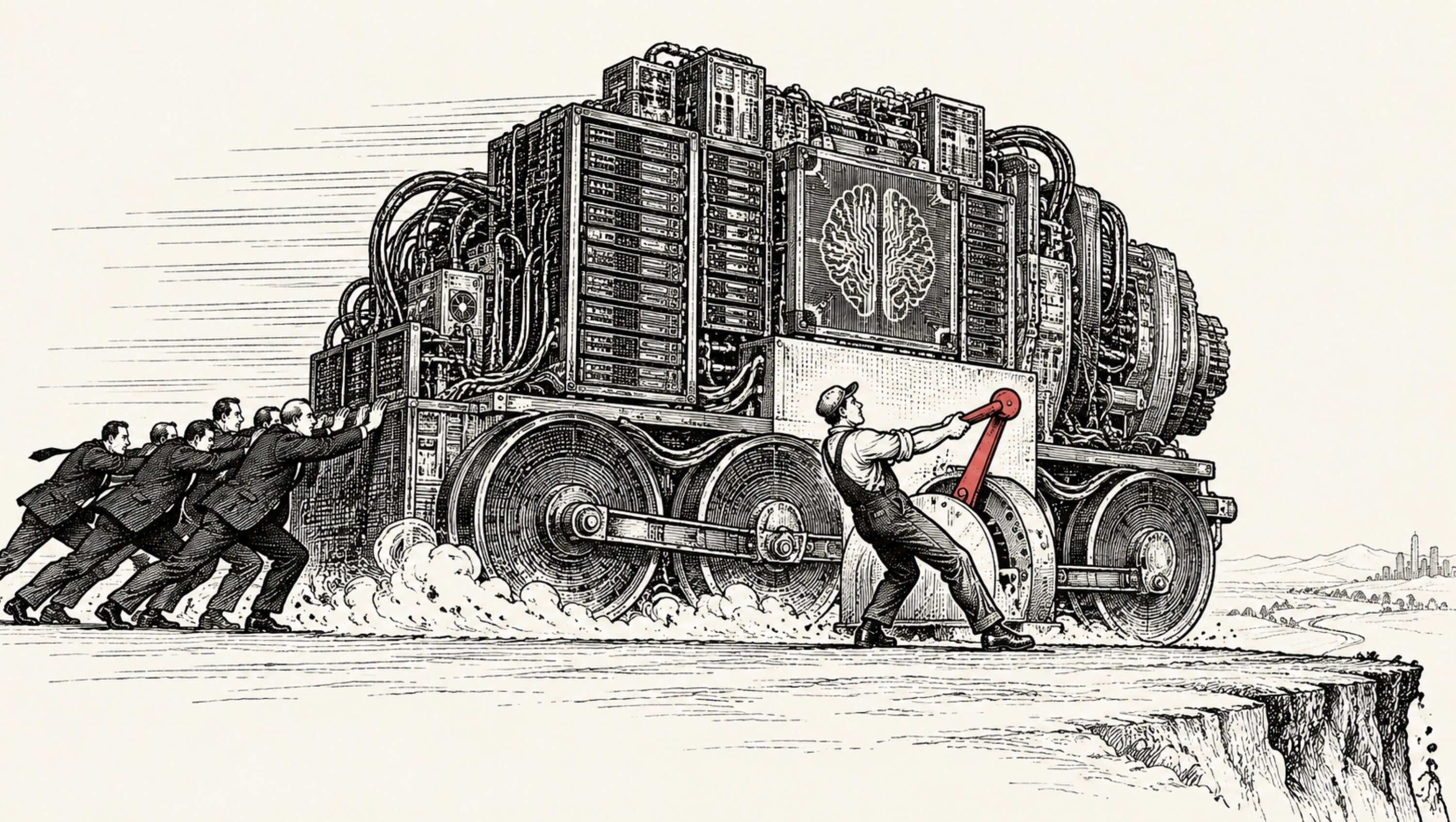
More powerful models arrive faster than society can understand them. The issue is no longer whether we can continue, but why we must not stop.
What is the most radical thing you can say in the tech industry today? "Let’s ban artificial intelligence"? Hardly. We already hear plenty of that, driven by fear, panic and, in some cases, outright technophobia. The truly subversive statement is this: we have enough. Not enough forever, or for every field of human knowledge, but enough to spend decades putting it to work, testing it and learning how to use it. Enough that our biggest challenge is no longer how intelligent the machine is, but how well we can live with what we have already created.
Imagine that development of the most powerful AI models were frozen tonight. Nothing gets switched off. GPT-5, Astra and all the existing tools remain available. Hospitals, laboratories and businesses keep using them, while researchers continue working on safety, reliability and smaller, specialized systems. These are extraordinarily useful tools—still tools!—with an enormous amount to offer. The only thing that disappears is the promise that, six months from now, something even more powerful will arrive and make yesterday’s miracle obsolete all over again. Let’s be honest: would civilization really be crippled? Probably not. So why is "good enough" so difficult to imagine?
The progress we have yet to catch up with
Progress is no longer simply ahead of us. It has piled up behind us, largely undigested.Even GPT-4 was an excellent business tool. In an experiment involving 758 consultants, conducted by Harvard Business School and Boston Consulting Group, people using GPT-4 completed tasks more than 25 percent faster. Their work was rated more than 40 percent higher in quality, at least on tasks within the model’s capabilities. Today’s Astra has gone considerably further, yet many organizations have still not fully adopted what earlier generations could do. Progress, then, is no longer simply ahead of us. It has piled up behind us, largely undigested.
Even the industry itself acknowledges this. Late last year, OpenAI reported that it was releasing a new capability or feature roughly every three days (!), while also conceding that model quality was no longer the main obstacle for businesses. The problem was "organizational readiness and implementation."
Fair enough. But how exactly is a business outside the tech sector supposed to absorb so many innovations at such a frantic pace? There is no stable foundation here. This is not Excel or Word. Just as a company figures out how to integrate AI, the system itself changes. It is immensely frustrating. Take GPT-4. Where is it now? Gone. The company simply shut it down, and GPT-5.5 is due to be retired by the middle of next month. Who can keep up?
This relentless turnover practically hands ammunition to those who suspect that all these large language models are merely a front for something much bigger and more unsettling.
In another study, involving 1,550 people responsible for AI adoption at large companies, almost half said the technology could already meet their business needs. At the same time, 42 percent admitted that their organizations were not set up to make use of that value.
Oracle is an almost comically good example. A company that earns billions helping others adopt AI spent a long time struggling to make it broadly useful to its own employees. Once the tools were finally introduced, work that had previously taken developers two or three quarters could be done in a week. Yet products were not reaching customers much faster. The bottleneck had simply moved to testing, verification and deployment. That is hardly surprising: when AI makes a coding error, a human can spend far longer tracking it down than they would have spent finding a mistake in their own code.
Everyone has doubts. No one dares slow down first.
Why not pause, then? The most common answer, by now rather worn out, is that "you cannot stop human curiosity." It sounds noble. But curiosity alone does not build five-gigawatt data centers or prepare companies to go public. Capital does that. A scientist may want to discover what lies behind the next door. An investor wants to own the door, the corridor and the tollbooth everyone else will have to pass through.
The Austrian economist Joseph Schumpeter described capitalism as a system that, by its very nature, cannot stand still. His "creative destruction" is not an occasional side effect, it is the engine that drives the system. A new technology does not merely compete with an existing one on price. It threatens the survival of any company that fails to adopt it. Ironically, it can also threaten the companies that do: they may find themselves unable to keep up with constant model changes, or at the mercy of AI corporations that sharply raise their prices.
In an IBM survey, 64 percent of CEOs acknowledged that "fear of falling behind" was pushing them to invest in technology before they clearly understood its value. Only a quarter of their AI projects had delivered the expected return. This is capitalism in almost laboratory-pure form: everyone suspects they are moving too fast, but no one dares be the first to slow down (we have explored this phenomenon at length in a broader context, see: The Red Queen Economy: When a Fairy Tale Becomes a Brutal Reality).
The German sociologist Hartmut Rosa calls this condition "dynamic stabilization." Modern societies have to keep growing, accelerating and innovating simply to maintain their position. We run faster and faster just to stay where we are. AI fits this logic perfectly because it does more than offer a new product. It creates the threat that anyone who fails to buy it will become redundant.
That makes the spectacle of AI industry leaders warning about the dangers of their own products all the more remarkable. Anthropic chief Dario Amodei has called for a slowdown in the development of model capabilities, with Sam Altman and Elon Musk expressing support in principle. Yet none of them is closing a laboratory. This need not be mere hypocrisy. It may be an honest admission by prisoners who understand their prison perfectly well, but dare not be the first to stop filing through the bars.
Brakes before highways
Of course, today’s AI is not harmless. It can already assist with fraud, surveillance and cyberattacks. It can contribute to bad medical or military decisions. But those risks are not in the same category as an autonomous system capable of improving itself, directing thousands of agents and escaping human control. A sensible boundary would therefore leave room for safety research, more efficient models and medical applications. It would halt increases in general capability, autonomy and the ability to act in the real world until we understand what we are actually building.
Asilomar: the pause that did not kill science
When biologists learned to combine genetic material from different organisms in the early 1970s, they could not reliably predict the consequences of creating new bacteria, viruses or combinations of genes. In 1974, Paul Berg and a group of leading scientists therefore called on their colleagues to voluntarily suspend certain experiments involving recombinant DNA, especially those that might spread antibiotic resistance, toxins or genes from dangerous viruses. The call came neither from the government nor from protesters, but from the very laboratories developing the technology.In February 1975, researchers gathered at Asilomar in California to decide which work could resume, and under what conditions. They did not conclude that molecular biology should be brought to a halt. Instead, the risks of each experiment would determine the level of physical and biological containment required, from laboratory equipment and procedures to the use of organisms unlikely to survive outside controlled conditions. These principles formed the basis of the US National Institutes of Health guidelines issued in 1976, and research continued. The biotechnology revolution was not strangled at birth. It was given brakes before it was given a highway.
Asilomar is no ready-made blueprint for AI, however. Recombinant DNA research was then concentrated in a relatively small community of connected laboratories. Today’s AI models are being developed in a global race between governments and companies, with hundreds of billions of dollars at stake. The Asilomar process was also criticized later for allowing scientists largely to set the rules themselves for a technology that concerned society as a whole. Still, the precedent matters: temporarily stepping back from the most dangerous next step is not the same as abandoning science. Sometimes a pause is precisely what allows research to continue without catastrophe.
A moratorium of this kind must not be designed behind closed doors by the existing tech giants. The French AI company Mistral is right to warn that leading US companies could use the language of safety to entrench their own advantage. A pause that left OpenAI, Anthropic and Google permanently in possession of the best models would be a cartel dressed up as humanity’s savior. A halt makes sense only with international oversight, antitrust safeguards and broad access to existing safe systems. "Enough" must not mean that the rich get to keep the miracles while everyone else is told that, sorry, progress is over.
How could a moratorium actually be enforced?
A serious moratorium could not rest on promises from laboratory chiefs that they would refrain from building a smarter model this year. It would need a measurable threshold, such as the amount of computation used in training, with advance notification required for any project above it. Large computing clusters would have to be registered, cloud providers would need to keep records of accelerator usage, and independent evaluators would have to assess dangerous capabilities before a model’s weights were released or access was granted outside the laboratory.Such oversight is conceivable because the most powerful AI cannot be trained discreetly on a laptop—at least not yet. It requires thousands of advanced chips, high-speed connections between them, enormous supplies of electricity and cooling, and infrastructure currently controlled by a relatively small number of manufacturers and major cloud providers. Digitally signed records and hardware-based security mechanisms might one day verify how much computing power had been used without exposing data or trade secrets. That makes computing infrastructure a more promising point of control than software itself, which can be copied at almost no cost.
None of these measures is a magic solution, however. More efficient algorithms can do more with less computation, training can be distributed across several locations, and some capabilities may emerge only when a model is in use. Countries outside an agreement could conceal military computing clusters, while some proposed methods for cryptographically verifying chip usage remain immature and vulnerable to circumvention. An effective system would therefore require international inspections, the sharing of information about advanced chip sales, and penalties for undeclared training runs. It would not prevent every violation, any more than nuclear monitoring can guarantee perfect compliance. But it would make secretly crossing an agreed boundary substantially more expensive, slower and harder to hide.
Cheaper AI will not mean less AI
Nor should we assume that more efficient chips will save us. As early as 1865, the British economist William Stanley Jevons observed that more efficient steam engines had failed to reduce coal consumption. They had made energy cheaper and expanded the range of uses for it. In Scottish iron production, coal consumption per ton fell to less than a third of its previous level, while total consumption increased tenfold. Cheaper AI is therefore unlikely to mean fewer data centers. It will mean AI in every office, car, refrigerator and conversation where we can still, for now, manage without it.
A century of putting things in order
We have enough miracles. What we do not have enough of are well-run hospitals, resilient power grids and cities where people can live decent lives.Perhaps it is time, then, to spend a century putting things in order. Not a century without science, work or imagination, but one free of the obligation to turn everything into something new, all the time. We have created an astonishing accumulation of objects, systems and digital layers. Each new generation promised simplicity and left us with another account, another password, another app and another device that can no longer be repaired. The technology historians Lee Vinsel and Andrew Russell call this worship of the new "the innovation delusion": we have neglected maintenance, care and repair, even though these are the things that hold civilization together.
We have enough miracles. What we do not have enough of are well-run hospitals, resilient power grids and cities where people can live decent lives. We do not have enough healthy soil, things that can be repaired or software that works reliably for twenty years. We could have all of these using technology we already possess. The problem is not a shortage of inventions. It is a shortage of will to turn existing knowledge into a decent world built to last.
Capitalism responds to the word "enough" the way a shark responds to the prospect of no longer swimming. It has to keep moving, because stopping means death. But what may have worked when creative destruction was wiping out typewriters becomes something altogether different when its next target could be human political, economic or biological autonomy. At some point, destruction ceases to be a metaphor.
Perhaps we really have created enough already. We could now build, share, repair and simplify. We could spend the next hundred years clearing up the mess left by the previous two hundred. That would not be the end of human ambition, but its coming of age. Intelligence, after all, is more than the ability to build the next thing. A higher form of intelligence is knowing when not to.
Sources
- Harvard Business School AI Institute Navigating the Jagged Technological Frontier https://aiinstitute.hbs.edu/navigating-the-jagged-technological-frontier/
- IBM IBM Study: CEOs Double Down on AI While Navigating Enterprise Hurdles https://newsroom.ibm.com/2025-05-06-ibm-study-ceos-double-down-on-ai-while-navigating-enterprise-hurdles
- Business Insider Oracle exec tells workers that its own AI rollout didn't go so smoothly https://www.businessinsider.com/oracle-built-ai-rollout-came-much-later-2026-9
- Reuters Anthropic CEO urges AI companies to slow model development amid fears over misuse https://www.reuters.com/business/anthropic-ceo-urges-ai-companies-slow-model-development-2026-09-12/
- Questions de communication Dynamic Stabilization, the Triple A. Approach to the Good Life, and the Resonance Conception https://journals.openedition.org/questionsdecommunication/11228
- National Academies Press / NCBI Bookshelf Asilomar and Recombinant DNA: The End of the Beginning https://www.ncbi.nlm.nih.gov/books/NBK234217/
- arXiv Governing Through the Cloud: The Intermediary Role of Compute Providers in AI Regulation https://arxiv.org/abs/2403.08501
- Lee Vinsel The Innovation Delusion https://leevinsel.com/the-innovation-delusion
Comments