
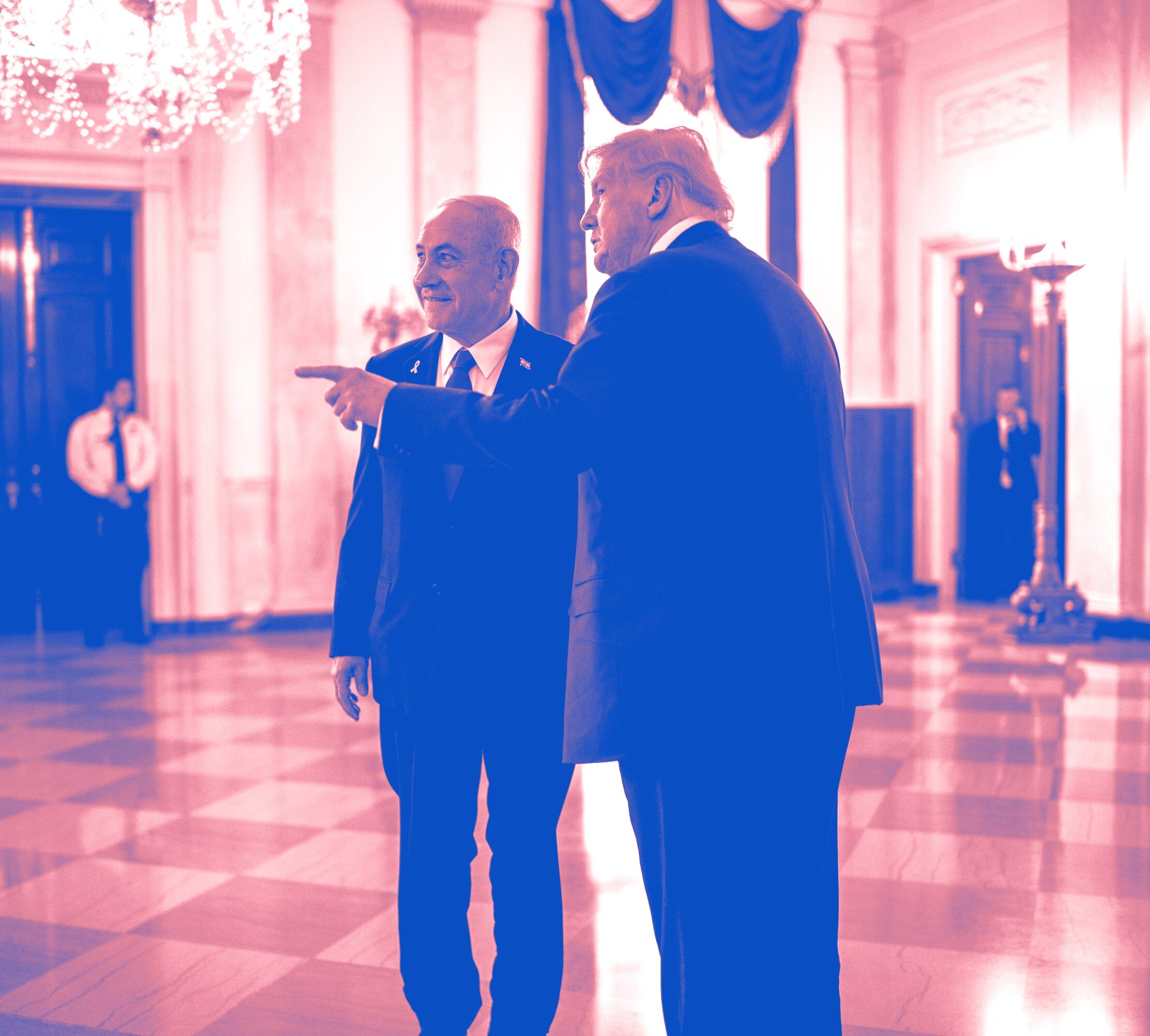
It would make sense for the two leaders of a failed war adventure to turn on each other. But it would also make sense for them to stage it.
Is Trump fighting with Netanyahu? That is what new media reports claim. But, is he really? Well, he should be at least "a little angry", because it is not every day that someone manages to lead the world’s greatest military power into an almost impossible and inescapable situation. It is not as if Trump needed much convincing, but Netanyahu managed it. The only thing he did not manage was to turn what he himself calls a "40-year dream" into something concrete.
The two of them entered into a criminal adventure and got stuck. One would therefore expect them to be angry with each other, with accusations flying over who is to blame for this fiasco. Maybe. Maybe not. Because real quarrels can offer some answers, but staged quarrels can offer even more.
Let us look at the situation. According to a report by Axios, Donald Trump and Benjamin Netanyahu had a "difficult" phone call after what is said to be a new initiative for a deal with Iran, shaped through mediation by Qatar and Pakistan, with the participation of other regional actors. At the center of the proposal is the idea that the U.S. and Iran would sign some kind of "letter of intent", formally opening space for an end to the war and 30 days of negotiations on Iran’s nuclear program, the Strait of Hormuz, and the unfreezing of Iranian funds. One source told Axios, rather vividly, that Netanyahu was in a state of near-panic after the call.
Such information should be read with considerable caution. What is presented as a quarrel may be a real clash of interests, but it may also be a controlled leak, diplomatic theater, or a psychological operation aimed at Tehran. If Iran believes that a serious rift is opening between Washington and Israel, it could misjudge American intentions, accept a certain easing of pressure, or conclude that the danger of a new strike is smaller than it really is. In such a scenario, this alleged tension between Trump and Netanyahu would not be a weakness of the alliance, but one of its instruments.
Trump, meanwhile, sent, as usual, an ambiguous message. On the one hand, he says a deal with Iran can still be reached. On the other, he openly warns that the war could resume very quickly if Washington does not get the "right answer". Even more interesting is his claim that Netanyahu will do whatever he, Trump, wants on Iran. That claim may look like Trump demonstrating authority over the Israeli prime minister, but it may also be an attempt to show the American public that Israel is not the one directing U.S. policy toward Iran.
That would make sense, because Trump has surely heard that his former supporters are now saying his new slogan is not MAGA, but MIGA — Make Israel Great Again.
From Israel’s perspective, the problem lies even in the very fact that Washington is talking to Tehran.Still, let us take the other possibility as well: that the quarrel may not be only a performance. Netanyahu, of course, has a very concrete reason to be dissatisfied with any American-Iranian agreement. Israel’s strategy toward Iran has for years rested on the conviction that Tehran must not be allowed any political breathing room, financial recovery, or international legitimization. A deal that would include the unfreezing of Iranian funds, an end to the war, talks on Hormuz, and a new round of negotiations on the nuclear program would be a pure geopolitical defeat for Israel.
From Israel’s perspective, the problem lies even in the very fact that Washington is talking to Tehran. If the Obama-era agreement, reached in 2015 and implemented from January 2016, was perceived as an "unacceptable concession" to Iran, then today’s deal, after a war, would certainly be even worse for Israeli interests.
That is why Netanyahu, according to the Axios report, wants "continued military pressure in order to further degrade Iran’s military capabilities and weaken the government in Tehran". Trump has certainly shown that he is capable of placing himself entirely at Israel’s service, but since not a single objective has been achieved, any further military escalation could now damage the United States beyond even this loyalist relationship with Israel.
In other words, if Trump were to attack Iran again now, it would become clear that the pro-Israel lobby is far stronger than it is currently perceived to be. If, on the other hand, he backs down and reaches a deal with Iran, it will become clearer where the limits of that lobby actually are. Either way, the outcome of this crisis will show us clearly just how much influence we are really talking about.
But even if he reaches a deal, that does not mean Trump necessarily wants peace. For him, a "deal" is often just another form of pressure. The rhetoric will always be present, because if Iran accepts the framework, even one favorable to Tehran, Trump can say he forced Iran to negotiate through strength. Likewise, if Iran refuses, he can claim that he exhausted diplomacy and that a new strike is inevitable.
Although it is an anticlimactic thing to say, this leak about a "quarrel" may be real, false, or both at the same time.
Can Trump Tell Netanyahu "No"?
Clearly, if Trump is willing to play to his own ego, if he wants to bring all his runaway supporters back into his arms — because however much he curses them, their opinion does matter to him — everyone knows what he has to do. He has to tell Netanyahu "no". And more than that. He would have to stand before the American people and "sing" about the pressures placed on the American executive branch, on himself personally. The chance of him doing that, even with Trump’s tendency toward the unexpected, is almost zero.
But he could try to deliver that concept partially, perhaps exactly like this, through the media, through the story of a "major quarrel". For some of the new MAGA skeptics, that may even be enough, as confirmation that, yes, Trump is still "in charge" in this situation, that he is directing the steps, not Netanyahu. Because it should be remembered that just as much as Trump would like his fiery supporters back, they too would like back the idea Trump sold them before the last election. The only thing now preventing the two sides from rushing back into each other’s arms is raw reality.
Sources
- Axios New Iran peace proposal triggers tense Trump-Netanyahu call https://www.axios.com/2026/05/20/trump-netanyahu-call-iran-peace-plan
- Ofac.treasury.gov JCPOA Implementation | Office of Foreign Assets Control https://ofac.treasury.gov/recent-actions/20160116
- Al Jazeera What’s Iran’s 14-point proposal to end the war? And will Trump accept it? https://www.aljazeera.com/news/2026/5/3/whats-irans-14-point-proposal-to-end-the-war-and-will-trump-accept-it
- Reuters Turkey's Erdogan tells Trump issues with Iran can be resolved, Ankara says https://www.reuters.com/world/asia-pacific/turkeys-erdogan-tells-trump-issues-with-iran-can-be-resolved-ankara-says-2026-05-20/
- Reuters Trump says US may strike Iran again but that Tehran wants deal https://www.reuters.com/world/asia-pacific/iran-says-peace-proposal-includes-reparations-war-damage-us-troop-withdrawal-2026-05-19/
- Associated Press Where Trump stands with Republicans nationally, according to the latest AP-NORC poll https://apnews.com/article/283a726342b3b41e0b71f2b2941d8484
Comments