
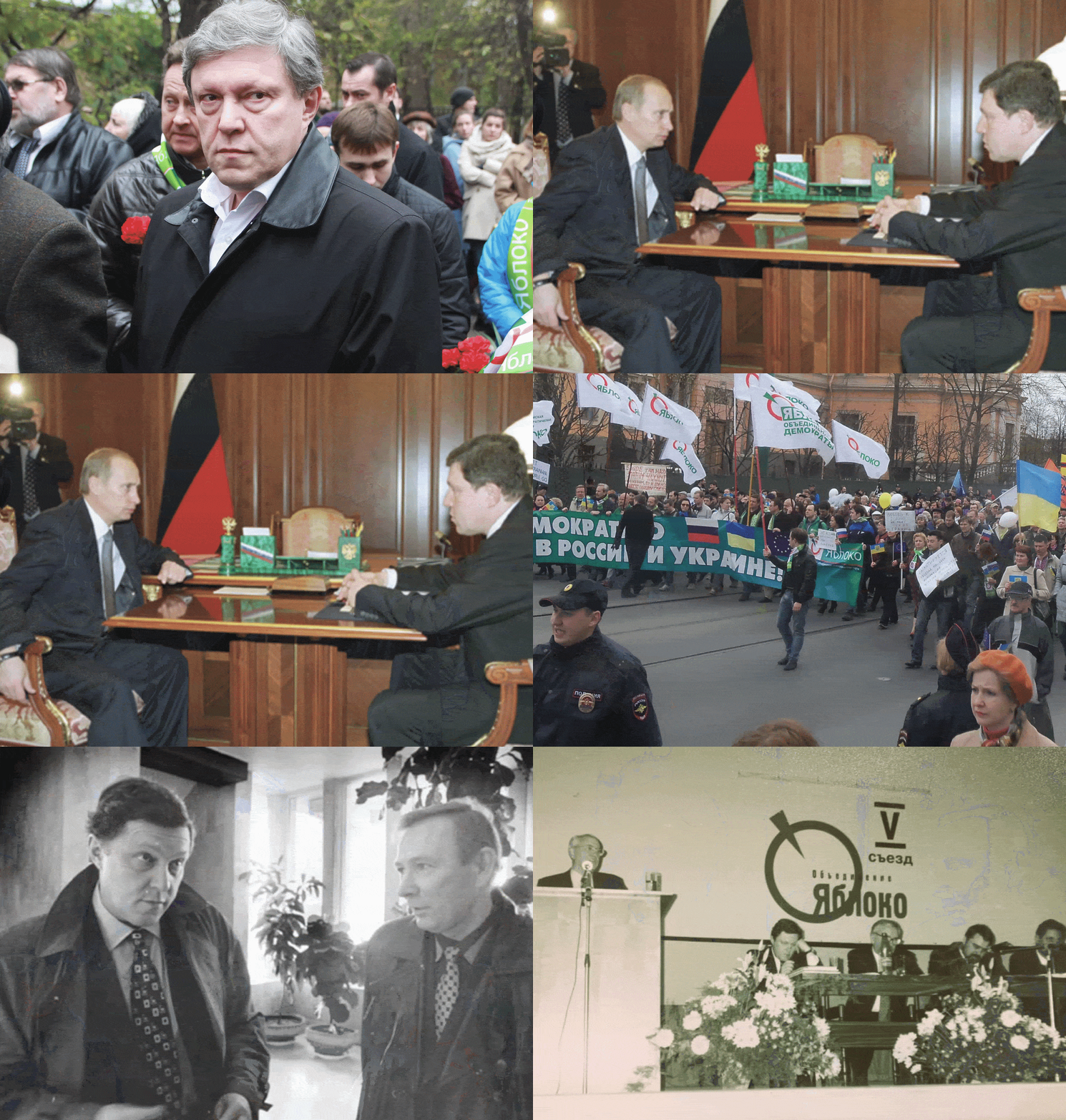
Is every outside help betrayal? Is every repression a defense of the state? Yabloko opens an uncomfortable question that Russia no longer wants to hear.
Within the space of just a few hours, Russian courts closed off two different exits from the same political story. The Supreme Court rejected Yabloko’s appeal and definitively barred from the State Duma elections the only registered Russian party openly calling for an end to the war. That same day, a court in Pskov sentenced the party’s deputy chairman, Lev Shlosberg, to 11 years in a penal colony for calling the war a "catastrophe for Russia" and demanding an immediate ceasefire.
A party that posed no conceivable threat to the government in terms of parliamentary numbers was suddenly being treated as though it threatened the state itself. Yet this is only the beginning of a much deeper Russian story, one that reaches back to the party’s very origins—or at least to the incarnation that emerged from the chaos of the 1990s.
The formal reasons for excluding Yabloko from the election are at once severe, bureaucratic, and faintly absurd: ruble donations from Russian citizens who had previously received money from abroad, social-media posts, the allegedly unauthorized use of the phrase "If only there is no war", the lyric "May There Always Be Sunshine," and an image created with the help of AI.
According to the party’s defense, the actual disputed sum that reached its election fund amounted to 16,900 rubles (barely €170!), and was subsequently returned. Behind those 16,900 rubles, a children’s song, and a computer-generated image lies a story that did not begin with the war in Ukraine, or even with Vladimir Putin. It begins in the final years of the Soviet Union, when there was still a belief that the enormous country might somehow be guided out of the planned economy without wholesale plunder, social collapse, and tanks in the streets of Moscow.
When a children’s song and an AI image become political evidence: How "May There Always Be Sunshine" and ChatGPT ended up before Russia’s Supreme Court
Among the reasons cited by Russia’s Supreme Court in support of Yabloko’s exclusion from the election is a detail so unusual that it deserves to be separated from the rest of the case. In an interview with Grigory Yavlinsky published on the party’s website, the words "Pust vsegda budet solntse"—"May There Always Be Sunshine"—were spoken, the title and best-known line of a Soviet anti-war children’s song from 1962, with lyrics by Lev Oshanin and music by Arkady Ostrovsky. The court concluded that this was "copyrighted material used without attribution to the author and without the necessary permission." Another disputed expression was the almost proverbial phrase "If only there is no war," which the court associated with Alexander Volodin’s play "Five Evenings."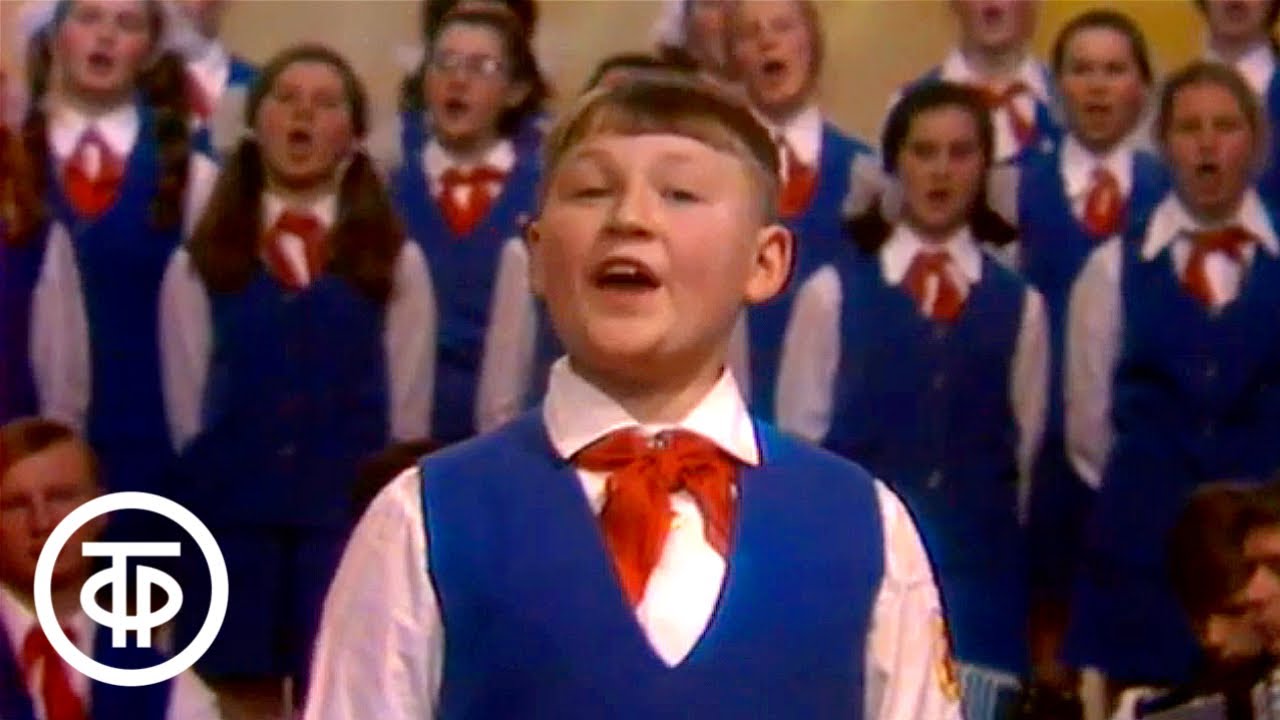
An even stranger case concerned an image of a "European railway station of the future" featuring two trains, one bound for Lisbon and the other for Vladivostok. Yabloko had used it as an illustration for a Yavlinsky article published on March 6, 2026, before the election campaign began, and the image was clearly labeled as having been created with ChatGPT. Prosecutors argued that this violated the rights of the American company OpenAI (!). The Supreme Court accepted the argument that OpenAI held the rights and concluded that Yabloko should have obtained the company’s permission before publishing the image.
The problem is that such reasoning is difficult to reconcile even with the rules of the company whose rights the Russian court had, rather unexpectedly, decided to protect. OpenAI’s current terms of use state that, as between the user and OpenAI and to the extent permitted by law, "you own the output," while OpenAI assigns to the user whatever rights it may have in that output. In other words, OpenAI specifically does not claim that every image generated with its systems remains the property of the company. Whether access to its services is permitted from Russia is an entirely separate question from who owns the copyright to an image that has already been generated.
That is why the children’s song and the two AI-generated trains matter more than they initially appear to. They were not the only grounds for banning Yabloko—the court also cited financing and a series of other alleged violations—but they reveal just how broadly the legal arsenal used to remove the party had been constructed. When the electoral fate of a political organization begins to depend on whether a politician is allowed to say "may there always be sunshine" and who owns a train that never existed, the discussion is clearly no longer just about copyright.
Yabloko is therefore an awkward subject for anyone seeking simple moral roles in Russian politics—and many certainly do. Western media would prefer to present Yabloko as "the last remnant of authentic democratic Russia being strangled by an authoritarian regime." Its opponents in Russia would rather reduce it to a political outpost of Washington, Brussels, and the opposition in exile. There is some truth in both images, but neither is sufficient. A party can be genuinely homegrown while also receiving outside assistance; it would hardly be the first or last. It can maintain close ties with Western liberal organizations and later clash with them over war. It can take money from oligarchs and still vote against their interests. In other words, the story of Yabloko is... to use that rather unhelpful term, "complicated," but we will try to interpret it as fairly as possible.
The man without whom Yabloko would not exist is Grigory Yavlinsky, an economist from Lviv who made his political name even before the collapse of the Soviet Union. In 1990 he was one of the principal authors of the "500 Days" program, a blueprint for transitioning from a centrally planned economy to a market system. The working group was jointly backed by structures associated with Mikhail Gorbachev and Boris Yeltsin, and the concept was ambitious almost to the point of political fantasy: within roughly a year and a half, the Soviet Union was supposed to establish property rights, market prices, competition, private enterprise, and a new relationship between the Soviet republics.
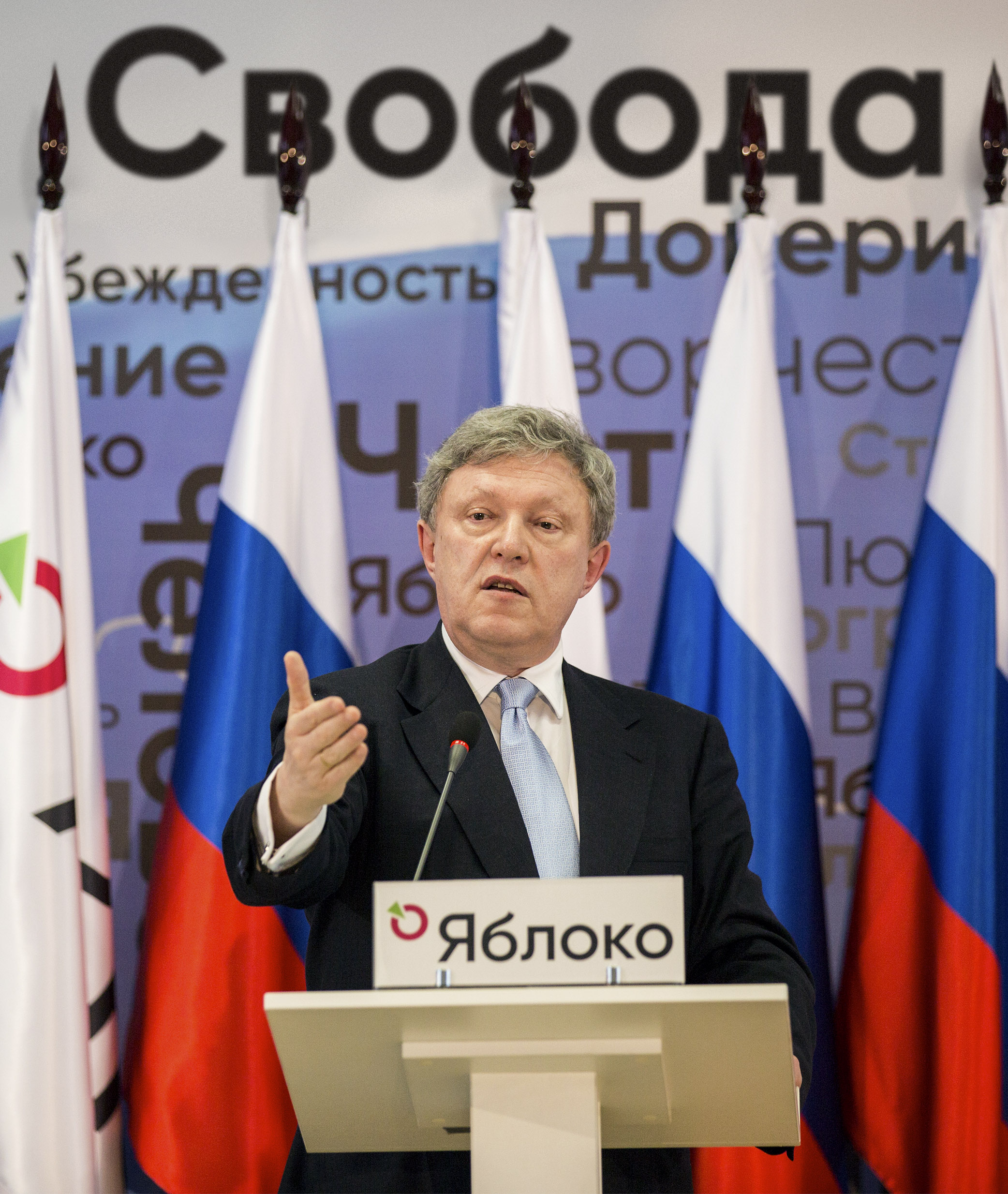
The program was radical in its speed and ambition, but it was not conceived as the kind of shock therapy Russia would later experience. It emphasized the sequencing of reforms, a legal framework, inflation control, preservation of a common economic space, and the use of citizens’ savings in the transformation of ownership. Yavlinsky would later argue that what he wanted was a market without social catastrophe: a transition that created private property, but not a new ownership caste produced by the political distribution of what had previously belonged to the state.
It sounds somewhat utopian, and history would confirm as much. The program was never implemented in its original form. The Soviet center was losing power, the republics were demanding sovereignty, and Yeltsin soon chose another team and a different economic philosophy.
That difference would later become almost tragic for Yabloko’s identity. Yavlinsky was no advocate of restoring Soviet socialism. He accepted markets, private property, and Russia’s integration into the world economy. Crucially, however, he rejected the idea that any privatization was good simply because it abolished state ownership, or that democracy could be built by wiping out the savings of most of the population almost overnight while opening the way for a small minority to acquire vast industrial empires.
Russia’s transition from socialism to capitalism was more than an economic reform; it was the division of historical spoils. The people who suddenly became owners of oil companies, mines, banks, and television stations did not acquire their power by prevailing in some neutral marketplace. Their power came from proximity to the state, privatization vouchers, rigged auctions, loans-for-shares schemes, and political deals struck while the overwhelming majority of the population was simply trying to survive and understand what was happening to them. The West, predictably, largely celebrated this process as a triumph of markets and democracy, even though it was precisely here that the fusion of power, wealth, and coercion later underlying Russia’s oligarchic system was created. Yavlinsky would spend years arguing that this was what had happened and that it had never truly ended—that Putin was not a break with the 1990s, but a product of them.
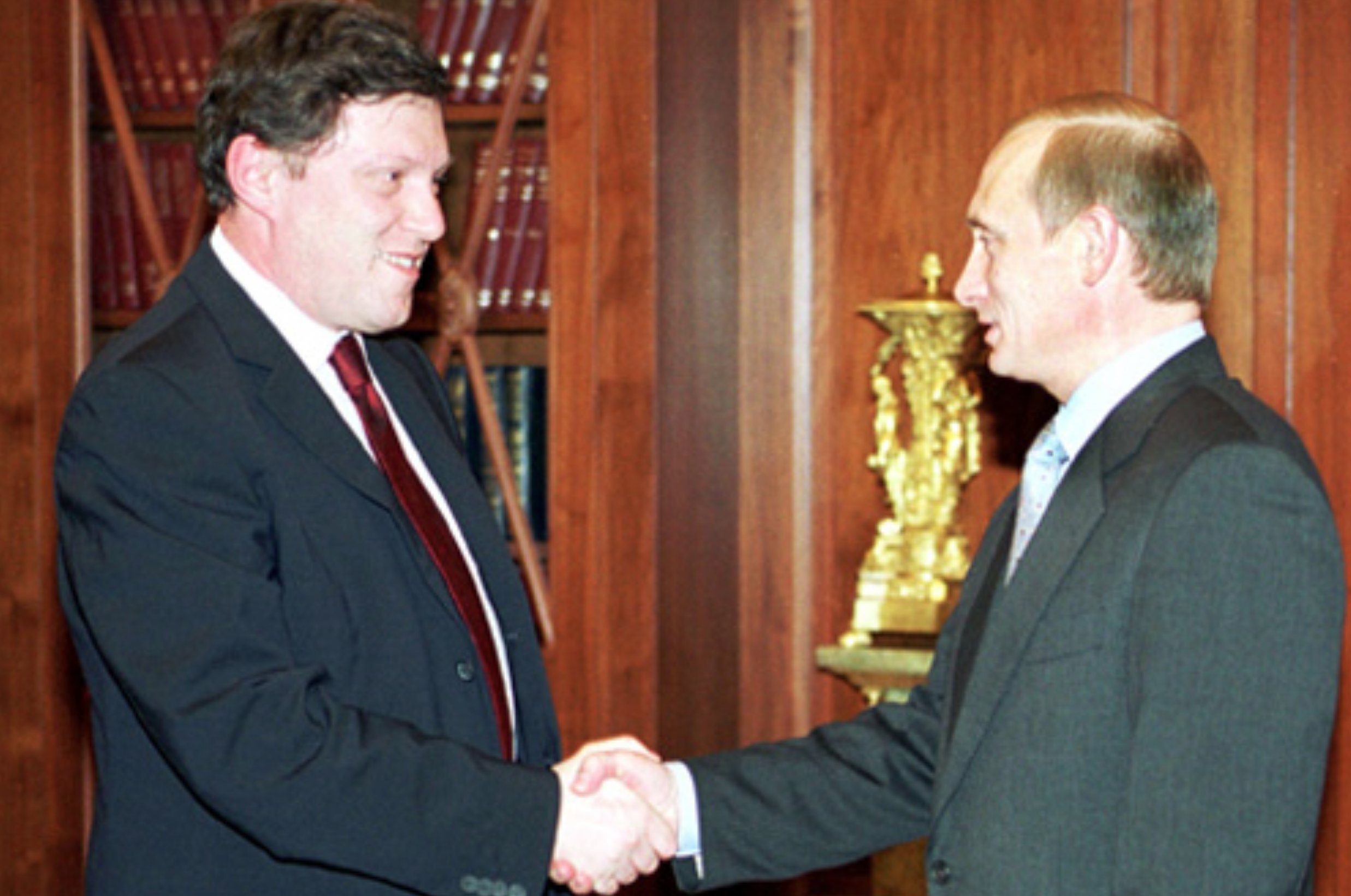
Yabloko formally emerged as a political bloc in the autumn of 1993, at the moment when Russia’s transition stopped pretending to be a civilized constitutional process. In September, Yeltsin dissolved parliament by decree despite having no clear constitutional authority to do so. The Constitutional Court declared his move illegal, lawmakers barricaded themselves inside Moscow’s White House, and in early October the confrontation turned into an armed uprising. Supporters of parliament seized the Moscow city administration building and attempted to capture the Ostankino television center. Yeltsin then sent in the army, and tanks opened fire on parliament. After the president’s victory, a new constitution was adopted that granted the Kremlin extraordinarily broad powers and laid the foundations of a system in which parliament would find it increasingly difficult to restrain presidential authority.
Here too Yavlinsky occupied no politically comfortable position. He considered Yeltsin’s decree unconstitutional and proposed simultaneous early presidential and parliamentary elections. Yet he did not support the hardliners gathered around parliament either. After they attacked the city administration and Ostankino, he called on the authorities to suppress the armed uprising, although he would later say that he had never expected tanks actually to shell the White House. His position was not some heroic neutrality above the conflict: he supported the use of force against armed rebels, while refusing to accept Yeltsin’s victory as the birth of a new and orderly democracy.
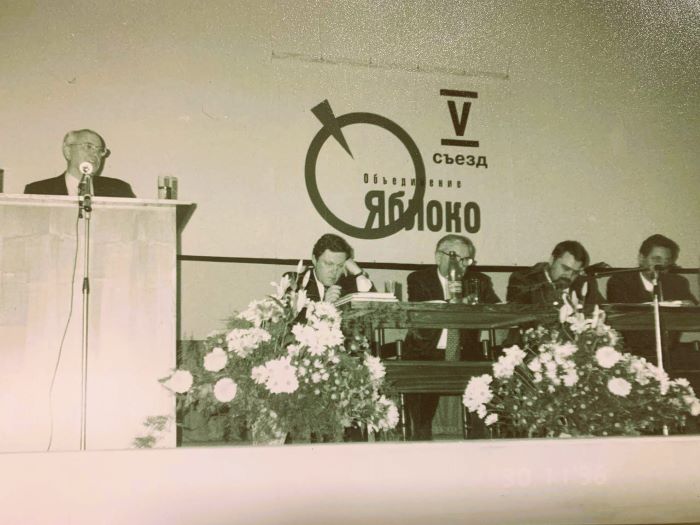
It was amid this chaos that the Yavlinsky–Boldyrev–Lukin electoral bloc was born. The first letters of the surnames of Grigory Yavlinsky, Yuri Boldyrev, and Vladimir Lukin combined to form the Russian word "Yabloko," meaning apple. It was an oddly gentle symbol for a political organization born amid economic collapse, armed barricades, and a burning parliament building. Yavlinsky represented economic expertise, Boldyrev the reputation of a government watchdog and anti-corruption figure, and Lukin the diplomatic experience of a former Soviet and Russian ambassador to Washington.
At first, the party was anything but marginal. In the December 1993 parliamentary elections it won 7.86 percent of the vote, followed by almost 6.9 percent in 1995 and around 5.9 percent in 1999. It had its own parliamentary faction and belonged to the small circle of genuinely relevant political forces during Russia’s first post-Soviet decade. Yavlinsky received more than five and a half million votes in the 1996 presidential election. That was obviously nowhere near enough to win power, but it was enough to ensure that Yabloko was more than a circle of Moscow intellectuals talking to themselves.
Programmatically, Yabloko sought to occupy a space somewhere between the communists and the victorious oligarchic version of capitalism. The party described itself as social-liberal: it supported a socially oriented market economy, equality of opportunity, private property, political and economic competition, an independent judiciary, federalism, strong local government, human rights, and civilian oversight of the state. It also included social-democratic, green, women’s, youth, and human-rights factions. Such a program was certainly not socialist, but nor did it imagine the state merely as a policeman guarding the property of privatization’s winners.
It is important to reject the image of Yabloko as a liberal ornament of the Yeltsin government. The party criticized his privatization policies, the concentration of presidential power, the war in Chechnya, and his economic policy. Yavlinsky repeatedly refused to enter the government unless he was given the ability to alter its direction, while party members who accepted ministerial positions without authorization risked expulsion. Yabloko supported part of the attempt to impeach Yeltsin relating to the launching of the First Chechen War. It was a democratic opposition to Yeltsin, not his liberal branch office.
Voters, however, did not necessarily distinguish Yabloko’s liberalism from the liberalism of those in power. For millions of Russians, the word "liberal" did not mean the rule of law, protection of citizens, and restraints on arbitrary state power. It meant unpaid wages, shuttered factories, hyperinflation, humiliated pensioners, tycoons, the International Monetary Fund, and a president who fired tank shells at Russia’s parliament while Western governments continued to describe him as a "guarantor of democracy." Yabloko criticized precisely that system, but because of its market-oriented program, Western ties, and the social profile of its voters, it remained marked by the system’s sins.
Part of the party’s decline resulted from changes to the political system, but part of it was self-inflicted. Yabloko never built a sufficiently strong organization outside the major cities. The US GAO (Government Accountability Office) was already describing Russian reformist parties in the mid-1990s as heavily concentrated in Moscow, weak in the regions, fragmented, and divided by personal ambitions almost as much as ideology. Yavlinsky was frequently criticized for political rigidity, reluctance to compromise, and refusal to merge with other liberal groups. By the time Putin’s system began closing down the media and electoral space, Yabloko had already been weakened by its own internal divisions and by public distrust of the entire liberal legacy of the 1990s.
The most sensitive part of its history, however, concerns its ties to the West. Those ties were very real. An official report by the US General Accounting Office, today known as the Government Accountability Office, shows that the publicly funded National Democratic Institute (NDI) and International Republican Institute (IRI) received a combined $17.4 million from 1992 through 1997 for programs aimed at the "development of reform-oriented political parties" in Russia. Yabloko is explicitly listed among the parties that took part in those programs.
This was not secret cash arriving in suitcases, but an open policy of American influence in post-Soviet Russia. The NDI and IRI organized seminars, trained activists, taught parties how to use opinion polls and focus groups, identify target voters, conduct door-to-door campaigning, develop political messaging, and establish links with civic organizations. One IRI official claimed that approximately 3,000 Russian party activists had been trained during 1994 and 1995, although that figure covered the broader range of reformist organizations rather than Yabloko alone.
Washington did not merely "cheer on" Russian liberals from afar. The American state financed an infrastructure of political influence intended to shape Russian parties, media, trade unions, legal institutions, and the electoral system according to its own conception of democratic development. Clearly, it did so not out of love for Russia, but in pursuit of its own hard interests.
Does it even need to be emphasized how directly this amounted to interference in another country? The United States today would almost certainly describe an equivalent Chinese or Iranian program for the "development of American political parties" as a foreign influence operation—and respond forcefully and without hesitation.
Yet it would still be unfair to describe the party as purely an American project. The money funded a broad program. Washington helped Yabloko learn some techniques of modern campaigning, but it did not invent Yavlinsky, the "500 Days" program, opposition to Yeltsin, or the millions of Russians who voted for the party before American consultants had even begun to understand the Russian electorate.
Those ties later continued through the international liberal movement. Yabloko became a full member of Liberal International in 2002 and from 2006 participated in the European ALDE alliance. This firmly embedded it within the transatlantic liberal ecosystem, providing international contacts and political protection, while simultaneously feeding the impression that the party belonged to a world whose interests were becoming increasingly difficult to separate from the strategic interests of NATO and the European Union.
Even so, the relationship was hardly one of obedience. In March 2025, Yabloko ended all participation in ALDE, formally after Russian prosecutors designated the organization "undesirable," but also amid an openly acknowledged political dispute. Yabloko accused ALDE of supporting the continuation of the war in Ukraine, escalation, and an unattainable military victory to be paid for with an enormous number of lives. Yabloko, by contrast, demanded an immediate ceasefire and negotiations. That is not a position easily described as automatic compliance with present-day Western priorities. In fact, a complete halt to the conflict is the only correct position one can take.
Yet the party’s domestic sources of money were hardly politically spotless either. In 2003, Yavlinsky openly acknowledged that several owners of the Yukos oil company, including figures connected to Mikhail Khodorkovsky, were providing a significant share of the party’s budget. He did not confirm contemporary media claims that they accounted for 90 percent of all party income, but he did acknowledge that they were a "major sponsor." He argued that the financing did not determine how Yabloko deputies voted and that "political parties’ dependence on oligarchs is a consequence of a political economy in which there is no sufficiently broad class of medium-sized entrepreneurs capable of financing independent politics."
Whichever way Yavlinsky tried to frame it, it does not sound good.
There is, to put it mildly, a very real contradiction here. A party that criticized the way state property had been transformed into oligarchic empires was taking money from one of the greatest beneficiaries of that process. And once we know who Khodorkovsky was, the problem becomes even clearer.
But this too demonstrated just how thoroughly almost every Russian party of the 1990s and early 2000s was trapped in a system where serious politics required access either to oligarchic capital or the state treasury. Oligarch money was not Western money, but it was a product of the same Russian order that the West was celebrating at the time.
After losing its entitlement to state funding, Yabloko once again came to rely more heavily on donations. In the 2021 Duma election it officially received 1.34 percent of the vote, or slightly more than 753,000 votes. In more recent campaigns, the party has publicly stated that it receives no money from the state budget and has appealed to supporters to fund it through donations. Today’s Yabloko is not a financial machine backed by anything comparable to major corporate or state infrastructure.
The best test of the party’s political authenticity, however, is not financial but historical. Yabloko did not suddenly discover its opposition to war in 2022, when taking an anti-war position became useful to the West. It opposed the First Chechen War when the war was being waged by the West’s favored Russian leader, Yeltsin. Yavlinsky traveled to Chechnya, called for negotiations, and described the war as a political adventure destroying both Chechens and Russia.
When NATO began bombing Yugoslavia in 1999 without authorization from the United Nations Security Council, Yabloko categorically condemned the operation. It demanded an immediate end to the bombing, a return to negotiations, and respect for international law. At the same time, Yavlinsky criticized Slobodan Milošević and rejected nationalist calls for Russia to intervene militarily on Belgrade’s side.
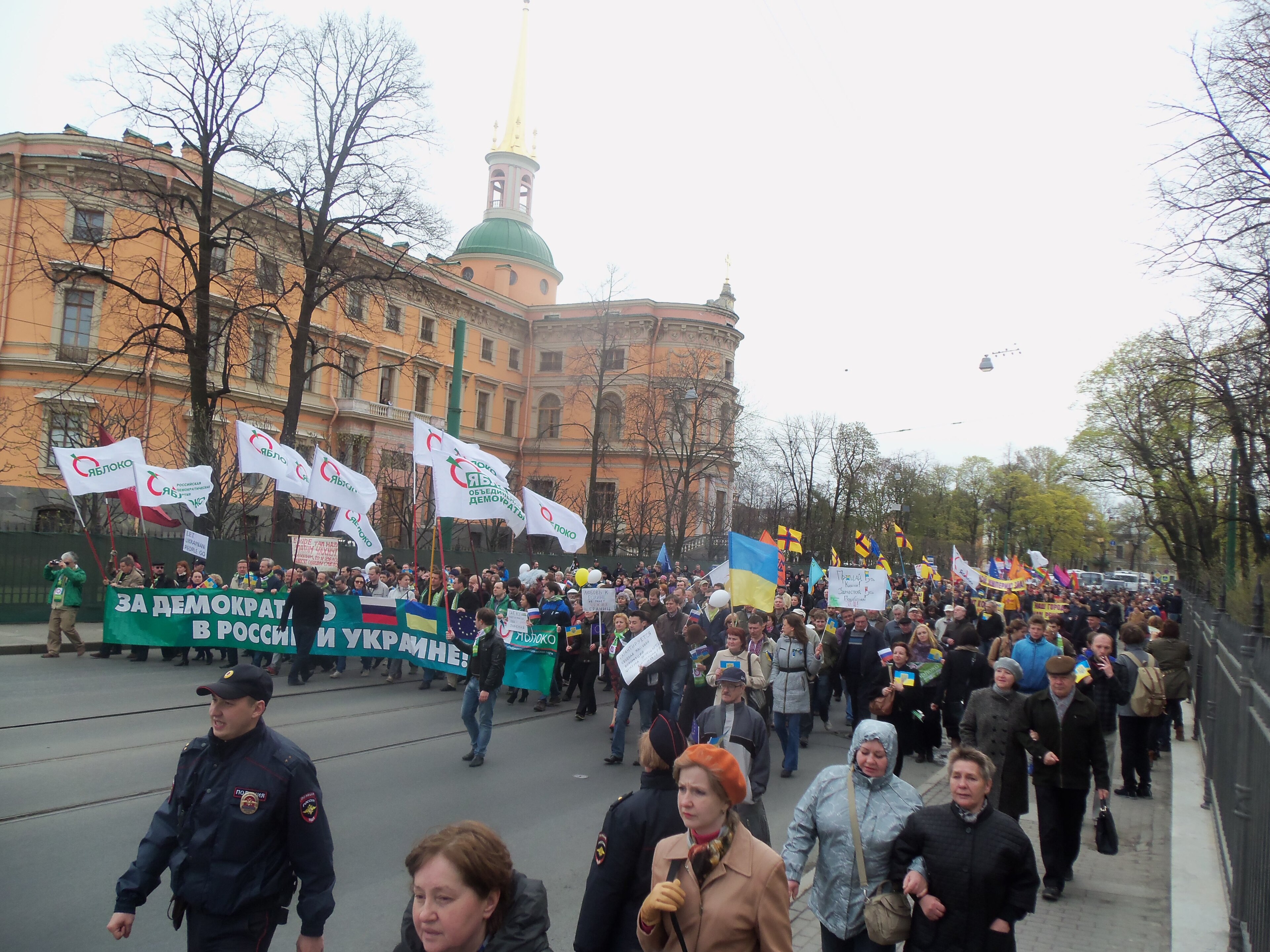
Likewise, Yavlinsky opposed the US invasion of Iraq in 2003. He considered Saddam Hussein’s regime dangerous, but argued that inspections, international pressure, and the legal framework should have been given priority over a war that would cause civilian casualties and long-term destabilization. That, it must be said, was not the position of a politician judging Russian foreign policy by one moral standard and American foreign policy by another.
The continuity from Chechnya through Iraq to Ukraine confirms that Yabloko cannot simply be accused of opposing wars only when doing so suits the West.
This also reveals the difference between Yabloko and Alexei Navalny, even though outside Russia the two are often placed in the same political category. Navalny was once a member of Yabloko, but was expelled in 2007 over his nationalist views and participation in political activities that the party leadership considered dangerous for a multiethnic Russia. Yabloko remained socially liberal, anti-nationalist, and institutionally oriented, while Navalny sought to combine anti-corruption politics, populism, Russian nationalism, and mass mobilization against Putin.
Over time, Navalny became the most useful face of the Russian opposition for Western governments, media, and organizations seeking to put pressure on the Kremlin. In that sense he was a politically useful actor for anti-Russian structures in the West, regardless of whether he agreed with them on every issue.
Yabloko’s present-day platform is far narrower than Yavlinsky’s grand transition plans of the early 1990s. At the heart of its 2026 election campaign were a ceasefire, diplomacy, the prevention of nuclear war, an end to political repression, and "life without fear". The party was proposing neither Ukrainian capitulation nor a Russian withdrawal according to a formula dictated in advance by the West, but rather a halt to military operations along the current lines and the beginning of negotiations over a future peace settlement and European security. It is not a program that would satisfy Kyiv, Brussels, or NATO’s hawkish wing.
How many people in Russia genuinely support that position is far more difficult to establish than either the government or the opposition would like to suggest. Yabloko officially received only 1.34 percent in 2021. In late March 2026, one poll put its electoral support at around three percent, while a significantly larger share of respondents said they were in principle willing to consider voting for the party. Another survey in July showed barely one percent of respondents certain to vote for it. There was no convincing evidence that Yabloko was on the verge of safely crossing the five-percent electoral threshold. It had only a handful of representatives in regional parliaments and posed no realistic threat to United Russia’s hold on power.
That is precisely what makes the ban politically significant. The Kremlin was surely not afraid that Yabloko might take control of the country. What it could fear, however, was that a legal anti-war list would make it possible to count the people who wanted the war to end. In a system where every other parliamentary party supports the military policy, a vote for a small party could become something much broader: a referendum on the war itself. Even a result of three or four percent would represent millions of people.
The foreign-financing case reveals just how far the legal boundary had been stretched. According to a Rosfinmonitoring document, 74 individuals identified among Yabloko’s donors and business partners had, between April 2023 and August 2026, received around 80 million rubles (roughly €810,000) from 310 foreign individuals. During the narrower pre-election period, several people who donated rubles to Yabloko had previously received a combined 2.8 million rubles (€28,000) from abroad. Yet according to the party’s lawyers, that foreign money was never transferred to Yabloko. What the party actually received from those individuals amounted to only around 17,000 rubles (roughly €170).
Alongside the financial allegations came claims of extremism, expressions of support posted on blocked social networks, and copyright violations. The written reasoning included lines from a Soviet children’s song, a familiar anti-war saying, and an image generated with the help of ChatGPT. According to the party’s published account of the ruling, the court even refused to accept the argument that ChatGPT was "artificial intelligence." This accumulation of mutually unrelated violations creates the impression that the process did not move from a clear breach of law toward a sanction, but rather from a politically desired sanction toward the search for enough legal pretexts to justify it.
Yabloko then applied the same methodology to the financial reports of other parties. Its anti-corruption center claims that parliamentary parties received more than 1.15 billion rubles between 2021 and 2025 from donors who themselves showed traces of prior foreign financing. According to the analysis, the largest share went to United Russia, while the list also included Rodina, the party whose lawsuit resulted in Yabloko’s removal from the election. This is a party analysis rather than an independently established judicial fact, but it goes directly to the heart of the problem: a criterion broad enough to disqualify almost anyone is, in practice, applied only to those whom the system wants removed.
The sentence handed down to Lev Shlosberg removes any remaining possibility of interpreting the affair as strict but politically neutral supervision of campaign financing. Shlosberg did not receive 11 years in prison for secretly transferring Western money, espionage, or plotting violence. He was convicted under laws introduced after the beginning of the war for "discrediting" the armed forces and spreading allegedly false information. Maxim Kruglov, another Yabloko deputy chairman, was sentenced in June to seven years in prison over two posts in which he expressed sorrow over the loss of human life. When a party is removed from an election and two of its deputy chairmen are sent to penal colonies for public speech, we are clearly no longer talking merely about the protection of state sovereignty. We are talking about the physical removal of politics from political life.
Russia nevertheless has a legitimate right to protect its elections from foreign money. The United States prohibits foreign nationals from directly or indirectly financing federal, state, and local elections, political parties, and election communications. Foreigners are also prohibited from participating in decisions concerning the electoral activities of American organizations, while knowingly acting as an intermediary for such money can constitute an offense. Any American party directly financed by the Chinese government, Iranian institutions, or Russian oligarchs would not be treated as a charming expression of democratic pluralism. It would become the subject of investigations, surveillance, political persecution, and criminal proceedings.
Western democracies are not neutral arenas in which every political force may operate without restriction for as long as it can win votes. The difference, if anything, lies in how broadly the rules are defined, how selectively they are enforced, and how severe the repression becomes.
Yabloko today is in no position to take over Russia. Unlike the late Navalny, hardly anyone in the Western public has even heard of it. Yet it is precisely through small, weak, politically inconvenient parties that one can see where the system draws its boundaries. A powerful opponent can be branded a threat. A weak opponent is persecuted because the authorities cannot tolerate even its presence.
The apple that sprouted beside Russia’s burning parliament in 1993 has now been removed from the ballot above all because it demanded that the war end. Yet the fate of a single liberal party may not even be the most important part of this story. What matters more is the kind of Russia such actions are already building for the period after the war—and while it continues: a country capable of having a conversation with itself, or one in which even the very thought of peace will have to prove that it did not come from abroad.
Sources
- Kommersant.ru Зато не экстремисты https://www.kommersant.ru/doc/8878352
- Reuters Russia jails anti-war politician for 11 years in further clampdown on dissent https://www.reuters.com/business/media-telecom/russia-jails-opposition-politician-11-years-anti-war-comments-mediazona-says-2026-08-17/
- Aldeparty.eu Joint ALDE Party-LYMEC statement on designation as ‘undesirable’ in Russia https://www.aldeparty.eu/blog/news-11/joint-alde-party-lymec-statement-on-designation-as-undesirable-in-russia-139
- Meduza.io Суд снял «Яблоко» с выборов — в том числе из-за иностранного финансирования. Звучит как идея! https://meduza.io/cards/sud-snyal-yabloko-s-vyborov-v-tom-chisle-iz-za-inostrannogo-finansirovaniya-zvuchit-kak-ideya
- The New Yorker The Evolution of Alexey Navalny’s Nationalism https://www.newyorker.com/news/our-columnists/the-evolution-of-alexey-navalnys-nationalism
- Vedomosti.ru «Яблоко» прекратило сотрудничество с ALDE https://www.vedomosti.ru/politics/news/2025/03/04/1095990-yabloko-prekratilo
- Fec.gov Foreign nationals - FEC.gov https://www.fec.gov/help-candidates-and-committees/foreign-nationals/
- The Washington Post Two Visions for Russia And One Battle of Wills https://www.washingtonpost.com/archive/politics/2003/11/05/two-visions-for-russia-and-one-battle-of-wills/bc45942f-3b45-478d-b706-ef6f18ce37a6/
- Jamestown.org PROFILES OF POLITICAL PARTIES: YABLOKO https://jamestown.org/profiles-of-political-parties-yabloko/
- Novayagazeta.eu «Пусть всегда будет солнце», ИИ-картинка и 16900 рублей из-за границы https://novayagazeta.eu/articles/2026/08/10/pust-vsegda-budet-solntse-ii-kartinka-i-16900-rublei-iz-za-granitsy
- Rbc.ru Росфинмониторинг нашел у «Яблока» иностранное финансирование https://www.rbc.ru/politics/10/08/2026/6a79d3e79a79471eaf3b577c
- Eng.yabloko.ru Moskovsky Komsomolets, September 2, 2003 Grigory Yavlinsky: "It is impossible to create a real opposition in Russia today." https://eng.yabloko.ru/Publ/2003/PAPERS/9/030902_mosk_koms.html
- Gao.gov Progress Report on U.S. Democratic Development Assistance to Russia https://www.gao.gov/assets/nsiad-96-40.pdf
- Rferl.org Transition Nations Press Review https://www.rferl.org/a/1090989.html
- Yavlinsky.ru 500 Days: Transition to Market | Grigory Yavlinsky https://www.yavlinsky.ru/en/book/500-dnej/
- Tass.ru Lev Shlosberg was sentenced to 11 years and 1 month for discrediting the Russian Armed Forces. https://tass.ru/proisshestviya/28019409
- Rg.ru Суд приговорил зампреда партии "Яблоко" Круглова к 7 годам колонии по делу о фейках о ВС России https://rg.ru/2026/06/24/prokuratura-prosila-bolshij-srok-eks-deputatu-mosgordumy-kruglovu-chem-dal-sud.html
- Ria.ru Верховный суд снял партию "Яблоко" с выборов в Госдуму - РИА Новости, 10.08.2026 https://ria.ru/20260810/yabloko-2110078447.html
- Lenta.ru Партию «Яблоко» сняли с выборов в Госдуму после иска «Родины». Что об этом известно? https://lenta.ru/news/2026/08/10/long-partiyu-yabloko-snyali-s-vyborov-v-gosdumu-posle-iska-rodiny-chto-ob-etom-izvestno/
- Gazeta.ru «Получали деньги из иностранных источников»: что известно о снятии «Яблока» с выборов https://www.gazeta.ru/politics/2026/08/10/23372677.shtml
Comments