
Alliances are forged to prevent war. But when the first soldier dies defending another country, the promise of security can turn into a duty of revenge.
While the world remains focused on Hormuz, fresh Houthi attacks on Saudi Arabia are confronting two major military powers with a difficult dilemma. Pakistan and Turkey face an uncomfortable question: what is a pledge to protect an ally worth if they never intend to honour it? And what might it cost them if they do? These questions can no longer be left to abstract diplomatic debate.
The attacks on 8 and 9 September struck southern Saudi Arabia, including the Khamis Mushait area, military facilities and oil infrastructure. According to published figures, 73 people were injured.
Yemen’s war, meanwhile, has a chronology of its own. The latest wave of attacks followed intensified fighting between the Houthis and forces backed by Riyadh. AP also reports an attack on a prison in Jawf province, attributed to the Saudi-led coalition, that killed at least 23 people according to figures available at the time. The Houthis do not need to invent a new grievance to fight Saudi Arabia. They need only reopen an old conflict.
That does not rule out Iranian coordination. Media reports cite unconfirmed claims by Iranian sources that Tehran "encouraged the attacks and promised assistance", while Iran denies controlling the Houthis. Clearly, influence is not the same as command, though in this case the two may overlap considerably.
The energy logic behind such cooperation is easy to understand. Saudi Arabia uses its East–West pipeline to move oil to the Red Sea port of Yanbu, bypassing Hormuz. The more important that outlet becomes, the greater the strategic impact of threatening it. It is therefore plausible that pressure on Saudi infrastructure is also intended to undermine the kingdom’s ability to circumvent the Gulf crisis. The latest attacks alone, however, do not establish that this export system has been disabled.
Nor is the Red Sea a single exit that can be closed in one move. Cargo leaving Yanbu can head south through the Bab el-Mandeb Strait, but it can also travel north towards Suez and Egypt’s SUMED pipeline. Threatening the southern passage therefore does not automatically amount to a complete blockade of Saudi exports. Yet a complete blockade is hardly necessary to inflict economic damage.
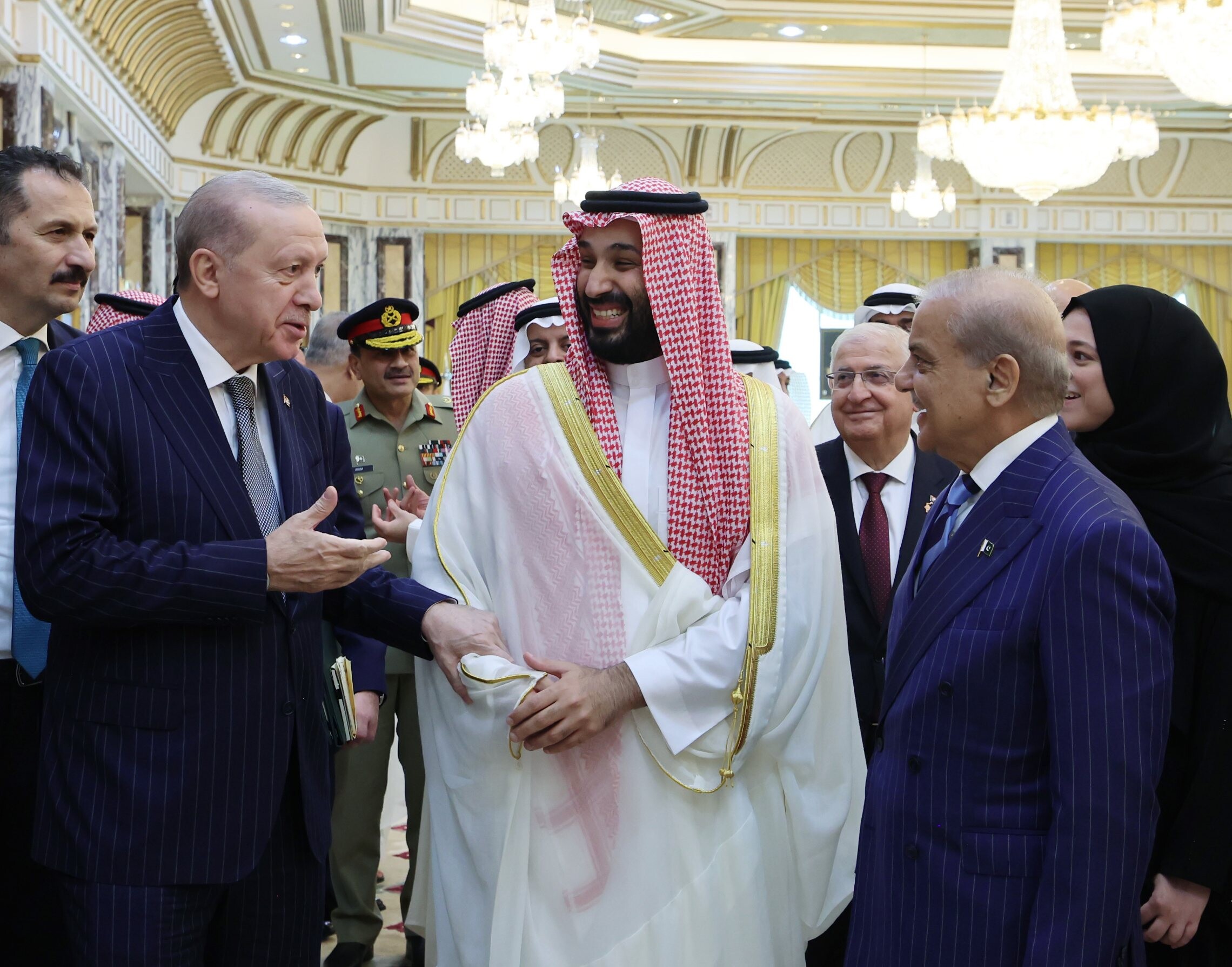
Against this backdrop, the defence agreement signed in Mecca on 7 August takes on a very concrete meaning. Saudi Arabia, Pakistan and Turkey agreed on the principle that an attack on one member is an attack on all. That politically appealing formula for collective security must now be translated into practice: which forces, what missions, and how far will they be allowed to go?
Pakistan has already conveyed a Saudi warning to Iran, and military representatives of the three countries have held consultations. Pakistani sources emphasise defending Saudi territory without entering Yemen. This does not yet confirm that the three will enter the war together, though events are moving towards a further escalation.
Islamabad has good reason to insist on that distinction. Iran is its neighbour, and defending Saudi Arabia and going to war with Iran are two radically different strategic decisions. Pakistan would struggle to explain why one partner’s security requires permanent hostility towards a country across its own border. But it would find it equally difficult to explain to Riyadh why a mutual defence guarantee ceases to apply precisely when missiles start falling. Diplomacy is now trying to preserve room between those two extremes.
Turkey faces a similar test, compounded by its own ambition to become an indispensable regional power. Its defence ministry outlined plans in August for joint political and military mechanisms, exercises, and cooperation in air defence, unmanned systems and electronic warfare. A framework for practical cooperation therefore exists, although a framework is not a decision to deploy forces.
Would Ankara send troops to Saudi Arabia? A limited mission seems a more likely opening move than a major expedition: protecting specific facilities, providing reconnaissance assistance, deploying specialists or offering air support. This is, of course, an assessment of a possible course of action, not a confirmed decision. Erdogan could use such a mission to demonstrate that Turkey’s guarantee carries weight while trying to keep channels open with Tehran. The problem is that the mission’s limits would also depend on what the other side does.
Consider an entirely plausible sequence of events. Pakistani or Turkish personnel arrive to protect a Saudi base. Another attack causes casualties among them. Their governments then decide to destroy the positions from which the missiles were launched. The Houthis respond by attacking the base from which the retaliation originated. Every participant can describe its own action as a response to a previous attack, even as the number of countries directly involved grows.
The promise that troops will not enter Yemen leaves a crucial question unanswered: will they take part in cross-border attacks from Saudi Arabia? A country does not need to send ground forces into Yemen to become a direct participant in the conflict through air strikes. What matters in genuinely limiting a mission is what its forces are authorised to do, which targets they may strike, and who approves any expansion of operations. A geographical limit alone is not enough.
Pressure on Saudi security could also backfire on Iran: instead of dividing its opponents, it could encourage them to close ranks. Tehran would then be helping to consolidate the very alliance that has just been formed.
Nor should the broader cause of the current crisis be lost from view. The US-Israeli war against Iran and the conflict over shipping in the Gulf have already created conditions in which local battlefields can merge. A renewed Saudi-Houthi war in this setting carries a different danger from an isolated escalation along the border: every new participant brings its own allies, obligations and potential for miscalculation.
A major regional war is therefore not yet inevitable. The Mecca pact could serve as a deterrent if its members managed to combine credible protection for Saudi Arabia with clear operational limits and negotiations. But de-escalation requires both sides to stop attacking. Lasting security for Saudi cities is difficult to envisage while war resumes in Yemen, just as negotiating over Yemen is difficult under the constant threat of fresh cross-border strikes.
The agreement’s real test will therefore be more than Pakistan’s and Turkey’s ability to send troops. It will be their ability to decide in advance where their involvement ends, and then hold that line after the first serious provocation. The history of major wars is full of governments that believed they were taking one last limited step. The costliest mistake now would be to assume that the word "defence" is itself a guarantee that the consequences will remain limited.
We may, however, soon get an answer to the central question: who really controls the new "Islamic NATO" created in Mecca? Is it truly these three countries, seeking greater autonomy through their alliance? Or is the nickname justified because behind it stands the actual NATO—or, more precisely, the power that commands it, the United States?
For America, which has no exit strategy for its war with Iran, it would be highly convenient to have regional powers join forces against Tehran, initially at least against its allies. Could Iran have prevented this? Should it have used its influence over the Houthis to stop their attack on the kingdom? Hardly. Iran’s overriding interest is to prevent a scenario in which it becomes the only country—or at least the largest—left trapped inside Hormuz. If that means risking further escalation, it understands that risk, along with the still greater one: that Iran, and Iran alone, will be subjected to the permanent blockade the United States is trying to impose.
Sources
- Associated Press Saudi Arabia, Turkey and Pakistan have signed a key defense agreement https://apnews.com/article/58048d4a100befd4d2c18e0cbae58b7c
- The Guardian Houthis strike Saudi Arabian cities in significant expansion of Middle East war https://www.theguardian.com/world/2026/sep/08/houthi-strike-saudi-arabia-oil-facilities-middle-east-war-iran
- Le Monde Yemen's deadliest fighting in years raises fears of return to all-out war https://www.lemonde.fr/en/international/article/2026/09/05/yemen-s-deadliest-fighting-in-years-raises-fears-of-return-to-all-out-war_6757196_4.html
- Reuters Pakistan warns Iran to rein in Houthis as Riyadh strikes back https://www.reuters.com/world/asia-pacific/pakistan-warns-iran-rein-houthis-riyadh-strikes-back-2026-09-09/
- Al Jazeera Houthi attacks on southern Saudi Arabia reportedly injure dozens https://www.aljazeera.com/video/newsfeed/2026/9/8/houthi-attacks-on-southern-saudi-arabia-reportedly-injure-dozens
- Vortexa.com Strait of Hormuz alternatives for crude exports | Vortexa https://www.vortexa.com/insights/strait-of-hormuz-alternatives-for-crude
- Eia.gov Amid regional conflict, the Strait of Hormuz remains critical oil chokepoint - U.S. Energy Information Administration (EIA) https://www.eia.gov/todayinenergy/detail.php?id=65504
Comments