
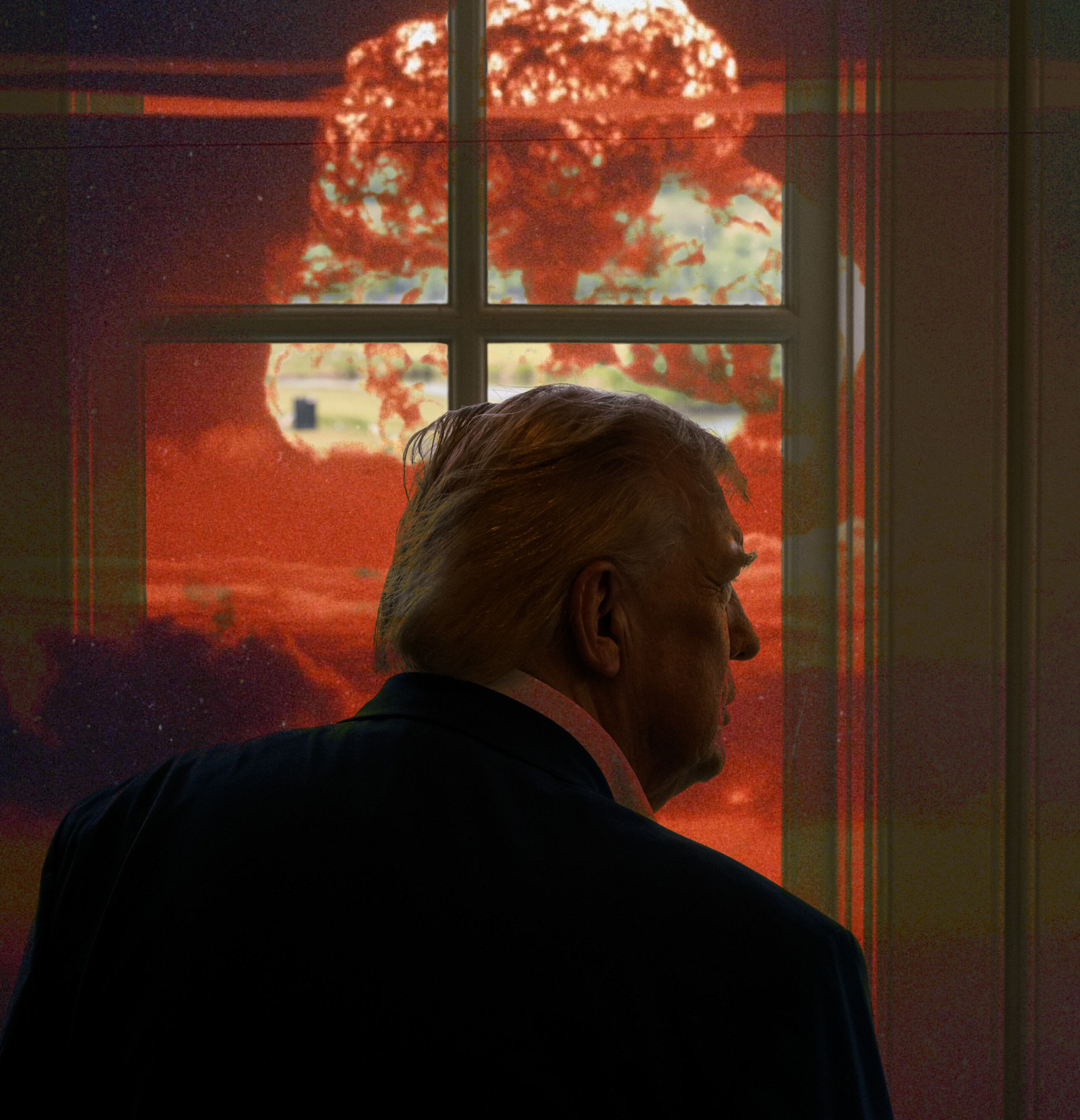
Let’s begin with speculation — very serious speculation, but speculation all the same. What if Iran already has a nuclear bomb? Let us assume that it does. Or, more precisely, let us assume — and this no longer belongs entirely to the realm of speculation — that it is very close to that threshold. Iran may already have a nuclear bomb. It may merely have the capacity to assemble one quickly. It may have an external guarantee. Or it may be deliberately creating just enough ambiguity to change how its enemies behave. In all these versions, the political effect can take hold even before technical proof exists.
We are not the first to speculate about this. A whole range of specialists are now seriously entertaining the possibility. None of them will say, "I have proof." But there is a real case for taking the speculation seriously.
If Washington has to consider even the slightest possibility that Iran could demonstrate it has a bomb, then the rumor itself has already become a strategic instrumentRobert Barnes, the American lawyer and political analyst — one of the many guests on Mario Nawfal’s relentlessly active podcast circuit — says the White House received a message about how Iran would respond in the event of a new escalation. According to that version, Tehran would walk away from negotiations, withdraw from the NPT, the Treaty on the Non-Proliferation of Nuclear Weapons, and "show that it has nuclear weapons."
As noted, this is speculation. But let us imagine the effect: a political catastrophe for Trump. The entire war was sold on the promise that Iran would "never have a nuclear bomb." An Iranian demonstration of such a capability would make Washington’s entire argument look humiliatingly hollow.
Put it this way: if Washington has to consider even the slightest possibility that Iran could demonstrate it has a bomb, then the rumor itself has already become a strategic instrument. And these rumors, even if we are gathering them from various podcasts whose guests always hedge with "that’s what I’ve heard" or "my sources tell me," have been piling up rather noticeably over the past several days.
There is another, perhaps more interesting, possibility. Tehran may never publicly say that it has a bomb. Washington may never admit that it received such a message. Between them, an unspoken equilibrium could emerge, in which everyone behaves more cautiously while the public is offered entirely different stories.
Far-fetched? Perhaps. But not unimaginable. Some nuclear secrets remain hidden for a very long time, even for decades. Think of the Cuban Missile Crisis. The Soviets withdrew their nuclear missiles from an island just off the American coast on the condition that the United States remove its own missiles from Turkey. Washington did so, but made secrecy a condition of the arrangement. History therefore misremembered the crisis as a unilateral Soviet retreat, when in reality the withdrawal was mutual. We learned all this only after the archives were opened following the collapse of the USSR.
Pape’s Underground Calculation
Robert Pape, another specialist on Iran, gives this speculation perhaps its most serious framework. Above all, he calculates what a state such as Iran actually needs in order to produce its first nuclear device. In his assessment, Iran’s chances of successfully developing such a weapon, even after the American-Israeli bombing campaign, remain above 50 percent. The reason is simple. Tehran does not need vast underground cities. Deeply buried spaces, a certain number of centrifuges, and a little time would be enough.
Pape estimates that roughly a thousand centrifuges could, over the course of a year, produce enough material for one bomb. After that would come several more months of work on a crude, first-generation nuclear device. Such a device would not have to be elegant. It would not even have to be miniaturized for a missile. For political effect, a test, a demonstration, or a credible message that the threshold has been reached would be enough.
After all, few would assume that Iran is "starting from zero." What if parts of the program have already been dispersed, hidden, and prepared for the moment when a political decision becomes unavoidable? What if the strikes merely accelerated a decision that Tehran had been postponing for years?
Pape agrees that, after an attack on Iran, nuclear deterrence becomes the rational continuation of Iranian security policy. Tehran has clearly seen the fate of Iraq and Libya; it has watched the West’s treatment of North Korea; and it could draw a very clear lesson. Negotiations buy time, sanctions exhaust the state, but a bomb changes the conversation.
The Ghost of A. Q. Khan and Pakistan’s Shadow Over Iran
Larry Wilkerson, the former chief of staff to the US secretary of state, brings a more explosive element into the story. According to his information, Pakistan’s military-intelligence apparatus may have sent Iran a message that nuclear weapons "exist if it needs them."
One must, of course, be cautious. It is impossible to forget that a strong sovereignist leader, Imran Khan, was swept from power in what he himself describes as an American conspiracy. So is there any room in today’s Pakistan for such a decision? Perhaps there is. American influence in Islamabad is real, but it is not limitless.
Nor is Pakistan just any nuclear state. Pakistan is the country of A. Q. Khan, the man whose name has for decades been associated with the idea of the "Islamic bomb" and with networks for transferring nuclear knowledge.
A. Q. Khan, whose full name was Abdul Qadeer Khan, was a Pakistani metallurgical engineer and the man celebrated in Pakistan as the "father of the Pakistani atomic bomb." He was born in 1936 in Bhopal, then part of British India, and moved to Pakistan after Partition. The decisive moment came after India’s 1974 nuclear test, when Pakistan resolved to accelerate its own program. Khan had worked in Europe, where he had access to centrifuge technology for uranium enrichment. He then returned to Pakistan and became the central figure in the program at Kahuta. In 1998, Pakistan publicly tested nuclear weapons, turning Khan into a national hero at home.
But there is another side to the story. Khan was linked to a vast "black network" for spreading nuclear technology, expertise, designs, and centrifuge parts to states such as Iran, Libya, and North Korea. That network showed that nuclear proliferation need not move only through official state channels. It can also pass through scientists, middlemen, companies, dual-use components, and political protection. That is why his name still appears whenever people discuss the possibility that Iran did not have to develop everything entirely on its own. Khan is therefore, for some, a Pakistani Prometheus who gave a Muslim state strategic deterrence; for others, he is the architect of the most dangerous nuclear underground of the modern age.

But what would this even look like in today’s context? Pakistani assistance would not have to take the dramatic form of delivering a finished bomb. One can imagine a guarantee, technical support, components, or even a discreet message intended for American channels. Deterrence, after all, is sometimes built both on the object possessed and on the belief that a network exists and will be activated if the pressure becomes existential. In plain language: it may be enough for a message to travel from Pakistan to Washington saying, "We will do it."
That changes the picture entirely if Iran is entering a broader Asian security architecture in which Pakistan, but also China and Russia, view American-Israeli pressure as part of a larger conflict. If Tehran has received even a political assurance that it will not be left isolated, then its position has already changed.
Trump’s Humiliation
Barnes’s essential point concerns Trump’s psychology. He argues that the Iranian nuclear message worked because what Trump fears most is public humiliation. If Iran demonstrates a nuclear capability after the American-Israeli campaign, Trump would be left as the president whose own war produced the very outcome it was supposed to prevent.
It would be a powerful Iranian blow against the American narrative.
As has been said for weeks, Trump needs an exit he can present as a "victory." Any concrete Iranian nuclear move now would shatter that scenario.
Possible Endgames
If Iran withdraws from the NPT, it would mark the end of an era. Tehran could argue that extraordinary circumstances have already arisen. A state that was attacked while its nuclear program officially remained within the international framework would have a simple argument: that framework quite obviously no longer guarantees security.
There is also a somewhat softer version of this scenario. Iran does not publicly withdraw, does not carry out a test, and does not announce a bomb, but gives Washington sufficiently credible information to make the war stop. There is also a more dramatic version. Tehran announces its withdrawal from the NPT and leaves the world in a state of uncertainty. The most radical version, of course, involves a demonstration — perhaps an underground test or some other form of proof that nuclear capability is present.
Pape warns that such a development would open the way to a new regional balance. Saudi Arabia and Turkey would have to consider their own security options. For the Persian Gulf, however, it would definitively mean the end of the old asymmetry in which one nuclear power attacks — in this case, even two — while the other defends itself by conventional means.
Iran has many ways to turn this situation to its advantage, giving it yet another lever of pressure beyond Hormuz, the proximity of targets across the Gulf, and the like. Ultimately, without cheering for a world in which nuclear proliferation becomes the "new normal," it is impossible to imagine complete security for Iran without such a capacity. Trump’s signature means nothing. In fact, Obama’s did not mean anything either, as we have seen. And even if Trump’s signature did mean something, who comes after Trump? Every American president has carried some version of the same anti-Iranian obsession, rooted in the desire for revenge over the 1979 Iranian Revolution and the fact that Iran drove out foreign influence on its own terms.
We shall see whether there is any truth to the rumors. But one thing is certain: there is no chance that Iran, in this situation, has "forgotten" that the nuclear option exists.
Comments