
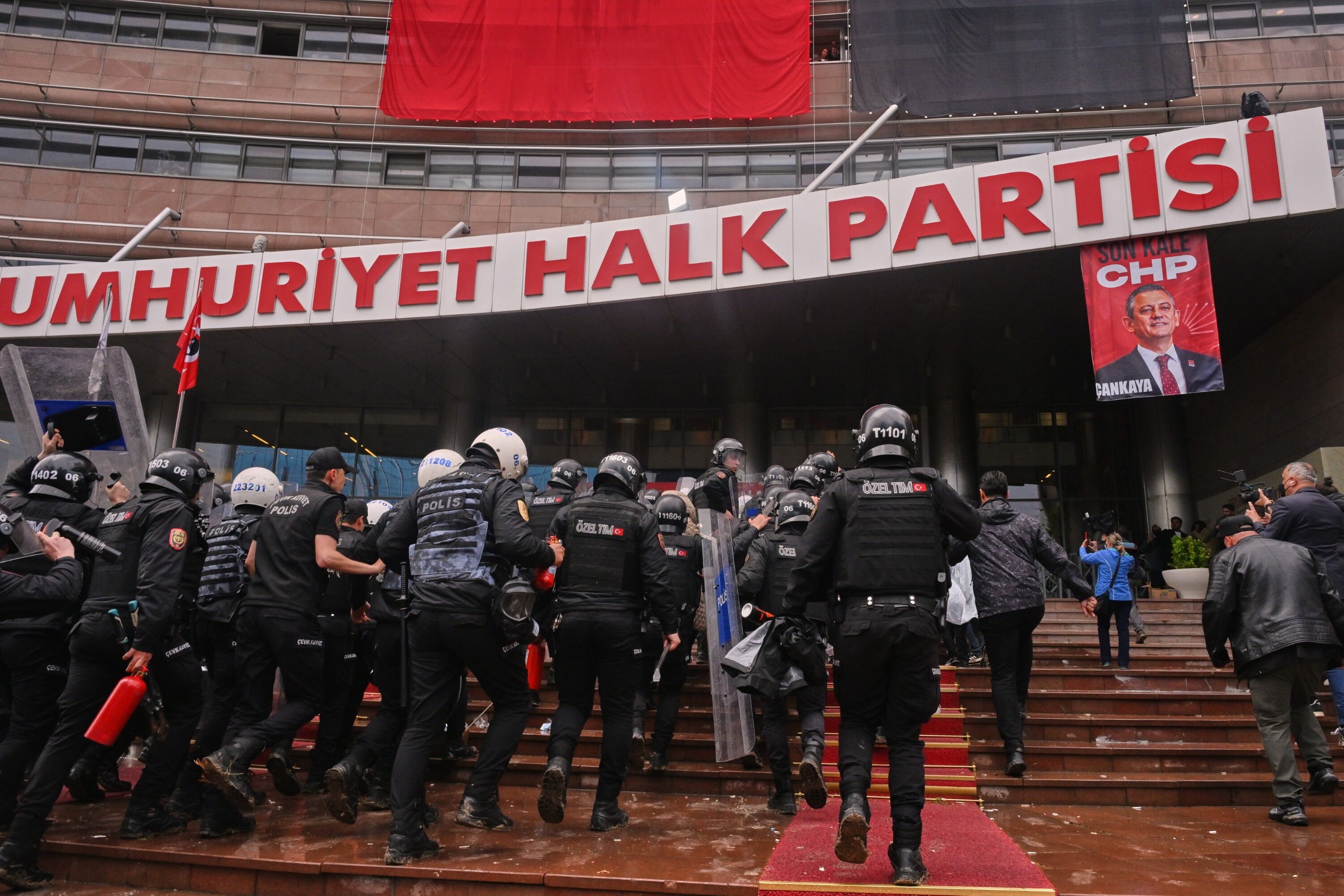
Riot police entered the headquarters of Turkey’s Republican People’s Party, the CHP, the country’s main opposition force. They used tear gas and force to clear out the party leadership after a court had ruled that it no longer had the legal right to remain in control. In the corridors of a party that still sees itself as the guardian of Turkey’s republican tradition, the state appeared in its crudest form. But what is really happening here?
At first glance, the affair may look like an internal opposition quarrel: one leader removed by court order, another restored to the party’s helm, the police simply carrying out an eviction. But the crisis now unfolding in Turkey tells a deeper story.
Özgür Özel, the ousted CHP leader, called the court decision a "judicial coup" and vowed that the party would continue its struggle in the streets and squares. His departure from the headquarters under police pressure, followed by a march toward parliament, carried powerful symbolism. With that gesture, the CHP tried to show that its headquarters was no longer just a building in Ankara. For its supporters, the party headquarters had moved wherever political will gathers: in front of parliament, among the people.
What the CHP is, and why this blow matters so much
The Republican People’s Party occupies a unique place in Turkish history. It is the oldest major political party of modern Turkey, tied to the legacy of Mustafa Kemal Atatürk, the idea of a secular republic, state-led modernization, and the political order that shaped Turkey’s elite for decades. In Erdoğan’s era, that tradition has lost its former dominance, but the CHP has remained the main institutional counterweight to his ruling AKP.
That is why the police operation inside CHP headquarters carries a weight that reaches far beyond an internal party procedure. Erdoğan’s rule has long been marked by its remarkable ability to turn institutions into instruments of political struggle. In such a system, a court ruling is rarely perceived as an isolated legal act.
For years, the CHP existed as an opposition party that could survive, but not quite win. It had historical capital, urban strongholds, more educated voters, and a strong secular identity, but it lacked the energy needed to defeat Erdoğan on the national stage. The ruling AKP, meanwhile, successfully cultivated the image of the CHP as the party of the "old elite", distant from conservative and Anatolian Turkey, while Erdoğan presented himself as the voice of the people against a cold bureaucracy and Western-oriented circles.
Anyone who has followed Turkish politics for any length of time knows this story well. But in recent years, that picture has begun to change. The opposition found room to win in the big cities. Istanbul and Ankara became proof that Erdoğan’s political machine has limits. When an opposition party controls the most important urban centers, it is only a matter of time before it returns as a national force as well. In a country like Turkey, where politics is always conducted through the symbolism of space, the big cities mean far more than local government.
The clash between Özel and Kılıçdaroğlu
At the center of the current crisis is the conflict between Özgür Özel and Kemal Kılıçdaroğlu. Kılıçdaroğlu led the CHP for many years and was Erdoğan’s main challenger in the 2023 presidential election. For the opposition, that election carried enormous expectations. Erdoğan entered the campaign burdened by economic turmoil, the aftermath of devastating earthquakes, and a society showing clear signs of fatigue after his long rule. Yet Kılıçdaroğlu still lost. It was not a catastrophic defeat, but it was a defeat all the same: 52.18% for Erdoğan, 47.82% for Kılıçdaroğlu.
The 2023 defeat opened the question of the party’s future direction. Many inside the CHP concluded that it could not continue with the same leadership and the same political formula. Özgür Özel was elected at the party congress later that year and took over at a moment when the opposition needed a new face. His arrival marked an attempt at internal renewal, after years in which Kılıçdaroğlu had managed to assemble a broad anti-Erdoğan coalition, but had plainly failed to finish the job.
Now comes the truly telling escalation. The court says there were "irregularities" at that congress. In practice, that meant the result was annulled, Özel was removed, and Kılıçdaroğlu was restored as party leader. One can describe this in the language of legal procedure, but the political meaning is visible at once. The decision brings back an old, defeated leader at the very moment when the new leadership had begun to create a different rhythm.
Kılıçdaroğlu’s career is now entering a dark final act. Returning to the head of the CHP through a court ruling and a police operation gives him a formal position, but strips him of moral force. A leader who comes back under state protection against his own party base enters a place from which it is difficult, perhaps impossible, to emerge without lasting historical damage.
Why Özel became a problem
Özgür Özel became dangerous for Erdoğan’s rule because of the political momentum the CHP began to generate after its leadership change. The 2024 local elections were the crucial proof. The CHP achieved a major victory, held Istanbul and Ankara, and showed that the AKP could no longer count on automatic dominance either in the large urban centers or in the country’s broader political mood.
For Erdoğan, the big cities have always been decisive. His own rise began in Istanbul, where, as mayor, he built the political capital that later carried him onto the national stage. Istanbul has an almost imperial weight in Turkish politics. Whoever holds Istanbul holds the country’s financial, cultural, and demographic heart. For the AKP, losing that city was never merely a local defeat.
Under Özel, the CHP began to look less like a tired party accustomed to losing and more like an organization capable of channeling accumulated discontent.
In Turkey, that discontent has been building for years: through inflation, falling living standards, pressure on the media, a sense of injustice, and the ever greater concentration of power around the presidential palace. Erdoğan remains powerful, with deep ties across the state, society, and the security apparatus, but his aura of invincibility is no longer what it once was.
That is precisely why the court decision looks like an intervention, not to say a commissioned one.
Özel and Kılıçdaroğlu: two versions of the CHP
The difference between Özgür Özel and Kemal Kılıçdaroğlu is not a difference between two completely opposing foreign policies. It is a difference between two political temperaments. Kılıçdaroğlu belongs to the old CHP world: institutional restoration, managed tensions, and a return to more predictable diplomatic habits. Özel is trying to turn the CHP into a livelier, more aggressive, broader opposition platform, a party that does not merely wait politely for power, but wants to show that it can take it.On Syria, Kılıçdaroğlu was more specific and more forceful. He advocated normalization with Damascus and the return of Syrian refugees, because the refugee question has become one of Turkey’s major domestic burdens. Özel speaks about the region more broadly, in terms of restoring diplomacy and stabilizing relations, but without the same personal fixation on Syria. With him, the stronger impression is one of new political energy, not a return to the old diplomatic school.
On Russia, Ukraine, and NATO, both remain within the framework of Turkish balancing. Kılıçdaroğlu criticized Erdoğan’s excessive dependence on Russia, while also stressing that Turkey must not be dragged into someone else’s war. Özel tries to express that position in a more "modern" key. Turkey would remain a member of the Western alliance, a neighbor of Russia, and an important partner of China. In essence, this is Erdoğan’s balancing act without Erdoğan’s privatization of the state.
On Iran and American-Israeli policy, Özel sounds more specific. He criticizes Ankara’s silence over attacks on Iran and emphasizes that change in Iran must not be imposed from outside. Kılıçdaroğlu views Iran more through the broader map of regional relations, transport corridors, and the Eurasian balance. As for China, Kılıçdaroğlu has shown an almost developmental fascination, seeing in the Chinese model proof of what the state and strategic planning can do. Özel treats China more pragmatically, but still as an important factor in Turkey’s future.
The judiciary as a mechanism of political control
Turkey’s government insists that the judiciary is "independent". Few people in Turkey, or beyond it, believe that.
Opponents of the government have for years faced investigations, pressure, dismissals, media campaigns, and accusations that drain them before they even reach the electoral contest.
The CHP now finds itself trapped inside precisely that mechanism. If Özel accepts the decision, the party loses a leadership that had won the support of a significant part of its membership. If he rejects it, the authorities can portray him as a man who refuses to recognize the legal order. If Kılıçdaroğlu takes over the headquarters, he gains physical space under state protection, but loses the trust of a large share of opposition voters. If he withdraws, he admits that his return was politically unsustainable.
The court case was not formally initiated by Erdoğan’s government, which makes the whole story even more interesting. It was brought by people from the CHP’s own orbit, among them former Hatay mayor Lütfü Savaş and a group of delegates who claimed that the 2023 congress had been tainted by irregularities.
For Erdoğan, such a development is almost ideal. The main opposition party, after major local victories and growing self-confidence, is forced into a struggle over its own legitimacy instead of attacking the government.
Theories of betrayal will certainly be heard in Turkey, but Kılıçdaroğlu does not need to be "Erdoğan’s ally" for his return to serve Erdoğan’s interests. It is enough for him to accept the role opened to him by the judicial apparatus and, by doing so, turn the crisis inside the CHP into a national spectacle. Perhaps he sees himself as the man saving the party from usurpation, but the effect is hard to miss. Erdoğan gains time, the opposition loses focus, and the CHP is transformed from a potential threat into a party of rupture.
Comments