
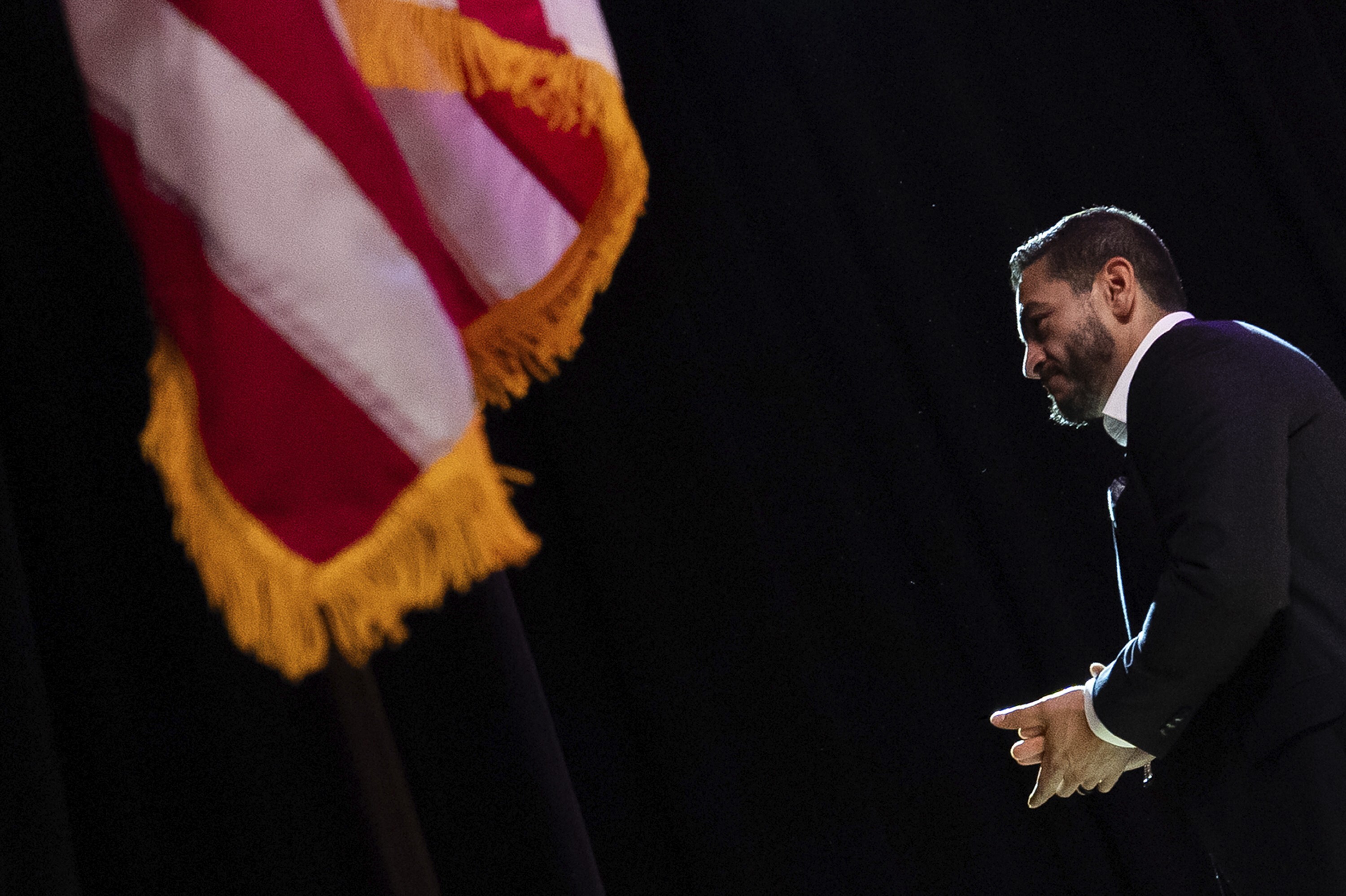
In American politics, vast sums of money usually dictate elections—and often do so by convincing people in advance that the candidate with the deepest pockets is bound to win. Candidates discipline themselves accordingly, party leaders choose among options already deemed acceptable, and voters are ultimately offered a choice within boundaries drawn long before they enter the booth. In Michigan, however, that arrangement—which turns democracy into a parody of itself—has now cracked wide open.
On one side stood tens of millions of dollars, almost the full weight of the Democratic establishment, and the warning that departing from America’s established pro-Israel line was, and would remain, an act of political suicide. On the other were volunteers, public healthcare, taxes on billionaires, and a refusal to declare yet another war an American national interest. When the votes had been counted, fear had lost its monopoly.
Abdul El-Sayed, a 41-year-old physician and former public-health chief in Detroit and Wayne County, narrowly defeated Representative Haley Stevens in the Democratic Senate primary. Stevens had the backing of Chuck Schumer, Governor Gretchen Whitmer, and much of the party machinery. El-Sayed campaigned for Medicare for All (a proposed national single-payer health-insurance system intended to replace private insurance and existing public programmes such as traditional Medicare and Medicaid with one government-run system), higher taxes on corporations and billionaires, and an end to unconditional US military aid to Israel. He won less than half the vote and still faces a far greater battle ahead. He has not won power, only a primary. But he has won the right to change what may be discussed in the first place.
The powerful pro-Israel lobby AIPAC and its affiliated organisations spent nearly $30 million to help Stevens—the largest amount they had ever poured into a single race—while outside groups spent another roughly $50 million on her behalf. Interestingly, many of the advertisements they financed mentioned neither Israel nor Palestine. Instead, they spoke of factories, jobs, and Barack Obama, as though voters were watching an entirely ordinary domestic campaign. El-Sayed, by contrast, mobilised more than ten thousand volunteers and turned the source of his opponent’s money into the defining issue of the election: us against the money.
Even more important—and particularly revealing—was what happened after Stevens lost. Schumer, who had endorsed her, immediately called for party unity behind El-Sayed, while Stevens herself promised to help him in November. The establishment that had tried to stop him discovered overnight that it might need him to keep Michigan, and with it its hopes of a Senate majority. Panic is rarely acknowledged as panic. In Washington, moments like this are called "party unity".
The Doctor Who Decided to Treat the State
Abdulrahman Mohamed El-Sayed is not a product of the conventional American political factory. Born in Michigan in 1984, he grew up with his father Mohamed, an Egyptian immigrant who came to the United States to study engineering, and his stepmother Jackie, whose family has lived in Michigan since the nineteenth century. His biography therefore contains two Americas: the immigrant America that still believes education can provide a path upward, and the provincial America deeply rooted in the towns and cities of the Midwest. At public school, he was not a withdrawn academic prodigy but the captain of the football, wrestling, and lacrosse teams—an early combination of intellectual discipline and instinct for an audience that would later become one of his political strengths.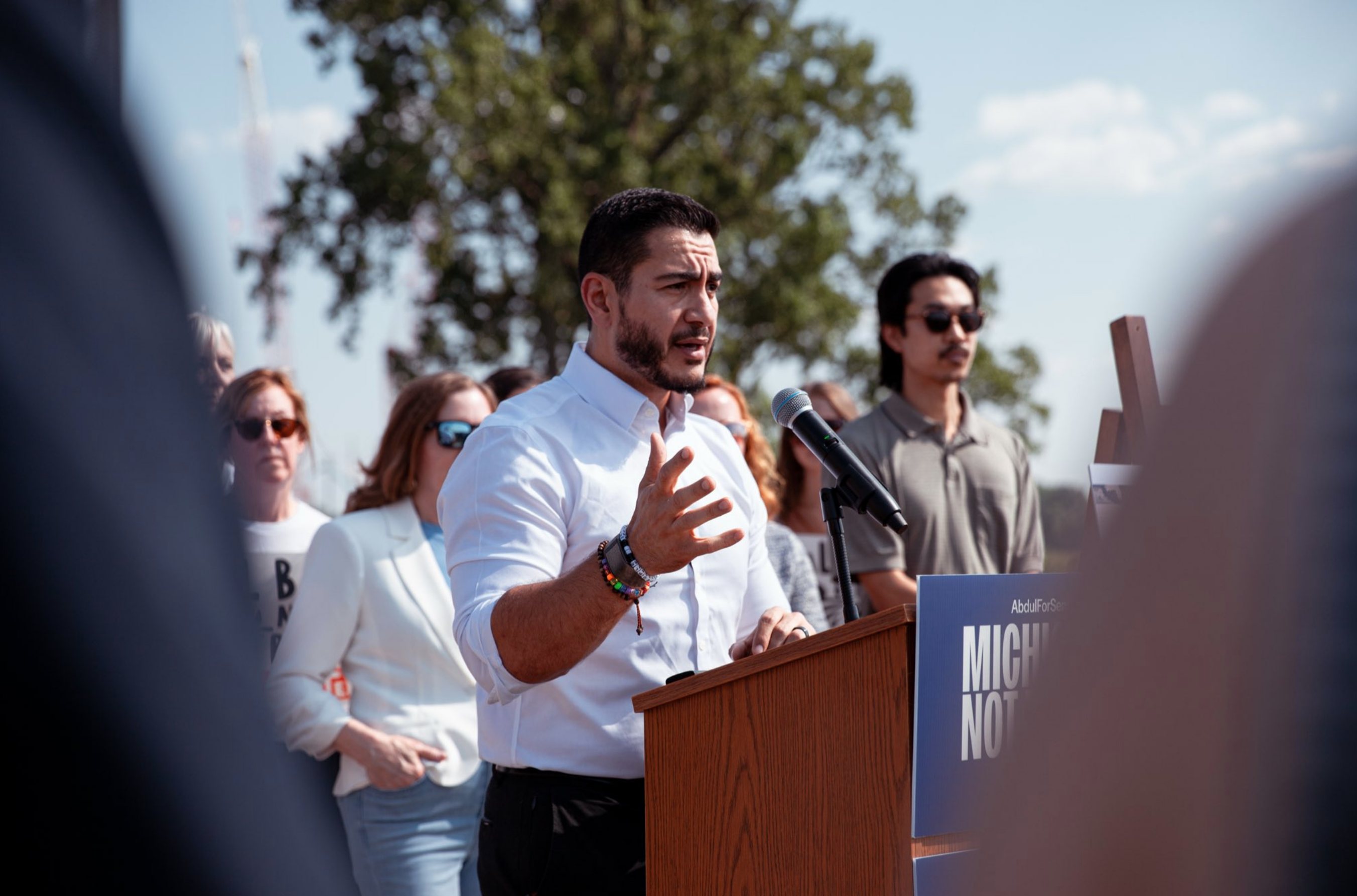
After working at Columbia, where he taught epidemiology, El-Sayed returned to Detroit at the age of thirty. The city was emerging from the largest municipal bankruptcy in American history, while its health department had been dismantled and largely privatised. He was given the task of rebuilding it almost from scratch. He thereby became one of the youngest public-health directors of any major American city—a physician without a hospital ward, but with nearly 700,000 residents as his patients.
The Flint water crisis further convinced him that public health ends where austerity politics begins. He watched supposedly "efficient" accounting decisions turn into lead in children’s blood, and in 2017 he left the Detroit administration to run for governor of Michigan. He lost to Gretchen Whitmer, but won around 30 percent of the vote and built a national profile with the support of Bernie Sanders and Alexandria Ocasio-Cortez. Defeat did not return him to obscurity. It turned him into one of the few American progressives familiar with academia, public administration, and the anatomy of a failed campaign.
He wrote about politics as a social disease, hosted programmes on public health, took part in the Biden-Sanders healthcare task force, and later assumed responsibility for Wayne County’s health, social services, and veterans system, serving a population of approximately 1.8 million. There he worked on removing lead from schools, expanding access to overdose-reversal medication, protecting communities from industrial pollution, and creating a programme to cancel hundreds of millions of dollars in medical debt. His political argument was not born in the seminar rooms of the American left, but in offices where one can see how quickly a single unpaid hospital bill can destroy an entire family.
El-Sayed is therefore an unusual combination: a Rhodes Scholar who attacks privilege, a Muslim of Egyptian descent who speaks the language of working-class Michigan, and a physician who chose not to devote himself to individual patients because he believes the disease has spread through the system itself. If he wins in November, he will become the first Muslim senator in the history of the United States. Yet something else may matter more than the symbolism: for the first time, the Senate would contain a politician whose career rests on the claim that American medicine cannot heal society while American politics itself remains beyond saving.
For decades, the pro-Israel consensus was one of the few places where Republican and Democratic elites understood one another almost without speaking. AIPAC did not create that order on its own. Behind it stood American strategy in the Middle East—and the perennial question of who was directing whom—the arms industry, the evangelical movement, donor networks, the legacy of the Cold War, and the deeply rooted idea that Israeli military superiority was an extension of American power. AIPAC, however, imposed electoral discipline on that wider system: rewarding the reliable, punishing the disobedient, and maintaining ties with both parties so effectively that, from the lobby’s perspective, American democracy came to operate according to one simple rule: it did not matter who won.
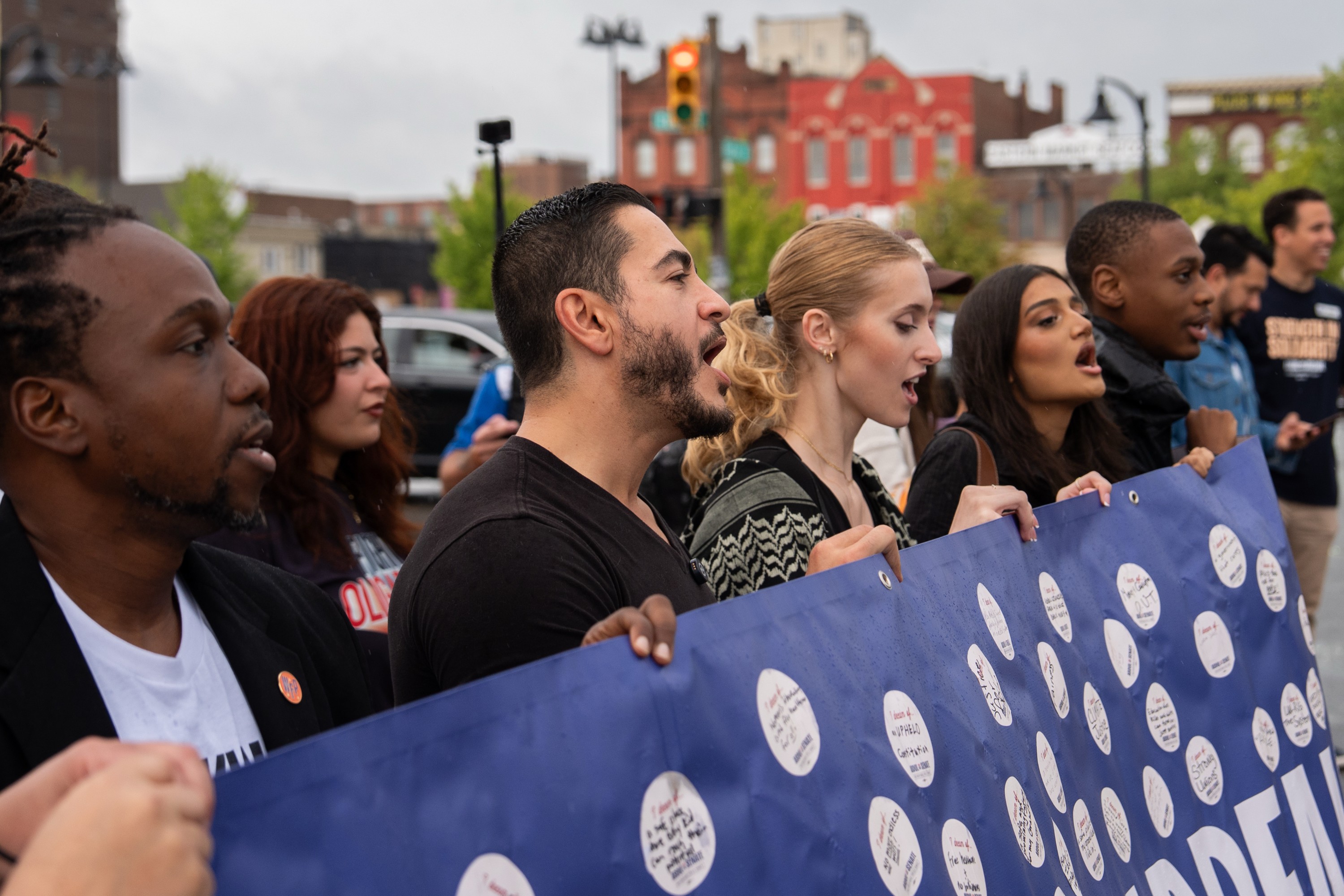
Something is changing, however, because in Michigan the enormous spending produced the opposite of its intended effect. When nearly $30 million is poured into a single primary, the hand that was meant to remain hidden in the background becomes impossible to ignore. Voters no longer see only the candidate promoted by the advertisements. They also see an attempt to purchase the boundaries of permissible politics. Some will say they should have noticed this much earlier, but the situation is different now. After the horrors in Gaza, perceptions of Israeli influence are no longer what they once were, and probably never will be again. Young people who risked so much by protesting Israeli aggression—above all their employment prospects and even expulsion from expensive universities—have created a new political climate that is now leaving the protest march and entering politics directly.
El-Sayed understood this better than his opponents. He did not campaign as though Gaza, Iran, healthcare, drug prices, and worker insecurity were separate issues. He brought them together in a single argument about a state that can always find money for war and military aid, while telling its own citizens that universal healthcare is "too expensive". The pro-Israel lobby was therefore no longer presented as an isolated foreign-policy issue—something that American voters, broadly speaking, often care little about—but as part of a wider oligarchic architecture in which billionaires, corporations, and the arms industry decide what America is permitted to become.
Attitudes towards Israel are changing rapidly. This year, Gallup recorded for the first time that more Americans sympathised with Palestinians than with Israelis, by 41 percent to 36 percent. Pew found that eight in ten Democrats had an unfavourable opinion of Israel. More troubling still for the Republican leadership, 57 percent of Republicans under fifty also viewed Israel negatively, while older generations remained far more firmly attached to the old policy.
These are profound changes in American society. Political turning points are beginning to make themselves felt.
This is also where AIPAC faces its greater challenge. The organisation can pour vast sums into advertisements, new opposing candidates, and fresh accusations of extremism, but it cannot manufacture a new generation of voters who see the world through the eyes of the 1980s. Younger Americans do not remember the Israel once presented to their parents as a threatened David facing a regional Goliath. What they see is a nuclear-armed state backed by billions of American dollars, occupying territory and waging wars that spread from Gaza into Lebanon, Syria, and Iran.
The change has already reached Congress. More than one hundred Democratic representatives recently voted against $3.3 billion in aid to Israel, while almost half of House Democrats supported another attempt to restrict military assistance. Until recently, votes on that scale would have been unthinkable. They do not mean the old consensus has disappeared, but they do show that disobedience is no longer an isolated act of political suicide. It is beginning to resemble a serious faction.
That same night, Michigan produced further evidence that this was not an isolated revolt. Progressive organiser William Lawrence won the Democratic nomination in a competitive congressional district while campaigning for universal healthcare and an end to US arms sales to Israel, while Donavan McKinney defeated incumbent Representative Shri Thanedar. The old guard did not lose only one race. It felt a younger generation entering through several doors at once.
AIPAC: From a Quiet Newsletter to a Machine of Political Discipline
AIPAC did not begin as a giant electoral machine, but as a small office with a highly specific task: persuading the US Congress that support for the new Israeli state was a permanent American interest. Its founder, Isaiah "Si" Kenen, a journalist and former lobbyist with ties to the Israeli government, established the American Zionist Committee for Public Affairs in the mid-1950s. In 1959, the organisation adopted its current name—the American Israel Public Affairs Committee—removing the explicitly Zionist label and creating space for a broader coalition of support for Israel that extended beyond the Jewish community.The decisive moment came after the 1973 Yom Kippur War. When President Gerald Ford’s administration announced a "reassessment" of relations with Israel in 1975, hoping to pressure it into making concessions in negotiations with Egypt, AIPAC helped organise a counterattack in Congress. A letter demanding that Ford maintain firm support for Israel was signed by no fewer than 76 senators. The White House discovered that a president might direct foreign policy, but could not implement it if Congress blocked the way—at least, that was still true in those days. At that moment, AIPAC ceased to be merely one interest group among many and became a Washington force that had to be consulted.
During the 1980s, under the leadership of Thomas Dine, the organisation built a network of activists, donors, and local groups capable of operating in almost every congressional district. AIPAC still did not distribute campaign money directly as it does today. Its power rested on something more discreet: members and affiliated donors were shown who was considered a "friend of Israel" and who was not, after which the money, so to speak, found its own way. The defeats of Republican Representative Paul Findley in 1982 and Senator Charles Percy in 1984 were turned into warnings for everyone else. There was no need to prove that AIPAC had personally brought them down. It was enough for every member of Congress to believe they might be next.
American presidents occasionally clashed with Israeli governments, and AIPAC did not win every battle. Over time, however, it achieved its greatest objective: making unquestioned support for Israel an assumption shared by both parties.
AIPAC gradually expanded beyond the Israeli-Palestinian question. It lobbied for strategic military cooperation, annual aid packages, missile-defence systems, and ever-tougher sanctions against Iran. Its conferences became stages on which Democratic and Republican presidents, cabinet members, and members of Congress competed to demonstrate their devotion to the alliance. Its greatest success was the creation of an almost surreal atmosphere in which politicians no longer asked whether they should support Israel, but how convincingly they had to display that support.
Yet for precisely the reasons highlighted by the story unfolding today, AIPAC spent decades keeping itself one step removed from the direct financing of candidates. That changed at the end of 2021, when it registered its own political action committee, together with the super PAC United Democracy Project, which could spend unlimited sums on advertisements for or against candidates. The organisation acquired a far more powerful electoral weapon, but lost some of the protective darkness in which it had once operated. Money that had previously flowed through networks of sympathisers now appeared on screens, in reports, and in campaign advertisements with a name, an amount, and a political target.
At first, this change appeared formidable. Progressive candidates could be buried overnight beneath tens of millions of dollars in negative advertising, often without any mention of Israel, Gaza, or the actual reason they had been targeted. But direct intervention in primaries also created a new vulnerability. AIPAC was no longer merely an invisible force capable of closing doors to a politician. It became a visible participant in elections—one against which candidates could mobilise, raise small donations, and tell voters that an outside force was trying to buy their vote.
That is why Michigan is historically significant. El-Sayed defeated an organisation whose model of political power had been built over more than seventy years—a model in which fear is manufactured with money and then converted into bipartisan obedience.
On the right of the political spectrum, the backlash has not yet acquired the same organisational form, but nor can it be dismissed as insignificant internet noise. After Trump’s war against Iran, Tucker Carlson announced that he would no longer support the Republican Party, then began discussing the creation of a third party and presenting his own political platform. This could prove highly significant. At conservative gatherings, the generational divide is becoming increasingly visible between older evangelicals, for whom support for Israel is almost a religious obligation, and younger Republicans who ask why American money, soldiers, and weapon stockpiles are being spent on other countries’ wars.
The revolts on the left and right are not the same, and they should not be idealistically merged. The left begins with Palestinian rights, social equality, and opposition to militarism. The insurgent right more often begins with the national interest, isolationism, and the belief that Trump betrayed the promise of America First.
The war against Iran is accelerating both processes. After five months of conflict, only about a third of Americans support the war, while most voters believe Trump has failed to explain clearly what he hopes to achieve. By July, the Pentagon had acknowledged costs of $37.5 billion, while fuel prices rose and the illusion disappeared that yet another Middle Eastern war could be fought quickly, cheaply, and without consequences at home. For the left, this is proof that the war machine consumes the welfare state. For the right, it is proof that "America First" once again ends in the Middle East.
The two sides do not need to form an alliance to bring down the central pillar of the old order. It is enough for a progressive Democrat to stop fearing AIPAC’s money, and for a conservative Republican to stop believing that every Israeli war is automatically an American war. When pressure arrives simultaneously from both edges, the centre—which for decades pretended to embody a national consensus—discovers that it was merely an agreement between two party oligarchies all along.
It would nevertheless be premature to declare victory for the new forces. By the end of June, before the final wave of spending in Michigan, AIPAC’s super PAC United Democracy Project had raised almost $104 million and still had more than $80 million available. In November, El-Sayed must defeat Republican Mike Rogers in a state won by Trump in 2024, and Republicans have already begun depicting him as "the most dangerous radical in America". The money, the media, the lobbyists, and the military-industrial interests have not disappeared. They have merely been given a reason to strike harder. Can the concept of "us against the money" prevail again? We will find out in November’s congressional elections. But if El-Sayed succeeds—if those around him who are willing to confront AIPAC’s money with their own time and commitment succeed as well—it will be a historic victory.
No outside power will "democratise the United States". Russia, China, Iran, and the rest of the world may constrain American military power, make imperial wars more expensive, and reject Washington’s dictates, but they cannot dismantle the American oligarchy. That task belongs to Americans, who must reject from within the world of both Biden and Trump, of lobbyists and weapons manufacturers—the world of two parties that quarrel over details while jointly financing war and enabling the exhaustion of the American worker.
America may finally be becoming the arena of a genuine democratic struggle. And the struggle for a better America, of course, concerns not only Americans. It concerns the entire world.
Sources
- BBC El-Sayed's victory sends tremors through Democratic Party https://www.bbc.com/news/articles/cp309ng0xq1o
- Reuters After bitter primary, El-Sayed seeks to unite Democrats in must-win Michigan race https://www.reuters.com/world/us/progressive-el-sayed-wins-michigan-primary-jolt-democrats-us-media-project-2026-08-05/
- News.gallup.com Israelis No Longer Ahead in Americans' Middle East Sympathies https://news.gallup.com/poll/702440/israelis-no-longer-ahead-americans-middle-east-sympathies.aspx
- Aipac.org AIPAC Politics https://www.aipac.org/politics
- Pewresearch.org Negative views of Israel, Netanyahu continue to rise among Americans – especially young people https://www.pewresearch.org/short-reads/2026/04/07/negative-views-of-israel-netanyahu-continue-to-rise-among-americans-especially-young-people/
- Associated Press How Abdul El-Sayed went from political oblivion to progressive breakthrough in Michigan Senate race https://apnews.com/article/60c79349b60ffbf24a34d60b76e130ed
- Fec.gov UNITED DEMOCRACY PROJECT ('UDP') https://www.fec.gov/data/committee/C00799031/
- Cambridge.org “The Edge of the Abyss”: The Origins of the Israel Lobby, 1949–1954 | Modern American History | Cambridge Core https://www.cambridge.org/core/journals/modern-american-history/article/edge-of-the-abyss-the-origins-of-the-israel-lobby-19491954/E1690BDB5CA87C66B2B65D12CA1D716A
Comments