
One dead sailor on a closed sea may just be a war statistic, but behind the attack, a strategic space is already emerging where there is no longer a neutral shore.
If we were to view this as an “isolated incident”, it would hardly rank as a major event amid the wars already under way: one sailor killed, one crew member wounded and one ship damaged. On the map of Eurasia, however, the Ukrainian attack on an Iranian vessel in the Caspian Sea could prove far more significant than the explosion itself.
Iran says a commercial vessel was struck, while Kyiv claims the ships were involved in transporting military cargo between Iran and Russia. There has been no independent confirmation of the nature of the cargo, but the political consequences have already arrived. Tehran summoned Ukraine’s chargé d’affaires, denounced the attack as an act of aggression, and Foreign Minister Abbas Araqchi warned that it “cannot go unanswered”. Even if Ukraine’s claim is accurate, the closest equivalent would be a hypothetical Russian strike on a weapons convoy in Poland, based on the assumption that it was carrying supplies to the Ukrainian front. Iran, of course, is not protected by NATO’s Article 5 as Poland is, but the distance to crossing even that boundary has now become considerably shorter.
This move has undoubtedly crossed a line that, until yesterday, still existed. Iran has supplied Russia with drones and military equipment — that is no longer a secret — while Ukrainian cities have endured years of attacks by aircraft derived from the Shahed design. Ukraine, in turn, began offering its interception expertise to Persian Gulf states affected by the war between Iran and the United States. In other words, these two major wars were already exchanging technology, intelligence, specialists and weapons. In the Caspian Sea, however, they have now exchanged fire so directly for the first time.
That same day, Volodymyr Zelenskyy accused Russia of providing Iran with satellite imagery of American bases and military facilities in Bahrain, Jordan and Kuwait. According to Kyiv’s account, Moscow and Tehran are no longer cooperating only against Ukraine, but also against “American infrastructure in the Middle East”. Kyiv then strikes ships operating along the Russo-Iranian Caspian route. Even when the claims made by warring parties are treated with the necessary caution, the pattern is difficult to ignore: the wars in Eastern Europe and the Middle East are beginning to behave like two wings of the same malignant crisis.
At first glance, the Caspian Sea appears to be an enclosed and remote body of water. In reality, it is one of the continent’s most important strategic joints. Russia lies on its northern shore, Iran to the south, Azerbaijan to the west, and Kazakhstan and Turkmenistan to the east. The vessel that was struck had sailed from Russia’s Astrakhan region towards Iran. It is precisely along this axis that Moscow and Tehran are trying to build a transport system linking Russia, through Iran, to the Persian Gulf, the Indian Ocean and, beyond them, the Indian market.
This is the North–South Corridor, a roughly 7,200-kilometre network of railways, roads and maritime routes connecting Russia, Iran and India. Its importance does not lie in the addition of a few more trains or ships, but in the possibility that countries under severe sanctions could develop trade that does not depend on northern European ports, the Suez Canal or Western logistics intermediaries. The unfinished Rasht–Astara railway is intended to close one of the final major gaps in the network. For Russia and Iran, the Caspian Sea is therefore an economic artery, a military hinterland and a route out of isolation.
Running across the same sea, but from east to west, is the Middle Corridor. It links China and Kazakhstan with the ports of Aktau and Kuryk, crosses the Caspian towards Baku, and continues through Georgia and Turkey to the European market.
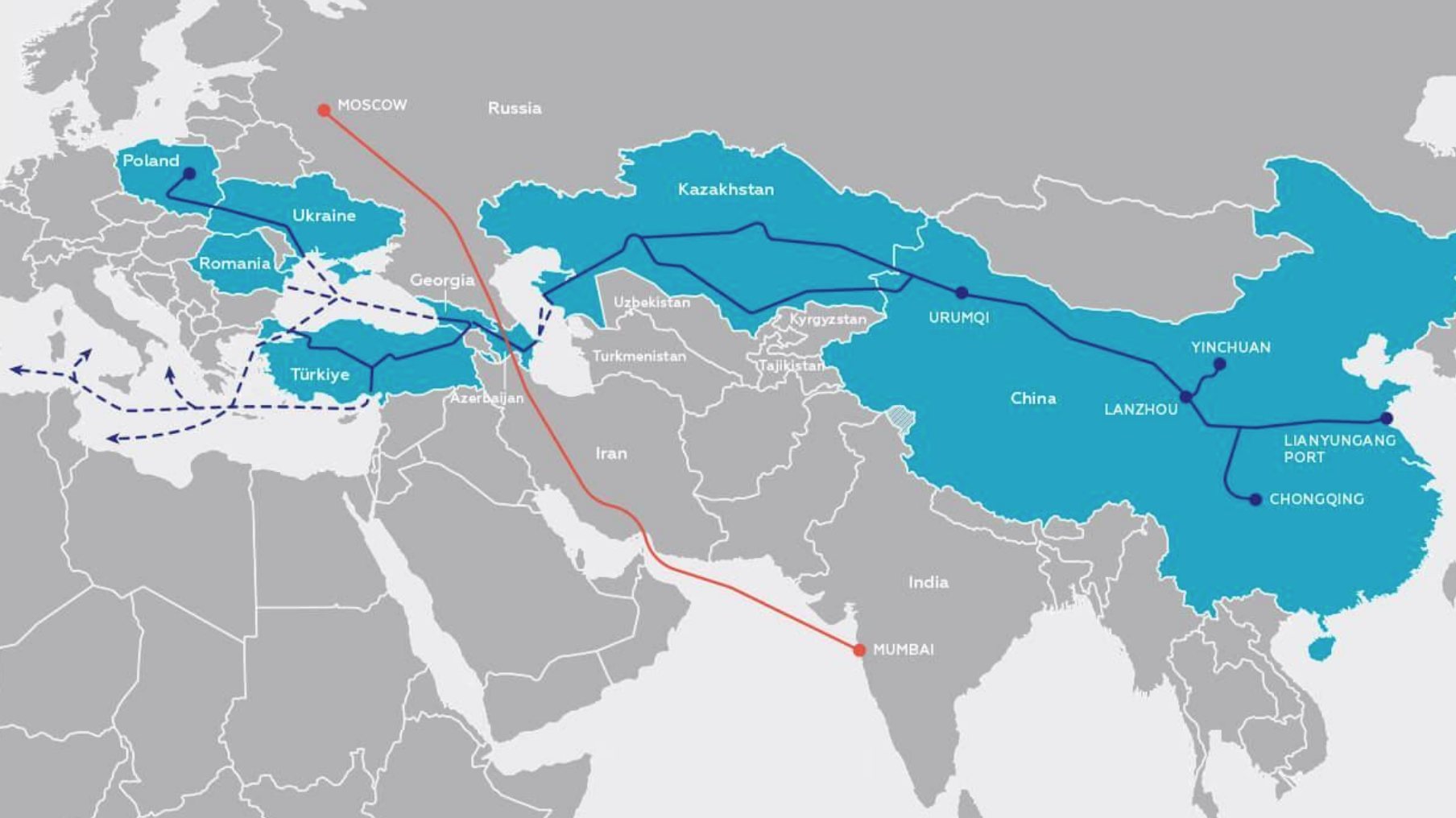
The European Union and international financial institutions have pledged €10 billion to turn this route into an alternative to the northern corridor through Russia. The World Bank estimates that, with the necessary investment, traffic across the Caspian Sea could triple by 2030, although it would still remain small compared with the total volume of trade between China and Europe.
The Five States Around the Caspian That Will Have to Choose Sides
Five countries share the Caspian Sea. Russia and Iran are tied together by military cooperation, sanctions, trade and the North–South Corridor. The other three coastal states — Azerbaijan, Kazakhstan and Turkmenistan — have spent years trying to profit from their position between rival blocs without binding their fate to either side. The war is now stripping them of that luxury.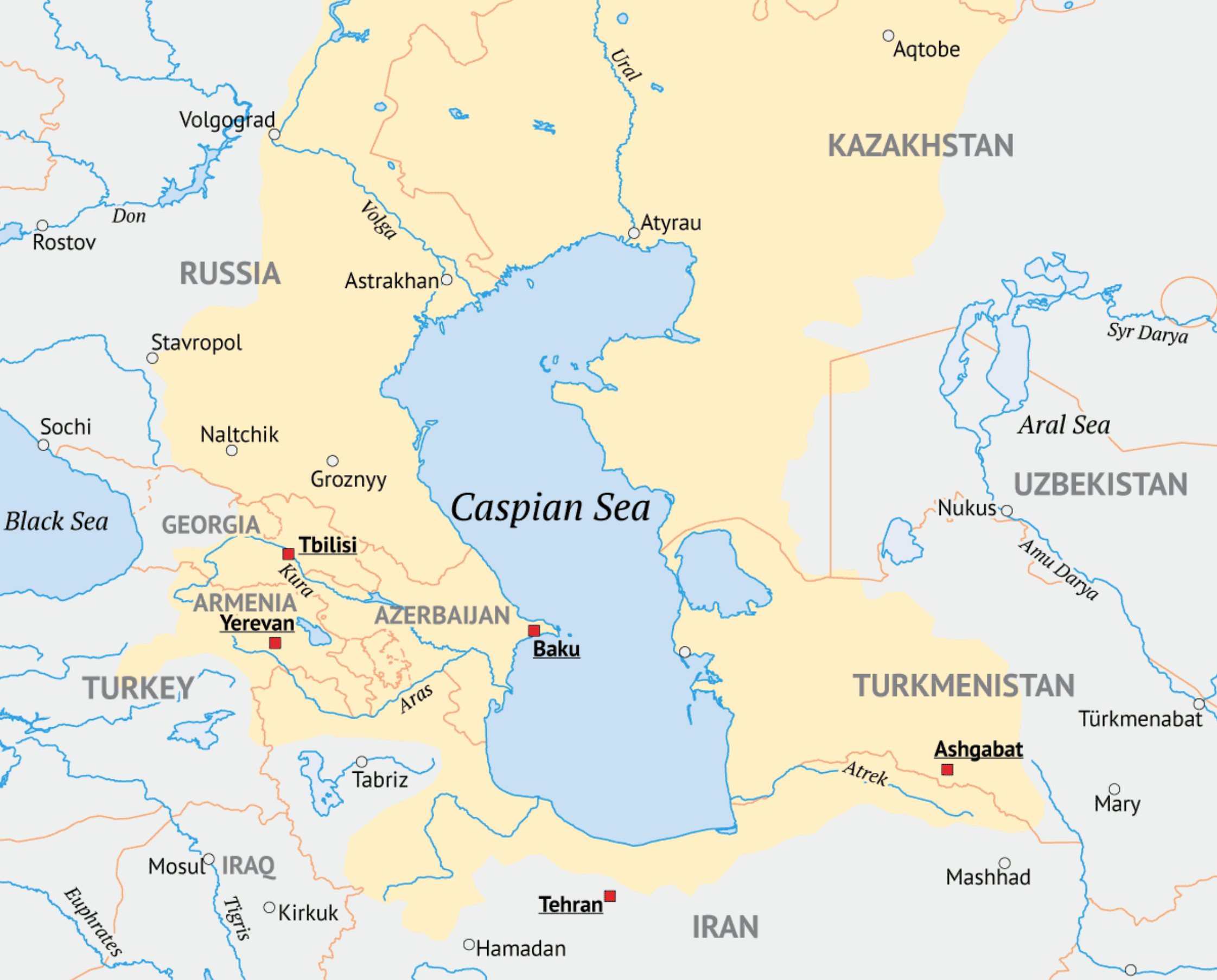
Kazakhstan is in an even more complicated position. It shares the world’s longest continuous land border with Russia, is building its economic future with China, sells energy to Europe and is trying to develop an alternative Caspian route that bypasses Russian territory. Astana wants neither a Russian defeat, Chinese domination nor Western isolation; it wants to trade with everyone at once. Yet Kazakh exports have already felt the consequences of Ukrainian attacks on Black Sea transport. The expansion of strikes into the Caspian could force Kazakhstan to choose between distancing itself politically from Moscow and more actively protecting the infrastructure that economically binds it to Russia.
Turkmenistan shelters behind an official policy of permanent neutrality, but geography has signed no such declaration. Its enormous gas reserves, the port of Turkmenbashi and its links to multiple transport corridors make it a potential bridge between China, Iran, the Caucasus and Europe. As long as the Caspian remains peaceful, such restraint is profitable. Once ships begin to burn, however, a neutral state must decide whether to close its ports, offer refuge to damaged vessels, permit overflights, share radar data or accept demands from more powerful neighbours. Turkmenistan has already joined both the North–South Corridor and broader Eurasian transport networks, meaning that any attempt to sever them militarily would pass close to its shores.
The 2018 Convention was supposed to preserve the Caspian as an enclosed space belonging to its five coastal states, free from the armed forces of outside powers. Drones, however, have demonstrated just how thin that legal barrier really is. A foreign aircraft carrier clearly cannot enter the sea, but its target can still be struck without a single foreign warship appearing there. If attacks and reprisals become more frequent, Azerbaijan, Kazakhstan and Turkmenistan will no longer be able to act merely as owners of ports and collectors of transit fees. They will have to decide whom they trust, whose ships they are prepared to protect and whose war they will shut out of their territory. The Caspian would then cease to be a shared sea and become a front with no neutral shore.
Two competing but equally important visions of Eurasia therefore intersect on the shores of the Caspian. One runs from Russia towards Iran and India; the other runs from China towards Europe while bypassing Russia. For Moscow, the Caspian is a route south. For Beijing, it is one of several routes west. For Brussels, it is an alternative to dependence on Russia. For Washington, meanwhile, it is a space in which the future of the vast landmass between the Pacific and Atlantic is being decided: will it one day possess connections that no outside power can easily sever?
The most dangerous possible development would therefore be the creation of a vertical war zone stretching from Ukraine and the Black Sea, through the Caucasus and the Caspian, all the way to Iran and the Persian Gulf. It would not be a physical wall capable of stopping every container travelling between China and Europe. Trade always finds a detour. Instead, it would create a belt of instability that makes overland transport expensive, unpredictable, difficult to insure and vulnerable to political coercion. Goods would return to longer maritime routes, while every remaining corridor would pass through territory under somebody’s military control.
This is also where the answer lies to the broader question of American dominance. The United States is not a Eurasian land power. Its power was built on the oceans, naval fleets, a global network of bases and alliances, a dollar-based financial system and control over crucial maritime chokepoints. Stable overland integration across Eurasia would not automatically bring down the United States, but it would undoubtedly weaken some of its most important sources of leverage. China would gain more routes to markets and energy supplies, Russia more ways out of its European blockade, Iran a role as a continental transport hub, and Europe the ability to choose between the Atlantic and the interior of the continent.
No secret or grandiose master plan is even required to disrupt such integration. In the present situation, it is enough for different actors, each pursuing their own immediate objectives, to produce the same result. Ukraine wants to interrupt Iranian supplies to Russia. Israel wants to weaken Iran. The United States wants to preserve pressure on Tehran and contain China. European governments want to bypass Russia while remaining connected to Asia. Each individual move may be tactically understandable, while their combined effect creates a continental fracture.
Zbigniew Brzezinski described this American interest quite openly as far back as 1997. He regarded Eurasia as the main chessboard on which global supremacy would be decided and tied American strategy to preventing the emergence of a power capable of dominating the supercontinent. Today, that challenger would not have to take the form of a single state or empire. It could be a network: Chinese industry and technology, Russian raw materials, Iran’s transport position, the Indian market, and European capital and purchasing power. Their interconnection would pose a greater challenge to American hegemony than any individual adversary.
The European market is crucial to this equation. In 2025, the European Union imported around €559 billion worth of goods from China, while its trade deficit with Beijing approached an astonishing €360 billion. In the first quarter of 2026 alone, it reached €98 billion. China does not need to conquer Europe militarily, nor does it have any such ambition. It is enough for it to become an indispensable supplier of machinery, electrical equipment, vehicles, chemicals and consumer goods. Overland corridors would make this process more resistant to naval blockades and American pressure.
At the same time, Washington does not necessarily have an interest in completely severing trade between Europe and Asia — the American economy itself remains deeply intertwined with China. What matters far more is that this trade continues to be organised through routes, institutions and security arrangements over which the West has the decisive say. Europe may trade with China, but as an American ally that restricts Chinese technology. It may import energy, but no longer from Russia. It may build the Middle Corridor, but in a way that bypasses both Moscow and Tehran. In other words, the struggle is not over whether these connections will exist, but over whose territory they will cross, who will secure them and who will have the power to shut them down.
In this sense, the Ukrainian strike in the Caspian Sea is exceptionally risky. Kyiv can reasonably argue that it has a military interest in attacking supply chains that deliver weapons to the Russian army. Russia has the same interest and may, as suggested at the beginning, one day begin acting on it regardless of the risks. Nevertheless, striking an Iranian vessel while Iran is at war with the United States draws Ukraine into a conflict whose objectives extend far beyond the “defence of Ukrainian territory”. The further Ukrainian operations expand towards Iran and towards Russian assistance for Tehran, while simultaneously aligning with American interests in the Middle East, the more difficult it will become to maintain that these are two separate wars.
Iran’s response, which has already been promised, need not come in the form of a direct attack on Ukraine. Tehran could provide Russia with more advanced drones, missiles, intelligence or technology that it may previously have withheld. It could attack Ukrainian interests in third countries or coordinate its activities with Moscow at a higher level. Russia could begin protecting Caspian shipping with warships and air-defence systems. Every such step would transform the enclosed sea into a new battlefield and a commercial corridor into a military line of communication.
The Black Sea is already a war zone, the Persian Gulf lives under the threat of closure, and the Red Sea has been unstable for years — particularly now that Yemen’s Houthis have announced a greater level of involvement. Turning the Caspian Sea into yet another theatre of conflict would engulf almost all the remaining space between these existing flashpoints.
One dead sailor may be an insignificant statistic in the context of major wars, but he may also become the first person killed in a new geography of conflict. The greatest danger is not that the wars in Europe and the Middle East will formally merge under a single command. More dangerous still is the possibility that the space of peace, neutral transit and political insulation between them will disappear. Once an uninterrupted line of strikes, reprisals and military alliances stretches from Ukraine to Iran, Eurasia will not be divided by a fence — it will be cut through by fire.
Sources
- Reuters Iran foreign minister says Ukraine's attack on Iranian vessel 'cannot go unanswered' https://www.reuters.com/world/china/iran-foreign-minister-says-ukraines-attack-iranian-vessel-cannot-go-unanswered-2026-07-26/
- Foreignaffairs.com A Geostrategy for Eurasia https://www.foreignaffairs.com/articles/asia/1997-09-01/geostrategy-eurasia
- Al Jazeera Iran accuses Ukraine of deadly attack on Caspian commercial vessel https://www.aljazeera.com/news/2026/7/25/iran-accuses-ukraine-of-deadly-attack-on-caspian-commercial-vessel
- Csis.org Resilience Through Linkage: Russia, Iran, and Aspirations for North–South Trade https://www.csis.org/analysis/resilience-through-linkage-russia-iran-and-aspirations-north-south-trade
- Worldbank.org The Middle Trade and Transport Corridor: Policies and Investments to Triple Freight Volumes and Halve Travel Time by 2030 https://www.worldbank.org/en/region/eca/publication/middle-trade-and-transport-corridor
- Ec.europa.eu EU trade with China - latest developments https://ec.europa.eu/eurostat/statistics-explained/index.php?title=EU_trade_with_China_-_latest_developments
Comments