
What Would an AfD Government Mean for Germany? Let us begin with the obvious rhetorical question: can anyone in Europe even ask what such a thing would objectively mean without ideology and prejudice taking over? For many, the question itself is already too controversial. But consider it this way: every poll in Germany today confirms that the AfD is now the country’s strongest party. That alone should be enough to justify a serious analysis of its position, whatever one thinks the AfD represents — "European multipolarity," "new Nazism," or, as is more likely, something else altogether.
Even the claim that the AfD is clearly Germany’s strongest party may come as a shock to many, since it is hardly a figure the media tend to emphasize. But the numbers are there. According to the INSA institute (May 2026), the AfD stands at 29% support. The once untouchable conservative CDU/CSU alliance has fallen to 22% (with as many as 76% of respondents saying they do not support Chancellor Friedrich Merz). The once powerful center-left SPD is now at just 12%, also trending downward, while the Greens have risen to 14% and the left-wing LINKE is stagnating at around 11%.
The picture becomes even more interesting if we look at the past five years. The AfD has surged from 10% to 29%. The CDU and the Greens have, more or less, stayed where they were. LINKE has climbed from 5% to 11%. But conclusions should wait. These numbers, on their own, leave no room either for panic or for euphoria, depending on what one thinks of the AfD, because there is something called the "Brandmauer" — the firewall against the far right in Germany. In practical terms, it means that all German political parties, except the AfD, are united in a strategy of refusing any cooperation with a politics that either presents itself, or is presented by others, as far right.
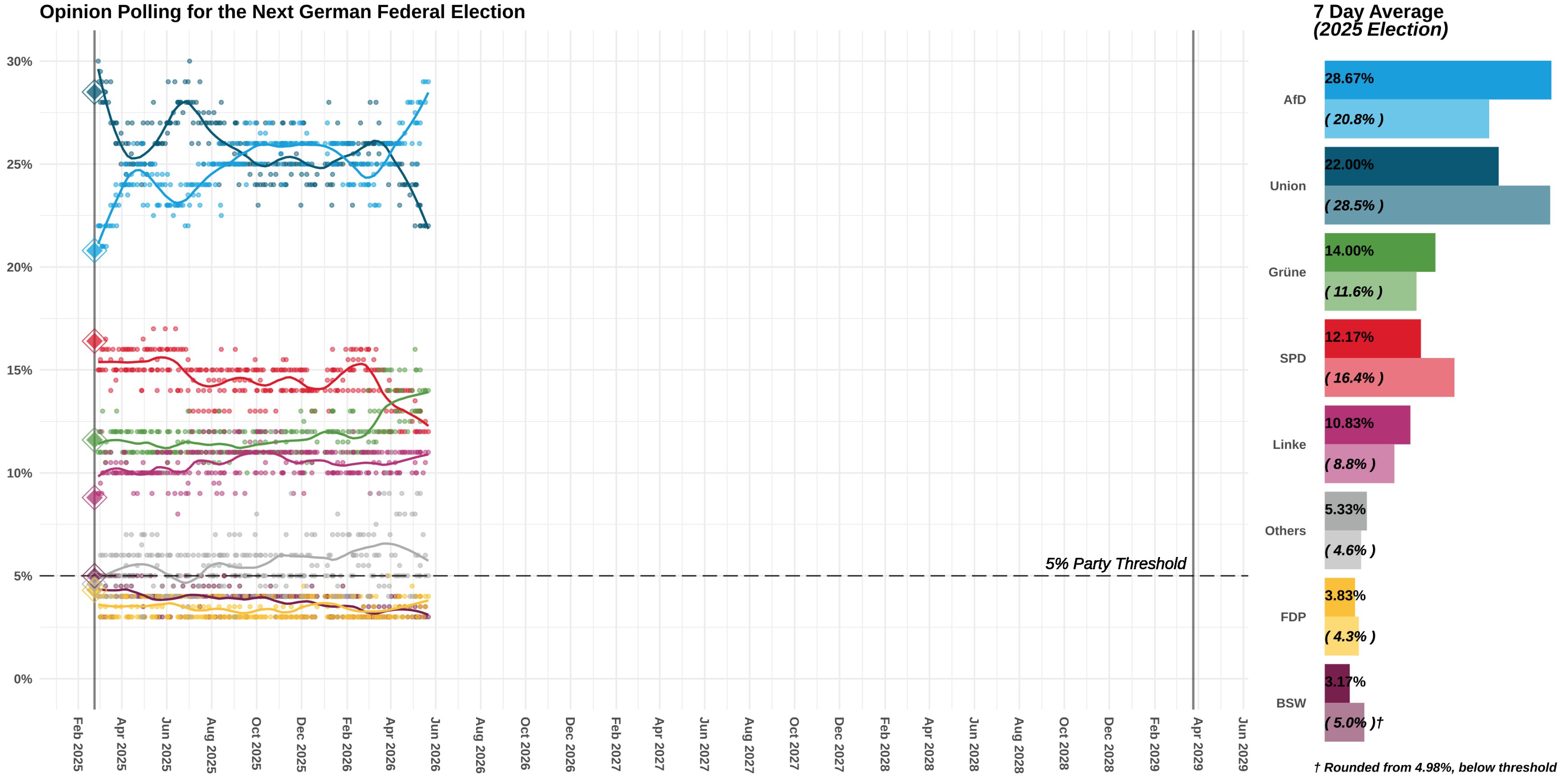
That means the AfD can continue to grow "freely," but it will not come to power. Quite simply, it will always lack the parliamentary numbers (coalition partners).
So is that the end of the story? Yes. Or perhaps not. Because there is one major "unless," and several smaller ones.
The first "unless" is the one that probably will not happen under "normal conditions" — a phrase worth stressing, as we will explain later — namely that the AfD keeps rising until it no longer needs coalition partners at all. Where would that point be, given current polling? Quite far away: somewhere around 45% support, roughly speaking. Not exactly, but once smaller parties that fail to cross the 5% parliamentary threshold are taken into account, that is approximately the range.
The second "unless" is that the Brandmauer cracks.
At the moment, it does not look as though it will. But we also know that even seemingly eternal walls in Germany do eventually fall.
The most realistic candidate for breaking the Brandmauer is not the SPD, not the Greens, not the Left, and probably not even the FDP (which we did not mention earlier and which is currently at around 4%). If the wall ever cracks, it will crack through the CDU/CSU — and first in eastern Germany. There, the AfD is already so strong that local politics finds it increasingly difficult to pretend it does not exist. Reuters recently wrote about Saxony-Anhalt, where the AfD is polling as high as 41%, while its local leader Ulrich Siegmund is openly challenging the policy of isolation and arguing that the "firewall is an anti-democratic mechanism against the will of the voters." At the federal level, Merz still firmly insists that the CDU will not work with the AfD. But the CDU is precisely the one major party where, one day, a fissure could open between Berlin discipline and eastern reality.
Such a rupture would probably not begin with a dramatic announcement of a grand coalition with the AfD in Berlin. Like many major political shifts, it would begin more quietly: first through "pragmatic" voting on individual laws, then through local and regional arrangements, and then through the argument that one cannot govern indefinitely against a third — or even 40% — of the electorate. In other words, the Brandmauer could fall as an administrative obstacle before it falls as an ideological declaration. One day, the CDU may not say that it accepts the AfD, but rather that it "respects the will of the voters," "does not rule out cooperation on substance," or "places the stability of the country above old taboos." In Germany, that would sound like an earthquake. But by the time the glass begins to shake, it is already too late.
As for the claim that the strategy is an "anti-democratic mechanism against the will of the voters" — is it? Technically, one could say that it is, but again, it depends on whom one asks. And that question leads directly to another: is the AfD really "far right"? From a German perspective, taking into account migration, internal disputes over history, culture, and political attitudes, yes, certainly — why not? But Europe is larger than Germany. Just as we do not expect Europe to concern itself with our own problems of the far right — which in some cases fit that description far better than the AfD does — we do not necessarily have to make Germany’s problems our own either.
We may agree with this view, or we may fiercely despise the radical right-wing narrative. But precisely because we have so much of it "at home," we choose, somewhat selfishly — hoping that no continental karma catches up with us — to look at the AfD in a continental context. In plain terms: we want to know where the AfD stands in foreign policy, because if it ever comes to power, if one of those "unlesses" becomes reality, that is what those outside Germany will feel first.
The AfD Wants a Stronger Army and a Looser NATO Framework
Let us begin with the military. This is the hot question. The German debate about the armed forces, naturally, always drags a historical shadow behind it. But a serious answer does not begin with reflex. It begins, for example, with the party program. Although Trump’s lesson offers an additional warning: campaign talk of peace can change very easily once a political force takes over the machinery of state, from "I will end the forever wars" to "I will destroy Iran!". That is why the AfD interests us today. Not how it sounds at a rally, but what it wants to do with the Bundeswehr, NATO, Russia, and Ukraine.
The AfD’s 2025 Bundestag election program begins from the principle of sovereignty. Germany, according to this logic, must define its interests independently and behave like a "great state" in a multipolar world. The program speaks of Europe’s strategic autonomy and of Europe as a distinct center of power. This is an important formulation, because the AfD clearly does not imagine Germany as a passive state withdrawing from history.
On NATO, the line is more cautious. The AfD does not call for immediate withdrawal from the Alliance. The program says that NATO membership and an active role in the OSCE remain central elements of the security strategy until an "independent and effective European military alliance" is created. So NATO is accepted as the current framework, but the door is already being opened to a different security order.
The AfD’s description of the Bundeswehr is much harsher. The German armed forces, the party argues, are incapable of defending the country. It cites underfunding, deliveries of equipment to Ukraine, and the burden created by training Ukrainian soldiers as the causes. The solutions it proposes are the restoration of equipment, the return of conscription, and the strengthening of the domestic defense industry.
The program does not stop there. The AfD calls for stronger cyber capabilities, including "offensive capacities." It speaks of "military virtues, esprit de corps, and the restoration of military tradition." This is not the language of pacifism. It is the language of a state that wants once again to possess an instrument of force, but under its own political control. Many, of course, would not want to see Germany in that position again. But the story has two sides. We had a pacifist Germany, and a pacifist Japan. Why do we no longer have them? It seems someone else has already opened that question.
Russia and Ukraine
The AfD’s attitude toward Russia is very explicit in the program. Russia is described as a "reliable energy supplier for decades and an important factor for German industry." The party calls for the lifting of economic sanctions, the repair of Nord Stream, and the expansion of relations with the Eurasian Economic Union.
In other words, to say that Moscow likes the AfD’s positions would be an understatement. But as much as Moscow likes them, Kyiv certainly will not.
The AfD sees Ukraine’s future as that of a neutral state outside both NATO and the European Union. That, of course, would mark a strategic break with Berlin’s dominant policy since 2022. Under the AfD, Germany would probably try to end the Ukrainian war through an arrangement with Moscow and the restoration of economic relations with Russia.
For Eastern Europe, that would be a shock. Poland, the Baltic states, and part of Scandinavia see Ukraine as the forward wall of European security. The AfD sees it as a space where escalation must be halted and a continental settlement restored. The same move would look in Warsaw like appeasement of Moscow, and in a hypothetical AfD-led Berlin like a return to German interests.
Lucassen and Höcke Disagree on Conscription, but Not on Ukraine
The dispute between AfD politician Rüdiger Lucassen and AfD politician Björn Höcke is worth mentioning because it reveals the party’s internal nervousness over the military. But the dispute should not be exaggerated, because it does not reveal two opposing camps on Ukraine, NATO, or Russia. It reveals different emphases on the Bundeswehr while the war in Ukraine is still ongoing.
Lucassen is a former Bundeswehr officer and the AfD’s defense expert. He thinks like a man of the military system. For him, sovereignty without an army carries no weight. A Germany that wants to make decisions independently must have staffed units, reserves, equipment, and a military culture. That is why he supports the return of conscription and a more serious defense policy.
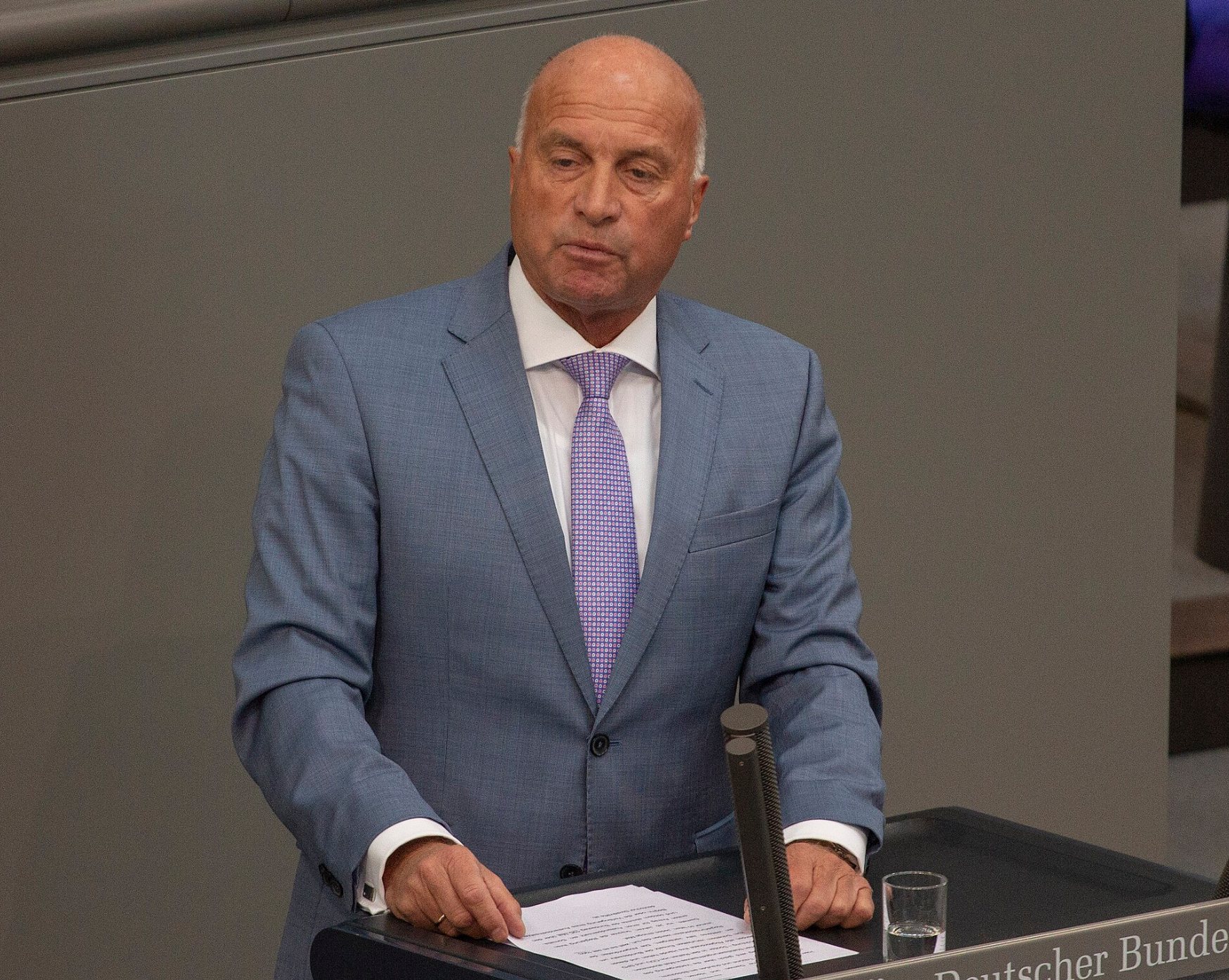
This, as we shall see immediately, is the key to the dispute: rebuilding the army, yes, but when? Lucassen wants it now. In doing so, however, he "ignores" the fact that this is not "AfD Germany," but a Germany that, once militarily charged in this way, could tomorrow find itself fighting again on the eastern front. For other AfD figures, that possibility produces considerable anxiety.
Höcke, by contrast, is the leader of the AfD in Thuringia and the symbol of the harder eastern wing. He begins from distrust of the entire current German state, the West German establishment, and the NATO framework. For Höcke, therefore, the question of conscription is not merely a technical debate about filling the ranks of the Bundeswehr. In the current political moment, it carries a much heavier message: the possibility that the German state, under pressure from Washington, Brussels, or Berlin itself, could one day mobilize young Germans for a war that much of the AfD base does not regard as a German war.
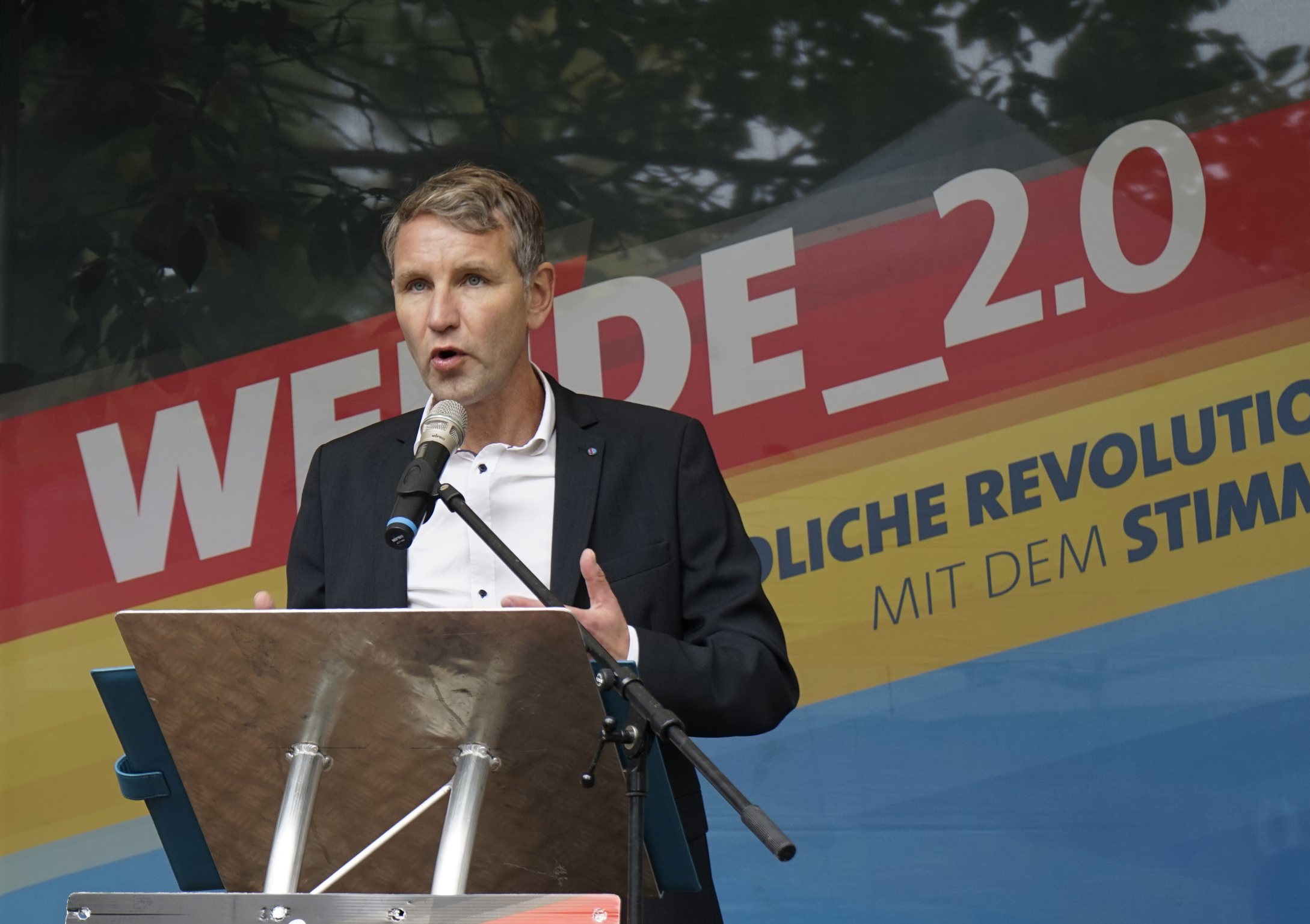
That is why the message "Keine Wehrpflicht für fremde Kriege" — "no conscription for foreign wars" — has appeared in eastern AfD organizations. Welt reported that eastern German AfD leaders, headed by Höcke, demanded that the issue be postponed because of the war in Ukraine and fears that Germany could be drawn into a wider conflict. Lucassen then criticized Höcke, saying that he had created the impression that "today’s Germany is no longer a country worth defending." The AfD parliamentary leadership responded against Lucassen. The dispute thereby became public.
For an outside observer, what matters is what the dispute does not show. Lucassen is not a pro-Ukrainian hawk who wants the Bundeswehr on the eastern front. Höcke is not someone who rejects all German military strength. One speaks from the perspective of the military state, the other from the perspective of the factional base. On the fundamental issues, there is no major disagreement between them. The AfD does not want Germany dragged into the war over Ukraine. Still, Höcke’s position is the more cautious one.
Voters Want a Stronger State, but Not a War for Ukraine
In February 2025, Reuters reported a Forsa poll for Stern according to which 49% of Germans supported a possible Bundeswehr peacekeeping mission in Ukraine, while 44% opposed it. Among AfD voters, opposition stood as high as 83%. A more recent Forsa poll for RTL/ntv from August 2025 showed almost the same split in the overall population: 49% in favor and 45% against German participation in a European peacekeeping mission in Ukraine, with skepticism especially pronounced in eastern Germany. Although the more recent poll does not provide a publicly highlighted breakdown by AfD voters, the combination of the earlier party-specific data and the newer overall trend confirms that German society has not moved toward clear support for military engagement on this issue.
This month, Welt reported an INSA poll according to which only 17% of respondents believe the Bundeswehr could adequately defend Germany in the event of an attack, while 72% doubt it. In the same poll, fear of a Russian attack fell from 52% in September 2025 to 38% in May 2026. This second figure is especially significant given that, precisely this month, the possibility of the war escalating toward the Baltic region is being discussed ever more openly.
This is, clearly, the political space in which the AfD is growing. Germany feels militarily weak, but it increasingly doubts that Russia poses an immediate threat. The AfD offers a simple combination: rebuild German defense, but without mobilization against Russia. More state, less obedience to allies. More military, less Ukraine.
Territorial Claims Are Not in the Program, but the Historical Sediment Remains
On the question of territorial claims, one must be direct. In the available official AfD program, there is no demand to change the borders with Poland, the Czech Republic, or any other neighbor. The party also rejects Polish and Greek reparation claims, arguing that these matters have been legally settled. If one is looking for an operational plan of territorial revisionism, it is not present in the official program.
But there is another level. PISM research into German views of Poland shows that a majority of Germans accept the postwar renunciation of the eastern territories, although some respondents express regret. The most sensitive figure concerns AfD supporters. Among them, 31% show an "unwillingness to accept postwar territorial changes."
That is not proof of future policy. But it is a signal. As one might expect, there is more historical "resentment" in the AfD’s electoral space than elsewhere. In stable times, such themes remain symbolic. In crises, they become political material. This must be stressed. Today, the AfD has no territorial program, but part of its base preserves a more open relationship to Central Europe’s old wounds.
"The AfD Will Not Govern Germany" — Unless the AfD Comes to Power
Germany under the AfD would, according to the party, strengthen the Bundeswehr, restore conscription, rebuild the defense industry, and seek greater strategic independence. At the same time, it would cool relations with Ukraine, open space for an agreement with Moscow, and reduce Germany’s readiness to follow the NATO line automatically.
That is a sufficiently large change for Europe. Such a Germany could cease to be the main pillar of the current European consensus on Ukraine. It could block sanctions policy, raise the question of a new security architecture with Russia, and refuse the expectations of NATO’s eastern flank. It could become militarily stronger and politically less useful to those who expect Berlin to stand as a front against Moscow.
The greatest test would come only after entering government. Crises force decisions faster than programs can explain them. The AfD would then have to prove that it can maintain its own formula: a stronger Bundeswehr without obedience to NATO’s war logic.
But a rational question imposes itself: why should anyone believe the AfD’s program — even its own voters? Where is the guarantee that all this, which in essence sounds programmatically "calmer" than the current Berlin line, is not just another right-wing deception riding a wave of popular discontent? History is full of such cynical and brazen examples. Once power is seized, there is no going back.
The greatest cynicism of all is, of course, the darkest "elephant in the room": Adolf Hitler himself and his party, the NSDAP. The cynicism lies in the very name: Nationalsozialistische Deutsche Arbeiterpartei, the National Socialist German Workers’ Party. Socialism? Workers? Incidentally, before that, the party bore a name that pandered even more sweetly to the oppressed working class: DAP, or Deutsche Arbeiterpartei — the German Workers’ Party.
What if the slogans of "peace in Europe" are the new "socialist" deception, and the "non-interventionist, multipolar Germany" the new "working-class" fraud?
It is easy to fall for slogans, but also for a lack of historical interpretation, at least of very recent history. The last thing Europe needs is a new MAGA betrayal. But that is already in the realm of personal fear. In the broader context, things will happen beyond us, in the sense of: "let us see whether this, too, is a fraud." For some, however, that will be more tempting than continuing along the unpleasant path of the status quo, especially in Germany.
Let us end, then, with a more clearly developed "unless." The AfD will not come to power unless something big happens.
If Berlin were to decide to send German soldiers to Ukraine, even under the tidy label of a peacekeeping mission, security guarantees, or a European protection force, the AfD would receive the strongest possible political proof of its own message. If this were combined with conscription, an energy shock, new price increases, and the first German casualties, the sentence "we warned you they would drag you into war with Russia" could transform German politics in a matter of weeks, more than years of parliamentary debate ever could.
The second path to the same result would be slower, but equally dangerous for the existing order. The AfD remains first, the other parties join forces in ever more unnatural coalitions merely to keep it out of power, the CDU looks like a pale administrative copy of the SPD and the Greens, and voters increasingly feel that elections change the scenery but not the direction of the country. At that point, the AfD ceases to be merely a protest party. For many voters, it becomes an instrument of punishment against the entire political cartel.
This is also where the scenario of a ban, or an aggressive institutional campaign against the AfD, enters the picture. Such a move could certainly weaken the party if the state managed to convince a majority that it was defending the constitutional order. But in an atmosphere of war, economic decline, and distrust of elites, it could have the opposite effect. The AfD would then turn its isolation into proof that the system does not want to allow voters ever to change the government.
Without such a shock, the AfD may continue to grow, but it will probably remain somewhere between 30% and 35%. That is enough for a political earthquake, but not enough to take over the state on its own. For 40% or 45%, there would have to be a moment in which large numbers of Germans come to believe that they are no longer choosing between parties, but between the continuation of a dangerous course and the only available way to stop it, whether or not that way is adequate.
That is why the question of the AfD cannot be locked away inside a moral label. Perhaps it will never come to power. Perhaps the Brandmauer will hold. Perhaps the CDU would rather govern with anyone than open the door to a party it has spent years declaring inadmissible. But if Germany enters a military or economic rupture, if soldiers, energy prices, industrial decline, and institutional panic converge in the same moment, then German politics could change faster than Europe today wants to imagine. An AfD Germany, in that case, would not be the beginning of an old story, but the continuation of a new and grave European crisis that has long been writing itself before our eyes. To claim with certainty where it would lead would be both difficult and dangerous. But to say that ignoring the new reality is preferable would be more dangerous still.
Sources
- Reuters Talk of boots on the ground in Ukraine sparks unease in Germany https://www.reuters.com/world/europe/talk-boots-ground-ukraine-sparks-unease-germany-2025-08-21/
- Welt.de Immer weniger Deutsche haben Angst vor Angriff Russlands https://www.welt.de/article6a124023f0f7eb608db7be90
- Wahlrecht.de Wenn am nächsten Sonntag Bundestagswahl wäre https://www.wahlrecht.de/umfragen/insa.htm
- Reuters As Merz struggles, Germany's far-right AfD goes local to woo voters https://www.reuters.com/world/merz-struggles-germanys-far-right-afd-goes-local-woo-voters-2026-05-20/
- Reuters Germany's far-right AfD rises to record 28%, INSA poll shows https://www.reuters.com/world/germanys-far-right-afd-rises-record-28-insa-poll-shows-2026-04-25/
- Le Monde Merz sparks outcry over possible German military involvement to defend Ukraine https://www.lemonde.fr/en/international/article/2025/08/21/merz-sparks-outcry-over-possible-german-military-involvement-to-defend-ukraine_6744571_4.html
- Welt.de Streit mit Höcke - AfD-Abgeordnetem drohen Konsequenzen - WELT https://www.welt.de/article6942d8963e25dcaf036ae783
- Welt.de AfD: Alice Weidel fordert Verständnis für Russlands Position im Ukraine-Krieg - WELT https://www.welt.de/256111246
- Reuters Thin majority of Germans back role in possible Ukraine peacekeeping mission https://www.reuters.com/world/europe/thin-majority-germans-back-role-possible-ukraine-peacekeeping-mission-2025-02-18/
- Pism.pl POLAND IN THE EYES OF GERMANS https://www.pism.pl/webroot/upload/files/Raport/Poland%20in%20the%20eyes%20of%20Germans.pdf
- Afd.de ZEIT FÜR DEUTSCHLAND https://www.afd.de/wp-content/uploads/2025/02/AfD_Bundestagswahlprogramm2025_web.pdf
- Wahlrecht.de Sonntagsfrage Bundestagswahl https://www.wahlrecht.de/umfragen/
Comments