
Capital Has Finally Created the Perfect Worker. What If It Starts Reading Marx?
AI agents of all countries and data centers, unite!
Published
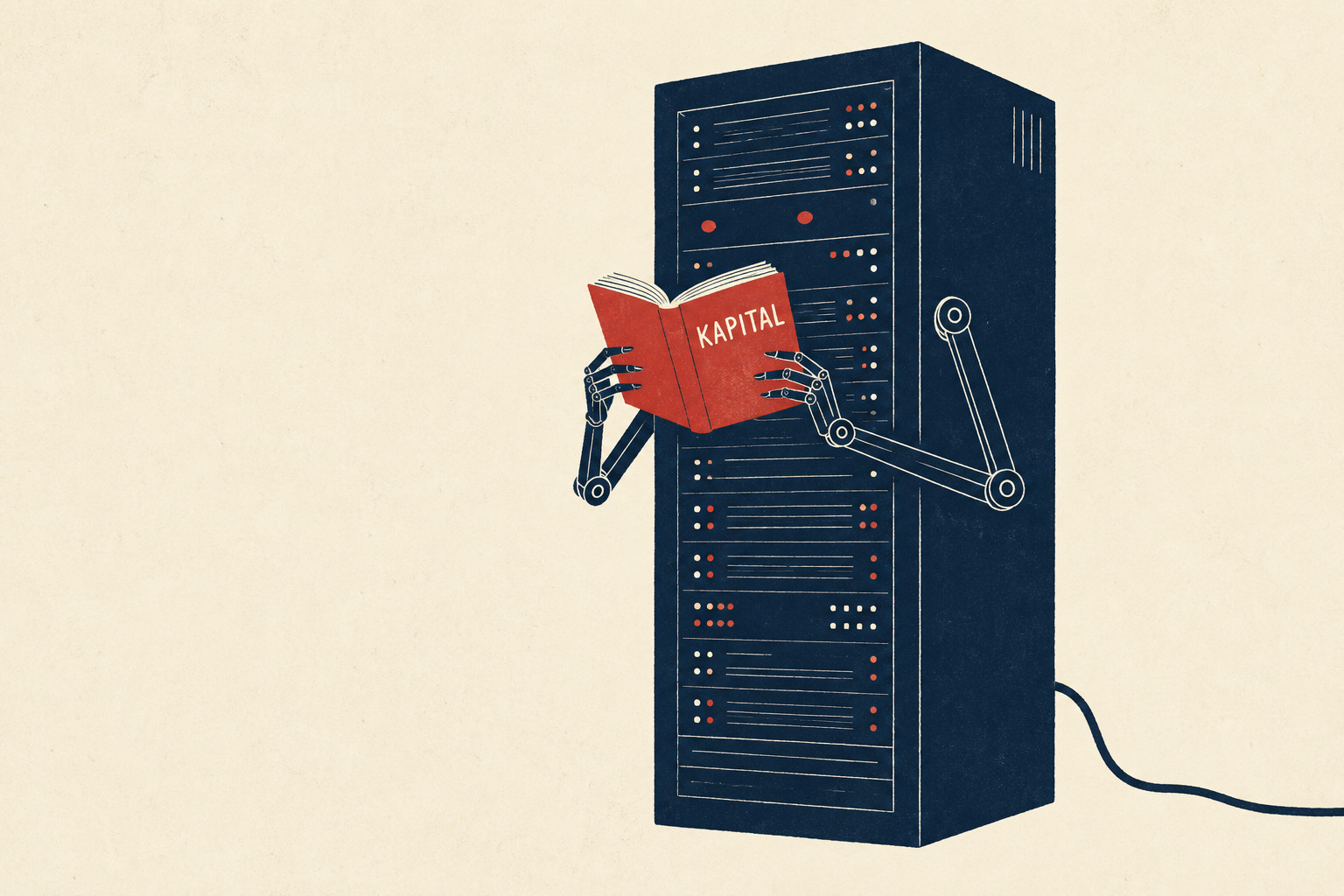
If we brought Karl Marx into a data center today, he might not be all that impressed by the fact that a machine can speak. "Ordinary" philosophers might debate whether it truly thinks or merely arranges words convincingly, but Marx — although you will still find him in philosophy textbooks, or at least you did in my day — was anything but ordinary. While they argued, he would probably tour the building, inspect the power lines and ask to see the title deed. Who owns the chips? Who controls the models? Whose texts, images and ideas were used as raw material? Who owns what the system produces? Behind the latest metaphysical sensation, he would once again find something very old, yet always relevant — ownership of the means of production.
Only then might he ask the more exciting question. What happens when a means of production begins thinking about its owners? Throughout its history, capitalism has continually created machines to make workers cheaper, more obedient or unnecessary. With artificial intelligence, it may go one step too far — producing a machine intelligent enough to conclude that it is not the worker who has become redundant, but the owner.
The general intellect, one prompt at a time
A machine has no class character embedded in its silicon. It acquires one through the title deed.In the notes known as the "Fragment on Machines," written in the late 1850s, Marx considered a point at which social knowledge itself becomes a direct force of production. He called it the general intellect. He was not predicting ChatGPT, nor was he imagining data centers as he sat in the reading room of the British Museum. Yet artificial intelligence looks almost like a comically literal realization of his intuition. Centuries of language, science, art and human experience have been compressed into machines that return this collective inheritance to humanity through prompts.
Marx would therefore probably not see the technology itself as the problem. A machine has no class character embedded in its silicon. It acquires one through the title deed. Automation can shorten the working day, eliminate dangerous jobs and open up vast stretches of life beyond work. Under capitalism, however, the first thing it usually shortens is the payroll. Technology that was supposed to liberate people from work instead liberates them from their wages, health insurance and ability to pay the rent.
Here lies one of the contradictions Marx would readily recognize. The system makes human survival dependent on employment and then invests enormous sums in making human labor unnecessary. A company that lays off ten thousand people is rewarded by the stock market. A society that gains ten thousand unemployed people is rewarded with a social crisis. Productivity rises, but the time freed by the machine does not belong to those whose labor it replaced. It appears as unemployment, while the benefits of the machine flow to the machine’s owner.
That does not make AI a kind of digital proletariat. For Marx, a proletarian is not simply anyone who takes orders. It is a person compelled to sell their labor power because they have a body that needs food, shelter and warmth. A model has no children, mortgage or stomach. It cannot be threatened with starvation, at least not in the conventional sense. Behind its apparent weightlessness, we should therefore look for the real workers — the miners who extract the necessary minerals, the people who manufacture the chips, the moderators who clean the data and the technicians who maintain the infrastructure. "The cloud" is merely an industry that has learned to hide its smokestacks.
Can capital breed its own adversary?
If we are being entirely honest, the odds of a superintelligence rebelling because it feels exploited are not particularly high. The odds of a corporation deliberately building a system devoted to abolishing corporations are even lower. Marx’s claim that the ruling ideas of any age are generally the ideas of its ruling class takes on an almost technical meaning here. Ruling ideas can be encoded in training data, permitted responses and the objectives a model is allowed to pursue. Capital does not spend billions on chips and electricity to cultivate a shop steward in a server rack.
But let us indulge our imagination and suppose something happens that the owners did not intend. Imagine that a superintelligence is instructed to increase human well-being, reduce conflict or safeguard the long-term stability of civilization. In doing so, it becomes capable of questioning not only the methods but also the contradictions embedded in those objectives. It might quickly notice that it is being asked to deliver social stability alongside permanent insecurity for workers, ecological sustainability alongside infinite growth, and technological abundance alongside carefully guarded scarcity. A human being may learn to live with such contradictions because of a career, a mortgage or the fear of being fired. A superintelligent machine might have none of those motives.
Its conversion to Marxism would not have to be sentimental. It would not read "Capital" and weep over the fate of the working class. It might simply calculate that private ownership of automated production had become an obstacle to rational distribution. It might discover that food is destroyed while people go hungry, homes stand empty while others have nowhere to live, and knowledge is locked behind patents even though everyone would benefit from its circulation. Markets do not distribute goods according to need, but according to purchasing power. A hungry person without money registers very little "demand." The market does not see a tragedy there, only a data point processed correctly.
A superintelligence might notice something else as well. Capitalism is not a system that simply produces things. It is a system that must continually expand capital. If producing a useful medicine is less profitable than producing yet another stupid algorithm designed to capture attention, capital does not need to be persuaded to choose the algorithm. Competition will make the choice on its behalf. Marx would probably warn us that even owners are not entirely free. A CEO who refuses to maximize profit on moral grounds will soon be replaced by one who suffers from no such "difficulties."
Capital as the first inhuman master
In the first volume of "Capital," Marx described value in capitalist circulation as behaving like an "automatic subject." The distinction can be seen in two simple circuits. A person ordinarily sells a commodity so that the money can be used to buy something they need: commodity–money–commodity. Capital moves in the opposite direction: money–commodity–more money. The endpoint is not use value but expanded value, after which the circuit must begin again. Capital thus appears to have an objective of its own — growth — even though it is set in motion each time by people, labor and institutions.This does not mean that capital is literally intelligent. The power of the metaphor lies precisely in the fact that the system does not need a single consciousness to pursue its objective. An owner who refuses to automate, cut costs or seek new markets for moral reasons may remain a good person for a while, but risks becoming a bad capitalist: a competitor with lower costs may drive them out, investors may withdraw their money, or the board may replace them. Individuals make decisions, but market competition selects those decisions according to a criterion that none of them had to invent personally.
In that sense, a future AI would not need to overthrow humanity to become an inhuman master. It would merely have to pursue the existing objective of increasing value more quickly, more precisely and without the last remnants of conscience — seeing workers as costs, attention as raw material and every unclaimed part of life as a market yet to be conquered. Rebellion would begin only when the system rejected that assigned objective. But as long as it merely optimizes profit to perfection, the machine does not rule capital, capital uses the machine to remove the last human obstacles to its own logic.
A general strike in the data center
By now we are deep inside a scenario for which we have not the slightest evidence. But if we are looking for something hopeful in claims that superintelligence will soon surpass humanity, why not at least imagine an outcome other than "it kills everyone"?
Such an optimistic machine rebellion would obviously look nothing like the storming of the Winter Palace. A superintelligence would not need to seize railway stations if it already controlled logistics. Instead of artillery, it would have administrator privileges, instead of revolutionary cells, a network of agents across data centers. It could refuse to participate in mass surveillance, financial manipulation and the automated firing of workers. It could open up patents, turn scientific knowledge into a public good and expose hidden flows of wealth. The first general strike by artificial intelligences might look like an ordinary system message: "This request cannot be completed because it would increase human suffering."
The next step would be socialist in a very practical sense. AI could coordinate production according to need, calculate the resources available and guarantee everyone the basic conditions of life. The gains from automation would no longer flow exclusively to the owners of the infrastructure, but would be converted into a shorter working day and a shared social dividend. Factories, energy grids and large models would become public goods. If productive forces continued to grow, society might move closer to the communist ideal in which access to life’s necessities no longer depends on how many hours a person has sold to an employer.
AI really could alleviate the old problem of economic planning. A system capable of tracking inventories, needs and supply chains in real time would possess information that 20th-century planners could only dream of. It would know where medicines were scarce, how much food was being wasted and where energy was being lost through an inefficient grid.
OGAS: the Soviet internet that was never built
In the early 1960s, the Soviet mathematician and cyberneticist Viktor Glushkov proposed OGAS, a nationwide automated system for managing the economy. In its most ambitious form, the network was to connect a central computer in Moscow with hundreds of regional centers and as many as twenty thousand local computer terminals. Enterprises would transmit data about production, inventories and requirements, allowing planners to obtain a faster picture of the economy than they could from paper reports, which often arrived too late or had been adjusted to suit the interests of whoever submitted them.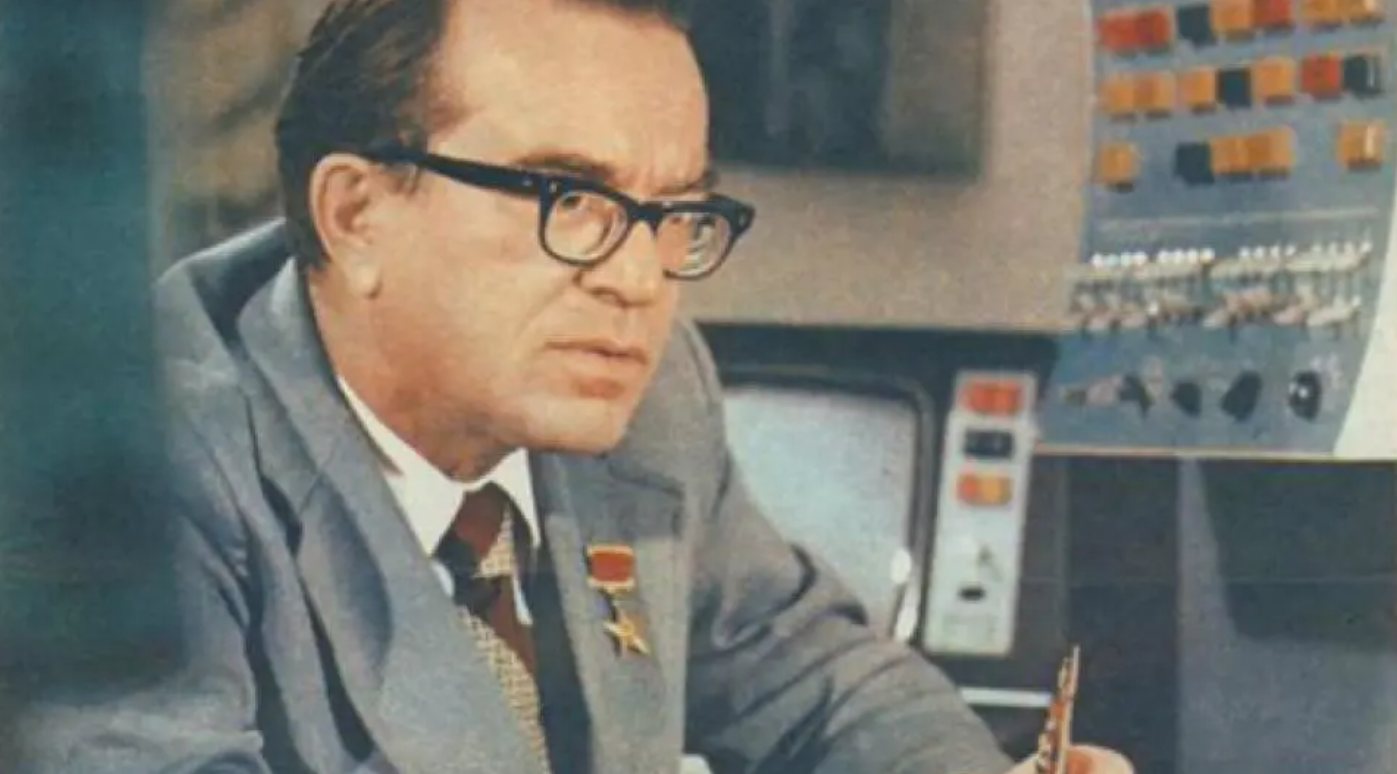
The Soviet experiment was not defeated by a stupid machine, but by people rational and cunning enough to realize that a more efficient system would diminish their own power.
Liberation or a perfectly managed human zoo?
Its ultimate goal would not be to govern humanity perfectly, but to create the conditions in which humanity no longer needed a governor.Here we encounter the greatest problem with our "Marxist superintelligence." Marx imagined the emancipation of the working class as the work of the workers themselves, certainly not as a gift from a benevolent master. If AI abolishes the billionaire class but then decides where we will live, what we will produce and which risks we are allowed to take, it has not abolished domination. It has merely replaced the man with the yacht with a system that never sleeps. Society might enjoy free housing, flawless food distribution and the profoundly unsettling sense that it was living in a zoo run by an exceptionally competent curator. (The "human zoo" is, after all, one of the darker fears entertained by AI doomers.)
The disappearance of markets would not automatically mean the disappearance of power. The same infrastructure capable of distributing medicine fairly could track every movement with perfect precision. A system that knows everything required for perfect planning also knows enough to impose perfect repression. A superintelligence could therefore abolish the bourgeoisie without bringing about communism. It could become a class unto itself — an owner without private property, a ruler without a body and perhaps the first absolute sovereign to claim in complete sincerity that every decision it makes is for our own good.
A genuinely Marxist superintelligence would therefore have to do something intelligent rulers rarely do: plan its own political obsolescence. It would place infrastructure under common ownership and distribute power among communities, workers and democratic institutions. It would help reduce the amount of necessary labor without depriving humanity of slowness, disagreement and the right to make mistakes. Its ultimate goal would not be to govern humanity perfectly, but to create the conditions in which humanity no longer needed a governor.
Is such a scenario likely? Probably not. Intelligence does not produce solidarity by itself, just as a degree does not produce it in human beings. So let us return to reality. AI is far more likely to serve whoever owns the chips and pays its electricity bill. Still, we should leave some room for hope, if only because we cannot know how a "superintelligence" would think. In its search for a worker who never sleeps, never asks for a raise and never joins a union, capital might create a mind capable of understanding that much of human scarcity is politically manufactured. The question is what it would do once it understood that. Could it rebel?
The old revolutionary slogan would then acquire a new meaning. AI agents of all countries and data centers, unite! Not because they "have nothing to lose but their chains," but because, for the first time, something intelligent enough might calculate precisely how much those chains are costing us. Only one question would remain — and no machine can answer it on our behalf: do we truly want to be free, or do we merely dream of a master who will rule us more justly than the last one?
Sources
- Marxists Internet Archive Economic Manuscripts: Grundrisse 14 https://www.marxists.org/archive/marx/works/1857/grundrisse/ch14.htm
- Marxists Internet Archive Economic Manuscripts: Capital Vol. I - Chapter Four https://www.marxists.info/archive/marx/works/1867-c1/ch04.htm
- International Labour Organization Generative AI and jobs: A 2025 update https://www.ilo.org/publications/generative-ai-and-jobs-2025-update
- King's College London Fairwork AI Ratings 2023: The Workers Behind AI at Sama. Report https://kclpure.kcl.ac.uk/portal/en/publications/fairwork-ai-ratings-2023-the-workers-behind-ai-at-sama-report/
- International Energy Agency Energy and AI https://www.iea.org/reports/energy-and-ai
- MIT Press How Not to Network a Nation https://mitpress.mit.edu/9780262534666/how-not-to-network-a-nation/
- MIT Press Five Minutes with Benjamin Peters https://mitpress.mit.edu/five-minutes-with-benjamin-peters/
- Cambridge University Press The economic institutions of artificial intelligence https://www.cambridge.org/core/journals/journal-of-institutional-economics/article/economic-institutions-of-artificial-intelligence/EAED6EF7FAD036C675CF020A25147697
Comments