
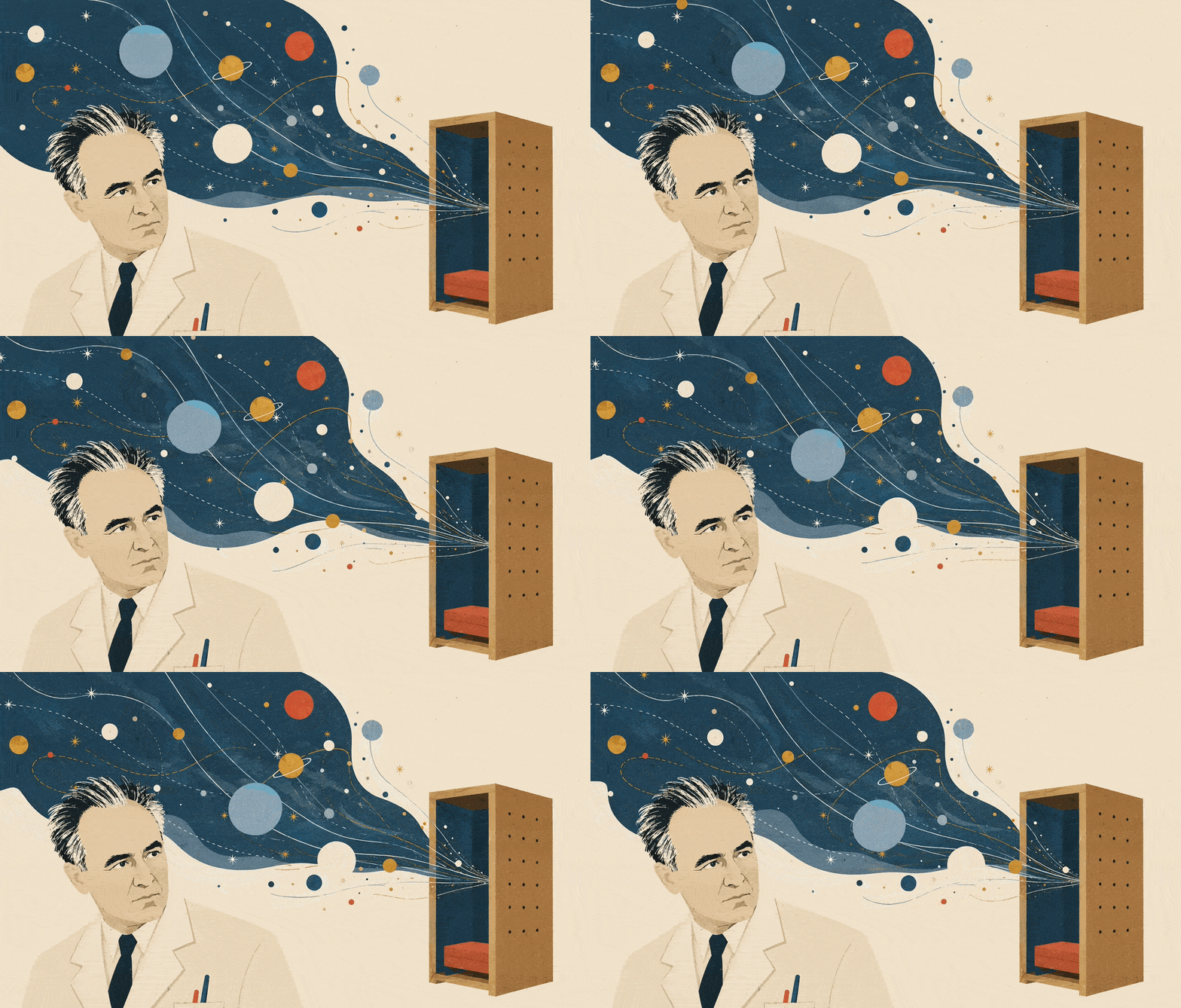
Wilhelm Reich was a student of Freud, a ally of the revolution, and an enemy of obedience. And then he believed he had found the energy of life.
In August 1956, the American state was burning the books of a man who had once claimed to have discovered "cosmic life energy". This was not Berlin in 1933, but New York two decades later. What went up in flames were not only obscure pamphlets about miraculous boxes, but also the works of a man who had once belonged to the very heart of Freud’s world.
Wilhelm Reich, an Austrian physician and psychoanalyst, managed in a single lifetime to connect the couch, revolution, anti-fascism, laboratory delirium, and federal prison. Few biographies look as if the 20th century itself wrote them after drinking too deeply from its own ideas.
Reich began where serious people of the time began if they wanted to understand human misery: with Sigmund Freud, the famous Austrian neurologist and founder of psychoanalysis. He ended, however, in Lewisburg, an American federal prison, after refusing to accept that a court had the authority to pass judgment on "cosmic orgone energy". Between those two scenes lies the story of how a brilliant intuition can harden into dogma, and how dogma can become a machine that manufactures its own reality. Reich was not an ordinary charlatan. That is precisely the problem. Ordinary charlatans rarely have such strong opening chapters.
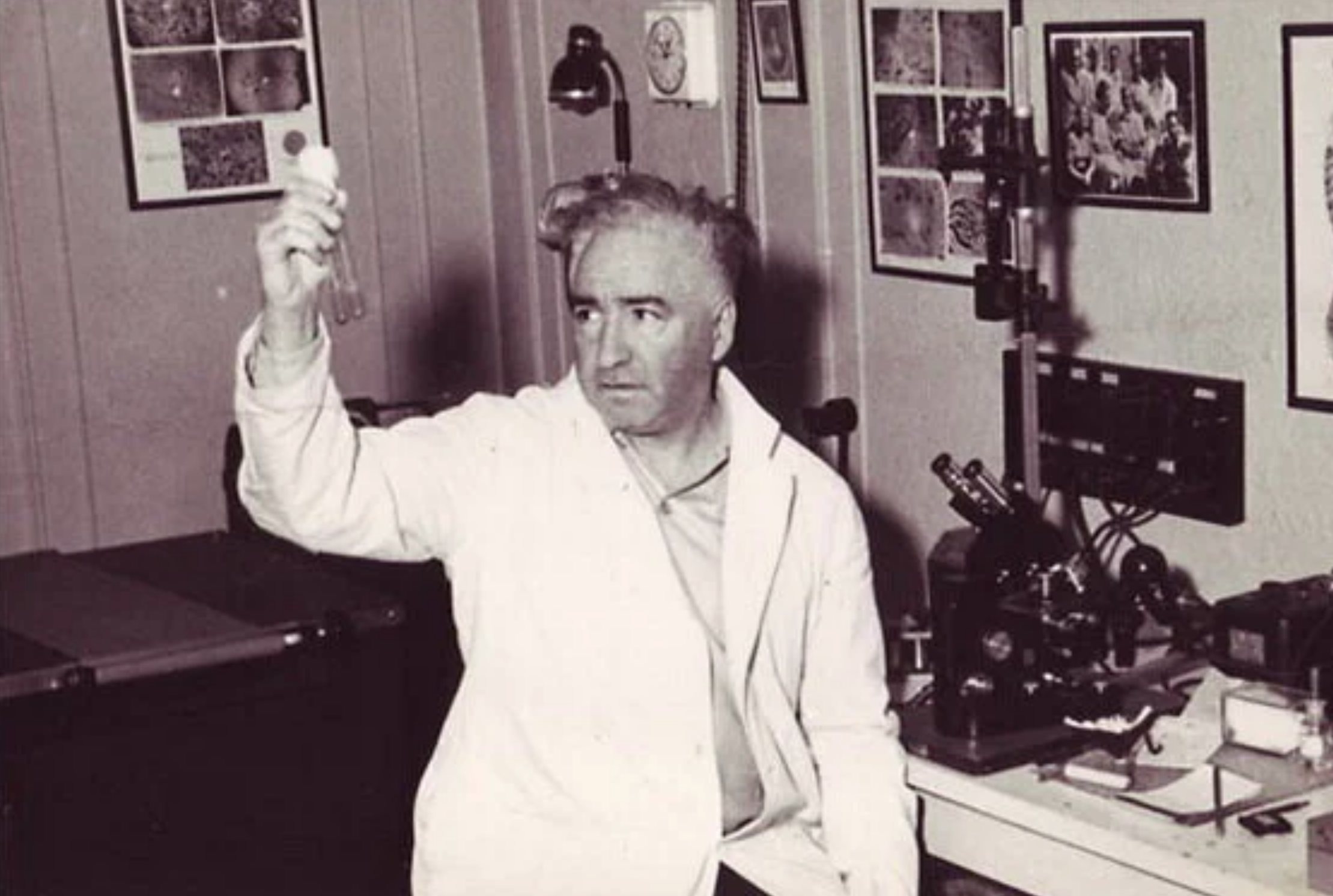
As a young psychoanalyst in Vienna, Reich was obsessed with the body. Not the body as the beautiful façade of the soul, but the body as an "archive of repression". Gestures, a stiff neck, shallow breathing, a stubborn way of speaking — all of this, for him, formed the "character armor", the physical and psychological defense a person builds against pain.
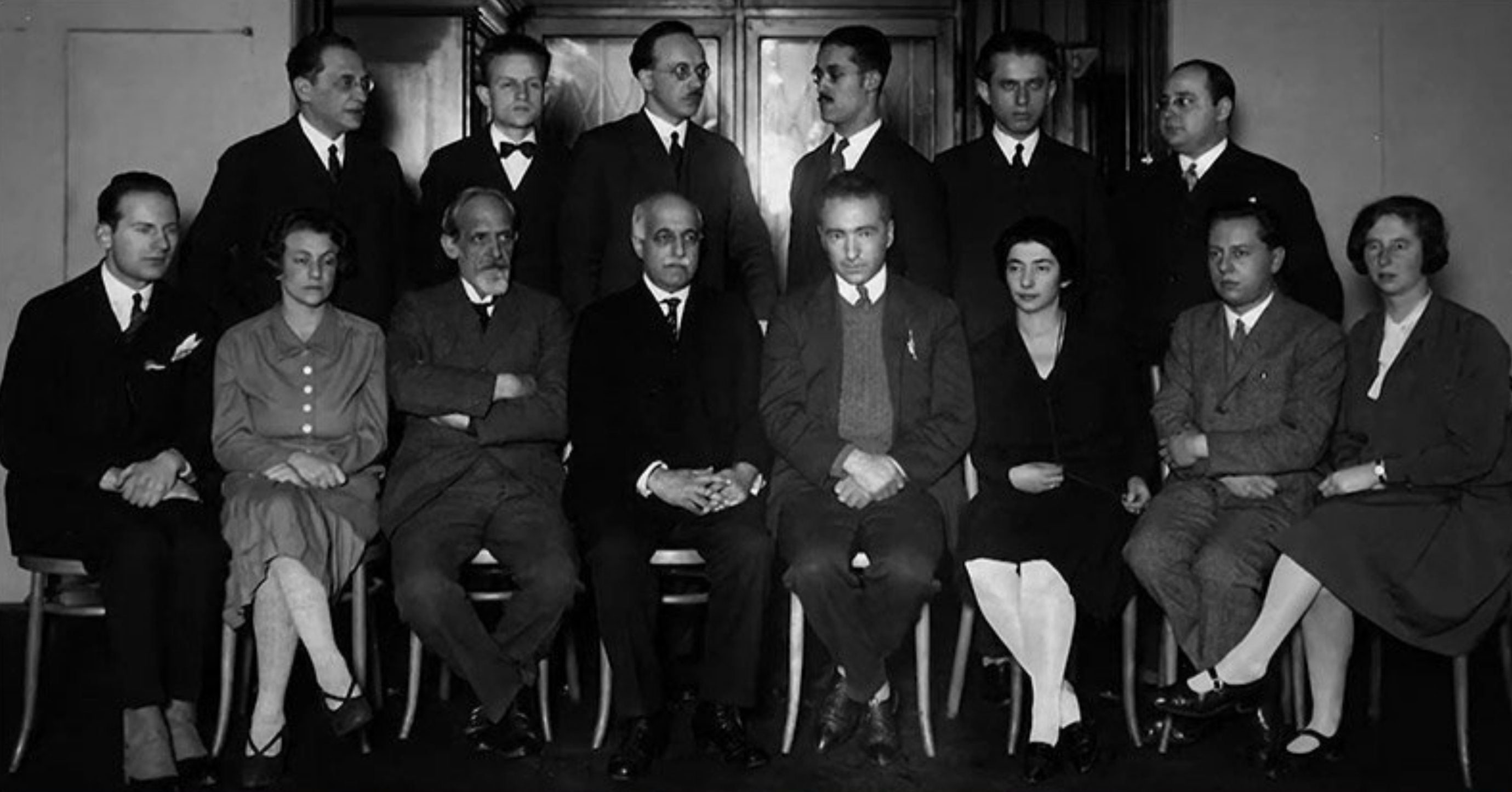
His 1933 book Character Analysis remained influential in the history of psychotherapy, and the idea that trauma is not only a thought but also a bodily habit sounds far less strange today than it did in Freud’s salon.
But Reich did not want merely to treat the neurotic citizen. His ambitions were much larger. He wanted to treat society.
After the bloody unrest in Vienna in 1927, when police fired on demonstrators, he turned to Marx with the same intensity with which he had once read Freud.
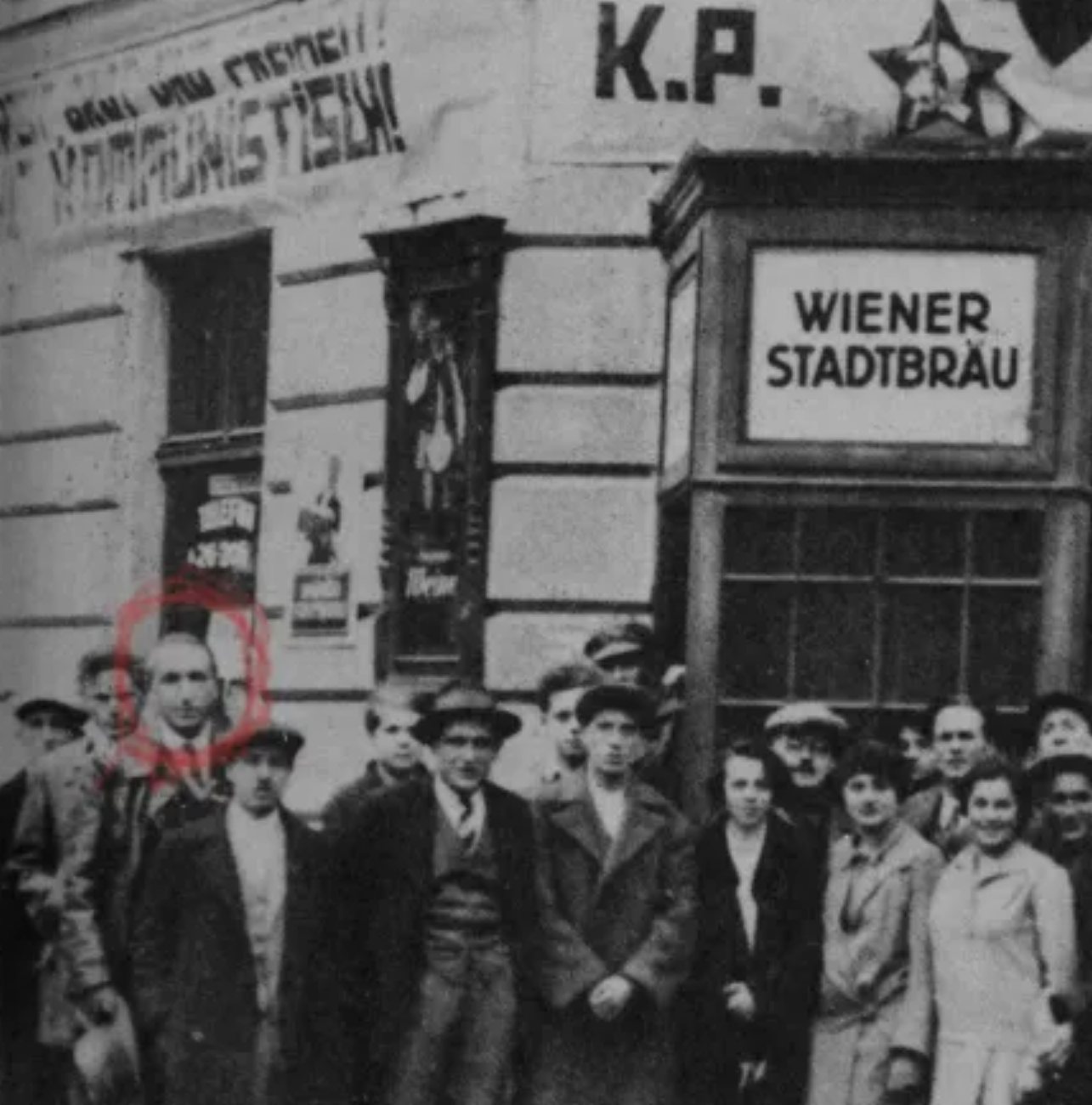
Christopher Turner, the British author who wrote about Reich’s sexual-political period, notes that Reich witnessed the street violence and then joined the medical corps of the Austrian communists. Soon he opened "free sexual clinics for poorer Viennese", offering advice on contraception and giving lectures on sexual misery under capitalism. It sounded like public health education, but also like a revolution that spent an unusual amount of time in the bedroom.
This is where the most comprehensible Reich emerges, and also the Reich who is hardest to dismiss. In The Mass Psychology of Fascism, published in 1933, he argued that fascism was not merely a program of parties, leaders, and uniforms. Fascism, Reich believed, was also the product of a certain kind of character: obedient, repressed, frightened, and sexually disciplined into political usefulness. To a reader today, the thesis may seem too sweeping, but it is not banal. Reich understood something liberal respectability often fails to see: authoritarianism does not succeed only because it lies to people, but because it gives shape to their fears.
Reich coined the word "orgone" from orgasm and organism. He claimed it was an omnipresent life energy: bluish, cosmic, and measurable.The problem was that Reich never knew when to stop. For the communists he was too obsessed with sex, and for the psychoanalysts too contaminated by communism. The German Communist Party expelled him in 1933, and psychoanalytic circles distanced themselves from him in 1934. The Nazis burned his books because he was a sexual radical, an anti-fascist, and a man of Jewish background, although he himself did not primarily identify as Jewish.
Reich left Germany for Scandinavia, and then, in 1939, for the United States. There his story shifted from political drama into scientific phantasmagoria.
"Orgone energy" was Reich’s attempt to turn Freud’s theory of libido into physics.
After all, if a life drive exists, why should it not be measured? If the body pulses between tension and release, why should the universe not pulse as well? Reich coined the word "orgone" from orgasm and organism. He claimed it was an omnipresent life energy: bluish, cosmic, and measurable. From today’s perspective, the idea contains an almost perfect formula for pseudoscience.
But the story goes further, and becomes even more interesting.
The "orgone accumulator" was the object in which this metaphor turned into furniture. It was a box a person could sit inside, made of alternating metallic and non-metallic layers, with the idea that it would concentrate "orgone energy" and transfer it to the body. Reich believed the accumulator could help with a range of illnesses, including cancer.
He quickly came under the scrutiny of the state.
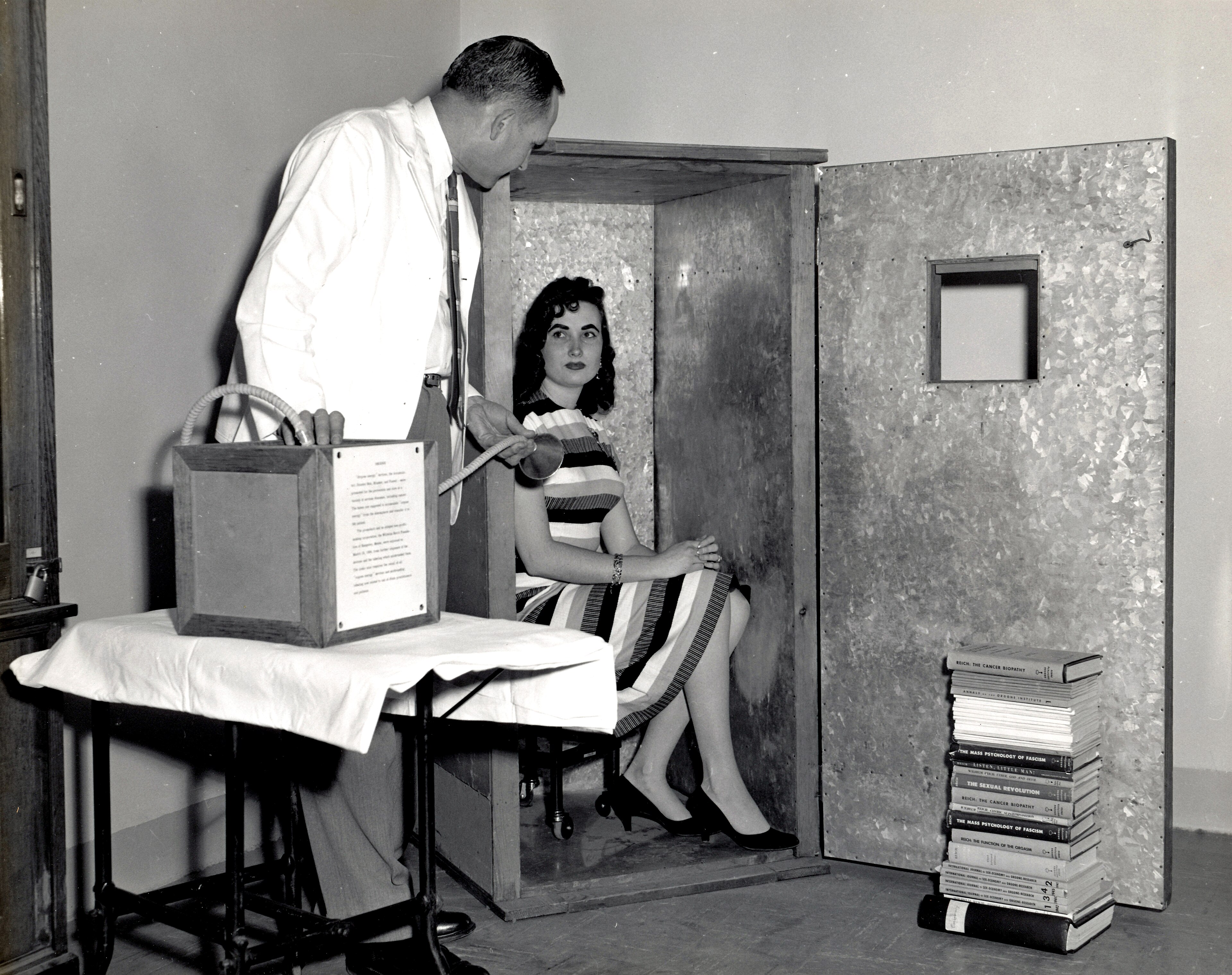
The American Food and Drug Administration, the FDA, brought proceedings against Reich and his foundation. In 1954, a court banned the interstate distribution of orgone accumulators and ordered the destruction of the devices, along with the accompanying literature.
When Reich Took Orgone to Einstein
One of the most fascinating episodes in Reich’s entire orgone story took place in early 1941, when Wilhelm Reich decided to do what every "prophet of a new science" must do if he wants to be taken seriously: he went to Albert Einstein, unquestionably the most famous scientist of the 20th century. In late December 1940, he wrote to him in Princeton and requested a meeting to discuss what he described as the discovery of a "specific biologically effective energy" that behaved differently from known electromagnetic energy. Two weeks later, Einstein received him. They spoke for nearly four hours.Interestingly, Einstein did not immediately dismiss him as a crank with a wooden box. Reich still retained traces of serious scientific and intellectual capital, and his claim was concrete enough to be tested. He argued that a temperature difference appeared inside the orgone accumulator, meaning that the inside of the box was warmer than its surroundings. Einstein agreed to examine the phenomenon. Reich then prepared the apparatus, returned to Princeton in early February 1941, and left the device with him for study.
What followed was a small collision between two worlds. Reich saw the temperature difference as a window through which a new physics of life was revealing itself. Einstein, after testing it, offered a much more prosaic explanation: the difference could be accounted for by ordinary thermal conditions, the position of the device, and air currents in the room. In other words, where Reich heard the whisper of the universe, Einstein saw a problem of experimental control. It may be the shortest possible lesson in the difference between scientific curiosity and scientific self-will.
Reich, of course, did not accept this. He continued writing, explaining, and defending his interpretation. Einstein, after that, largely withdrew from the discussion. To Reich, that silence may have looked like a sign that the great physicist did not know how to respond. From a cooler perspective, it probably meant something far more banal: Einstein concluded there was not enough reason to continue the conversation. In that episode, Reich was not merely defeated. He had, for a moment, been heard, and that made the defeat heavier.
In the legal proceedings, Reich did not appear as a man defending a disputed hypothesis, but as a prophet convinced that a court could not judge natural truth. In a letter to the judge, he wrote that the FDA had no authority over "primordial, pre-atomic cosmic orgone energy".
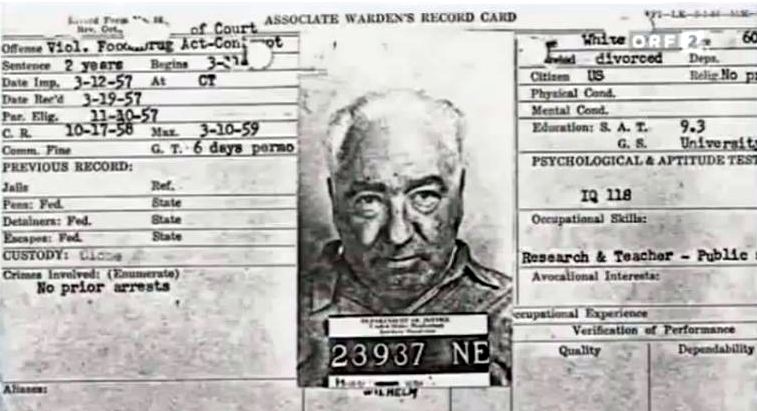
In 1956, he was convicted of violating the court injunction. The FDA later maintained that this had been a matter of regulating a commercial medical product, not an attack on freedom of thought. Legally, that may have made sense. Culturally, it looked catastrophic. A state that burns books can rarely count on history to read such legal explanations carefully.
The Cloudbuster and the Blueberries of Maine
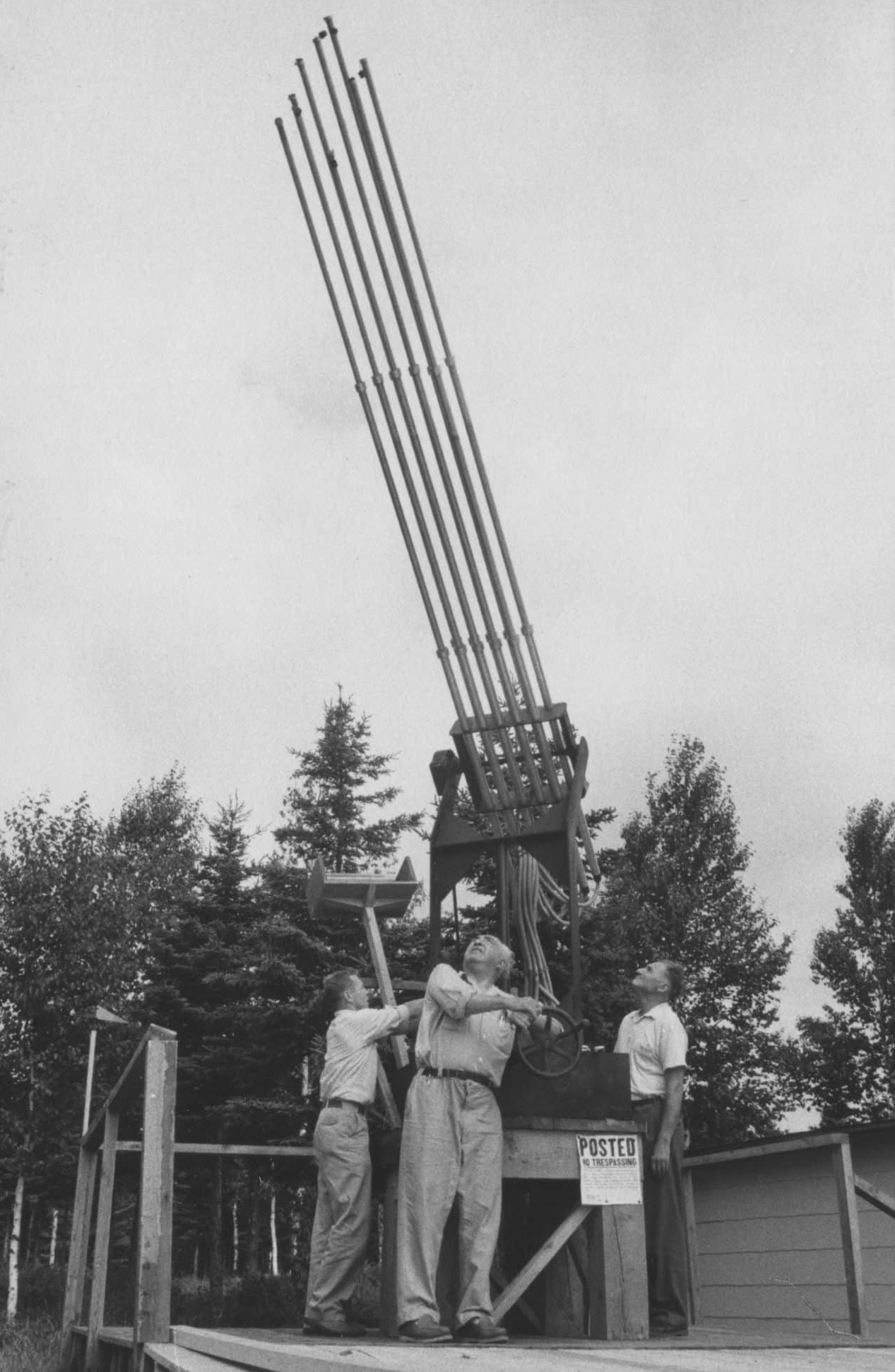
The most cinematic episode of Reich’s late period occurred in 1953 in Maine, where a drought was threatening the blueberry crop. By then, Reich was living and working at Orgonon, his estate that was part laboratory, part refuge, and part private republic of orgone science. According to the best-known version of the story, local growers were desperate enough to call on a man who claimed he could influence clouds. That, in itself, is a perfect American scene: farmers, drought, an uncertain harvest, and a European psychoanalyst pointing a device at the sky that looked like a cross between a telescope, a cannon, and a badly assembled organ.
According to reports that later became part of the Reichian legend, Reich carried out a cloudbusting operation on July 6, 1953, and rain began to fall that evening or the following morning. Over the next few days, enough rain fell for the story to become a local sensation. The blueberries were saved, the farmers were satisfied, and Reich could see what he most wanted to see: confirmation that his strange apparatus was not only speaking to his theory, but also to the sky.
Reich died in federal prison in 1957.
His death allowed two lazy interpretations to feed each other for decades. In one, he was a genius smothered by bureaucracy because it feared the truth. In the other, he was simply "the madman with the box".
Both versions spare us the more uncomfortable conclusion. Reich was a man who asked good questions early on, and then began offering ever more extravagant answers. His fall does not prove that every heresy is noble, nor that every institution is reasonable. It proves that even liberating ideas can spoil when they lose contact with verification.
Reich and the Later Counterculture
After his death, Reich acquired a second, almost ironic life. A man whose books had been burned in America by court order became one of the stranger details of the sexual revolution, Beat culture, and the 1960s. His idea of freeing the body from repression, stripped of its medical claims and orgone physics, sounded to a new generation like a call to escape the world of Cold War discipline, the office suit, and the marital bedroom where everything was permitted except the truth.The orgone accumulator, meanwhile, became a bizarre cultural prop. Among the names associated with Reich’s box were J. D. Salinger, the American writer and author of The Catcher in the Rye, Saul Bellow, the American Nobel laureate, and Norman Mailer, a writer who viewed postwar America as a mixture of neurosis, violence, and testosterone with literary ambitions. Mailer found something in Reich that evidently suited him: a theory according to which sexual energy was at once political, cosmic, and personal. In other words, the perfect philosophy for a man who already seemed to believe that the universe could be explained if you addressed it loudly enough.
Reich thus moved from laboratory catastrophe into pop-cultural myth. Woody Allen turned him into a comic symbol in the film Sleeper through the "Orgasmatron", a futuristic device for instant sexual gratification. Dušan Makavejev, the Yugoslav director, brought Reich, the sexual revolution, communism, American counterculture, and satire together in his 1971 film W.R.: Mysteries of the Organism, one of those cinematic explosions possible only when an author believes that montage is a form of political psychotherapy.
And then there is the gentler, almost unexpected trace: Kate Bush, the British musician, recorded the song Cloudbusting in 1985, inspired by the memoirs of Reich’s son Peter. In that version, Reich is no longer only the man of the orgone idea, but a father remembered by a child through strange machines, rain, persecution, and the feeling that the adult world always arrives a little too soon. That may be the most interesting part of his afterlife. Science rejected him, the state punished him, but culture never let him go. It turned him into a symbol, and symbols, unlike experiments, do not have to pass verification in order to survive.
Yet the most interesting Reich is not the one from the mythology of orgone, but the earlier one: the analyst who understood that politics does not live only in parliaments, but also in families, muscles, shame, and fear. In that, he was ahead of many.
Reich’s tragedy is that he wanted to measure life and ended up manufacturing myth. In Freud’s world, he learned that people repress what they cannot bear. In Marx’s world, he learned that societies build systems to justify their own injustice.
In America, finally, there remained a third lesson, perhaps the cruelest precisely because it is not entirely fair. A man can spend his life exposing other people’s illusions, and then, faced with his own suffering, ambition, and loneliness, begin to believe that he has found the final law of life. Reich’s orgone energy was a delusion, but not an ordinary fraud. It contained vanity, blindness, and dangerous stubbornness, but also something that makes him tragic rather than merely ridiculous: the desperate need to find, in a scattered world, some hidden and living connection between the body, freedom, and the universe.
Sources
- Daily.jstor.org Wilhelm Reich: Twice Burned - JSTOR Daily https://daily.jstor.org/wilhelm-reich-twice-burned/
- Wilhelmreichmuseum.org Biography of Dr. Wilhelm Reich - Wilhelm Reich Museum https://wilhelmreichmuseum.org/about/biography-of-wilhelm-reich/
- Law.justia.com Wilhelm Reich et al., Defendants, Appellants, v. United States of America, Appellee, 239 F.2d 134 https://law.justia.com/cases/federal/appellate-courts/F2/239/134/108394/
- Fdanj.nlm.nih.gov 5391. Orgone Energy Accumulators. https://fdanj.nlm.nih.gov/catalog/ddnj05391
- Pmc.ncbi.nlm.nih.gov Wilhelm Reich and Sexology from Below - PMC https://pmc.ncbi.nlm.nih.gov/articles/PMC10108179/
- The Guardian Wilhelm Reich: the strange, prescient sexologist who sought to set us free https://www.theguardian.com/books/2021/apr/17/wilhelm-reich-the-strange-prescient-sexologist-who-sought-to-set-us-free
Comments